10 Active Listening Exercises to Build Real Focus
10 Active Listening Exercises to Build Real Focus

Active listening is the practice of giving a speaker your complete attention, then reflecting what you heard before responding. You can start building the skill in under five minutes with these three warm-ups:
- The mindful pause (2 minutes): Before your next conversation, sit quietly and notice three sounds around you. This primes your brain to receive rather than broadcast.
- The 2-minute paraphrase (2–5 minutes): Ask a friend or colleague to talk about anything for two minutes. When they finish, say back what you heard in your own words before you say anything else.
- Silence practice (2 minutes): Set a timer and let a pause sit for a full two seconds after someone finishes speaking. Count silently if you need to.
Pro Tip: The most common rookie mistake is paraphrasing the words instead of the meaning. Aim to reflect the feeling or the core point, not a word-for-word replay.
The core components that underpin every exercise below include full attention, nonverbal engagement, avoiding interruptions, reflecting or paraphrasing, and asking clarifying questions. The following sections break these components down into drills you can run.
Key Takeaways
Active listening is a trainable skill built through short, repeated practice, and the fastest gains come from pairing daily solo warm-ups with structured partner drills scored against a rubric.
| Point | Details |
|---|---|
| Five core components | Full attention, nonverbal engagement, no interruptions, paraphrase, and open questions form the foundation of every drill. |
| Best starter exercise | The 2-minute speaker/listener round is an effective exercise to build the paraphrase habit efficiently. |
| Silence is a skill | Holding a 2-second pause after a speaker finishes consistently surfaces information they would otherwise withhold. |
| 4-week cadence | Daily warm-ups plus two structured partner sessions per week produce measurable improvement by week four. |
| Xl for team practice | Xl delivers scored, transcript-backed role-play sessions so managers can track and coach listening gaps at scale. |
Table of Contents
- What do active listening exercises actually train?
- Why active listening practice pays off at work and at home
- Short solo and partner warm-ups you can run today
- Structured partner drills and role-play exercises with scripts
- How to apply active listening in meetings, 1:1s, and sales conversations
- How to run a 4-week practice plan and measure your progress
- Common listening mistakes and how to fix them fast
- What to look for in a role-play platform for listening practice
- Scale active listening practice across your team with Xl
- Sources
What do active listening exercises actually train?
Active listening rests on five components that work together: paying full attention, demonstrating nonverbal engagement, avoiding interruptions, reflecting or paraphrasing to confirm understanding, and asking clarifying or open-ended questions. Most people assume they already do all five. Most people are wrong about at least two of them.
A table can help map each component to why it matters and suggest one targeted drill to train it.
| Component | Why it matters | Quick drill |
|---|---|---|
| Full attention | Reduces misunderstanding at the source | Phone-away rule: device face-down for the full conversation |
| Nonverbal engagement | Signals presence and encourages the speaker to continue | Mirror drill: match posture and eye contact for 3 minutes |
| Avoiding interruptions | Lets the speaker complete their thought before you react | Pause-and-count: wait 2 seconds after every speaker pause |
| Reflecting/paraphrasing | Confirms understanding and shows the speaker they were heard | 2-minute paraphrase drill (see Section 4) |
| Clarifying questions | Surfaces detail and intent the speaker may not have stated | Open-question swap: replace every yes/no question with “what” or “how” |
The five-component model is not just a framework for self-improvement. It is the architecture behind every exercise in this article. When you know which component a drill targets, you can diagnose exactly where your listening breaks down and fix that specific gap rather than practicing everything at once.
Why active listening practice pays off at work and at home
The payoff is faster than most people expect: speakers who feel genuinely heard are less defensive, more willing to share detail, and far less likely to escalate a disagreement.
Personal relationships:
- Reduces conflict by helping speakers feel understood before a response is given
- Builds trust over time because people remember who actually listened to them
- Supports emotional processing when someone needs to talk through a problem
Workplace and team settings:
- Clearer meetings because misunderstandings get caught in real time through paraphrase checks
- Faster onboarding when managers listen to what new hires actually need rather than assuming
- Better cross-functional collaboration when team members feel their input is received, not just tolerated
Leadership and coaching:
- Leaders who listen first create space for direct reports to surface problems and generate their own solutions, turning routine 1:1s into genuine coaching moments
- Managers who use reflective responses catch performance issues earlier, before they become formal problems
- Coaches who resist giving advice immediately get richer information from the people they are coaching
The Greater Good Science Center frames active listening as a tool for connection, empathy, and conflict resolution, and recommends structured practice as the path to making it a reliable habit rather than an occasional good intention.
Short solo and partner warm-ups you can run today
These drills run 2–10 minutes. They are designed to build the habit before you try longer role-plays.
Solo warm-ups
1. The mindful sound scan (2 minutes) Goal: prime your attention before a high-stakes conversation.
- Sit quietly and close your eyes.
- Name three distinct sounds you can hear right now.
- Notice which sounds you were filtering out before you started.
- Open your eyes and carry that receptive state into your next conversation.
2. Silence hold (2 minutes) Goal: get comfortable with pauses so you stop filling them with your own voice.
- During your next conversation, set a mental rule: wait a full two seconds after the speaker stops before you respond.
- Count “one, two” silently.
- Notice what the speaker adds in that gap. Silence and holding space consistently encourage speakers to disclose details they would otherwise withhold.
3. Paraphrase-only journaling (5 minutes) Goal: practice translating what you hear into your own words.
- Listen to a podcast or audio clip for three minutes.
- Pause it.
- Write two to three sentences summarizing the speaker’s core point and emotional tone.
- Replay the clip and check how close you were.
Partner warm-ups
4. The 2-minute speaker/listener round Goal: practice the full paraphrase loop with a real person.
- Partner A speaks on any topic for two minutes without interruption.
- Partner B paraphrases: “What I heard you say is… Is that right?”
- Partner A confirms or corrects.
- Switch roles.
Useful listener phrases: “So what you’re saying is…” / “It sounds like you feel…” / “If I’m understanding you correctly…”
5. Minimal encouragers drill (5 minutes) Goal: practice staying present without taking over the conversation.
- Partner A tells a story for five minutes.
- Partner B may only respond with minimal encouragers: nods, “mm-hmm,” “go on,” “tell me more.”
- No questions, no opinions, no paraphrases until the five minutes are up.
- Debrief: what did Partner A notice? What did Partner B find hard?
6. Emotion label practice (5–10 minutes) Goal: identify and name the emotional content of what you hear.
- Partner A describes a recent frustrating or exciting situation.
- Partner B listens, then responds with an emotion label before anything else: “It sounds like you were frustrated when…” or “That sounds genuinely exciting.”
- Partner A rates the accuracy of the label from 1–5.
- Switch and repeat.
Structured partner drills and role-play exercises with scripts
The single best partner drill for building reflective listening is the Speaker–Listener Technique: one person speaks for a set time, the other paraphrases before responding, then roles switch. It is simple, repeatable, and it makes the paraphrase step non-negotiable.
Vignette scripts for practice
These short speaker prompts give the listener a realistic scenario to respond to. They are adapted from the Glencoe/McGraw-Hill active listening exercise, which structures practice around three listener responses: show empathy, ask a clarifying question, and give non-evaluative feedback.
Vignette 1 (personal context): Speaker prompt: “I’ve been trying to get my manager to notice my work for six months. I put in the extra hours, I hit my numbers, and nothing. I’m starting to wonder if it’s even worth it.”
Listener tasks:
- Empathy response: “That sounds exhausting, especially when you’ve been putting in real effort.”
- Clarifying question: “What does recognition look like to you — is it a conversation, a formal review, something else?”
- Non-evaluative feedback: “It makes sense that you’d start questioning the effort when the feedback loop feels broken.”
Vignette 2 (workplace context): Speaker prompt: “The project deadline moved up by two weeks and nobody told me until this morning. Now I have to redo the whole schedule and I don’t even know if the team has capacity.”
Listener tasks:
- Empathy response: “That’s a lot to absorb at once, especially without any warning.”
- Clarifying question: “What’s the piece you’re most worried about — the timeline itself or getting the team aligned?”
- Non-evaluative feedback: “It sounds like the communication gap is the real problem here, not just the deadline.”
Scoring rubric for partner drills
Use this rubric to score each role-play round. Observers or coaches can rate each dimension on a 1–3 scale.
| Dimension | 1 — Needs work | 2 — Developing | 3 — Proficient |
|---|---|---|---|
| Paraphrase accuracy | Missed the core point or repeated words verbatim | Captured the main idea but missed emotional tone | Reflected both content and feeling accurately |
| Emotional validation | No acknowledgment of the speaker’s emotional state | Named the emotion but felt formulaic | Named the emotion naturally and specifically |
| Question quality | Asked a yes/no or leading question | Asked an open question but slightly off-topic | Asked an open question that opened new information |
| Nonverbal engagement | Distracted, minimal eye contact, closed posture | Mostly present with occasional lapses | Consistent eye contact, open posture, nodding |
Observer checklist and debrief questions
Observer checklist (mark each as observed / not observed):
- Listener waited for the speaker to finish before responding
- Listener paraphrased before asking a question or sharing an opinion
- Listener named or acknowledged an emotion
- Listener asked at least one open-ended question
- Listener maintained consistent eye contact and open body language
Debrief questions:
- What did the speaker feel when the listener paraphrased accurately?
- Where did the listener jump to a question or opinion too quickly?
- Which of the three response types (empathy, clarification, non-evaluative feedback) felt most natural? Which felt forced?
- What would the listener do differently in the next round?
StoryCorps’ classroom lesson pairs audio vignettes with timed listener rounds and group debriefs, showing that scripted scenarios make listening explicit and teachable rather than something people are expected to pick up by osmosis.
How to apply active listening in meetings, 1:1s, and sales conversations
The single most effective change you can make in a meeting or 1:1 is to add one structured paraphrase before you respond to any substantive point. That one habit shifts the dynamic from a back-and-forth of opinions to a conversation where people feel heard.
10-minute listening check-in template
Use this at the start of a 1:1 or team meeting to set a listening-first tone.
- Minutes 1–2: The speaker shares one current challenge or priority without interruption.
- Minutes 3–4: The listener paraphrases and names the emotional tone they detected.
- Minutes 5–6: The speaker confirms or corrects the paraphrase.
- Minutes 7–10: Open discussion, with the listener continuing to paraphrase before shifting topics.
30-minute coached role-play session
This format works for managers running sales roleplay training or team listening drills.
| Phase | Time | Activity |
|---|---|---|
| Setup | 5 min | Assign roles (speaker, listener, observer) and distribute the scoring rubric |
| Role-play round 1 | 2–10 min | Speaker uses a vignette prompt; listener practices the three response types |
| Debrief round 1 | 5 min | Observer shares checklist; group answers debrief questions |
| Role-play round 2 | 2–10 min | Roles rotate; listener applies one specific fix from the debrief |
| Final debrief | 4 min | What changed? What is one thing each person will do differently this week? |
Adaptations for sales and support conversations
Sales and support conversations require a specific listening goal: understand the buyer’s or customer’s actual problem before proposing anything. The Adaptive Listening framework (S.A.I.D.) helps here. It teaches listeners to read the goal behind a conversation — support, advance work, immerse in detail, or discern a decision — and adapt their listening mode accordingly.
For sales conversations, the listening goal during discovery is almost always “immerse”: absorb as much context as possible before you say anything prescriptive. Scripted prompts that help:
- “Tell me more about what’s driving that priority right now.”
- “What have you already tried?”
- “What would a good outcome look like for you?”
For support conversations, the goal often shifts between “support” (emotional acknowledgment first) and “discern” (identify the root cause). Listening exercises for sales and support teams should practice both modes, not just one.
Pro Tip: In a customer service roleplay session, assign the listener a specific mode from the S.A.I.D. framework before the scenario starts. It forces deliberate listening rather than defaulting to whatever feels natural.
How to run a 4-week practice plan and measure your progress
The recommended cadence for building active listening as a reliable skill is a short daily warm-up plus two structured partner sessions per week. That combination gives you enough repetition to form a habit without requiring large blocks of time.
4-week practice plan
- Week 1 — Attention and silence: Daily 2-minute silence hold. Two partner sessions using the minimal encouragers drill. Goal: notice how often you fill pauses.
- Week 2 — Paraphrase accuracy: Daily 5-minute paraphrase journaling. Two partner sessions using the 2-minute speaker/listener round. Goal: paraphrase the meaning, not just the words.
- Week 3 — Emotional validation: Daily emotion label practice with a podcast or audio clip. Two partner sessions using the emotion label drill. Goal: name the emotional tone accurately at least 70% of the time (self-rated by the speaker).
- Week 4 — Full role-play: Run the 30-minute coached role-play session twice. Use the scoring rubric and observer checklist. Goal: score 2 or higher on all four rubric dimensions.
Progress measurement checklist
Track these observable behaviors after each session. Score each on a 1–3 scale using the rubric from Section 5.
| Behavior | Week 1 baseline | Week 4 target |
|---|---|---|
| Paraphrase accuracy | Self-rated | Score 2–3 consistently |
| Emotional validation | Self-rated | Speaker confirms accuracy |
| Open question ratio | Count yes/no vs. open questions | At least 2 open questions per 5-minute exchange |
| Silence comfort | Note how often you fill pauses | Consistently hold 2-second pauses |
| Nonverbal engagement | Observer-rated | Score 2–3 consistently |
Structured training programs, including courses on platforms like Udemy, break active listening into a sequence of prepare, receive, understand, reflect, and respond, and treat each step as a practiceable micro-skill. The 4-week plan above maps directly to that sequence, front-loading the hardest steps (attention and silence) before adding complexity.
Common listening mistakes and how to fix them fast
The three most common pitfalls are interrupting before the speaker finishes, jumping to advice before the speaker feels heard, and multitasking while listening. All three are fixable with a single behavioral rule each.
- Interrupting: Set a physical rule — keep your hands in your lap and do not open your mouth until the speaker has been silent for two full seconds. The physical cue makes the rule harder to break unconsciously.
- Advice-first listening: Before you offer any solution, say the paraphrase out loud. If you cannot paraphrase what the speaker said, you do not have enough information to advise yet.
- Multitasking: Phone face-down, laptop closed, no exceptions during a conversation where listening matters. Research on attention consistently shows that divided attention degrades comprehension even when people believe they are managing both tasks.
- Paraphrasing words instead of meaning: If your paraphrase sounds like a transcript, try again. Ask yourself: what is the speaker actually worried about? Lead with that.
- Asking leading questions: “Don’t you think you should…?” is not a clarifying question. Replace it with “What are you thinking about doing?” and notice how differently the speaker responds.
- Nodding without tracking: Nodding is useful when it signals genuine engagement. When it becomes automatic, speakers notice. Slow your nods down and make them deliberate.
Pro Tip: Silence is one of the hardest skills to practice and one of the highest-leverage ones. When a pause feels uncomfortable, resist the urge to fill it. The speaker almost always adds something important in that gap — something they would not have said if you had jumped in.
What to look for in a role-play platform for listening practice
Tech-enabled role-play helps when it provides realistic scenarios, easy repetition, and scored feedback. Without those three elements, it is just a more expensive version of practicing in front of a mirror.
Feature checklist for evaluating a role-play platform
| Feature | Why it matters for listening practice |
|---|---|
| Realistic scenario library | Gives learners authentic speaker prompts that require genuine listening, not scripted recall |
| Automated transcripts | Lets learners review exactly what they said versus what they heard, closing the gap between perception and reality |
| Rubric-based scoring | Turns subjective “how did that feel?” into objective, repeatable measurement across paraphrase accuracy, question quality, and emotional validation |
| Coach/manager dashboard | Lets managers track progress across a team without sitting in on every session |
| Replay and annotation | Allows learners and coaches to mark specific moments in a session for targeted feedback |
| Scenario customization | Lets teams build prompts that match their actual conversations, not generic training scripts |
Transcripted, scored role-play creates objective evidence that managers can act on, which is what separates a practice session that builds skill from one that just builds confidence. A learner who gets a verbatim transcript alongside a rubric score can see exactly where their paraphrase missed the emotional content or where they asked a closed question when an open one would have opened the conversation.
The S.A.I.D. adaptive listening framework is a useful lens for platform evaluation too: does the platform let you configure scenarios around different listening goals (support, advance, immerse, discern), or does it treat all conversations as the same type? Teams that practice only one listening mode tend to apply it indiscriminately, which is its own kind of listening failure.
Pro Tip: Integrate one scored role-play session per week into your team’s existing meeting rhythm rather than scheduling it as a separate training event. Embedding practice into the workflow is what turns a training initiative into a lasting habit.
Why practice beats theory every time
The conventional wisdom in listening training is that awareness is the first step. Read about the five components, understand why they matter, and you will start doing them. That is mostly wrong.
Awareness tells you what to do. Repetition tells your nervous system how. The gap between knowing that you should paraphrase and actually doing it under pressure — when someone is upset, when the meeting is running long, when you already have an answer forming — is a physical gap, not an intellectual one. You close it with reps, not with reading.
What repeated role-play actually delivers in real training contexts is the experience of discomfort becoming manageable. The first time you hold a two-second silence, it feels like a full minute. By the tenth time, it feels like a pause. That shift does not happen in a seminar. It happens in practice.
The early friction is real. The first few partner sessions will feel awkward, the paraphrases will sound stilted, and the emotion labels will miss. Keep going. The stilted phase is not a sign that you are bad at this. It is a sign that you are building a new neural pathway, and that takes repetition before it takes shape.
Scale active listening practice across your team with Xl
Realistic, scored role-play is the fastest way to move active listening from a concept your team has heard about to a skill they can demonstrate under pressure.
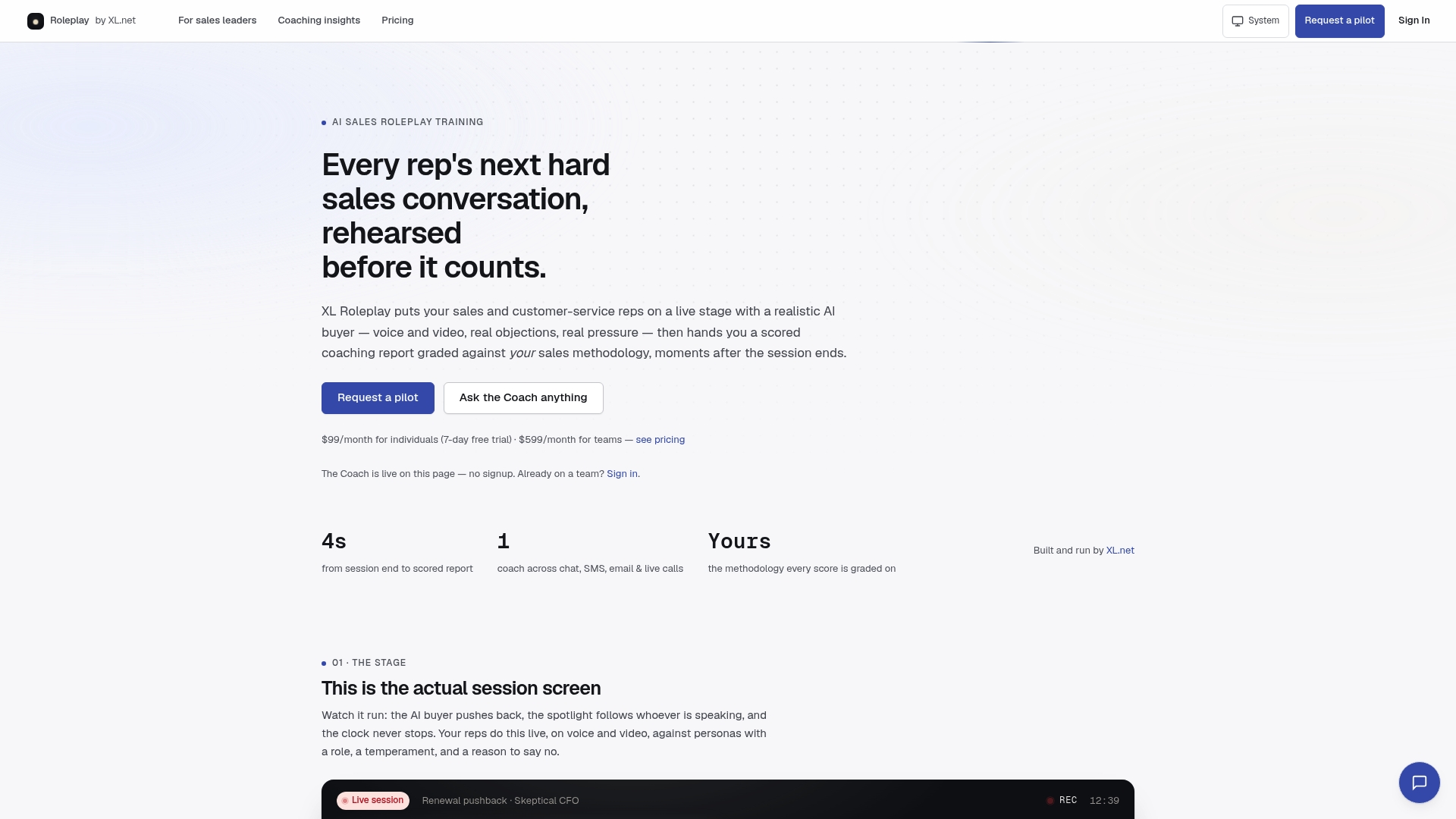
Xl’s platform puts reps and managers in live voice and video role-play sessions with AI buyers who present real objections and emotional pressure, then delivers scored coaching reports tied to your organization’s specific methodology. Every session produces a verbatim transcript and a rubric score across paraphrase accuracy, question quality, and emotional validation, so managers can see exactly where listening breaks down and coach to the specific gap rather than the general skill.
For teams running active listening training at scale, Xl removes the bottleneck of scheduling human role-play partners and gives every rep consistent, repeatable practice on demand. Start with a free trial at Roleplay and run your first scored session this week.
Sources
These sources ground the exercises above in research and practitioner experience. Work through the practice plan first, then use these for deeper study.
- Active Listening | Practice | Greater Good in Action
- Active Listening Skills Practice — Sagebrush Counseling
- Active Listening Exercise (Glencoe/McGraw Hill)
- Active Listening Training for Teams | Duarte
- Active listening — Trevor Muir
- Active Listening: Using listening skills to coach others — CCL