Hybrid Coaching for Individual Learners: AI+Human Beat AI Alone by 74%
Hybrid Coaching for Individual Learners: AI+Human Beat AI Alone by 74%

For most people, the strongest results come from combining both: AI for repeated practice and human coaching for judgment and relational depth. AI-driven tools scale drills, feedback, and data collection at a cost humans cannot match, while human coaches handle nuance, ethics, and complex emotional terrain. The evidence below explains why a hybrid model outperforms either option alone, and how to choose the right mix for your goals.
TL;DR:
- Combining AI and human coaching yields better results, with studies showing hybrid models outperform AI alone in domains like weight loss and skill transfer.
- AI coaching excels at high-frequency practice, such as roleplay simulations and goal tracking, especially when immediate feedback and accessibility are priorities.
- Human coaches are essential for emotionally sensitive topics, ambiguous problems, and high-stakes conversations that require nuanced judgment and relationship building.
- Choosing the right approach depends on goal complexity, privacy concerns, budget, and urgency, with hybrid workflows maximizing efficiency and effectiveness.
- Standards like those from the ICF emphasize transparency, consent, and ethical use of AI, making pre-assessment of data handling and scope critical before adoption.
Table of Contents
- What AI coaching does and where it excels
- What human coaches bring that AI can’t replicate
- What the research shows: key studies and what they mean for you
- How to choose: a practical decision guide for individuals
- A practical hybrid workflow you can adopt today
- Ethics, standards, and what to check before you start
- What each option costs and what you get for it
- Where AI coaching technology is headed
- Publisher perspective: how XL Roleplay operationalizes the hybrid model
- Try a pilot and see the hybrid model in practice
- Sources
- FAQ
What AI coaching does and where it excels
AI coaching tools work best as high-frequency practice partners, not replacements for judgment. They simulate conversations, score performance against a rubric, and surface patterns a person would need hours of listening to catch. The International Coaching Federation draws a useful line here, separating coach-assisting tools that support a human coach’s work from coaching-service tools that interact with the client directly, a distinction laid out in the ICF’s practical guide to AI coaching standards.
Where AI tends to add real value:
- Roleplay simulations that let someone rehearse a hard conversation as many times as needed, without scheduling a person.
- Automatic scoring against a fixed rubric, so feedback is consistent across sessions and reps.
- Goal tracking and nudges that keep a habit or skill on the radar between sessions.
- Around-the-clock access, useful for shift workers, global teams, or anyone practicing outside business hours.
A meta-analysis of intelligent tutoring systems found moderate positive effects compared with large-group instruction, and in some contexts these systems approached the results of one-on-one human tutoring, according to research published by the American Psychological Association. That pattern shows up in skill drills and habit reinforcement more than in emotionally loaded conversations.
The limits are real. AI struggles with emotional nuance, carries the bias of its training data, and raises legitimate privacy questions when conversations are recorded and scored. None of that disqualifies it, but it does mean AI coaching earns its place as one part of a system rather than the whole system.
What human coaches bring that AI can’t replicate
A human coach offers something no rubric fully captures: a relationship built over time, attuned to tone, hesitation, and what a client isn’t saying. That relational alliance, combined with ethical judgment in ambiguous situations, is where human coaching still leads. Interestingly, an RCT comparing client perceptions of a simulated AI coach against human coaches found similarly high working-alliance ratings in that specific study context, a result reported in Frontiers in Psychology. That finding is worth taking seriously, but it measured one context, not every coaching scenario, and it does not erase the value of a trained human reading a room.
Human coaching tends to outperform AI in a few recurring situations:
- High-stakes conversations where the cost of a wrong move is steep, such as a leadership transition or a client relationship on the line.
- Emotionally loaded or culturally sensitive topics that require reading unspoken cues.
- Ambiguous problems with no clear rubric, where judgment matters more than pattern matching.
The trade-offs are practical, not just philosophical. Human coaches cost more per hour, are harder to access on demand, and vary widely in skill and training, since “coach” is not a uniformly regulated title.
Pro Tip: Before hiring a human coach, ask for their credentials, request two client references, and get clear on the scope of what they will and won’t cover.
What the research shows: key studies and what they mean for you
The strongest recent evidence points toward hybrid models beating AI alone, at least in domains where outcomes are easy to measure. A longitudinal study found that people with access to both AI and human coaching lost more weight than those using AI alone, with significantly more weight loss over three months, a difference of roughly 74%, according to Stanford’s Graduate School of Business. That is a specific domain, weight loss, but the pattern of “AI plus human beats AI alone” recurs across the literature.
Other findings complicate a simple “humans always win” story:
- The Frontiers RCT found no statistically significant difference in working-alliance ratings between a simulated AI coach and human coaches in its sample, suggesting some relational tasks may transfer to AI better than assumed.
- ITS meta-analyses show moderate gains over group instruction and, in some cases, results close to individualized human tutoring, per the APA’s review.
- Field trials of AI-enabled clinical training tools found the technology acceptable and feasible, but adoption lagged because of structural barriers like recording anxiety and lack of protected practice time, not because the tools underperformed, based on a field trial published through APA’s PsycNet.
The catch with all of this evidence is scope. These studies measure specific domains over short windows with particular populations, so a result in weight loss coaching or clinical training doesn’t automatically generalize to sales coaching or executive development. The practical takeaway is to treat the research as a signal to expect hybrid benefits for skill transfer, not a guarantee that any single tool will replicate the exact numbers in your context.
How to choose: a practical decision guide for individuals
Start by getting specific about what you actually need before comparing tools or coaches.
- Define your goal clearly: skill repetition, habit change, or a complex personal or professional decision.
- Decide how much relational depth the goal requires. Repetitive drills need little; identity-level change needs a lot.
- Weigh privacy and data concerns, especially if sessions will be recorded or scored.
- Set a realistic budget and timeline, since AI tools are cheaper per session but human coaching often moves faster on complex issues.
- Match urgency to format: a script to practice by Friday favors AI; a leadership crisis favors a human conversation this week.
A few if/then rules make this concrete: practicing a sales pitch or handling objections points toward AI-first, since repetition is the whole game. Leadership development or a values conflict points toward a human coach, since judgment and trust matter more than reps. Anything touching mental health should go to a licensed professional, not a coach of either kind.
Before committing to any option, ask:
- Does this platform or coach follow recognized standards, and can they explain how?
- How is my data stored, and who can see session recordings or transcripts?
- Is there a clear path to a human referral if the issue goes beyond coaching?
- Can I try a limited session or pilot before committing?
Watch for red flags: vague answers about data handling, marketing that implies AI can replace therapy, or a coach who can’t explain their training. The ICF’s guidance on AI coaching standards is a solid benchmark for both sides of that question.
A practical hybrid workflow you can adopt today
The most reliable pattern is simple: prepare with AI, deepen with a human, reinforce with AI again. Practice a scenario repeatedly with an AI tool until the mechanics are automatic, then bring the recording or transcript into a human session to work through judgment calls, tone, and the parts a rubric can’t score. Afterward, return to AI for spaced repetition so the skill sticks.
The efficiency gain comes from what you hand the human coach. Sharing transcripts, rubric scores, and a readiness rating before the session means less time recapping and more time on the hard parts.
- AI-side activities: roleplay drills, scored transcripts, micro-feedback after each attempt.
- Human-side activities: reframing tough moments, working through hesitation or anxiety, negotiating the next goal.
- Shared inputs: transcripts, rubric-aligned scores, and a short readiness summary going into the human session.
| Metric | What it tracks | Where it comes from |
|---|---|---|
| Skill score | Rubric-based performance on a specific skill | AI-scored session |
| Practice frequency | How often the skill is rehearsed | AI platform usage log |
| Goal attainment | Progress on the objective set in the last human session | Human coaching notes |
Triangulating these three, rather than trusting one number, gives a fuller picture of whether the hybrid loop is actually working.
Ethics, standards, and what to check before you start
AI coaching raises questions that didn’t exist for human-only practice, and the ICF has done real work to answer them. Its standards guide sets expectations around transparency, informed consent, bias mitigation, and the coach-assisting versus coaching-service distinction mentioned earlier. Separate ICF ethics guidance pushes coaches to manage technology risk directly: get explicit consent before recording, be clear about how data is stored, and know when to refer someone outside the scope of coaching.

Bias deserves specific attention. An AI trained on limited or skewed data can reinforce blind spots rather than correct them, which is part of why transparency about training and scope matters as much as accuracy. Consent isn’t just a checkbox either: someone using an AI coaching tool should know clearly whether they’re talking to a simulation, how the conversation is scored, and who can review it later.
Practically, this means asking any platform or human coach the same short list of questions: what’s disclosed about AI’s role, how data is handled, and whether there’s a real path to a qualified human when an issue goes beyond coaching. Platforms and coaches that answer plainly are the ones worth trusting with something as personal as coaching data.
What each option costs and what you get for it
AI coaching tools are generally priced for high-frequency use: a flat monthly rate that gives unlimited or near-unlimited practice sessions, which makes the cost per rep drop the more you use it. Human coaching is priced per session or per package, and a single hour with an experienced coach often costs more than a full month of AI access, reflecting the coach’s time, training, and limited capacity.
The honest way to compare them isn’t dollars per hour, it’s dollars per outcome. If the goal is reps, like rehearsing a script fifty times before a big call, AI wins on cost by a wide margin. If the goal is a single high-stakes decision, like navigating a leadership transition, a few hours with a skilled human coach can be worth far more than the price tag suggests, because the judgment involved doesn’t scale.

Budget is also a legitimate filter for choosing where to start. Someone testing whether coaching helps at all can try AI tools at low cost and low commitment, then bring in a human coach once they know specifically what they need help with. That sequencing avoids paying premium human rates for practice that a scored simulation could have handled just as well.
Where AI coaching technology is headed
The near-term direction is less about AI coaching becoming more humanlike and more about it getting better at feeding human coaches useful material. Expect tighter integration between practice platforms and coaching sessions: timestamped transcripts, rubric-aligned scores, and short summaries designed specifically to save a human coach’s prep time rather than to replace them.
Voice and video simulation quality will keep improving, making practice scenarios feel closer to real conversations, which matters most for skills like objection handling or de-escalation where tone carries real information. Expect more platforms to build in explicit disclosure and consent flows as standard, following the direction set by the ICF’s standards work, rather than treating transparency as an afterthought.
The harder problem, and the one still unsolved, is adoption. Field trial data on AI-enabled training tools found the technology acceptable and feasible, but usage lagged behind expectations because of structural issues like recording anxiety and a lack of protected practice time, according to PsycNet field trial data. Future tools will likely spend as much effort on making practice feel safe and low-stakes as they do on improving the underlying model. A standards-led guide to AI coaching makes a similar point: the technology is rarely the bottleneck, implementation is.
Publisher perspective: how XL Roleplay operationalizes the hybrid model
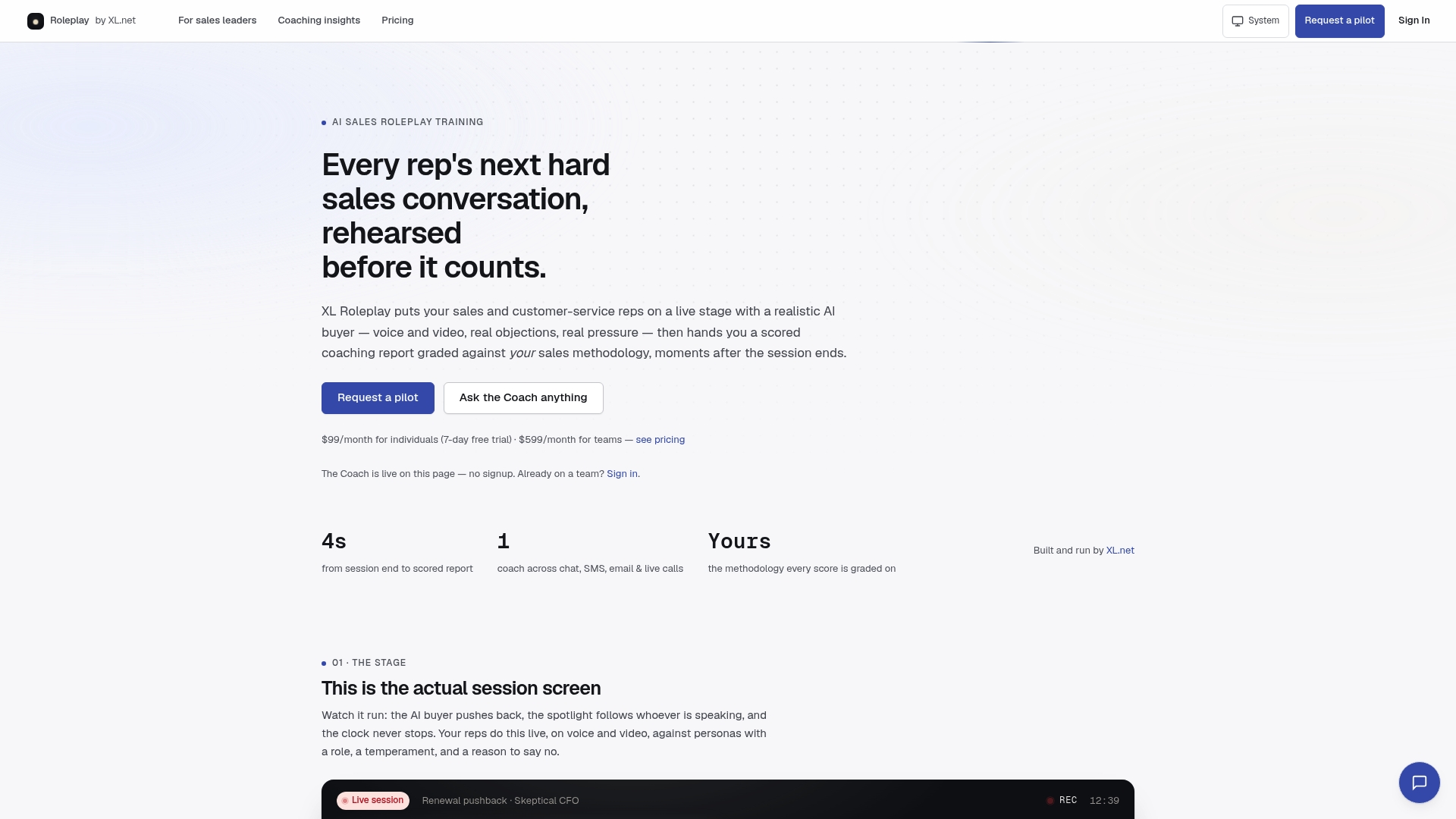
XL Roleplay is built around the exact pattern this article recommends: AI handles repeatable practice, humans handle judgment. Reps run live voice and video roleplay sessions against AI buyers that raise realistic objections, then get a scored coaching report tied to their organization’s own sales methodology.
Managers use those transcripts and rubrics to review calls in detail, build new drills from real objections that came up, and give targeted feedback instead of spending a coaching session recapping what happened. That structure means human coaching time gets spent on the parts that actually need a person: tone, hesitation, negotiation, not repetition.
— Adam
Try a pilot and see the hybrid model in practice
If you need scalable practice plus room for a human coach to focus on judgment calls, that’s exactly the gap XL Roleplay is built to fill. You can request a pilot, try a live demo, or check current plans before committing to anything.
- Request an XL Roleplay pilot to test the workflow on a real skill, like objection handling.
- Compare the Individual and Business plans, including seat and video add-on pricing.
- Visit the XL Roleplay platform for a full walkthrough of scoring, transcripts, and rubrics.
Pricing is straightforward: the Individual plan runs $99 per month and the Business plan runs $599 per month, both listed on the pricing page.
Sources
- Does access to human coaches lead to more weight loss than AI coaches alone? (Stanford / Marketing Science)
- Client perceptions of working alliance with simulated AI vs human coaches (Frontiers in Psychology)
- ICF AI coaching standards: practical guide
- Meta-analysis of intelligent tutoring systems (American Psychological Association)
- AI-enabled clinical training tool field trial (APA / PsycNet)
FAQ
What does an AI coach do?
An AI coach typically runs practice simulations, scores performance against a rubric, and sends nudges or reminders to reinforce a skill between sessions. Some AI coaching tools operate as coach-assisting technology that supports a human coach, while others function as a coaching-service on their own, a distinction the ICF’s AI coaching standards lay out clearly.
Which is better, AI or human coaching?
Neither wins outright: AI tends to be more effective for repeatable practice and data-driven feedback, while human coaches are stronger for relational depth and complex judgment calls. Evidence increasingly points to a hybrid model outperforming either approach alone, including a Stanford study that found people with access to both AI and human coaching achieved better outcomes than those using AI alone.
Is AI replacing human coaching work?
No credible evidence supports that AI is replacing human coaches outright. Research and expert commentary describe AI as a tool that scales practice and handles data-driven tasks, while relational presence and complex judgment remain areas where human coaches lead, a point echoed in analysis from INSEAD.
What should I look for in an AI coaching platform?
Look for clear disclosure of the AI’s role, transparent data handling, and a real path to a human referral when an issue falls outside coaching. Platforms built around a specific methodology, like objection handling drills scored against a sales rubric, tend to produce more useful feedback than generic simulations, and reviewing a sales roleplay training rollout can help set expectations before you start.