AI Customer Service Training: Role-Play That Scales
AI Customer Service Training: Role-Play That Scales

AI role-play simulations combined with human-in-the-loop coaching are the most effective way to train agents for complex, emotionally charged customer interactions. For managers who need a deployable solution now, Xl Roleplay delivers realistic voice and video role-play, scored coaching reports, and manager dashboards built around your own rubrics.
Here is why this approach works:
- Faster ramp time. Agents reach proficiency in weeks, not months, because they practice real scenarios before going live.
- Measurable KPI lift. Programs structured around scenario practice and coached debriefs consistently move CSAT, AHT, and FCR in the right direction.
- Scalable coaching. Manager dashboards and session transcripts replace the guesswork of informal observation with evidence-based coaching cycles.
- Compliance-ready. Scored rubrics and transcript archives give you an audit trail that passive e-learning cannot provide.
Table of Contents
- What does AI customer service training actually do for your team?
- How are AI training programs structured, and how long do they take?
- What must every AI-driven training program include?
- How do you roll out AI training from pilot to full deployment?
- What should you measure, and how do you prove ROI?
- How do you train agents to catch AI errors before they reach customers?
- What reporting and coaching tools should you demand from a platform?
- How does Xl Roleplay structure a training program in practice?
- How do you evaluate and choose an AI training platform?
- Key Takeaways
- The case for practice over content
- Xl Roleplay gives your team a place to practice before it counts
- Useful sources for further reading
What does AI customer service training actually do for your team?
The short answer: it replaces passive video-watching with practice. Agents run through realistic conversations with AI personas that push back, go off-script, and escalate, then receive immediate scored feedback tied to the behaviors your organization actually cares about.
The core features to expect from a mature platform:
- Scenario-based role-play across voice and text channels, with persona libraries that mirror your real customer segments
- Immediate scoring against a rubric aligned to your competency model, so agents know exactly which behaviors need work
- Coachable transcripts that managers can annotate, share, and use in one-to-one sessions
- Manager dashboards showing individual and cohort readiness scores, trend lines, and drill-down by behavior or scenario
- LMS and CRM integrations so training activity feeds into existing performance records
The benefits map directly to the metrics you report upward. Agents who practice on realistic scenarios reach conversation proficiency faster than those who only shadow calls. CSAT improves when agents handle objections and emotional escalations with confidence rather than improvising. AHT drops when agents know their next move without pausing to think.
Coursera’s Generative AI for Customer Support specialization makes the underlying shift explicit: AI does not replace agents, it changes the skill mix. Agents now need stronger problem-solving, empathy, and judgment, skills that develop through practice environments rather than passive learning.
Pro Tip: Build your scenario library around your actual failure modes. Pull your last quarter of escalated calls, identify the top five interaction patterns that triggered escalation, and make those your first five scenarios. Agents who can handle your hardest 20% of calls will handle the rest with ease.
How are AI training programs structured, and how long do they take?
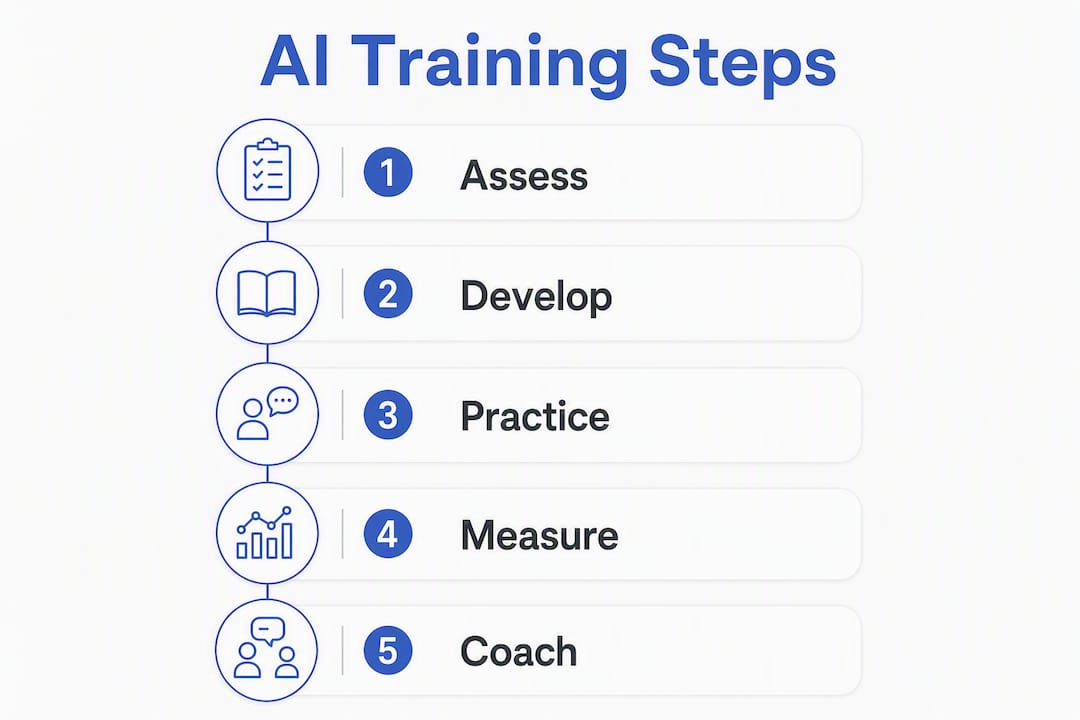
Most programs follow a modular structure blending foundational knowledge with hands-on practice, including AI basics and responsible use, prompt and draft review, scenario-based role-play practice that progresses to complex interactions, coached debriefs reviewing transcripts and scores, knowledge-base updates by agents, and a capstone evaluation testing readiness before live deployment.

Time commitments vary by format. CompTIA’s AI Customer Support Essentials is a self-paced course covering practical prompting, drafting, triaging, and responsible AI use in 4–6 hours. The Coursera Generative AI for Customer Support specialization is a multi-course series with hands-on labs that motivated learners can complete quickly. The Microsoft Customer Service (with AI) Professional Certificate adds Dynamics 365, Power BI, and Power Virtual Agents across multiple courses with a capstone project.
For a hybrid program that combines structured coursework with ongoing practice, a typical timeline includes an onboarding sprint with AI basics and initial scenarios, a few weeks of scenario practice with scored debriefs, followed by ongoing short micro-practice sessions triggered by quality assurance gaps and periodic content refreshes.
The micro-practice cadence is what separates programs that stick from those that fade after launch. Short, frequent, targeted drills outperform a single intensive workshop every time.
What must every AI-driven training program include?
Think of this as your vendor evaluation checklist. A program that is missing any of these components will leave gaps that show up in your QA scores within 90 days.
- Realistic, brand-safe scenario authoring. Scenarios must reflect your actual customer language, product set, and escalation patterns. Generic scenarios produce generic agents.
- Voice and text simulation. Customers contact you across channels; training that only covers text leaves agents unprepared for the tone and pacing of live calls.
- Scored rubrics aligned to your competency model. Scoring that does not map to your actual behaviors is noise. Agents need to see their score against the same criteria their manager uses in QA.
- Manager dashboards and transcripts. Without visibility into session data, coaching stays anecdotal. Dashboards and transcripts are what turn training into a management tool.
- CRM and LMS integrations. Training activity should flow into the systems you already use, not sit in a separate silo that nobody checks.
- Data governance and privacy controls. Role-play sessions contain sensitive conversation data. The platform must document how that data is stored, accessed, and deleted, and it must comply with your organization’s security requirements.
AWS SageMaker AI is worth knowing about if your team wants to build or customize internal simulation models at the infrastructure level, offering model customization and serverless training workflows for enterprise deployments.
Pro Tip: Prioritize scenario authenticity over superficial complexity. A scenario that perfectly replicates your hardest call type, with realistic pushback and off-script customer behavior, is worth ten generic “angry customer” templates. Train on the interactions that actually break your agents.
How do you roll out AI training from pilot to full deployment?
A structured rollout prevents the two most common failure modes: launching too broadly before the content is validated, and running a pilot so small it produces no useful signal.
- Define learning goals and baseline KPIs. Before a single agent logs in, document current CSAT, AHT, FCR, and onboarding time-to-proficiency. You cannot prove ROI without a baseline.
- Pick a representative pilot cohort. Choose 8–15 agents who reflect your typical mix of tenure and performance. Avoid selecting only top performers; the program needs to work for your median agent.
- Select 5–10 high-impact scenarios. Use QA data and escalation logs to identify the interaction types that drive the most coaching conversations. Those become your first scenario set.
- Train coaches and admins first. Managers need to understand the rubric, the dashboard, and the debrief workflow before agents start practicing. A confused coach undermines the whole program.
- Integrate with your CRM and LMS. Connect training activity to your existing performance records so completion and scores appear where managers already look.
- Run a 4–6 week pilot. Schedule two to three micro-practice sessions per week, hold weekly scored debriefs, and track rubric score trends against your baseline KPIs.
- Review and decide. At the end of the pilot, compare readiness scores, QA trends, and any early CSAT signals against your success thresholds. If the signal is positive, scale. If not, adjust scenarios and repeat.
Manager pilot sign-off checklist: baseline KPIs documented, scenario library approved by QA lead, coach training complete, integrations tested, success thresholds agreed in writing.
Pro Tip: Connect your QA tool to the training platform so that when QA flags a behavior gap, the system automatically assigns the relevant drill to that agent’s practice queue. This closes the loop between live performance and training without requiring a manager to manually track every gap.
What should you measure, and how do you prove ROI?
Measurement works in three time horizons. Short-term signals tell you the training is working. Medium-term signals tell you it is transferring to live calls. Business signals tell you it is worth the investment.

| Metric | Source of truth | Cadence | Owner |
|---|---|---|---|
| Readiness / rubric score | Training platform | Weekly | Coach / trainer |
| Onboarding time-to-proficiency | LMS / HR system | Per cohort | Training manager |
| CSAT | Survey tool (e.g., Medallia, Qualtrics) | Monthly | CX manager |
| AHT / ART | CRM / telephony platform | Bi-weekly | Operations |
| FCR | CRM / ticketing system | Monthly | Operations |
| Escalation rate | QA tool / CRM | Bi-weekly | QA lead |
| Quality score | QA tool | Weekly | QA lead |
The measurement sequence matters. Start with readiness scores and rubric trends in weeks one through four. Those are your leading indicators. CSAT and AHT typically move in weeks six through twelve, once agents have enough live reps to apply what they practiced. Escalation rate and FCR are lagging indicators; expect meaningful movement at the 90-day mark.
Programs built around human-in-the-loop workflows, where QA and coaching continuously feed scenario assignments, produce higher ROI than one-off workshops because they close performance gaps as they appear rather than waiting for the next training cycle.
How do you train agents to catch AI errors before they reach customers?
AI in customer service fails in predictable ways. Agents who know the failure modes can catch them in seconds; agents who do not will pass them straight to the customer.
The common failure modes to train against:
- Hallucinations. The AI states a policy, price, or product detail that does not exist. Detection cue: the agent cannot verify the claim in the knowledge base within 10 seconds.
- Off-brand language. The AI uses a tone, phrase, or level of formality that does not match your brand voice. Detection cue: the response would sound wrong coming from a human agent.
- Unsafe suggestions. The AI recommends an action that violates policy, creates legal exposure, or could harm the customer. Detection cue: the suggestion involves a refund, exception, or commitment the agent is not authorized to make.
- Privacy leaks. The AI surfaces account details, transaction history, or personal information in a context where it should not. Detection cue: the response includes data the customer did not ask for.
Training activities that build this judgment:
- Dual-run role-plays. The agent handles the same scenario twice: once with AI assistance, once without. Comparing the two builds awareness of where the AI adds value and where it drifts.
- Error-recognition debriefs. Coaches present transcripts containing planted errors and ask agents to identify and correct them before the response goes out.
- Escalation scripts. Agents practice the exact language for taking ownership: “Let me step in here and confirm this directly for you.” Smooth handoffs preserve customer trust.
CompTIA’s AI Customer Support Essentials addresses this directly: responsible AI modules teach agents simple verification checks and escalation cues so they can take ownership when the AI output is unreliable.
Pro Tip: Embed red-team checks into your scenario authoring process. For every new scenario, have a QA lead or senior agent try to get the AI to produce an unsafe or off-brand response. If they can, fix the guardrails before the scenario goes live.
What reporting and coaching tools should you demand from a platform?
The platform’s reporting capability is what separates a training tool from a coaching system. If managers cannot act on the data, the data does not matter.
The tools you should require:
- Session transcripts with timestamps and behavior annotations, accessible to managers and exportable for audit
- Scored rubrics that show each behavior, the target score, the agent’s actual score, and the delta from the previous session
- Drill-down filters by behavior, agent, scenario, and date range so managers can isolate exactly where a cohort is struggling
- Auto-assigned practice tasks triggered by rubric gaps, so the system does the triage work instead of the manager
- Cohort reporting that shows team-level trends alongside individual performance, making it easy to spot systemic gaps versus individual ones
- Escalation and SLA trackers that flag agents whose readiness scores fall below a threshold before they go live
The coaching workflow that works best: pull the week’s lowest rubric scores, open the transcripts for those sessions, annotate the two or three moments that drove the score down, and use those clips as the agenda for a 20-minute one-to-one. The Xl Roleplay coaching insights library documents exactly this kind of workflow, with practical examples of how managers turn scored sessions into targeted practice assignments.
Pro Tip: Require raw transcript access, not just summary scores. Summary scores can obscure the specific moment where an agent lost control of a conversation. The transcript shows you exactly what was said, which makes coaching precise and removes the “I didn’t say that” disputes that slow down feedback cycles.
How does Xl Roleplay structure a training program in practice?
Xl Roleplay runs training through realistic voice and video role-play sessions with AI personas that behave like actual customers: they push back, change their mind, escalate emotionally, and go off-script. The platform generates a scored coaching report after every session, mapping agent behavior to the rubric your organization defines.
A scored coaching report from Xl Roleplay typically contains:
- Behavior rows listing each competency (e.g., empathy acknowledgment, objection handling, resolution confirmation)
- Target score set by the manager or QA lead during program setup
- Session score showing what the agent actually achieved
- Delta from previous session so progress is visible at a glance
- Recommended practice pointing to the specific scenario or drill that addresses the gap
Manager dashboards aggregate these reports across the team, with filters by behavior, scenario, and time period. Transcripts are stored and searchable, giving coaches the raw material for targeted one-to-ones and giving compliance teams an audit trail.
This kind of evidence-based coaching cycle, where practice data feeds directly into the manager’s coaching agenda, is what drives durable improvement in CSAT and onboarding time rather than a temporary post-training bump.
How do you evaluate and choose an AI training platform?
Start with your non-negotiables, then run a structured pilot before committing.
Evaluation criteria:
- Scenario realism. Can the platform simulate your actual customer types, including emotional escalations and off-script behavior?
- Scoring alignment. Does the rubric map to your competency model, or is it a generic template you cannot customize?
- Integrations. Does it connect to your CRM, LMS, and QA tool, or will training data live in a separate silo?
- Admin UX. Can a non-technical manager build and update scenarios without vendor support?
- Security and privacy. Is session data encrypted, access-controlled, and deletable on request? Is there a documented data retention policy?
- Vendor support and customization. Will the vendor help you build your first scenario library, or do you get a blank canvas and a help article?
- Cost model. Is pricing per seat, per session, or flat subscription? Does it scale predictably as your team grows?
Use the Xl Roleplay buyer’s checklist to structure your vendor conversations.
Pilot template:
- Scope: one team, 8–15 agents, 5–10 scenarios
- Timeline: 4–6 weeks
- Baseline KPIs: CSAT, AHT, FCR, onboarding time documented before day one
- Success thresholds: agree in writing (e.g., rubric scores improve by X points, onboarding time drops by Y days)
- Decision gate: at week six, compare actuals to thresholds and decide to scale, adjust, or exit
Red flags that should disqualify a platform:
- Scoring is opaque and cannot be mapped to your rubric
- No access to raw transcripts
- Integration options are limited to a single LMS with no API
- Manager controls are minimal or require vendor involvement to change
- No documented privacy controls or data retention policy
Key Takeaways
AI role-play combined with human-in-the-loop coaching is the most reliable method for training agents on complex interactions, and the programs that sustain results are the ones that tie practice directly to live QA data.
| Point | Details |
|---|---|
| Start with your hardest scenarios | Build your first scenario set from escalation logs and QA gaps, not generic templates. |
| Baseline KPIs before day one | Document CSAT, AHT, FCR, and onboarding time before the pilot starts or you cannot prove ROI. |
| Require transcripts and scored rubrics | Raw transcripts and behavior-level scores are what make coaching precise and auditable. |
| Automate micro-practice from QA | Connect your QA tool to the training platform so gaps trigger targeted drills automatically. |
| Xl Roleplay as your deployable option | Xl Roleplay provides voice and video role-play, scored coaching reports, and manager dashboards aligned to your rubric. |
The case for practice over content
Most training programs fail not because the content is wrong but because agents never practice applying it under pressure. A well-written policy document does not prepare someone for a customer who is furious, repeating themselves, and threatening to cancel. Only practice does that.
The managers who see the fastest improvement in CSAT and onboarding time are the ones who treat training as a coaching system, not a content library. They use scored transcripts to run targeted one-to-ones. They connect QA data to practice assignments so gaps close automatically. They review scenario libraries quarterly and update them when customer behavior shifts.
The AI does the heavy lifting on volume: it can run hundreds of practice sessions simultaneously, score every one of them, and surface the patterns a manager would never catch by observation alone. The human-in-the-loop piece, the coach who reads the transcript and has the direct conversation, is what turns that data into behavior change. Neither works as well without the other.
Xl Roleplay gives your team a place to practice before it counts
Agents who practice on realistic, scored scenarios before they take live calls make fewer mistakes, handle escalations more confidently, and reach full proficiency faster. Xl Roleplay is built for exactly that: voice and video role-play with AI personas that behave like real customers, scored coaching reports aligned to your rubric, session transcripts your managers can actually use, and dashboards that show you where every agent stands.
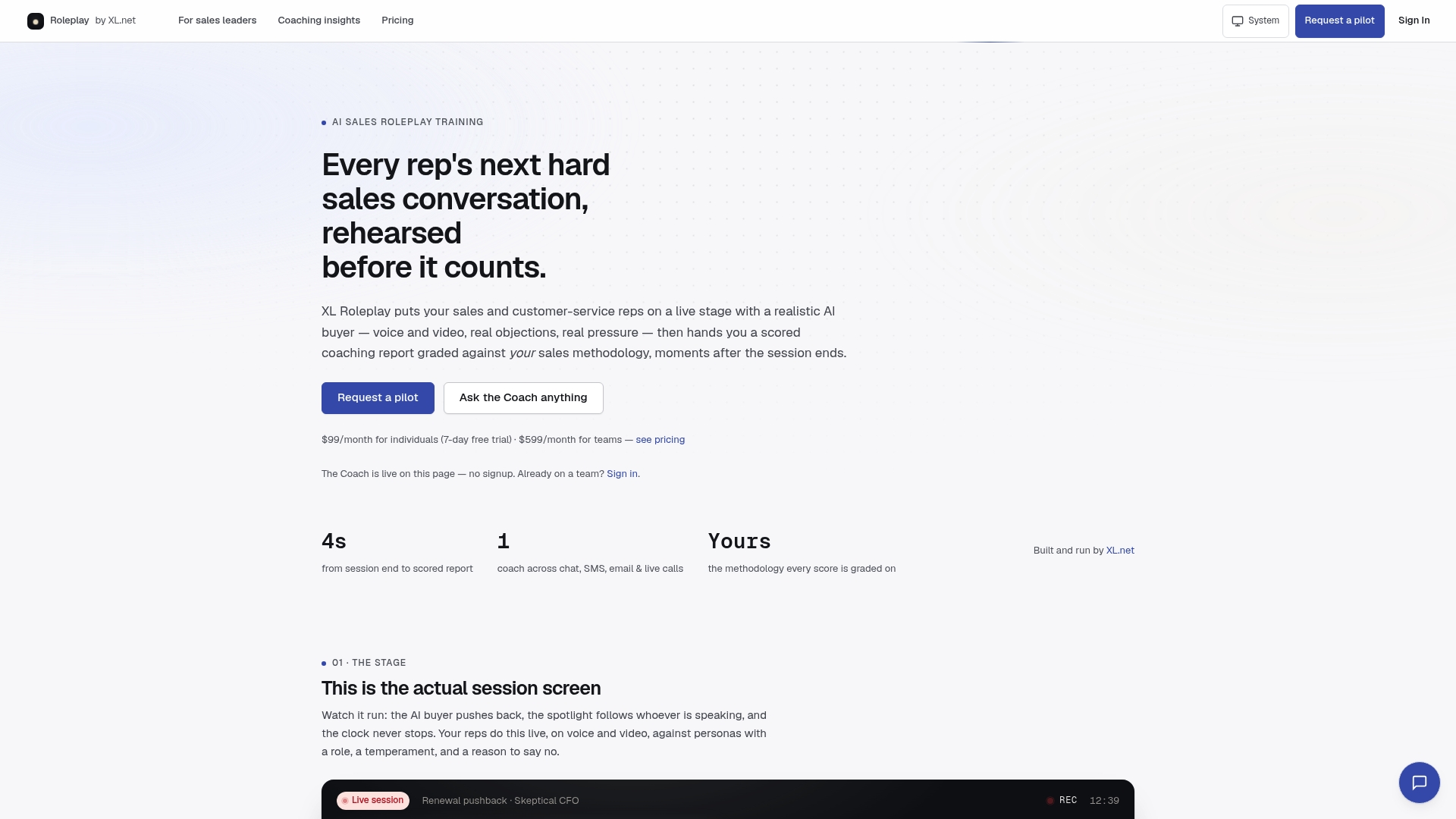
The platform connects to your existing CRM and LMS so training data flows into the systems you already manage. Setup is fast, scenarios are customizable to your product and customer base, and the free trial lets you run your first sessions before you commit to a plan.
Start a free trial or book a demo and see what a scored coaching report looks like for your team’s hardest scenario.
Useful sources for further reading
- Amazon SageMaker AI — AWS — enterprise infrastructure for teams building or customizing internal AI simulation models
- Xl Roleplay — platform overview — product capabilities, use cases, and trial options for customer service training
- Customer service role-play training guide — Xl Roleplay — practical guidance on designing scenario-based drills aligned to service behaviors and rubrics