AI Sales Training for Sales Leaders: Role-Play First
AI Sales Training for Sales Leaders: Role-Play First

AI sales training combines role-play simulations, conversation intelligence, and on-demand coaching to scale skill development across your entire team. The recommended approach: start with a scenario-driven role-play pilot, measure readiness scores and conversation quality, then expand to full coaching plus CRM integration.
The core components you need in place from day one:
- Role-play simulation engine with adaptive AI buyer personas that mirror real objections
- Conversation intelligence that transcribes calls, detects intent, and surfaces coaching signals
- Scored coaching reports tied to your specific sales methodology (not generic rubrics)
- CRM and LMS integration so practice data connects to pipeline performance
Pro Tip: Run a multi-week pilot with a small team of reps before committing to an enterprise rollout. Define your baseline KPIs before the first session, not after.
Gartner tracks this category shift and recommends measuring skill lift and adoption rates as the primary evaluation criteria when comparing vendors.
Table of Contents
- What is AI sales training and how does it actually work?
- What benefits and ROI can you realistically expect?
- Which features actually move the needle for your team?
- What use cases and scenarios should you run first?
- How do you pilot, roll out, and measure impact?
- How do you choose the right vendor?
- How Xl Roleplay delivers the role-play–first approach
- Key Takeaways
- Why most sales leaders are thinking about AI training backwards
- Xl Roleplay: practice that transfers to your next live deal
- Useful sources
What is AI sales training and how does it actually work?
AI sales training is a technology-driven approach that replaces static e-learning modules and infrequent manager ride-alongs with always-on, data-rich practice environments. Reps rehearse real conversations, get scored immediately, and managers see the results without sitting in on every call.
The role-play simulation engine
The simulation layer is where reps practice live. An AI buyer persona responds in real time, pushes back on pricing, asks hard discovery questions, or stalls on next steps. The best platforms let you configure the persona’s industry, seniority, objection style, and pressure level so the scenario matches the actual deal your rep is about to work.
What separates a good simulation from a bad one is adaptability. A static script that follows a fixed path teaches reps to memorize, not respond. Adaptive personas change direction based on what the rep actually says, which is the only way to build genuine conversation skill.
Conversation intelligence: from transcript to coaching signal
After each session, the platform transcribes the audio, then applies natural language processing to extract meaning: which questions the rep asked, how long they talked versus listened, whether they handled the objection or deflected it, and what the buyer’s sentiment looked like at each turn. NLP accuracy matters here because a model that mishears “budget” as “budget constraint” will score the rep incorrectly.
The data flow looks like this: live session → transcript → NLP analysis → scored rubric → coaching report → manager dashboard. Every step compounds. A weak transcript produces a weak score; a weak score produces a coaching conversation built on bad data.
Scoring, rubrics, and integrations
Scoring is only useful when it reflects your methodology. A rubric built around MEDDIC looks different from one built around Challenger or SPIN. Platforms that offer generic scoring (“great job asking questions!”) tell you almost nothing. Methodology-aware scoring tells you whether the rep actually identified the economic buyer or just asked a question that sounded like they did.
CRM integration closes the loop between practice and pipeline. When a rep’s readiness score from role-play connects to their open opportunities in Salesforce or HubSpot, managers can prioritize coaching where the revenue risk is highest. Connected systems deliver measurably more value than coaching platforms that sit in isolation.
Pro Tip: Before your first pilot session, export your top three objection types from your CRM win/loss data. Build your first scenario library around those three, not around what feels intuitive.
What benefits and ROI can you realistically expect?
The honest answer: vendor claims vary widely, and the strongest ones come with a methodology and a baseline. Treat any ROI figure without a stated sample size and time window as a starting point for your own questions, not a guarantee.
That said, the category-level evidence is solid. Gartner’s analysis of sales training and coaching technology confirms the shift toward simulation and always-on coaching as the dominant model, with skill lift and adoption as the metrics that matter most. The underlying logic is straightforward: reps who practice more, with immediate feedback, develop skills faster than reps who practice once a quarter in a group role-play.
Evidence to request before you sign
| Evidence Type | What to Ask For | Red Flag |
|---|---|---|
| Case study | Sample size, time window, baseline metric | No baseline stated |
| Ramp time claim | Cohort definition, how ramp is measured | Single anecdote |
| Deal lift | Control group or A/B design | Correlation only |
| Practice volume | Sessions per rep per week, completion rate | No completion data |
| Methodology fit | Which sales methodologies the rubric supports | Generic rubric only |
Review sites like G2 surface useful signal on user experience and adoption, but the sample transparency varies. Cross-reference any review-site data with direct reference calls to customers in your industry and deal size.
Which features actually move the needle for your team?
Not every feature in a vendor’s demo deck earns its place in a pilot. Here is how to prioritize.
Must-have features for any pilot
- CRM integration — (at minimum, Salesforce or HubSpot) to connect practice data to pipeline
Feature priority by deployment stage
| Capability | Must-Have for Pilot | Nice-to-Have for Scale | Enterprise |
|---|---|---|---|
| Adaptive buyer personas | ✓ | ||
| Methodology-aware scoring | ✓ | ||
| Instant scored debrief | ✓ | ||
| Transcript + rubric export | ✓ | ||
| CRM integration | ✓ | ||
| Video + voice role-play | ✓ | ||
| Native LMS integration | ✓ | ||
| Localization / multilingual | ✓ | ||
| Role-based admin controls | ✓ | ||
| SSO and SOC 2 compliance | ✓ | ||
| Custom API access | ✓ |
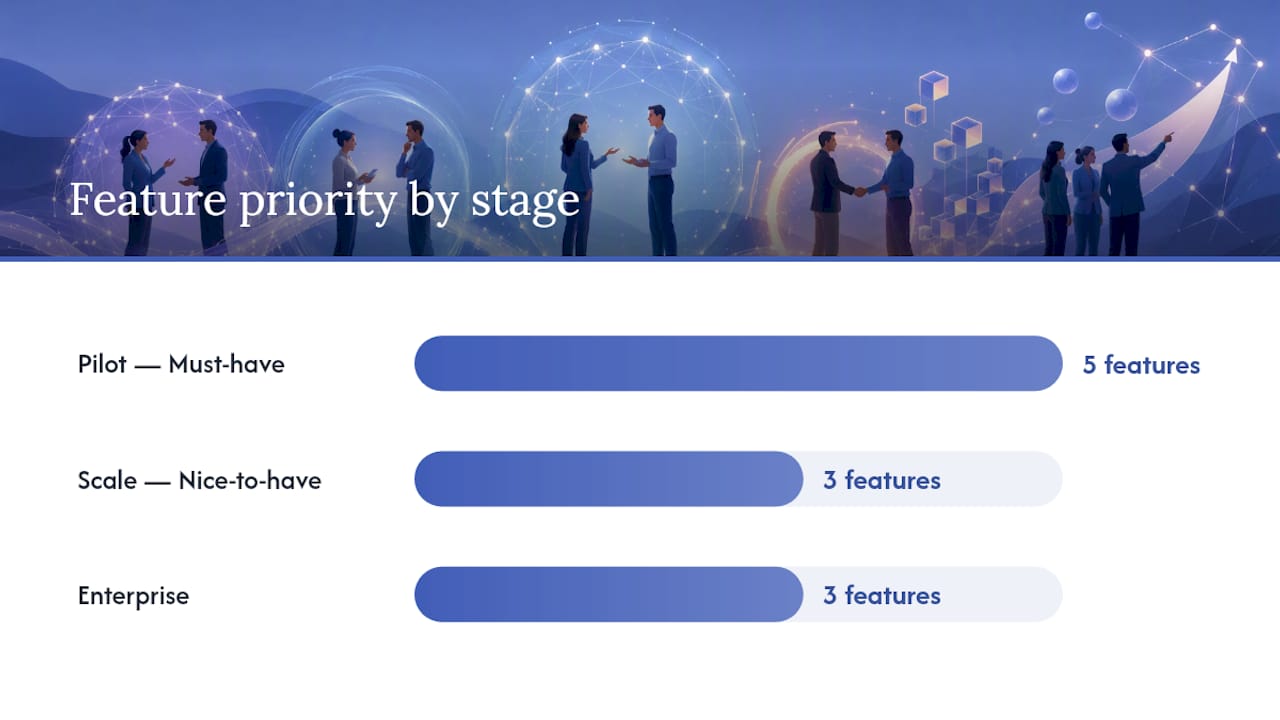
The video layer matters more than most buyers expect. Text-based role-play misses the nonverbal signals that buyers read in live calls. If your reps sell via video conference, they need to practice via video conference.
What use cases and scenarios should you run first?
The highest-value use cases map to the moments where reps most often lose deals: discovery calls where they talk too much, cold outreach where they fail to earn the next step, and objection handling where they cave on price instead of reframing value.
Six scenario templates to run immediately
-
Discovery call: uncovering the real problem Objective: Rep must identify the economic buyer and quantify business impact before the call ends. Set-up: AI persona is a mid-level manager who deflects to “we’re just exploring options.” Success criteria: Rep asks at least three impact questions and earns a commitment to a next meeting. Difficulty tuning: increase by having the persona mention a competitor early.
-
Cold outreach: earning the first meeting Objective: Rep delivers a 30-second value proposition and handles the “send me an email” brush-off. Set-up: AI persona is a skeptical VP who has heard every pitch. Success criteria: Rep connects to a specific business problem and secures a 15-minute slot. Difficulty tuning: add a second objection (“we already have a solution”).
-
Objection handling: price pushback Objective: Rep reframes value without discounting. Set-up: Persona says “your price is 30% higher than the competition.” Success criteria: Rep quantifies ROI and holds price. Difficulty tuning: persona escalates to “I need to take this to my CFO.”
-
Demo: keeping the buyer engaged Objective: Rep leads a discovery-first demo rather than a feature walkthrough. Set-up: Persona asks “can you just show me the product?” Success criteria: Rep redirects to business outcomes before showing features. Difficulty tuning: persona interrupts with off-topic questions.
-
Negotiation: protecting margin Objective: Rep closes without giving away discount. Structured negotiation drills are one of the highest-ROI scenario types because margin erosion is measurable. Set-up: Persona demands a 20% discount as a condition of signing. Success criteria: Rep offers non-price concessions and closes at or above target. Difficulty tuning: add a deadline (“we need this resolved today”).
-
Renewal conversation: defending against churn Objective: Rep surfaces unspoken dissatisfaction before the renewal date. Set-up: Persona gives a lukewarm “we’re reviewing our options.” Success criteria: Rep uncovers the real concern and proposes a concrete resolution path. Difficulty tuning: persona mentions a competitor’s lower price.
Rehearsal cadence that actually sticks
Map scenarios to rep personas and pipeline stages. A new rep in month two needs discovery and cold outreach drills daily. A mid-tenure rep preparing for a negotiation needs two focused sessions the week before the call, not a general refresher. The XL Roleplay insights library has playbooks for structuring these cadences by rep tenure and deal stage.
How do you pilot, roll out, and measure impact?
KPIs to track
| KPI | Goal | Measurement Frequency | Data Source |
|---|---|---|---|
| Scenario pass rate achieving a strong success threshold by week 4 | Weekly | Platform dashboard | |
| Ramp time to first deal | Reduction vs. prior cohort | Per cohort | CRM |
| Conversation quality score | Improving trend | Per session | Platform scoring |
| Pipeline velocity | Faster stage progression | Monthly | CRM |
| Manager coaching time | Shift to AI-surfaced moments | Monthly | Manager survey |
Sales readiness scoring converts these individual signals into a single rep-level readiness index, which makes it easier to prioritize coaching time across a large team.
The manager workflow shift is the hardest change to make and the most important. Managers who keep sampling calls randomly will underuse the platform. The goal is to move them from “I’ll listen to a few calls this week” to “I’ll coach from the three moments the platform flagged as high-risk.” That shift requires a new coaching cadence and explicit manager enablement, not just access to a dashboard.
How do you choose the right vendor?
Prioritize three things above everything else: pilot alignment (can they configure your scenarios in under two weeks?), scoring transparency (can they show you exactly how a rubric score is calculated?), and integration ease (does their CRM connector work with your stack without a custom build?).
Questions to ask in every demo
- Show me how you configure a scenario for a specific objection type. How long does it take?
- Walk me through how a rubric score is calculated. What does the rep see versus what the manager sees?
- Which CRM connectors are native versus requiring middleware?
- Where is session data stored, and who can access it?
- What is your data retention policy, and can we export all transcripts on request?
- How does your model handle industry-specific terminology?
Contract and security red flags
- No ability to export transcripts in a standard format (CSV, PDF)
- Unclear data lineage: the vendor cannot explain where your session data goes after processing
- Weak role-based access controls: any rep can see any other rep’s scores
- No SOC 2 Type II certification for enterprise deployments
- Scoring rubric is a black box with no explainability layer
How Xl Roleplay delivers the role-play–first approach
Xl Roleplay is built specifically for the scenario-driven, methodology-first rollout described in this guide. The platform provides live voice and video role-play sessions with adaptive AI buyers, scored coaching reports tied to your organization’s sales methodology, detailed session transcripts, and a manager dashboard that surfaces coaching moments automatically.
Here is how Xl’s capabilities map to the feature checklist:
- Transcript and rubric export: Every session produces a full transcript and a scored rubric that managers can use for structured coaching conversations. The guide on coaching from transcripts walks through how to run those conversations effectively.
- Readiness scoring: — Xl tracks individual and team readiness over time, giving managers a single number that reflects practice volume, score trends, and scenario completion.
A typical pilot setup takes one to two weeks: scenario configuration, CRM connection, and manager briefing. Most teams complete their first scored session in the first week.
Pro Tip: Use Xl’s scenario library as a starting point, then customize the buyer persona’s objection style to match your three most common deal-loss reasons. The specificity is what makes practice transfer to live calls.
Key Takeaways
AI sales training delivers measurable results when you start with role-play, define KPIs before the pilot begins, and connect practice data to pipeline through CRM integration.
| Point | Details |
|---|---|
| Role-play first | Start with adaptive scenario drills before adding conversation intelligence or full CRM analytics. |
| Define KPIs before day one | Pull ramp time, win rate, and conversation quality baselines in week 1 or you cannot prove lift. |
| Methodology-aware scoring | Generic rubrics produce generic insights; require scoring tied to your specific sales framework. |
| Manager workflow shift | Move managers from random call sampling to coaching from AI-surfaced moments for maximum impact. |
| Xl Roleplay | Xl delivers live voice and video role-play with adaptive AI buyers, methodology scoring, and manager dashboards built for a pilot-first rollout. |
Why most sales leaders are thinking about AI training backwards
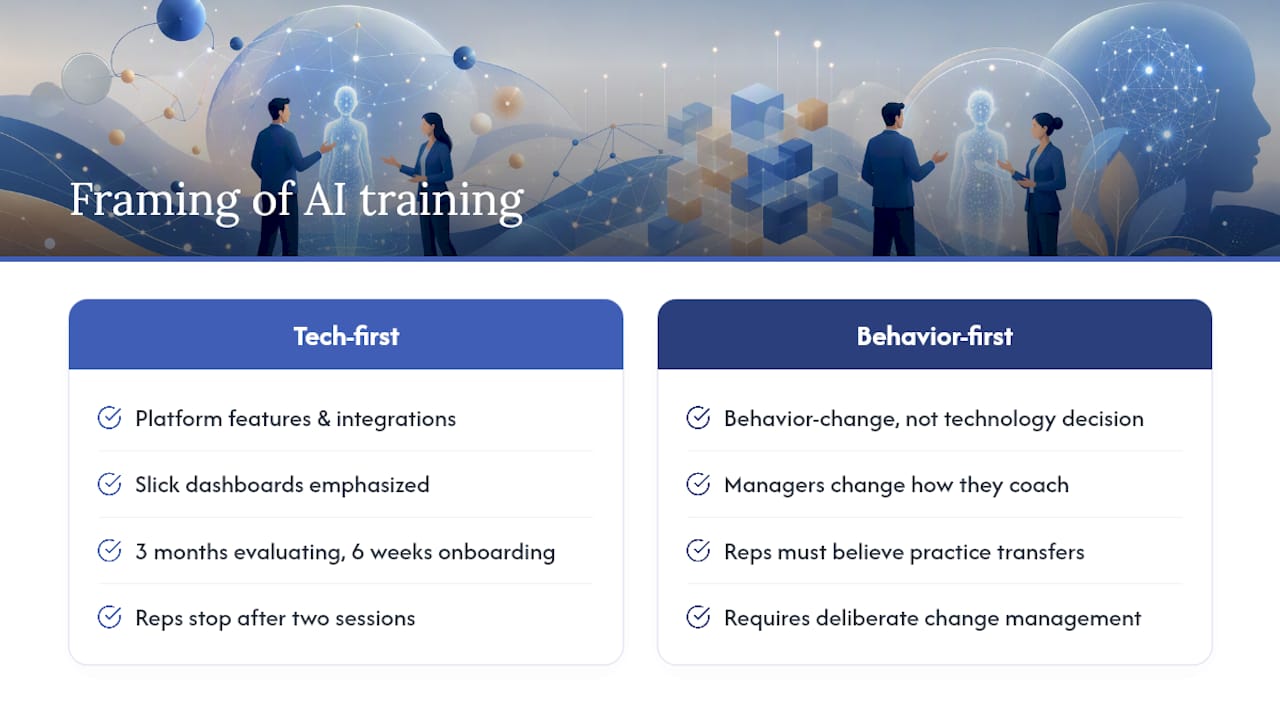
The conventional framing treats AI sales training as a technology decision: which platform has the best features, the most integrations, the slickest dashboard? That framing leads teams to spend three months evaluating software and six weeks onboarding, only to find that reps complete two sessions and stop.
The real decision is a behavior change decision. The platform is almost secondary. What actually determines whether AI training sticks is whether managers change how they coach, and whether reps believe that practice in the platform transfers to their live calls. Both of those require deliberate change management, not just a software license.
The augmentation argument is worth taking seriously. AI does not replace the manager’s judgment about a rep’s career trajectory, their motivation, or the interpersonal dynamics of a deal. What it does is eliminate the information gap. A manager who has reviewed a scored transcript of a rep’s last three discovery calls is coaching from evidence. A manager who is going on instinct is guessing, even if they are experienced.
The teams that get the most out of AI-powered sales coaching are the ones that treat the pilot as a learning exercise, not a proof-of-concept for procurement. They define what success looks like before they start, they keep the scenario library tight and relevant, and they give managers a new cadence rather than just a new tool. Small wins in the first four weeks create the organizational belief that makes scale possible.
Xl Roleplay: practice that transfers to your next live deal
Most sales teams practice too little and too late. Xl Roleplay gives reps a realistic place to rehearse the exact conversations they are about to have, with AI buyers that push back the way real buyers do, and scored reports that tell them specifically what to fix before the next call.
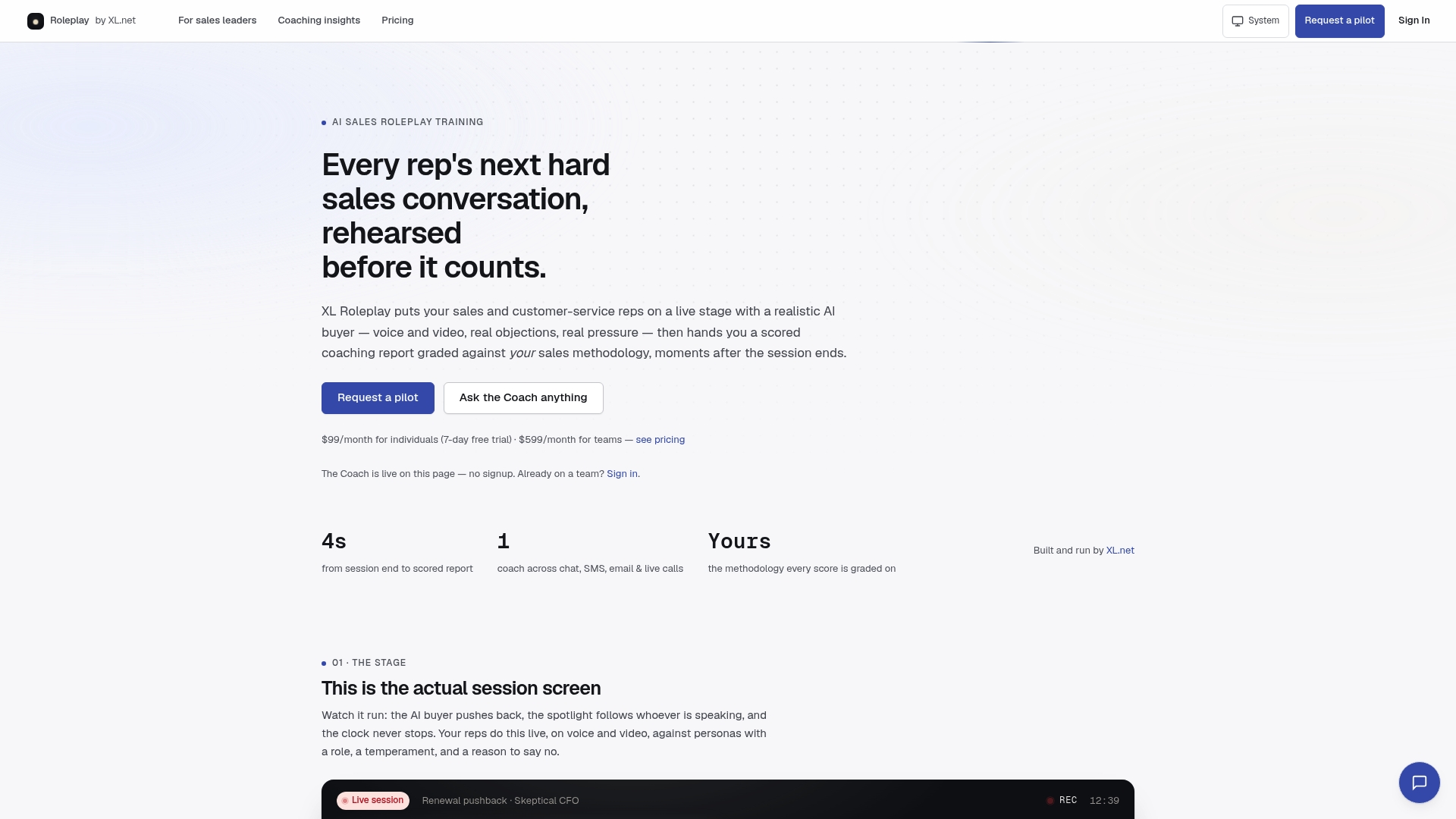
A free trial includes live voice and video role-play sessions, scored coaching reports tied to your methodology, full session transcripts, and access to the manager dashboard. You can configure your first scenario in under an hour and have your pilot cohort running sessions the same week.
Sales leaders can review the pilot package for sales leaders for cohort sizing, KPI templates, and enterprise integration options. Ready to run your first session? Start your free trial at Xl Roleplay and have your first scored debrief in hand before the end of the week.
Useful sources
- The evolution of sales training and coaching technology | Gartner
- Natural language processing | NNLM Data Science Glossary
- MuleSoft case studies
- AI Sales Roleplay Software — XL Roleplay by XL.net
- Coaching insights · XL Roleplay
- How to Evaluate AI Sales Roleplay Tools: A Buyer’s Checklist · XL Roleplay
- Sales Negotiation Roleplay Scenarios That Protect Margin · XL Roleplay