AI Sales Training Pricing: What Teams Pay in 2026
AI Sales Training Pricing: What Teams Pay in 2026

AI sales training is priced in three main ways: a flat monthly subscription, a per-seat fee, and a custom quote for enterprise or consulting-style programs. Self-serve role-play platforms usually sit in the low hundreds of dollars a month for one person, and in the high hundreds or low thousands for a team. Large platform rollouts can reach six figures once implementation is counted. Below you will find how each model works, what drives the final number, a worked budget example, and how to tell whether the spend pays back.
TL;DR
- AI sales training is sold as a monthly subscription, a per-seat fee, a usage add-on, or a custom quote. Which one you get shapes your real cost more than the list price does.
- Our published prices are $99 per month for Individual and $599 per month for Business, plus $54.95 per month for each extra seat and $16.99 per hour of extra video.
- Broader sales enablement platforms can add $20,000 to $150,000 in implementation on top of per-user licenses, according to one advisory firm’s 2026 guide.
- Customization, session volume, video use, seat count and manager time are the factors that move a quote.
- Judge the spend by before-and-after performance and practice activity, not by price alone.
Table of Contents
- The three ways AI sales training is priced
- What our pricing looks like
- What pushes the price up or down
- A worked budget example
- Costs buyers forget
- How to compare AI sales training quotes
- Is the cost justified?
- Our perspective
- Start with a plan that fits your team
- FAQ
- Sources
The three ways AI sales training is priced
Pricing in this category has not settled. A 2024 sales AI report from HG Insights notes that AI features are costly to run and that vendors are still debating the ideal model. Some move to usage-based pricing to tie cost to the value delivered. Others fold AI into a traditional subscription or seat fee.
In practice you will meet these structures.

Flat subscription per user or per team
You pay a fixed monthly amount for a person or a team. It is the easiest to budget, because the invoice looks the same every month. The questions to ask are how many people the plan covers, how many practice sessions are included and whether the price changes when your team grows.
Per-seat pricing
You pay for every rep who practices. Costs scale in a straight line with headcount, which is fair for a team that is growing slowly and painful for one that onboards a large cohort at once. Check whether managers and admins who only review reports count as seats.
Usage-based add-ons
Voice and video sessions cost more to run than text chat, so some vendors price the heavier formats by the hour. A team that practices a lot on video should model this line separately instead of assuming the base plan covers it.
Custom quotes and pilots
Enterprise buyers, or teams that want scenarios built around their own deals, often get a quote rather than a price list. A pilot is a common first step: a limited group practices for a set period before you commit to a full rollout.
What our pricing looks like
We publish our prices so you can budget before you talk to anyone. Here is what is on our pricing page.
| Item | Price | How it is billed |
|---|---|---|
| Individual plan | $99 | per month |
| Business plan | $599 | per month |
| Extra seats | $54.95 | per month, per seat |
| Extra video | $16.99 | per hour |
| XL Roleplay pilot | No published price | See the pilot page |
The Individual plan fits a single rep, a new hire preparing for live calls or a professional who wants a place to rehearse. The Business plan is for teams that want shared scenarios, managers reviewing transcripts and scoring, and coaching built on the company’s own sales methodology. For the current plan contents and any trial terms, the pricing page is the source of truth.
What pushes the price up or down
Two vendors can quote very different numbers for what looks like the same product. These are the variables behind the gap.
Customization. A generic scenario library costs less to deliver than scenarios built on your own deals, buyers and playbook. Written custom material and a methodology-specific scoring rubric take real setup effort, and quotes reflect it.
Session volume and format. Voice and video practice use more compute than text. A team that rehearses three times a week on video has a different cost profile from one that practices once a month.
Group size. Per-seat costs often fall at higher volumes, but only if the vendor offers tiers. Ask where the breakpoints are.
Manager involvement. If managers are expected to review transcripts and run debriefs, you pay for their seats and their time. Reinforcement is also where much of the value comes from, so it is a cost worth planning, not avoiding.
Implementation and integration. This is where larger platforms diverge. An advisory firm’s 2026 comparison of enablement platforms puts license pricing at $50 to $150 per user per year, with implementation running $20,000 to $150,000 once integration, content migration and ongoing optimization are included. A self-serve role-play tool avoids most of that, because there is little to migrate and nothing to integrate before the first session.
A worked budget example
Numbers help more than adjectives. The figures below use our published prices and simple arithmetic. They are an illustration, not a quote, and your plan details are on the pricing page.
One rep on the Individual plan. $99 a month is $1,188 over twelve months.
A team on the Business plan. $599 a month is $7,188 over twelve months.
A growing team. Take the Business plan and add five extra seats at $54.95 each. That is $274.75 in seats, so $873.75 a month, or $10,485 over twelve months.
A video-heavy month. Add ten extra hours of video at $16.99 an hour and you pay $169.90 on top.
The point of the exercise is not the totals. It is that a subscription with clear add-on rates lets you forecast the year in a few minutes. If a vendor cannot give you the equivalent of this list, you cannot forecast either.

Costs buyers forget
The license is rarely the whole bill. Add these lines to your spreadsheet before you compare vendors.
- Rep time. Practice happens on the clock. Fifteen to thirty minutes per session across a team adds up, and it is worth planning where those hours come from.
- Manager time. Reviewing transcripts and running debriefs is a recurring commitment.
- Content setup. Turning your methodology, objection list and ideal customer profiles into scenarios and a scoring rubric takes someone’s attention, whoever does it.
- Seat growth. New hires, a second team or a customer service group joining later all change the monthly number.
- Heavier formats. Video hours billed separately can become a meaningful line.
- Renewal terms. Look at the billing period, the notice needed to cancel and how prices change at renewal.
The same advisory guide notes that rollout success depends on executive sponsorship, a phased launch, content cleanup and steady adoption efforts. Those are the unglamorous costs that decide whether a purchase gets used.
How to compare AI sales training quotes
A price per seat tells you little until you line the quotes up on the same terms. Use this checklist.
- Who is a seat? Reps only, or managers and admins too?
- What is a session? Voice, video and text can be priced differently. Ask what is included each month.
- How is the buyer built? Are scenarios generic, or can they reflect your own objections, personas and deal stages?
- What does scoring measure? Feedback tied to your sales methodology is more useful for coaching than a generic score.
- What can managers see? Transcripts, rubrics and team-level reports are what turn practice into coaching.
- What happens when you grow? Get the price of seat 11, seat 51 and seat 101 in writing.
- How do you start? A trial, a pilot or a full contract changes how much risk you carry.
The guide above also stresses matching a platform to your organization’s maturity, not only a feature list. A five-person team and a 200-person team with a formal methodology are different buyers, and the right tool for one is rarely the right size for the other.
Is the cost justified?
Training spend is easy to approve and hard to defend a year later unless you decided how to measure it at the start. Insivia’s guide to measuring AI sales training ROI recommends evidence-based comparisons, such as performance before and after training, or teams with structured reinforcement against teams with basic exposure. It also advises being realistic about attribution, since training rarely explains all of a revenue change.
A practical scorecard has two halves.
Activity. How many reps practiced, how often, and how many sessions they completed. If nobody practices, nothing else matters.
Outcomes. Win rate, average deal size, ramp time for new hires, and specific skills such as discovery quality and objection handling. Pick two or three before you start and record the baseline.
A simple way to frame the math: if the Business plan costs $7,188 a year, ask how much one additional closed deal, or one month shaved off a new rep’s ramp, is worth to you. Your own numbers will answer this better than any benchmark.
Our perspective
Most pricing conversations in this category start with the wrong question. Buyers ask how cheap the seat is. We think the better question is how much of the practice turns into better live calls.
That is why we built XL Roleplay around one persistent AI coach with shared memory across channels, and scoring that follows your own sales methodology instead of a generic standard. A rep who rehearses against a buyer that raises the objections your team actually hears, and then gets a scored report linked to the transcript, knows exactly what to fix. A manager who can open that transcript and rubric can coach in minutes rather than guess from a call recording weeks later.
We also publish our prices. A leader should be able to work out a year of spend from a pricing page, including seats and video hours, without waiting on a sales call. Practice that reduces the risk of learning on a live prospect is, in our view, one of the more direct ways to protect pipeline.
Adam
Start with a plan that fits your team
If you are a single rep or a new hire preparing for real conversations, the Individual plan at $99 per month gets you live voice and video practice with realistic AI buyers. If you lead a team, the Business plan at $599 per month adds the structure managers need to review sessions and standardize on one methodology, with extra seats at $54.95 per month each as you grow.
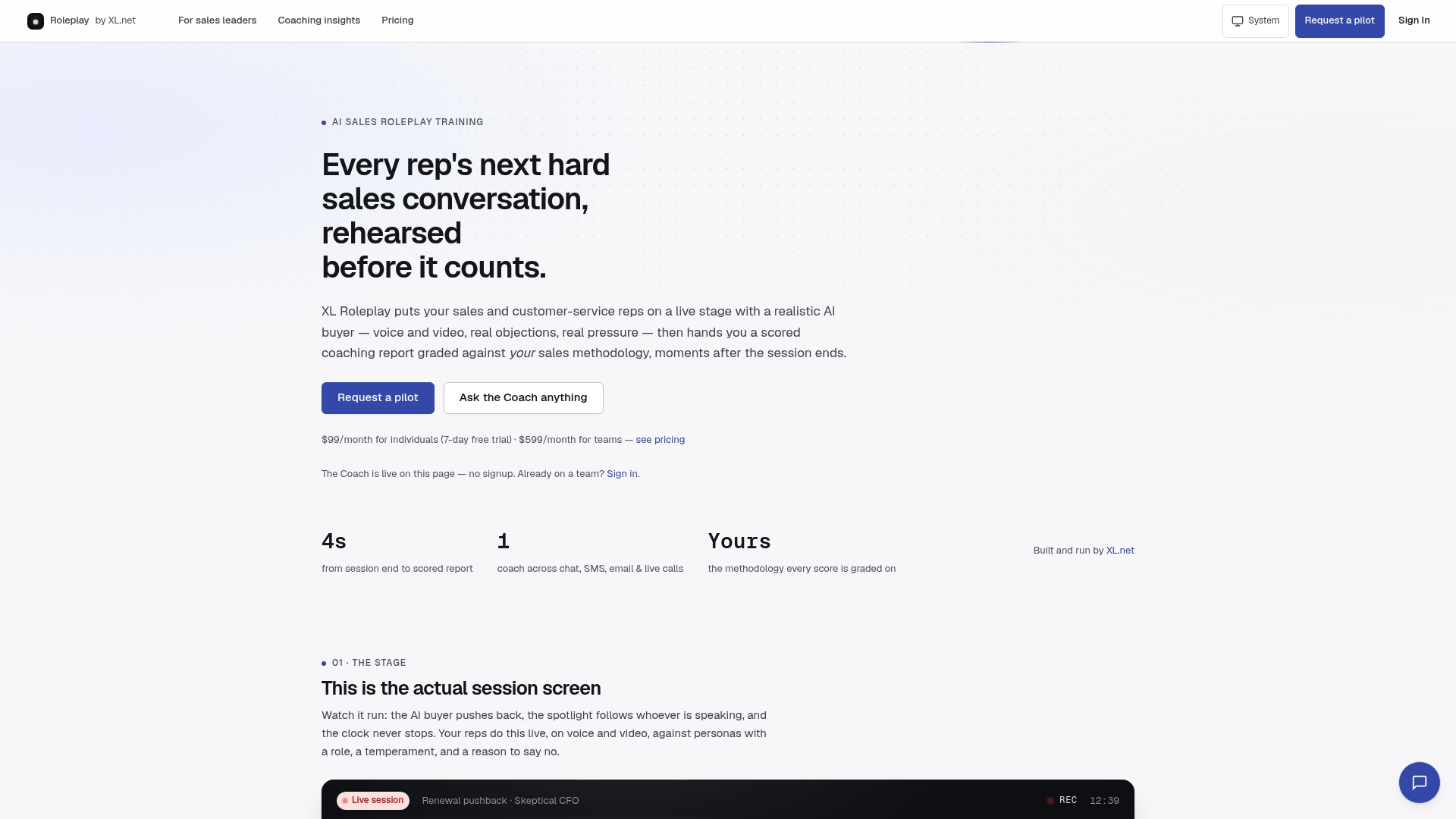
See the full details on the pricing page. If you want to test the approach with a small group before committing, look at the XL Roleplay pilot. Sales leaders can also see how we support teams on our page for sales leaders. For a wider budget view, our guide to sales role-play software cost goes line by line.
FAQ
How much does AI sales training cost per month?
It depends on the model. Our Individual plan is $99 per month and our Business plan is $599 per month, with extra seats at $54.95 per month each. Enterprise platforms and custom programs are usually quoted individually and can include significant implementation fees.
Is per-seat or flat pricing better?
Flat team pricing is easier to forecast when your headcount is stable. Per-seat pricing suits teams that add or remove reps often. Whichever you pick, confirm who counts as a seat and what the price is when you grow.
Are there costs beyond the subscription?
Yes. Plan for rep and manager time, scenario setup, extra seats and any usage add-ons such as video hours. Larger enablement platforms may add implementation and integration work, which one 2026 advisory guide puts in the tens of thousands of dollars.
How do I know if AI sales training is worth it?
Set a baseline before you start, then track practice activity and a few outcome metrics such as win rate, deal size and new-hire ramp time. Compare against the baseline or against a group with less structured reinforcement, and stay realistic about how much of any change training alone explains.
Can I try it before buying for my whole team?
A smaller starting point lowers the risk. You can begin with an individual plan, or ask about our pilot for a limited group. Current trial and pilot terms are on the pricing page and the pilot page.
Sources
- The Next Generation of Sales AI Report, HG Insights
- Sales enablement platform comparison 2026 guide, Altisima Advisory
- How to Measure the ROI of Your AI Sales Training, Insivia