AI Role Play: Async Sales Coaching for Sales Leaders, 4–8 Week Pilot
AI Role Play: Async Sales Coaching for Sales Leaders, 4–8 Week Pilot

Async sales coaching is AI-driven live role-play that simulates realistic buyer conversations and returns transcript-linked, scored coaching instantly. Sales leaders and customer-service managers who need more practice reps, objective feedback, and a way to coach at scale should consider this approach. A two-year coaching study tied disciplined practice to real skill and revenue gains, and managerial coaching research shows why objective, evidence-based feedback matters more than coaching frequency alone.
TL;DR:
- Practicing with AI role-play and transcript-linked scoring leads to measurable improvements in sales skills and revenue, especially with consistent weekly practice.
- Building scenarios from real call logs and objections increases engagement, relevance, and the likelihood of translating practice into real deal success.
- Objective, rubric-based feedback helps mitigate the risk of under-skilled managers providing vague or inconsistent coaching.
- Starting with targeted pilots—such as new-hire ramp drills or common objection handling—yields clearer early insights into effectiveness within 4 to 8 weeks.
- Integrating coaching data into CRM and enabling short, framed sessions encourages ongoing participation and embeds coaching into routine sales activities.
Table of Contents
- How AI role-play sessions, scoring, and transcript-linked coaching work
- What the research says about practice rhythm and coaching quality
- Who benefits and which pilot scenarios to run first
- How to evaluate, pilot, and select a role-play coaching platform
- Comparing async role-play coaching to traditional live coaching
- Common challenges in rolling out async sales coaching
- What successful async sales coaching programs look like in practice
- Where this technology is headed
- Connecting role-play coaching to your CRM and enablement stack
- Getting reps to actually engage with practice
- From pilot to full rollout: what to track along the way
- What changes in coaching culture once teams adopt this approach
- XL Roleplay pilot and practical next steps
- FAQ
- Sources
How AI role-play sessions, scoring, and transcript-linked coaching work
A typical session puts a rep into a multi-turn voice or video conversation with an AI buyer persona that raises realistic objections, shifts tone, and applies pressure the way a real prospect would. The rep works through discovery, handles pushback, and tries to close, all without the risk of burning a live lead. When the session ends, the platform scores the conversation against a rubric built from the organization’s own sales methodology rather than a generic standard, and every score links back to the exact moment in the transcript that produced it.
That linkage is what separates this from a recorded practice exercise. A manager reviewing a rep’s “discovery” score can click straight to the minute where the rep skipped a qualifying question, instead of relying on memory or a general impression. From there, managers typically:
- Scan transcripts for patterns across a rep’s recent sessions rather than judging one call in isolation.
- Assign targeted re-runs of the specific scenario type where a rep scored lowest.
- Run one-to-one debriefs using the transcript as shared evidence instead of a subjective recap.
- Track readiness scores over time to decide when a new hire is ready for live calls.
XL Roleplay builds its scoring and coaching reports around each organization’s own playbook, so a rep trained on MEDDIC sees different rubric criteria than one trained on a custom discovery framework. Guidance on building scenarios from real calls explains how uploading actual objection logs and call moments makes the practice feel close to the reps’ real pipeline instead of a generic script.
What the research says about practice rhythm and coaching quality
The strongest evidence for this approach comes from outside any single vendor. A two-year coaching project tracked in the Kent Academic Repository found that intensive, coached practice produced measurable gains in core selling skills and a real lift in revenue.
A large majority of reps improved core sales skills, and teams saw a significant year-on-year revenue lift in markets that otherwise saw only single-digit growth, according to the Kent coaching study. The same research points to practice rhythm, not one-off coaching events, as the strongest predictor of program success. Weekly deliberate practice with measured scorecards consistently beat sporadic coaching sessions.
That rhythm only pays off when the coaching behind it is good. Research on managerial coaching skill and frequency found a coaching-frequency paradox: more coaching from a manager with weak coaching skill can actually hurt sales goal attainment, while coaching skill itself improves outcomes by clarifying what good performance looks like. A few implications follow directly:
- Frequent coaching is not automatically good coaching if the feedback stays vague or inconsistent.
- Objective, transcript-grounded scoring reduces the chance that a well-meaning but under-skilled manager does more harm than good.
- Standardized rubrics give every rep the same bar, regardless of which manager reviews their calls.
It is worth tempering expectations about the AI side of this equation. Recent AAAI research on LLM-driven sales dialogue shows that even purpose-built frameworks still face real challenges with factual fidelity and multi-turn planning, which is why grounding scenarios in real objection logs and battlecards matters more than relying on a generic model.
Who benefits and which pilot scenarios to run first
This approach fits teams where coaching capacity, not selling knowledge, is the bottleneck. The clearest candidates are sales managers juggling too many reps to coach each one deeply, enablement teams building a repeatable ramp program, customer-service managers who need consistent objection-handling standards, and hiring teams who want a structured way to score candidates before an offer.
A focused pilot tends to produce clearer signal than a broad rollout. Consider prioritizing scenarios in this order:
- New-hire ramp drills that measure how quickly a cohort reaches a baseline readiness score.
- Tough objection handling for the two or three objections that show up most often in lost deals.
- Price and negotiation role-play to see how reps hold ground under pressure.
- Interview scoring for sales candidates, using the same rubric the team will coach against later.
A 4 to 8 week pilot should show an early read on practice frequency per rep, a measurable shift in skill scores between the first and last session, and a readiness threshold the team can use to graduate reps to live calls.
How to evaluate, pilot, and select a role-play coaching platform
Buying this kind of platform means testing it against the realities of your sales process, not just a demo script. A practical evaluation checklist covers:
- Scenario customization: can you upload your own objection logs, call recordings, or battlecards to build scenarios instead of relying on generic templates?
- Methodology alignment: does the scoring rubric map to your actual sales framework, whether that is MEDDIC, a custom discovery model, or something else?
- Transcript fidelity: do scores link directly to the transcript moment that produced them, or do you only get a summary number?
- Admin workflows: can managers assign re-runs, track rep progress, and run debriefs without exporting data into another tool?
- Reporting: does the platform show trends across a team, not just individual session scores?
- Integrations: does it connect to your CRM or sales enablement stack, or does coaching data live in a silo?
- Security and compliance: how is call and transcript data stored, and who can access it?
A pilot blueprint should define a sample size of one or two teams, a 4 to 8 week timeline, and success metrics that include sessions per rep per week, the change in skill scores from first to last session, and the share of reps who cross a defined readiness threshold. Loop in sales leadership, enablement, and at least one frontline manager before locking the pilot design.
Budget planning matters too. Subscription pricing typically scales by seat, and add-on costs like extra video sessions can shift the total cost depending on how heavily a team uses live practice.
Pro Tip: Run the pilot on your lowest-performing objection type first. It is the fastest way to show a measurable skill-score delta inside eight weeks.
Watch for a few red flags: platforms that only offer a summary score with no transcript linkage, vague scoring criteria that never reference your own methodology, and sales pitches that overpromise what an AI buyer persona can actually handle in an open-ended conversation.
Comparing async role-play coaching to traditional live coaching
Traditional coaching relies on a manager sitting in on live calls or reviewing recordings after the fact, then giving feedback from memory or scattered notes. It works, but it is capacity-limited: a manager can only shadow so many calls in a week, and feedback often arrives days after the moment it describes.
AI-driven role-play coaching removes the capacity ceiling. A rep can run a scenario on their own schedule, get scored instantly, and a manager can review the transcript later without needing to have been on the call. This also standardizes feedback: every rep is scored against the same rubric, rather than whatever a particular manager happens to notice that week.
The tradeoff is that role-play scenarios, however well built from real objection logs, are still simulations. They are strongest for repeatable skills like discovery questions, objection handling, and negotiation tactics, and weaker for judgment calls that depend on deep account context a live deal carries. The practical answer most teams land on is a blend: role-play for volume and consistency, live coaching for complex, high-stakes deals where nuance matters most.
Common challenges in rolling out async sales coaching
The most common failure point is scenario quality. Generic, out-of-the-box scenarios feel disconnected from a rep’s actual pipeline, and reps disengage fast. The fix is building scenarios from real objection logs and call moments, as outlined in guidance on building roleplay scenarios from real calls, so the practice mirrors what reps actually face.
A second challenge is manager adoption. Giving managers a pile of transcripts and scores without a workflow for using them just adds another dashboard nobody opens. Pairing the platform with a structured one-on-one coaching template that builds scorecard review into existing 1:1 cadences solves this more reliably than hoping managers figure it out on their own.
A third challenge is rep anxiety about being scored. Framing early sessions as low-stakes practice rather than evaluation, and keeping drills short, reduces the psychological barrier and increases how often reps actually use the tool. Finally, teams sometimes underestimate the setup work: mapping a rubric to an existing methodology takes real effort up front, but skipping it produces generic feedback that reps learn to ignore.
What successful async sales coaching programs look like in practice
The clearest pattern across programs that work is consistency: a cadence of short, scored drills built into the weekly routine, not a one-time training event. Teams that treat role-play as an ongoing rhythm, rather than a launch-week novelty, are the ones most likely to see the kind of skill and revenue gains the Kent coaching study documented over its two-year window.
A second pattern is tight scenario relevance. Programs that pull scenarios directly from real lost-deal transcripts and common objections see higher engagement than those using generic buyer personas, because reps recognize the situations as ones they will actually face. A third pattern is manager follow-through: programs that pair scored sessions with structured debriefs, using the transcript as shared evidence, convert practice into changed behavior faster than programs that leave reps to interpret their own scores. Guidance on coaching reps from transcripts and scorecards outlines how to run that kind of evidence-based debrief.
Programs that stall tend to share the opposite traits: scenarios that go stale after the first few weeks, no clear link between practice scores and real coaching conversations, and no defined readiness bar for when a rep is considered ready for high-stakes calls.

Where this technology is headed
Expect scoring to get more precise as AI buyer personas improve at handling open-ended, multi-turn conversations without losing track of context. Current research into LLM-driven sales dialogue shows frameworks that combine structured training data with dynamic inference can already improve persuasive, multi-turn exchanges, though factual fidelity and long-range planning remain open problems worth watching rather than capabilities to assume.
A likely near-term shift is tighter integration between role-play practice and real call data, so scenarios update automatically as new objections show up in live deals rather than requiring manual rebuilding. Readiness scoring is also likely to get more granular, moving from a single composite score toward skill-specific benchmarks that map directly to a rep’s next coaching priority. None of this replaces the fundamentals: grounded scenario data and clear rubrics will still matter more than the sophistication of the underlying model.
Connecting role-play coaching to your CRM and enablement stack
Coaching data is most useful when it does not live in a separate silo from the rest of the sales stack. Connecting readiness scores and skill-score trends to a CRM lets managers see a rep’s coaching progress alongside their actual pipeline and win rates, which makes it easier to spot whether a skill gap is actually costing deals.
Linking to a sales enablement platform also closes the loop between training content and practice. If a rep completes a module on a new objection-handling technique, a connected role-play scenario can immediately test whether that training stuck, rather than waiting for the next live call to find out. For teams running structured onboarding, this kind of integration turns ramp time into a measurable curve instead of a fixed number of weeks on a calendar.
Getting reps to actually engage with practice
Engagement drops fast when practice feels like a chore or a test. Keeping sessions short, usually under fifteen minutes, keeps the psychological stakes low enough that reps return to the tool voluntarily rather than treating it as an assignment.
Framing matters as much as length. Early sessions should be pitched as rehearsal, not evaluation, so reps build comfort with the format before scores start feeding into formal reviews. Guidance on running roleplay training reps don’t dread points to variety as a second lever: rotating scenario types and difficulty levels keeps practice from feeling repetitive. Tying practice to a visible, personal goal, such as a readiness score needed to take on larger accounts, gives reps a reason to keep showing up beyond manager pressure. Consistent timing also helps: a fixed slot each week, rather than an open-ended “whenever you get to it” expectation, is what turns practice into a habit instead of a backlog.
From pilot to full rollout: what to track along the way
Most teams start with a contained pilot: one or two teams, a defined scenario set, and a 4 to 8 week window. The goal is not to prove the whole program works, but to establish a baseline on a few concrete metrics before scaling spend or seat count.
Track practice frequency per rep per week, since the Kent study’s strongest predictor of success was consistent rhythm rather than occasional bursts of activity. Track the skill-score delta between a rep’s first and last pilot session, since this is the clearest early signal of whether the practice is translating into improvement. Track the share of reps who cross your defined readiness threshold, since this tells you whether the program is actually clearing people to handle harder conversations. For teams running a sales leadership-driven AI strategy more broadly, frameworks like the one in Chad Burmeister’s AI sales strategy playbook offer useful context on sequencing AI adoption across a sales org.

Once the pilot metrics hold up, a full rollout typically expands scenario libraries to cover more objection types, adds the platform to new-hire onboarding by default, and builds scorecard review into every manager’s regular 1:1 cadence rather than treating it as optional.
What changes in coaching culture once teams adopt this approach
The real shift is moving from episodic coaching, a few intense sessions before a big deal, to a weekly rhythm of short, scored drills that become part of the routine rather than an event. Transcripts change the nature of the coaching conversation itself: instead of a manager reconstructing what happened on a call from memory, both sides can point to the exact moment a question got skipped or an objection got mishandled, which cuts through recall bias and defensiveness alike.
None of this removes the need for a skilled manager. The platform amplifies good coaching habits and standardizes feedback, but a manager still has to run the debrief, ask the right follow-up question, and decide what to prioritize next. The tools make coaching more consistent, not optional.
— Adam
XL Roleplay pilot and practical next steps
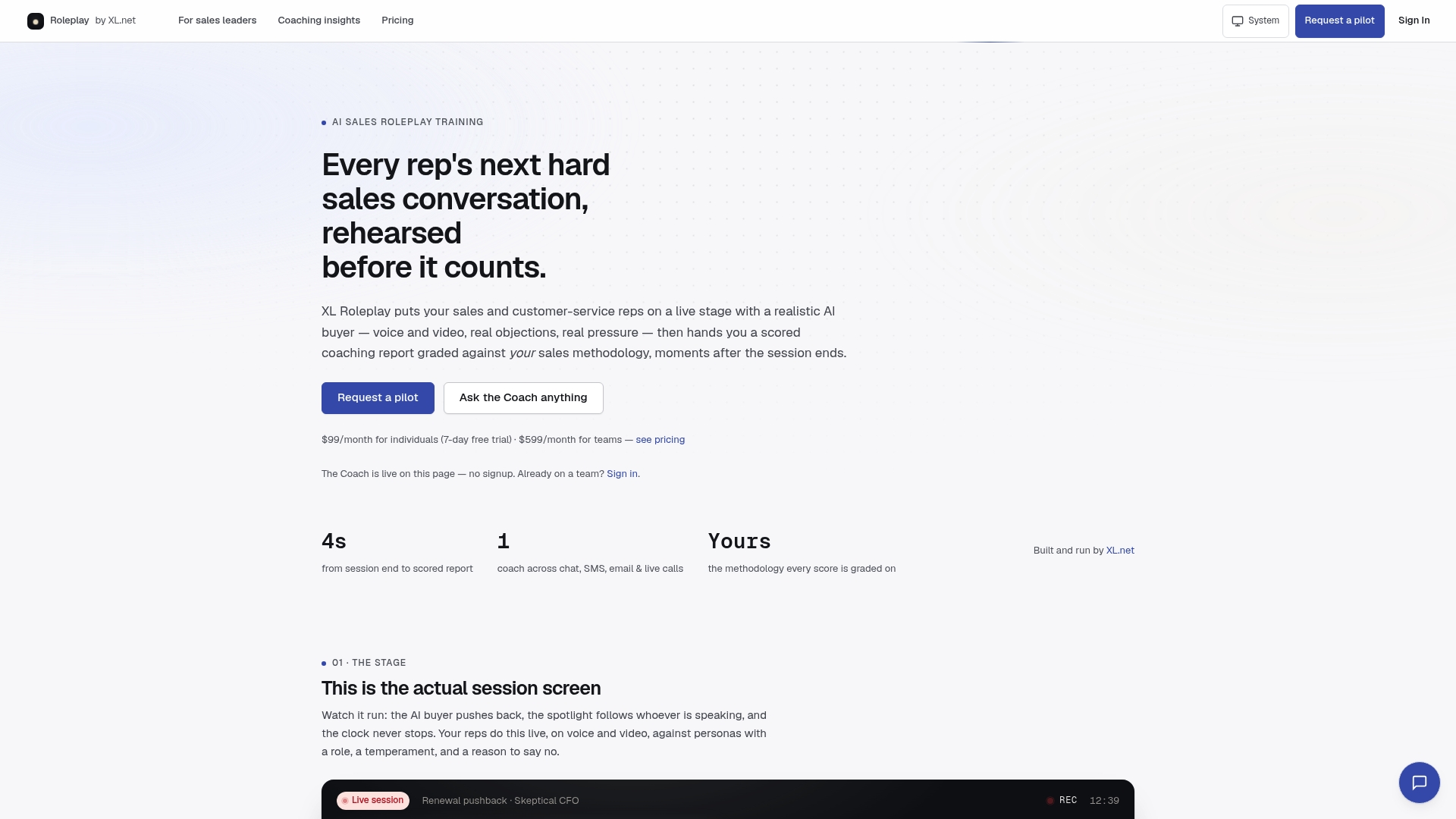
If you are ready to test this approach rather than keep reading about it, XL Roleplay runs live voice and video role-play sessions against AI buyer personas, with scored coaching reports and transcripts mapped to your own sales methodology. Reports link directly to the moment in a call that produced each score, so managers can coach from evidence instead of memory.
A sensible pilot scope to request:
- A defined scenario set built from your own objection logs, not generic templates.
- A practice frequency target per rep, tracked weekly.
- A skill-score delta and readiness threshold you agree on before the pilot starts.
Pricing covers an Individual plan at $99 per month and a Business plan at $599 per month, with extra seats and extra video sessions available as add-ons. If you want to test the approach first, the XL Roleplay pilot is the direct next step, or visit XL Roleplay to see what a sales leader’s rollout typically looks like.
FAQ
What is async sales coaching?
Async sales coaching, in the sense used here, is AI-driven live role-play where a rep practices against a simulated buyer persona and receives instant, transcript-linked, scored feedback. The scoring maps to the organization’s own sales methodology rather than a generic standard, so managers can coach from specific moments in the conversation.
Does practicing this way actually improve sales performance?
A two-year coaching study found that intensive, coached practice led to measurable skill gains for 84% of reps and a 29% year-on-year revenue lift in markets that otherwise saw single-digit growth. Consistent weekly practice, not occasional sessions, was the strongest predictor of that result.
How is this different from just having managers coach more often?
Research on managerial coaching skill and frequency found that coaching frequency without strong coaching skill can hurt sales goal attainment, while coaching skill itself improves outcomes. Objective, transcript-grounded scoring standardizes feedback quality across managers, which reduces that risk.
How much does an AI role-play coaching platform cost?
XL Roleplay offers an Individual plan at $99 per month and a Business plan at $599 per month, with extra seats at $54.95 per month per seat and extra video sessions at $16.99 per hour. Teams that want to test the approach first can start with the XL Roleplay pilot.
Can AI buyer personas fully replace live coaching?
Not entirely. Recent research on LLM-driven sales dialogue shows these systems still face real challenges with factual fidelity and multi-turn planning, so role-play works best for repeatable skills like discovery and objection handling, alongside live coaching for complex, high-stakes deals.
Sources
- Quality coaching and a two-year coaching project (Kent Academic Repository)
- Does Coaching Matter? A multilevel model linking managerial coaching skill and frequency to sales goal attainment (Wiley)
- AI-Salesman: towards reliable large language model driven telemarketing (AAAI)