Call Ready BANT Qualification Questions: Reps & Managers 0–3 Rubric
Call Ready BANT Qualification Questions: Reps & Managers 0–3 Rubric

This page gives you the actual questions to ask across Budget, Authority, Need, and Timeline, plus a simple 0 to 3 rubric for scoring what you hear. BANT means Budget, Authority, Need, Timeline, and it works best as an early filter, not a final verdict. Use the phrasing below on your next discovery call, score the answers honestly, and you will stop chasing leads that were never going anywhere.
TL;DR:
- BANT is effective for early-stage qualification in high-volume, short sales cycles but requires documented evidence for each claim to avoid false positives.
- Asking impact-based questions about budget and funding sources yields more helpful answers than direct budget inquiries.
- Identifying the actual sign-off process and key decision-makers early prevents wasting time on powerless contacts.
- Focusing on specific, measurable business impacts and real deadlines helps determine genuine urgency versus vague timing claims.
- Structured roleplay training with AI buyers enhances reps’ ability to ask qualification questions naturally and gather verifiable evidence.
Table of Contents
- What Is BANT and When Should You Use It?
- Budget Questions That Don’t Sound Like an Interrogation
- Authority: Who Actually Signs the Deal?
- Need: Questions That Uncover Real Business Impact
- Timeline: Finding Out What’s Actually Driving Urgency
- How to Score BANT and Sequence the Conversation
- Practicing BANT Questions Before They Count
- When BANT Works and When It Doesn’t
- Train Your Team to Ask These Questions Under Pressure
- Where to Dig Deeper on BANT and Qualification
- Sources
- FAQ
What Is BANT and When Should You Use It?
BANT breaks a prospect into four checks: can they pay, can they decide, do they have a real problem, and will they act on a schedule. It became a useful early-stage qualification framework because it forces a fast yes-or-no filter before you invest hours in a proposal.
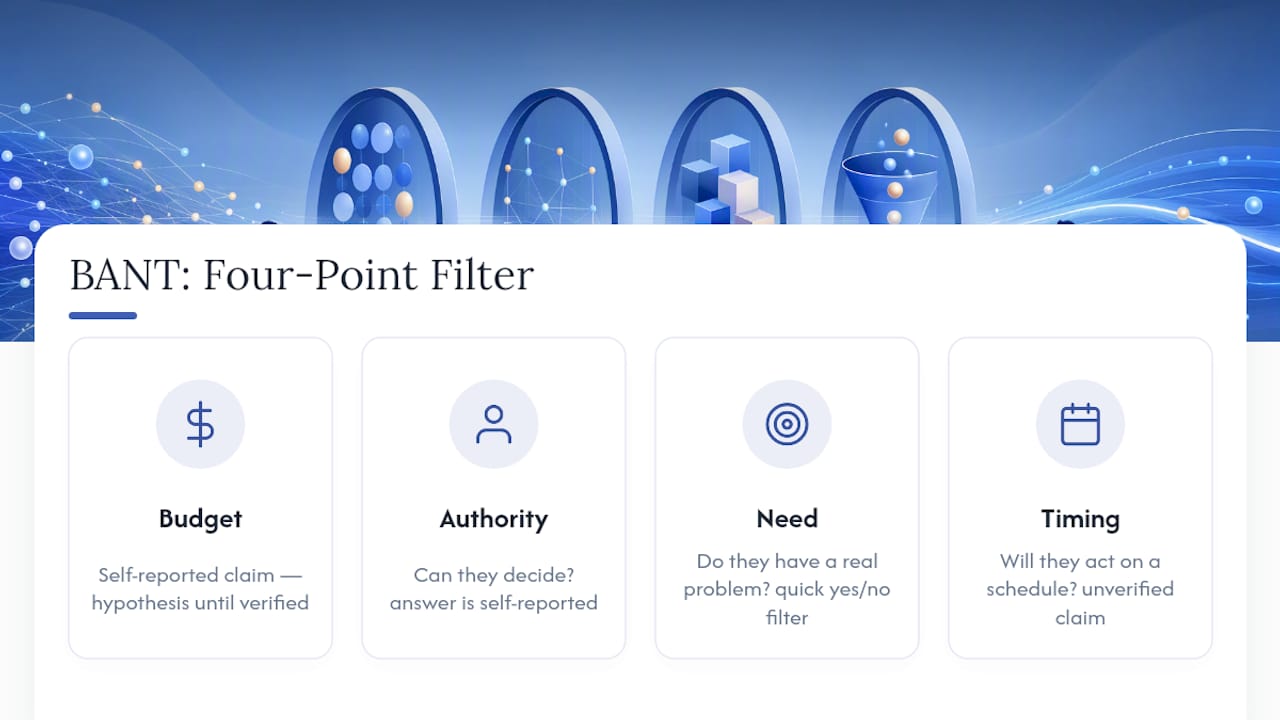
BANT fits high-volume inbound and short sales cycles where speed matters more than nuance. Complex enterprise deals need more. MEDDPICC adds paper process, competition, and champion mapping, all things a 15-minute discovery call can’t surface. The manager-level rule: BANT answers are self-reported claims, not verified facts. Every “yes, we have budget” is a hypothesis until you see evidence.
Budget Questions That Don’t Sound Like an Interrogation
Asking “what’s your budget?” point-blank usually gets you a guarded, unhelpful answer. Frame the question around impact and typical spend ranges instead, and prospects open up.
- “What have you invested in solving this problem before, and how did that work out?”
- “Companies your size in this situation typically spend within a certain range that fits similar cases. Where does that put you?”
- “Who else needs to sign off before dollars get allocated to this?”
- “Is this coming out of an existing budget line, or would it need new approval?”
- “What’s the cost of doing nothing about this problem for another quarter?”
- “If the fit is right, what does the approval process look like on your end?”
Follow up on any budget claim with evidence, not just agreement. Ask about the funding source, the last time they bought something comparable, and who controls the actual purchase order. A prospect who can’t name a budget owner or a rough range is a weak signal, even if they’re enthusiastic. Consultative framing around impact and spend ranges gets you further than a bare number ever will.
Pro Tip: If someone answers a budget question in one clipped sentence, don’t move on. Ask “walk me through how that number got approved last time” — the length and detail of the answer tells you more than the number itself.
Authority: Who Actually Signs the Deal?
Your contact might be enthusiastic, informed, and completely powerless to sign anything. Finding that out early saves weeks.
- “Who else is involved in evaluating a decision like this?”
- “Walk me through how a purchase like this typically gets approved.”
- “If we move forward, whose sign-off do you need?”
- “Has anyone on your team pushed back on similar purchases before? Why?”
- “Who would be most affected if this project stalled?”
- “Is there a procurement or legal step we should plan for?”
- “Would it help to get [economic buyer] on a call before we go further?”
Map the buying committee as you go: who’s a champion pushing internally, who’s a skeptic you need to win over, and who has veto power but no interest in the details. If your contact hedges on every authority question, ask directly for an introduction to whoever owns the budget line. A polite “I want to make sure I’m not wasting your boss’s time later” usually works better than pressing your contact for power they don’t have.
Need: Questions That Uncover Real Business Impact
Vague pain (“we want to be more efficient”) doesn’t close deals. Specific, measurable pain does.
- “What’s this problem actually costing you, in hours, dollars, or lost deals?”
- “What have you already tried, and why didn’t it stick?”
- “If this stayed unsolved for another six months, what happens?”
- “Who on your team feels this problem most acutely, and how?”
- “What does success look like six months after this is fixed?”
- “How are you measuring this today, if at all?”
Translate every answer into a number you can carry into a proposal: hours saved, revenue protected, churn avoided. A prospect who can name a specific KPI and a specific consequence is a strategic fit. One who talks in generalities about “improving processes” usually isn’t ready to buy, no matter how friendly the call feels. Consultative need questions asked early also set up your budget and authority questions to land with context instead of feeling transactional, a sequencing tip backed by research from Monday.com and echoed in customer-feedback-driven discovery practices.
Timeline: Finding Out What’s Actually Driving Urgency
A deadline someone mentions in passing is not the same as a deadline tied to a business event. Test the difference.
- “What’s driving the timing on this, specifically?”
- “Is there an event, contract renewal, or deadline forcing a decision by a certain date?”
- “What happens internally if this slips another quarter?”
- “What are the remaining steps between now and a signed agreement?”
- “Has a budget or resource already been set aside for this timeframe?”
A timeline backed by a named event, like a contract expiring or a fiscal year closing, is real urgency. A timeline that’s just “soon, hopefully” is a nurture signal, not a priority. If a prospect can’t name a single milestone standing between today and a decision, don’t disqualify outright, but drop it several slots in your pipeline.
How to Score BANT and Sequence the Conversation
Score each pillar 0 to 3: 0 means no information, 1 means a weak self-reported claim, 2 means specific detail without documentation, and 3 means documented evidence like an approved budget line or a signed mandate. This scoring discipline reduces false positives in your pipeline more than any single question ever will.
Sequence matters more than most reps realize:
- Open with need and impact questions to build rapport and context.
- Thread budget questions in conversationally once the pain is established.
- Map authority by asking about the approval process, not by demanding a title.
- Close on timeline to surface real urgency and next steps.
A short sample script: “It sounds like this is costing your team real hours each week. Roughly what has a fix like this cost companies your size before? Who typically weighs in before something like this gets approved? And if we get all that aligned, what’s driving your timing?” Log the evidence, not just the answer, in your CRM: a screenshot of an approved budget line beats a verbal “yes” every time.
Pro Tip: Never mark a BANT letter as “confirmed” on a self-report alone. Require something documented, an email, a procurement date, a named approver, before you move a deal to the next stage.

Practicing BANT Questions Before They Count
Reading a list of questions is not the same as asking them under pressure while a prospect pushes back or goes quiet. Roleplay drills built around realistic discovery calls sharpen the exact skill that separates a good BANT call from a wasted one: knowing when to push for evidence instead of accepting a vague answer.
Structured drills covering inbound qualification, SDR-to-AE handoffs, and competitive displacement scenarios force reps to practice follow-up phrasing until it becomes automatic. Managers get transcripts, rubric scores, and readiness ratings that show exactly where a rep stalls, whether that’s accepting a soft budget answer or failing to ask who else needs to sign off. Track three things over time: whether reps follow up on vague answers, whether they capture evidence instead of impressions, and whether qualified leads survive the handoff to the next rep intact.
When BANT Works and When It Doesn’t
BANT earns its keep in early triage and short cycles. For complex enterprise deals with multiple stakeholders and long procurement paths, escalate to MEDDPICC before you commit real resources. Treat every BANT answer as a hypothesis, and require recorded evidence, not enthusiasm, for anything entering high-value pipeline.
— Adam
Train Your Team to Ask These Questions Under Pressure
A list of good questions only helps if reps can deliver them naturally when a prospect hedges, deflects, or goes quiet mid-call. XL Roleplay gives reps live voice and video sessions with AI buyers built to throw exactly those curveballs, then scores the call against your organization’s own BANT or qualification rubric instead of a generic template.
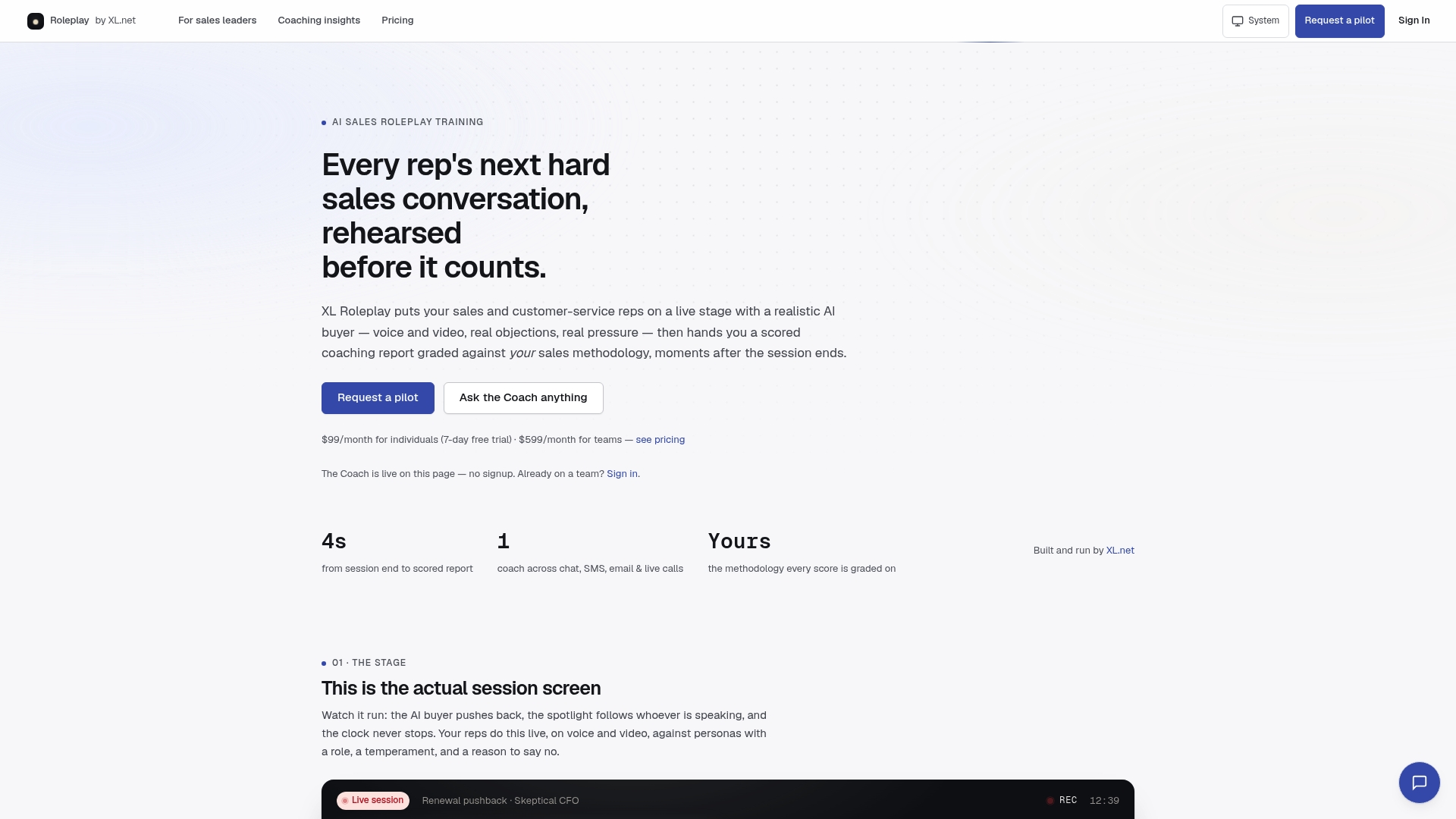
Managers get the transcript and readiness score right alongside the rep’s, so coaching conversations start from specifics: “you accepted a soft budget answer in minute six” instead of a vague “work on discovery.” Drills covering inbound qualification, negotiation and price pushback, and SDR-to-AE handoffs all map directly to the BANT pillars covered above. The Individual plan runs $99 per month, and Business plans start at $599 per month for teams that need shared scenario libraries and manager-level reporting. If you want to test this with your own team’s playbook first, request a pilot and see how your reps score before you commit.
Where to Dig Deeper on BANT and Qualification
A few sources shaped the guidance above and are worth reading directly if you want more example scripts or a deeper comparison of frameworks.
- What Does BANT Stand for in Sales? covers the core definitions and sequencing logic in more detail.
- Salesforce’s BANT guide has additional consultative phrasing for budget conversations.
- HubSpot’s BANT questions and examples offers a larger bank of phrased questions by pillar.
- MEDDPICC vs BANT breaks down exactly when to escalate past BANT.
- The Highspot BANT overview covers CRM logging practices that keep pipeline data honest.
Sources
- What Does BANT Stand for in Sales? A Complete Guide
- What is BANT? (Salesforce blog)
- The BANT sales qualification method and consultative sales (Whitebeard Strategies)
- MEDDPICC vs BANT: Which Framework Gates Enterprise Deals? | ORM
FAQ
What Are Some Good Qualifying Questions?
The strongest qualifying questions ask about past spend, decision process, and business impact rather than yes-or-no facts. Questions like “what has this problem cost you so far?” or “who else needs to approve this?” pull out detail a simple budget or authority question misses.
What Are BANT Qualifications?
BANT qualifications are the four checkpoints a lead needs to pass: confirmed Budget, a mapped Authority structure, a documented Need, and a real Timeline. BANT is a widely used early-stage framework for filtering leads before deeper discovery.
Is BANT Outdated?
BANT isn’t outdated, but it’s incomplete for complex sales. It remains a solid triage tool for short cycles and high lead volume, while enterprise deals typically need MEDDPICC to map competition, paper process, and champions.
What Are the 5 W Questions in Sales?
The 5 W questions (who, what, when, where, why) are a general discovery framework, not a BANT-specific tool, and they overlap heavily with BANT’s Need and Authority pillars. Asking “why now” and “who’s involved” covers similar ground to BANT’s Timeline and Authority questions.
How Much Does XL Roleplay Cost?
The Individual plan costs $99 per month, and the Business plan runs $599 per month with extra seats available at $54.95 per seat per month. Teams that want to test the platform first can request a pilot program before committing to a plan.