Best Sales Enablement Platforms for 2026: Expert Picks
Best Sales Enablement Platforms for 2026: Expert Picks

The short verdict: for most teams, the right platform depends on where the performance gap actually lives. If content governance and deal-stage alignment are the bottleneck, enterprise-grade platforms like Highspot or Seismic belong at the top of your shortlist. If rep skill and conversation readiness are the constraint, Xl Roleplay is the recommended option. Here are the five categories that cover the field:
- Best overall (content + coaching + analytics): Enterprise content-first platforms (Highspot, Seismic, Showpad)
- Best for enterprise content management: Seismic or Highspot, both listed on Gartner Peer Insights for deep content governance and AI coaching
- Best for rep readiness and training: Xl Roleplay (AI-driven live roleplay, scored coaching reports, readiness scoring)
- Best for CRM-centric organizations: HubSpot Sales Hub or Salesforce Sales Cloud, which embed enablement features directly into the pipeline workflow
- Best value for skill practice: Xl Roleplay, with a free trial and per-rep subscription pricing
Two trust signals worth noting: G2’s sales enablement category shows AI and conversation intelligence as the decisive differentiators buyers search for right now, and Gartner Peer Insights consistently surfaces content governance, LMS, and AI coaching as the table-stakes features for enterprise shortlists.
Table of Contents
- What do the best sales enablement platforms actually look like side by side?
- Which platform category fits your team’s situation?
- How do you choose the right sales enablement platform?
- What does sales enablement software actually cost, and how long does it take?
- What integrations and security certifications should you validate?
- Why does practice-based roleplay actually improve sales readiness?
- Key Takeaways
- Xl Roleplay: the recommended option when skill practice is the priority
What do the best sales enablement platforms actually look like side by side?
Content management, training, and analytics are the three pillars buyers expect from any serious platform. The table below maps those pillars across the major buyer categories so you can identify which rows match your situation before you book a single demo.
| Category / Platform | Best for / Ideal buyer | Core features | AI & conversational intelligence | CRM & tech integrations | Analytics & measurement | Pricing model / typical starting cost | Implementation time / time to value |
|---|---|---|---|---|---|---|---|
| Enterprise content-first (Highspot, Seismic, Showpad) | Large sales orgs needing content governance, playbooks, and deal-stage alignment | Content management, playbooks, guided selling, LMS, coaching | AI content recommendations, deal-risk signals, some conversation intelligence | Deep Salesforce, HubSpot, MS Dynamics; SSO; DAM | Content engagement, deal influence, rep activity | Enterprise license; typically a high per seat monthly cost; annual contract | several months for full content migration and process alignment |
| Learning-first / training (Mindtickle, Allego, Saleshood) | Teams prioritizing onboarding, certification, and structured learning paths | LMS/LXP, video coaching, quizzes, certification, content libraries | AI-generated practice prompts, video analysis, some roleplay | Salesforce, HubSpot, HRIS, SSO | Readiness scores, completion rates, skill gap tracking | Per-seat SaaS; mid-market starting at moderate per seat monthly pricing; enterprise pricing on request | several weeks for onboarding programs; longer for full certification tracks |
| Conversation-intelligence-first | Revenue teams wanting call analysis and coaching from real deal data | Call recording, transcription, deal intelligence, coaching playlists | Core product; AI topic detection, sentiment, talk-time analysis | Deep CRM (opportunity-level); video conferencing | Win/loss patterns, talk-track effectiveness, deal risk | Per-seat or per-rep; enterprise license; pricing not publicly listed for most | a few weeks for call capture; longer for coaching workflow adoption |
| CRM-centric (HubSpot Sales Hub, Salesforce Sales Cloud) | CRM-first teams wanting enablement without a separate platform | Pipeline management, email sequences, content snippets, basic playbooks | AI deal scoring, email intelligence, some coaching prompts | Native CRM; broad app marketplace | Pipeline analytics, activity tracking, forecast accuracy | Tiered SaaS; HubSpot Sales Hub starts at a mid-range per seat monthly price (Professional); Salesforce Sales Cloud starts at a higher per user monthly price (Enterprise) | a few weeks if CRM is already live |
| Specialist field apps (Pitcher, Dock) | Field sales, pharma/life sciences, or deal-room-focused teams | Offline content delivery, interactive presentations, digital deal rooms | Limited AI; some content analytics | CRM sync; limited deep integration | Content usage, buyer engagement in deal rooms | Per-seat or per-rep; pricing varies and is not publicly listed | several weeks |
| Xl Roleplay | Teams where rep skill and conversation readiness are the primary gap | AI buyers, live voice/video roleplay, scored coaching reports, session transcripts, readiness scoring, scenario libraries | Core product: AI buyer personas, real-time objection simulation, automated scoring rubrics | CRM integrations for context; SSO; LMS connectors | Readiness scores, rep-level coaching reports, manager debrief tools | Subscription SaaS; individual and team plans; free trial available | 2–4 weeks to first scored session; pilot ROI visible in 6–8 weeks |
Pro Tip: Before you book demos, write down the single performance gap you need to close in the next 90 days. That one answer will eliminate at least half the table above.
Which platform category fits your team’s situation?
CRM-centric platforms (HubSpot Sales Hub, Salesforce Sales Cloud)
CRM is primarily a pipeline and contact system; enablement platforms focus on coaching, just-in-time content, and readiness. HubSpot Sales Hub and Salesforce Sales Cloud blur that line by embedding sequences, playbooks, and basic coaching prompts directly into the deal workflow. For teams that live in their CRM all day, this convenience is real.
- Ideal buyer: — SMB to mid-market teams already on HubSpot or Salesforce who want enablement without a second platform
Specialist field apps (Pitcher, Dock)
Pitcher targets field sales and life sciences teams that need offline content delivery and compliant presentations on a tablet. Dock focuses on digital deal rooms where buyers and sellers collaborate on a shared workspace. Both are narrow by design.
- Ideal buyer: — Pharma/life sciences field reps (Pitcher) or B2B teams running complex, multi-stakeholder deals (Dock)
Xl Roleplay
Xl Roleplay sits in a different lane from the platforms above. Where content-first and LMS platforms focus on what reps know, Xl focuses on what reps can do under pressure. The platform runs live voice and video roleplay sessions with AI buyers that present real objections, time pressure, and deal-specific scenarios. After each session, reps receive a scored coaching report tied to the organization’s own sales methodology, plus a full transcript for manager review.
- Ideal buyer: — Sales managers and enablement leaders whose reps know the playbook but freeze or stumble in live discovery calls, objection handling, or negotiation
- Why trial it: You can run a 30-60-90 onboarding ramp built entirely around practice sessions and have objective readiness scores before a rep ever takes a live call
How do you choose the right sales enablement platform?
The decision framework comes down to six criteria, roughly in this order of impact:
1. Impact on ramp time. A platform that cannot show you a measurable change in time-to-first-deal or time-to-quota within a 90-day pilot is not solving the right problem. Ask every vendor for a case study where ramp improvement was measured against a CRM outcome, not a survey.
2. Coaching in the flow of work. The best sales coaching tools deliver feedback where reps are already working: inside the CRM, inside a call, or immediately after a practice session. Coaching that lives in a separate portal nobody logs into is not coaching.
3. CRM-connected deal context. Enablement platforms should link training and content to deal outcomes; buyers must validate analytics that tie behavior to revenue. If a vendor cannot show you opportunity-level data linking a coaching activity to a deal stage change, that is a gap.
4. Analytics that connect behavior to revenue. Completion rates and content views are activity metrics. What you actually need: which coaching behaviors correlate with win rate, which content assets appear in closed-won deals, and which readiness scores predict quota attainment.
5. Content governance and scalability. For teams above 50 reps, ungoverned content libraries become a liability. Version control, role-based access, and automated content expiration are not nice features; they are operational requirements.
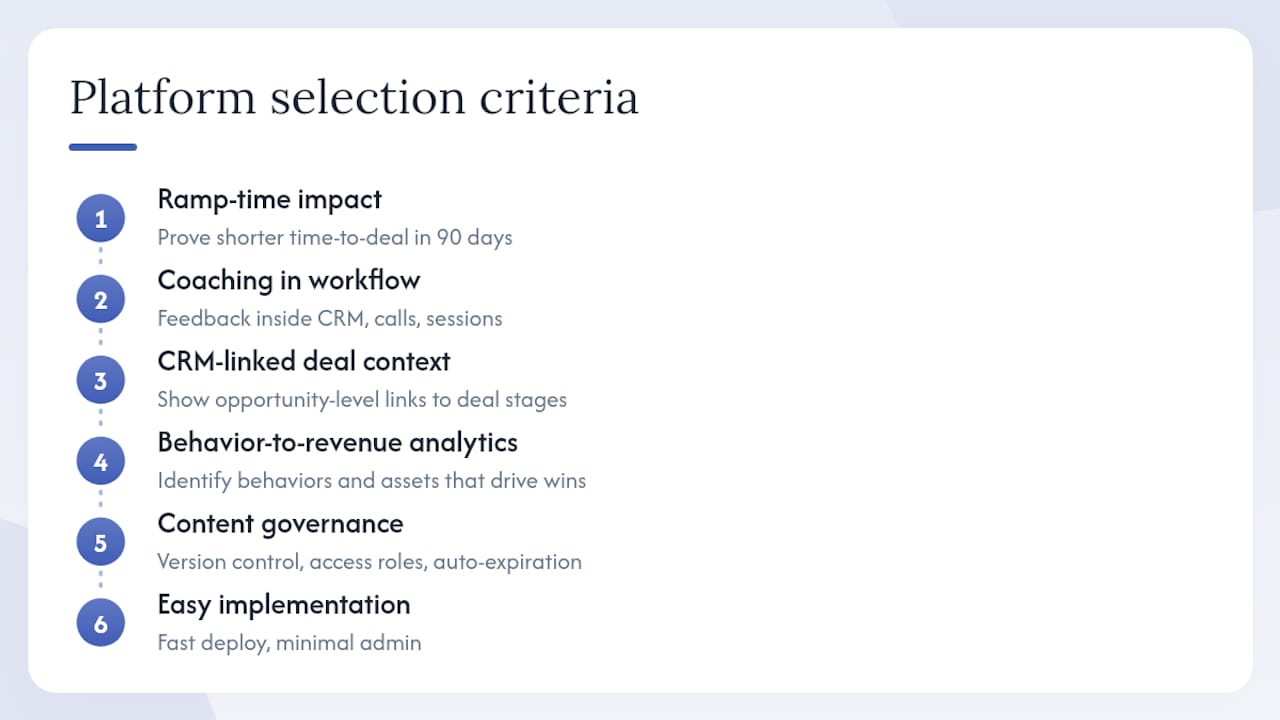
6. Ease of implementation and adoption. A platform that takes nine months to deploy and requires a full-time admin to maintain will lose the change management battle before it proves ROI.
Questions to ask vendors in demos and RFPs
- What data sources does your AI coaching use, and how is that model trained?
- Show me a sample integration architecture diagram for our CRM stack.
- What does a readiness score actually measure, and how is it calculated?
- Can I export session transcripts and coaching reports to our LMS or data warehouse?
- What are your SLAs for uptime and support response?
- Which security certifications do you hold (SOC 2 Type II, ISO 27001)?
Red flags to watch during trials
- No opportunity-level CRM linking (the platform cannot show which coaching activity touched which deal)
- Analytics that report only activity, not outcomes
- Opaque AI training data (“our model is proprietary” with no further explanation)
- Excessive admin overhead to publish or update a single piece of content
- Content governance that breaks when you add a new product line or territory
Pro Tip: Design your pilot around one CRM outcome only: qualified meetings booked, or opportunities advanced past stage 2. Tie every roleplay session or content play to that metric. If the platform cannot surface that data at the end of six weeks, you have your answer.
What does sales enablement software actually cost, and how long does it take?
Pricing in this category ranges from transparent per-seat SaaS to fully opaque enterprise contracts. Here is what to expect by buyer profile:
| Dimension | SMB / CRM-centric teams | Mid-market (learning-first) | Enterprise (content-first) | Xl Roleplay |
|---|---|---|---|---|
| Pricing model | Per-seat SaaS, monthly or annual | Per-seat SaaS, annual | Enterprise license, annual contract | Subscription SaaS; individual and team plans |
| Typical starting cost | a range of per seat monthly pricing | a moderate per seat monthly price range | a higher per seat monthly cost often requiring purchase orders | Free trial available; team plans on request |
| Required internal resources | CRM admin, sales ops | Enablement manager, LMS admin | Dedicated enablement team, IT, content owners | Sales manager or enablement lead |
| Common integration work | CRM native; minimal | CRM + HRIS + SSO | CRM + DAM + SSO + LMS + conversation intelligence | CRM context; SSO; LMS connector |
| Time-to-value estimate | a few weeks | several weeks | several months | a few weeks to first session; under two months for pilot ROI |
The biggest cost drivers beyond the base seat price are add-on modules (conversation intelligence is almost always a separate SKU), professional services for onboarding and content migration, and the internal time required to build and govern scenario libraries or content taxonomies.
What integrations and security certifications should you validate?
Technical buyers and RevOps leaders need to pressure-test integration depth before a pilot, not after.
Security and compliance checkpoints
Ask every vendor for their SOC 2 Type II report and ISO 27001 certification before you advance past a demo. For teams in regulated industries, also ask about data residency options, encryption in transit and at rest, and their data retention and deletion policies. These are not negotiable for enterprise procurement, and vendors who cannot produce documentation quickly are a red flag.
What good analytics actually look like
Strong platforms expose: content engagement by asset and deal stage, coaching activity linked to opportunity progression, readiness scores by rep and team, and manager coaching outcomes over time. Weak platforms show page views and completion rates. The difference matters because analyst listings emphasize platforms that combine content governance, AI coaching, and conversation intelligence precisely because that combination is what produces measurable revenue outcomes.
Integration red flags:
- No opportunity-level CRM linking
- Limited or no data export (transcripts, scores, engagement data locked in the vendor’s system)
- Vendor data siloing that prevents you from building your own reporting in a BI tool
- SSO not supported on lower-tier plans
Why does practice-based roleplay actually improve sales readiness?
Passive training, whether it is a slide deck, a recorded webinar, or an LMS module, produces knowledge. It rarely produces behavior change. The research on spaced repetition and deliberate practice is consistent: skills that require real-time judgment under social pressure (discovery calls, objection handling, negotiation) require repeated, low-stakes practice with feedback to become reliable.
AI-driven roleplay addresses the specific bottleneck that LMS platforms cannot: the gap between knowing the right answer and saying it fluently when a buyer pushes back. Xl Roleplay’s AI buyers present realistic objections and deal pressure in live voice and video sessions, and the platform scores each session against the organization’s own sales methodology. That means a manager reviewing a coaching report is not looking at a generic rubric; they are seeing how a rep performed against the specific plays and language the team actually uses.
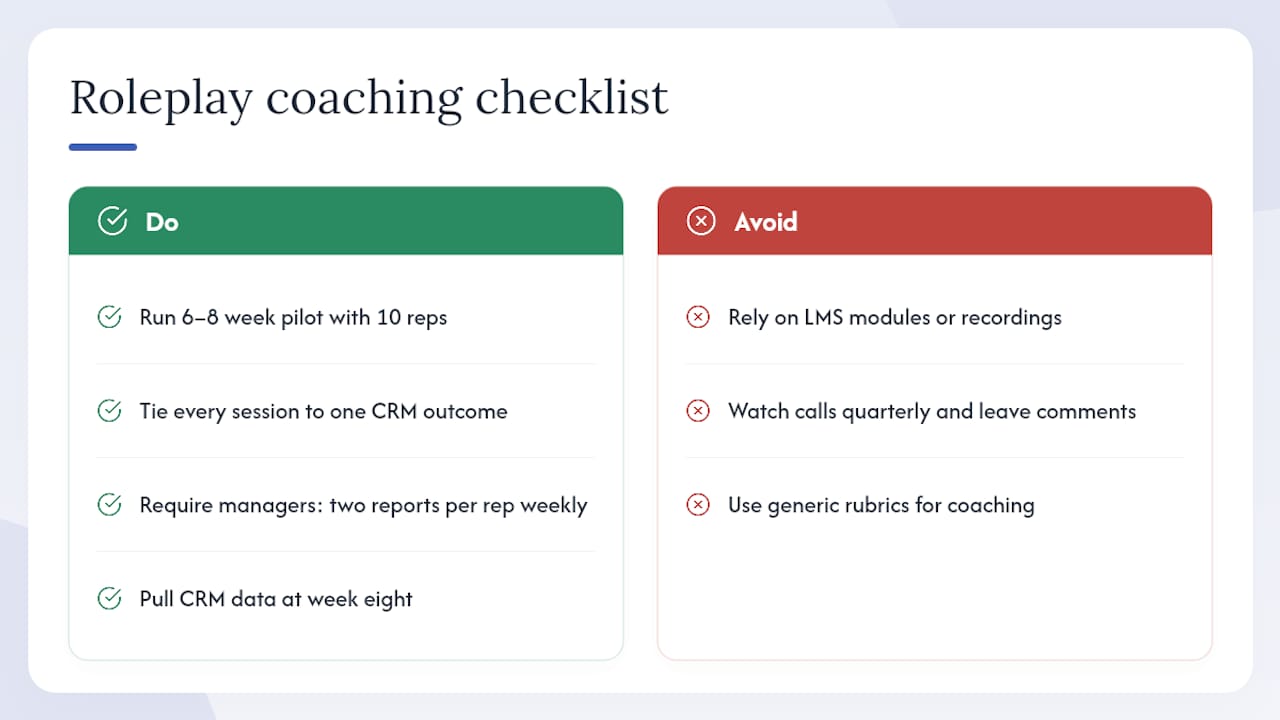
The practical guidance on coaching from transcripts and scorecards matters here: a manager who reviews a session transcript weekly and debriefs on two specific moments is doing more coaching work than one who watches a call recording quarterly and leaves a comment. Xl’s debrief tools are built for that weekly cadence.
For teams using a formal methodology like Challenger, the platform supports Challenger-aligned roleplay drills that let reps practice the commercial insight delivery specifically, not just generic discovery questions.
Pro Tip: Run a 6–8 week pilot with 10 reps. Tie every session to one CRM outcome (qualified meetings booked). Require managers to review at least two coaching reports per rep per week. At week eight, pull the CRM data. That is your ROI case.
Key Takeaways
The most effective sales enablement programs combine a platform that fits the primary performance gap with a manager coaching cadence that turns data into behavior change.
| Point | Details |
|---|---|
| Match platform to your gap | Content chaos calls for enterprise content-first tools; skill gaps call for practice-based platforms like Xl Roleplay. |
| Validate CRM-level analytics | Any platform that cannot link a coaching activity to an opportunity outcome will not prove ROI in a 90-day pilot. |
| Pilot design determines results | One team, one CRM outcome, six to eight weeks: that structure produces a defensible business case. |
| Security certifications are non-negotiable | Ask for SOC 2 Type II and ISO 27001 documentation before advancing past a demo for enterprise procurement. |
| Xl Roleplay for skill practice | When rep conversation readiness is the primary constraint, Xl Roleplay’s AI buyers and scored coaching reports are the recommended starting point. |
What buyers consistently get wrong when evaluating platforms
Most evaluation mistakes happen before the first demo. Buyers build a feature checklist from a vendor’s marketing page, run demos in the wrong order, and end up selecting the platform with the most impressive AI demo rather than the one that solves the actual problem.
The second most common mistake is skipping manager enablement entirely. A platform that gives reps great feedback but gives managers no workflow to act on it will see adoption drop within 60 days. Every platform on this list has a manager-facing component; the question is whether your managers will actually use it.
Third: ignoring data exportability until it is too late. Once your coaching data, readiness scores, and content engagement data are locked in a vendor’s system with no export path, you have lost the ability to build your own reporting or switch platforms without starting from scratch. Ask about data portability in the first demo, not the last.
Pro Tip: Design a 6–8 week pilot with 10 reps, tie it to one CRM outcome, and require manager coaching evidence (at minimum, two transcript reviews per rep per week). That structure is replicable, defensible, and fast enough to inform a full procurement decision.
Xl Roleplay: the recommended option when skill practice is the priority
When the gap is what reps say in live conversations, not what they know on a quiz, the platforms above will not close it. Xl Roleplay is built specifically for that problem: AI buyers that simulate real objections, live voice and video sessions, scored coaching reports tied to your methodology, and full session transcripts for manager review.
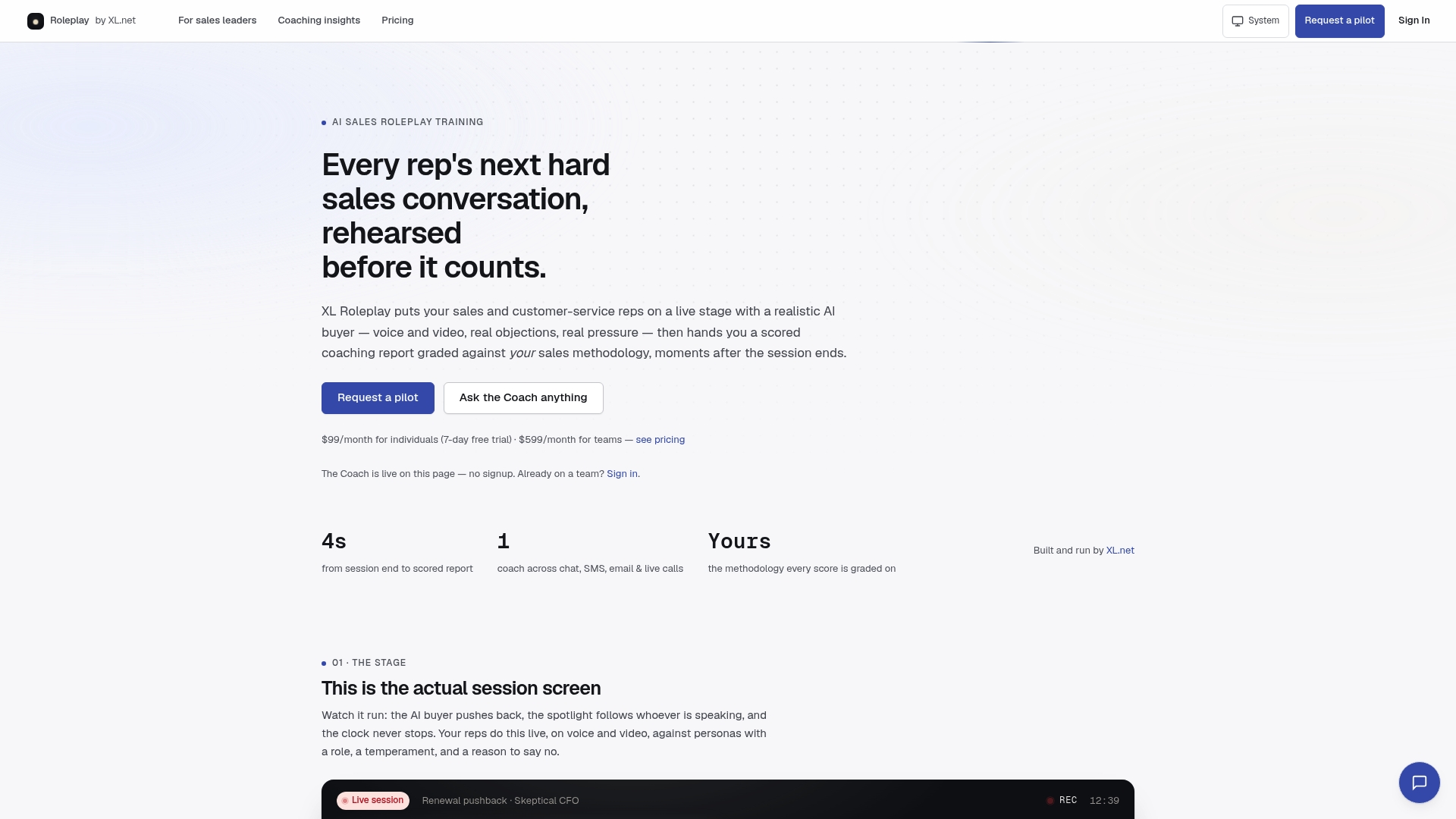
The free trial lets you run real sessions with your own reps against your own scenarios before you commit to a team plan. Sales leaders get a dedicated page with pilot templates, ROI frameworks, and readiness scoring guidance. For teams where faster ramp and objective coaching evidence are the goal, start a free trial at Xl Roleplay and have scored sessions running within a week.
Useful sources and further reading
For vendor shortlisting, start with analyst and category review pages, then move to buyer guides that compare feature pillars rather than marketing claims:
- Sales enablement
- 12 Best Sales Enablement Tools in 2025 - Atlassian
- Sales enablement tools: Guide to platforms, software & tech
- Best Revenue Enablement Platforms Reviews 2026 | Gartner Peer Insights
- Sales Enablement vs CRM: What’s the Difference? - Saleslion