Stop Discounting: 4 Questions Sales Reps Use to Beat Budget Objections
Stop Discounting: 4 Questions Sales Reps Use to Beat Budget Objections

Don’t accept “no budget” at face value. Diagnose whether it’s priority, authority, timing, value, or a genuine freeze, then run the matched play. Acknowledge the objection, isolate it with one sharp question, reframe the cost of waiting, and close with a concrete next step like a paid pilot or a reallocation map. That sequence keeps deals alive without touching your price.
TL;DR:
- Most “no budget” objections are related to priority, authority, timing, perceived value, or genuine financial constraints, not a lack of funds.
- Asking four diagnostic questions quickly reveals whether a deal is stalled by structural budget issues, authority gaps, or just timing, enabling targeted strategies.
- Effective responses include proposing pilots, reallocation maps, or executive reviews, rather than discounting or assuming the objection is non-negotiable.
- Jumping straight to discounting or feature expansion often destroys deal value and prevents identifying the true constraint.
- Rehearsing these diagnostic and response scripts through roleplay improves reps’ ability to navigate budget objections confidently and consistently.
Table of Contents
- What Budget Objections Really Mean
- The Four-Question Diagnostic to Run In-Call
- Scripts That Match Each Diagnosis
- Three Plays That Actually Move Stalled Deals
- Mistakes That Kill Deals When Budget Comes Up
- Why Roleplay Turns These Scripts Into Habits
- What Managers Should Prioritize Right Now
- Practice the Exact Plays With XL Roleplay
- Sources
- FAQ
What Budget Objections Really Mean
“We don’t have budget” is rarely a factual statement about a bank account. It’s shorthand for something else the prospect either can’t or won’t say directly.
Most of the time, one of five things is actually happening:
- Priority: the problem is real but ranked below three other fires this quarter.
- Authority: the person you’re talking to can’t approve spend and doesn’t want to admit it.
- Timing: budget cycles are locked, but the appetite exists for next quarter or next year.
- Perceived value: they don’t yet believe the outcome is worth the price, so “no budget” is easier to say than “I’m not convinced.”
- Genuine constraint: the money truly isn’t there, and no amount of reframing changes that this cycle.
Call analysis on this exact objection suggests a large share of “no budget” pushback is recoverable rather than literal, meaning the deal is stalled by something diagnosable, not dead. Treat the objection as a symptom, not a diagnosis, and you preserve both the deal and your margin. Jump straight to a discount and you’ve solved a problem the prospect may not even have.
The Four-Question Diagnostic to Run In-Call
Run this the moment “budget” comes up. Waiting until a follow-up call to dig in costs you leverage, because the prospect has already mentally filed you under “no.”
- Is there an allocated line item for this category, or would this require a new one? This tells you whether you’re fighting a structural budget wall or a discretionary spending decision.
- If we showed you clear reallocation savings elsewhere, would that change the math? A yes here points to priority or value, not a true freeze.
- Who needs to sign off on this, and do they have the authority to move money between categories? This exposes authority gaps fast, often within one answer.
- What does doing nothing cost you over the next two or three quarters, in time, errors, or missed revenue? If they can’t answer, you likely haven’t built enough urgency yet. If they can, you have your ROI argument.
Pro Tip: Ask these questions in this exact order. Skipping straight to the ROI question before you know who holds authority means you might build a beautiful business case for someone who can’t actually approve it.
The answers tell you which play to run next: a reallocation map, a paid pilot, or an executive escalation. Guessing wastes a call cycle you don’t get back.
Scripts That Match Each Diagnosis
Isolating the objection matters more than the eventual comeback. If you jump into a value pitch before confirming what “no budget” actually means, you’re pitching in the dark.
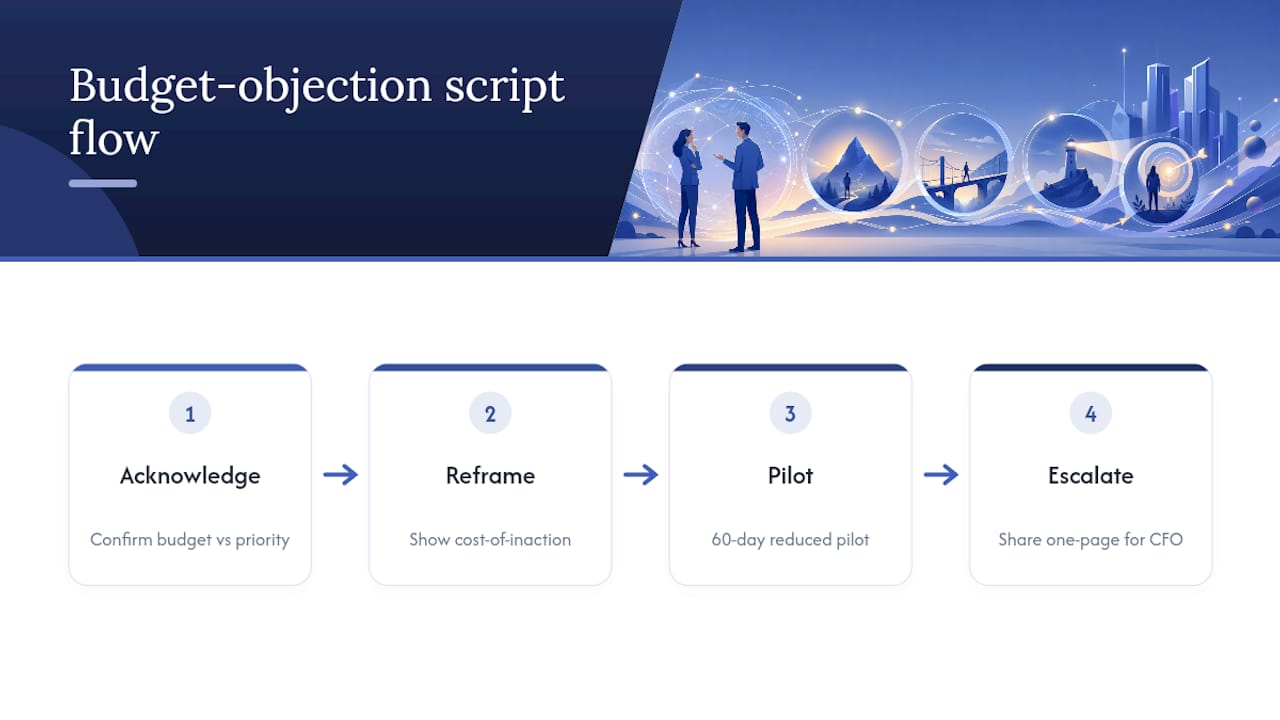
Acknowledge and isolate: “Totally understand. Just so I’m solving the right problem, is this a ‘no funds allocated’ situation, or is it more about priority right now?”
That single question does the work of five minutes of guessing, and it’s the isolation step that experienced negotiators run before ever discussing price.
Reframe with a cost-of-inaction calculation: “If this issue is costing your team roughly four hours a week in rework, that’s over 200 hours a year. At even a modest hourly cost, the price of waiting outpaces the investment we’re discussing.” Build this micro-calculator with the prospect’s own numbers, not yours. It lands harder when they do the math with you.
Propose a pilot: “What if we scoped a 60-day pilot at a reduced entry point, tied to two or three metrics you already track? That removes the full-budget decision from the table for now.”
Escalate respectfully: “Would it help if I put together a one-page summary for your CFO or VP, so they can weigh in with full context instead of secondhand notes?” Bringing in the actual decision maker isn’t a threat to the relationship. It’s often what your champion has been waiting for you to suggest, since a repeatable acknowledge, isolate, reframe, close sequence is exactly what protects price integrity through escalation instead of discounting toward it.
Three Plays That Actually Move Stalled Deals
Diagnosis tells you which play to run. Execution is where most reps lose the thread, because each play needs its own prep, not just a good line on a call.
- Build a reallocation map. Ask the prospect where budget currently sits (a legacy tool, a manual process, an underused headcount line) and quantify what shifting even 20 percent of it would fund. Champions can defend an internal reallocation far more easily than a brand-new budget request.
- Design a paid pilot with real boundaries. Scope it to 30 to 90 days, price it low enough to remove approval friction, but never free, and attach two or three KPIs both sides agree to measure before the pilot starts. A paid pilot gives your champion a low-risk internal funding path that doesn’t require a full budget cycle.
- Request an executive sponsor review. Prepare a one-page brief with the cost-of-inaction number, the reallocation math, and a specific ask. Frame it as giving leadership the full picture, not going around your contact.
Mistakes That Kill Deals When Budget Comes Up
The instinct to discount the moment budget gets mentioned is almost always the wrong move, and it teaches the prospect that your price is negotiable before you’ve even isolated what’s actually wrong.
- Discounting immediately. It signals your original price was inflated and trains the buyer to object every renewal cycle.
- Accepting the objection at face value. Moving on without a single diagnostic question forfeits deals that were never actually dead.
- Pitching more features to justify cost. A value gap isn’t fixed by adding scope. It’s fixed by connecting to a business outcome the buyer already cares about.
- Failing to disqualify when the constraint is real. If the four-question check confirms a genuine freeze with no reallocation option and no authority to move funds, say so, set a specific follow-up date tied to their next budget cycle, and exit gracefully. That’s a stronger move than chasing a deal that was never going to close this quarter.
Why Roleplay Turns These Scripts Into Habits
Knowing the four questions and reading a script cold on a live call are two different skills. The gap between them is repetition under realistic pressure, which is why live roleplay with scored feedback tends to close that gap faster than reading a playbook once and hoping it sticks.
Effective drills isolate one variation at a time: an authority gap, a fiscal-year freeze, or a perceived-value gap, each requiring a different follow-up question and a different play. Reps who rehearse the isolation question until it’s automatic stop panicking when budget comes up mid-call. On the XL Roleplay platform, reps run these exact scenarios against AI buyers, then review scored coaching reports and transcripts against their own methodology, so managers can see precisely where a rep skipped the diagnostic step and jumped straight to discounting.

What Managers Should Prioritize Right Now
Slide decks don’t fix budget objections. Coaching against real call patterns does. If your team’s win rate dips whenever “budget” comes up, the fix isn’t a new script. It’s more repetition of the diagnostic sequence under realistic pressure.
Run short drills two or three times a week, each scored against a specific outcome: did the rep isolate before reframing, did they build the cost-of-inaction number with the buyer’s own data, did they propose a concrete next step instead of retreating. Track pilot conversion and reallocation wins, not just how often reps avoid discounting. A rep who never discounts but also never closes the pilot hasn’t actually fixed anything.
— Adam
Practice the Exact Plays With XL Roleplay
This type of platform gives your team a place to rehearse these exact moves before they’re tested on a real buyer’s budget. It runs live voice and video roleplay against AI personas trained to throw priority, authority, timing, and genuine-constraint variations of “no budget,” then scores sessions against the organization’s sales methodology.
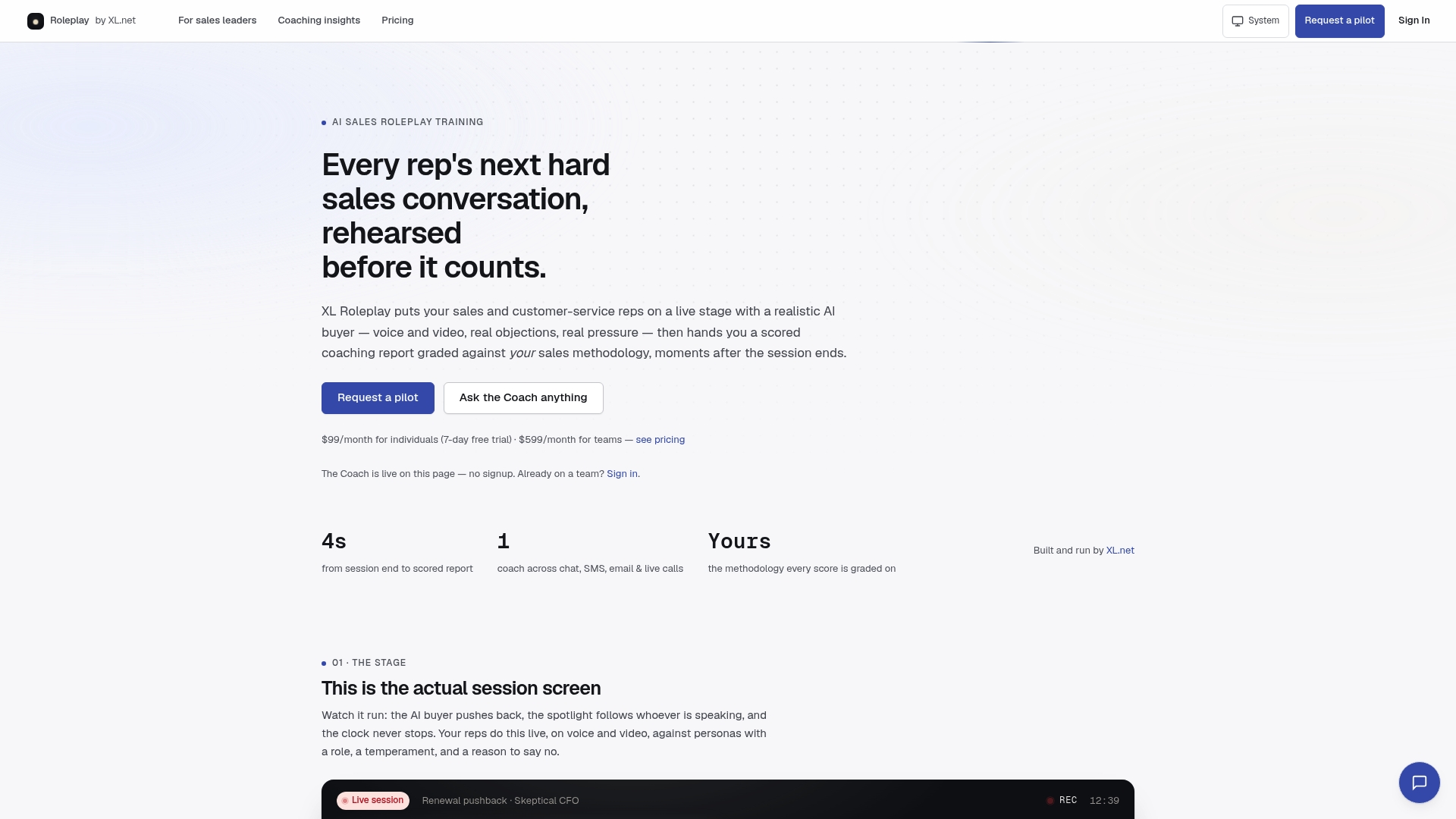
Use it to rehearse the reallocation map conversation until the isolation question is automatic, or run executive escalation roleplay so reps stop hesitating before looping in a CFO. If you’re evaluating a training vendor for this, ask for a trial run, a sample scored transcript, and a rubric tied to a specific skill like isolation or reframing, not a generic “objection handling” score. Visit the sales leaders page to start a trial and see a sample coaching report against your own methodology.
Sources
- Beating the No Budget Objection in B2B Sales | SalesTap
- Budget objection handling | Tomba
- Reframe a No Budget This Year Timing Objection Template — Keep the deal moving | MangoApps
- Budget Objection Handling: 9 Expert Strategies to Overcome ‘No Budget’ | Nutshell
FAQ
What are the four types of objections?
Sales objections generally fall into price, timing, need, and trust (or authority). Budget objections most often live inside price or timing, depending on whether the constraint is genuine or a stall tactic.
What are the five most common customer objections?
The five that come up most often are price, timing, need, trust in the vendor, and authority to decide. Budget objections frequently mask one of the other four rather than standing alone.
What are the three major objection categories?
Most frameworks group objections into price, product fit, and process (timing or authority). A budget objection can technically point to any of the three, which is exactly why isolating it matters before responding.
How should reps respond to budget objections without discounting?
Acknowledge the concern, isolate it with a direct question about allocation and authority, then reframe using a cost-of-inaction calculation before proposing a pilot or reallocation map. Platforms like XL Roleplay let reps rehearse this exact sequence against AI buyers before trying it live.
What is the 50/30/20 rule for a budget?
The 50/30/20 rule is a personal-finance guideline for splitting take-home income into needs, wants, and savings. It doesn’t apply to B2B sales budget objections, which are about organizational priority, authority, and timing instead of a fixed spending ratio.