Five Buyer Persona Templates Trainers Can Import to AI Role Play
Five Buyer Persona Templates Trainers Can Import to AI Role Play

These buyer persona templates give trainers ready-to-run characters that produce realistic discovery and objection-handling practice, without an hour of setup per session. Built right, a persona sheet shortens scenario prep, keeps coaching consistent across reps, and gives every role-play a repeatable signal to score against. Platforms like XL Roleplay can take a filled-out persona sheet and turn it into a live AI buyer that improvises objections while still producing a transcript and a scored coaching report.
TL;DR:
- Persona templates focus on specific roles, objections, and language to create realistic simulations for discovery, negotiation, or objection handling training.
- Each scenario should be carefully sequenced with clear success criteria, possible escalation prompts, and objection stems grouped by theme for authenticity.
- Using varied personas regularly, rotating them, and applying a scoring rubric enhances skill transfer and prevents pattern memorization.
- XL Roleplay automates the process by importing filled persona sheets, running them as AI buyers, and providing transcripts plus coaching reports for efficient practice.
- Training effectiveness improves when role-play mimics real conversations, includes stakeholder dissent, and emphasizes practicing with live, unpredictable buyer behaviors.
Table of Contents
- Five ready-to-use personas for role-play training
- Turning a template into a short role-play
- What every persona sheet needs to feel real
- Objection stems and escalation moves to seed into scenarios
- Scoring role-play so the feedback actually sticks
- Where to get printable sheets and starter packs
- What actually moves the needle in persona-based training
- How XL Roleplay runs persona-driven scenarios
- Sources
- FAQ
Five ready-to-use personas for role-play training
Each template below is a starting character, not a finished script. Fill in the blanks with details from your own deal cycle and you have a scenario ready in minutes.
- Technical evaluator: Focused on specs, integrations, and failure modes. Best for discovery practice. Sample objection: “How does this handle our existing data pipeline?” Opener: “Walk me through the architecture before we talk price.”
- Economic buyer: Owns the budget, measures everything in return on investment and risk. Best for closing and negotiation drills. Sample objection: “I need to see payback inside two quarters.” Opener: “What happens to my numbers if this underdelivers?”
- Champion: Internal advocate who wants ammunition to sell the deal upward. Best for coaching reps on arming an internal ally. Sample objection: “My boss will ask why we didn’t just extend the current contract.” Opener: “Help me make the case internally.”
- Gatekeeper/procurement: Controls access and terms, skeptical of anything outside standard process. Best for practicing stakeholder navigation. Sample objection: “This needs to go through a formal RFP.” Opener: “Send me your standard terms first.”
- Skeptical end user: Will actually use the product and distrusts anything that disrupts a known workflow. Best for objection handling under low trust. Sample objection: “The current tool is annoying, but at least I know it.” Opener: “Why should I trust this won’t break my routine?”
Assign one persona per skill focus rather than running all five in a single session. A rep practicing discovery gains more from thirty minutes with the technical evaluator than from five minutes each with every character on the list.
Turning a template into a short role-play
A persona sheet becomes a usable scenario once you sequence it into a short, timed exercise.
- Pick the skill you are training: discovery, objection handling, or negotiation.
- Select the persona that naturally tests that skill.
- Set the context: what stage of the deal, what the buyer already knows, what is at stake for them.
- Script a one-line opener for the buyer to start the conversation.
- Seed one or two objections tied to that persona’s priorities.
- Define what success looks like before the rep starts talking.
To raise difficulty, add a second persona as a dissenter in the room, introduce a hard deadline, or reveal a hidden stakeholder halfway through the call. The same character sheet works with a live colleague playing the buyer or as an import into an AI role-player, though AI sessions need a short prompt describing tone and variability so the buyer does not repeat the same objection every run.
Pro Tip: Keep the first run of any new persona low-stakes: the goal is to confirm the character behaves believably before you use it to score anyone.
What every persona sheet needs to feel real
A persona sheet only works in role-play when it has enough specificity to sound like a person, not a label. The fields below cover what a rep needs to react to and what a coach needs to score against.
- Role and title: who they are inside the buying group.
- Decision power: final say, strong influence, or veto only.
- Top goals: what success looks like for them personally and professionally.
- Priorities: the two or three factors they weigh most when evaluating options.
- Purchase timeline: urgent, exploratory, or tied to a budget cycle.
- Typical language: phrases, jargon, or tone they default to.
- Top three objections: the predictable pushback for this persona.
- Emotional pressure points: what makes them defensive or anxious.
- Red flags: behaviors from a rep that would lose their trust.
- Trainer prompts: one or two questions a coach can ask mid-scenario to redirect the rep.
A filled example for the technical evaluator: role, Senior Systems Architect. Decision power, strong influence, no veto. Top goals, avoid a migration that breaks uptime. Priorities, integration depth, documentation quality, vendor support speed. Typical language, “latency,” “edge cases,” “rollback plan.” Top objections, “What’s your uptime guarantee,” “How do we roll back if this fails,” “Who handles support escalations.” Pressure point, fear of being blamed for a bad technical call. Red flag, a rep who can’t answer a specifics question without stalling.
For virtual sessions, add a short tone note, since trust and connection flexibility matter more when nonverbal cues are missing. A terse one-line email response reads differently than the same objection delivered on a video call, and reps should practice both.
Objection stems and escalation moves to seed into scenarios
Give every persona a bank of objection stems grouped by theme so coaches can swap pressure in and out without rewriting the scenario.
- Budget: “We don’t have room for this until next fiscal year.”
- Timeline: “We’re mid-implementation on something else right now.”
- Trust: “The last vendor who promised this didn’t deliver.”
- Feature-fit: “This doesn’t match how our team actually works.”
Escalation prompts add realism mid-call: introduce a dissenting stakeholder, have procurement interrupt with a process question, or let scope creep into the conversation as the buyer asks for one more thing. Time these about halfway through the scenario, after the rep has built some rapport but before they have closed anything. Sales influence tactics work best when adapted to the buyer and the moment, so coach reps to open with rational, fact-based framing, shift to a collaborative tone once trust builds, and reserve emotional appeals for moments where logic alone has stalled.
Scoring role-play so the feedback actually sticks
A rubric turns a role-play from a performance into a measurable coaching event. Five behavior categories cover most scenarios:
- Discovery quality: did the rep uncover real priorities, not just surface answers.
- Objection handling: did they address the actual concern, not just push past it.
- Stakeholder management: did they notice and respond to a dissenter or second voice.
- Clarity of next steps: did the call end with a concrete, agreed action.
- Coachability: did the rep take a mid-call redirect without derailing.
Score each from 0 to 3, where 0 is absent and 3 is clearly demonstrated, and combine the five scores into a single readiness signal for that scenario. Buying centers often include a dissenting voice, and reps who never practice handling one tend to freeze the first time it happens live.
Debrief with three short prompts: what went well, what the rep will change on the next call, and one micro-skill worth re-running immediately while it is still fresh.
Where to get printable sheets and starter packs
Rather than building every persona from scratch, pull from a few core assets and adapt them. XL Roleplay’s character sheet resource offers filled persona templates built for role-play specifically, not marketing segmentation.
- A printable character sheet PDF for live, in-person role-play.
- A trainer checklist covering setup, timing, and debrief steps.
- A five-scenario starter pack covering common deal stages.
For AI role-players, paste the filled fields directly into the platform’s scenario setup and add a short tone instruction; for live sessions, print the sheet and hand it to whoever is playing the buyer. Rotate personas every few weeks so reps don’t start anticipating the same objections by memory, and check XL Roleplay’s guide to building scenarios from real calls when a persona needs refreshing with current deal language.
What actually moves the needle in persona-based training

The programs that get real traction from persona templates are the ones that treat role-play as practice for live selling, not as a scripted performance to win. Pedagogical research on sales role-play backs this up: role-play aligned with live-selling outcomes builds stronger practical skills than competition-style scripted exercises. The failure mode I see most often is trainers reusing one persona until reps memorize the pattern instead of the skill.
The fix is boring but effective: rotate personas, track the five-behavior rubric over time, and watch prep time per session drop as the template library grows.
— Adam
How XL Roleplay runs persona-driven scenarios
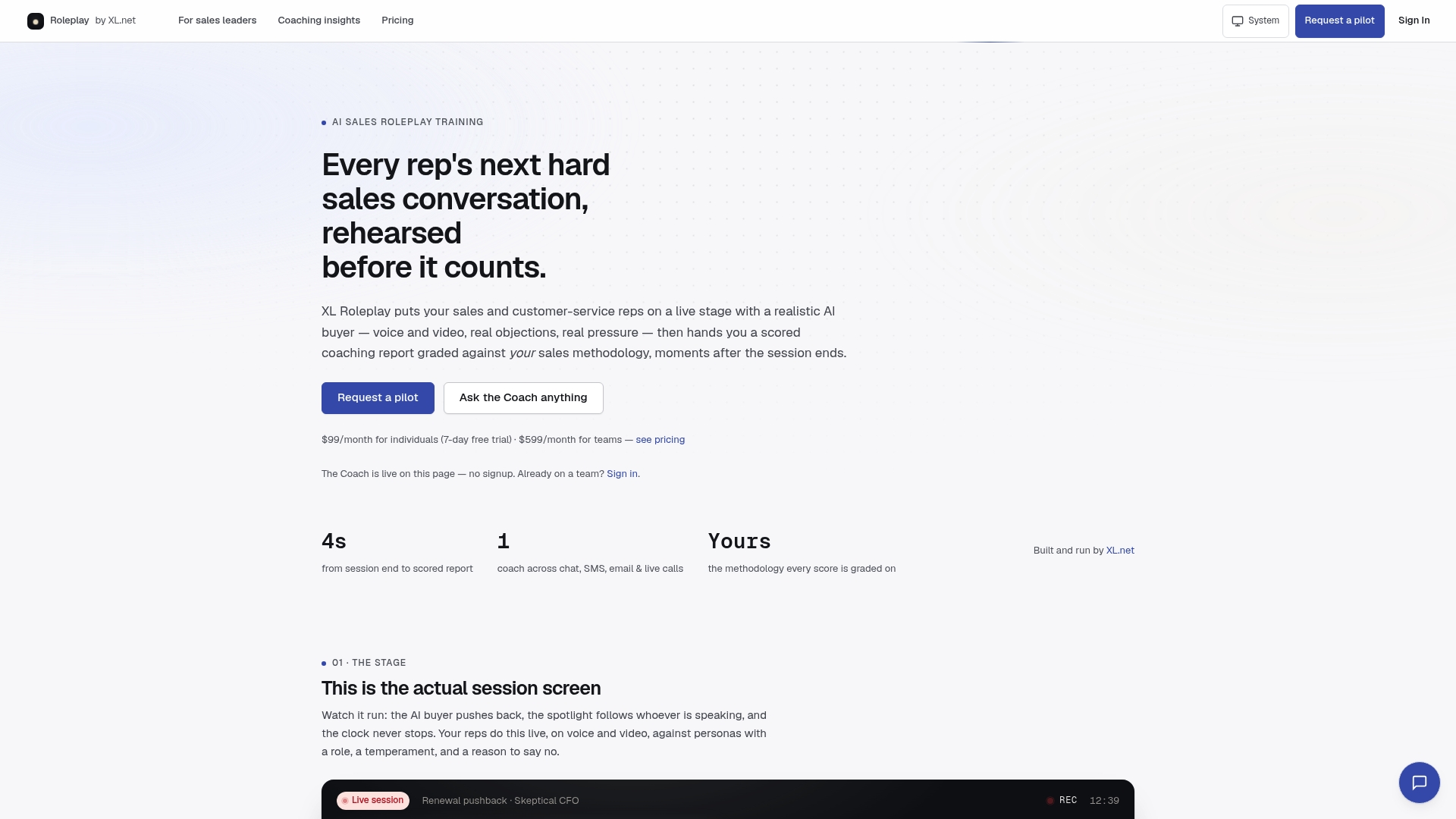
Building and running these personas by hand works, but it takes real coordination between trainers and whoever plays the buyer each session. XL Roleplay imports a filled persona sheet directly, runs it as an AI buyer with built-in variability so reps can’t memorize a single script, and returns a transcript with a scored coaching report tied to your own sales methodology. Upload a persona, run the scenario, review the report, then adjust the sheet and run it again. Check pricing for Individual and Business plans or start with the XL Roleplay pilot to test a persona library before rolling it out to a full team.
Sources
- Beyond the Script: Assessing the Effectiveness of Sales Role-Plays in Developing Selling Skills
- Sales influence tactics in B2B sales: A systematic literature review and future research directions
- Unlocking B2B buyer intentions to purchase: Conceptualizing and validating inside sales purchases
- How business-to-business salespeople deal with buying center dissenters
FAQ
What is a buyer persona template for sales role-play?
It is a short character profile describing a buyer’s role, goals, objections, and typical language, built specifically so a trainer or AI platform can run a realistic practice conversation. It differs from a marketing persona because every field exists to drive a scripted or AI-simulated objection, not to guide campaign targeting.
How many personas should a training program use?
Five core types, technical evaluator, economic buyer, champion, gatekeeper, and skeptical end user, cover most buying-group dynamics without overwhelming a rotation schedule. Add a dissenting stakeholder variant occasionally, since buying centers commonly include a dissenting voice that reps need practice managing.
Can these templates be used with AI role-play platforms?
Yes. Platforms built for this, including XL Roleplay, accept a filled persona sheet and generate a live AI buyer that improvises within that character while producing a transcript and a scored coaching report.
How do I score a role-play session fairly?
Use a short behavior rubric covering discovery quality, objection handling, stakeholder management, clarity of next steps, and coachability, scoring each from 0 to 3. Combine the scores into one readiness signal per scenario so progress is comparable across sessions and reps.
Where can I find printable persona character sheets?
XL Roleplay’s character sheet resource offers filled templates built specifically for role-play rather than marketing use. Printable personality profile tools like DISC Assess can also help trainers add believable language and emotional triggers to a custom persona.