Manager Ready Call Coaching Template: Copy Paste 30–40 Minute Agenda and Rubric
Manager Ready Call Coaching Template: Copy Paste 30–40 Minute Agenda and Rubric

A call coaching template is a structured form for reviewing a rep’s call, scoring specific behaviors against a rubric, and turning the review into a written development plan tied to timestamped evidence. It works because it forces feedback to connect to measurable KPIs instead of general impressions. The fastest way to see the value: grab the session agenda and scorecard below and run a real coaching session with one rep this week, using AI productivity workflows to prepare and deploy templates quickly.
TL;DR:
- Using three different coaching templates tailored to the call cycle improves feedback specificity and prevents program stall, especially for new versus experienced reps.
- Incorporating timestamped evidence and specific KPI context into scoring rubrics ensures feedback is evidence-based and adds trustworthiness, reducing arguments during reviews.
- Running focused 30-minute sessions with pre-prepared calls and clear action plans yields better results than longer, unfocused coaching, and narrowing feedback to one behavior enhances follow-through.
- Tracking core KPIs like AHT, FCR, CSAT, and quality scores over a rolling four to eight-week window provides meaningful insights, avoiding misleading judgments based on single-week data.
- Building a habitual coaching process with small, regular sessions—such as one call per month—leads to sustained improvement more effectively than sporadic, extensive reviews.
Table of Contents
- What Should a Call Coaching Template Include?
- How Do You Run a 30-Minute Coaching Session Step by Step?
- Which KPIs Actually Belong on a Call Coaching Scorecard?
- How Do You Build a Rubric Reps Trust Instead of Argue With?
- What Goes in the Development Plan and Follow-Up?
- Should Sales and Support Teams Use Different Scorecards?
- How Do Managers Combine Role-Play, Transcripts, and Scored Reports?
- Templates and Guides Worth Bookmarking
- Start Small, Then Build the Habit
- Sources
- FAQ
What Should a Call Coaching Template Include?
Most managers do not need one template. They need three or four, each built for a different moment in the coaching cycle. Trying to force every review into a single generic form is why so many coaching programs stall after a few weeks.
A quick-fill scorecard is for daily or weekly spot checks. It has five to eight scored line items, a total score, and one comment field. Use it when you are reviewing several calls in a sitting and need speed over depth.
A full coaching session form is heavier. It includes administrative fields (rep name, call ID, date, reviewer), a KPI snapshot pulled from your dialer or CRM, a scored rubric section, and timestamped evidence fields for two or three moments in the call, and a development plan block for the action the rep commits to.
A 1:1 coaching log tracks a rep over time rather than one call. It rolls up scores from the last several sessions, notes trends, and lists open action items from prior meetings so nothing gets dropped.
A new-hire or ramp template narrows the rubric to the two or three skills a new rep needs first, usually call opening and discovery, rather than scoring everything a tenured rep would be judged on.
Here’s what each template needs to actually function, not just look organized:
- Admin metadata: rep name, date, call ID or recording link, reviewer name, call type or campaign
- Context fields: call reason, customer segment, deal stage or ticket category
- Scoring section: rubric items with a numeric scale and a comment box tied to each score
- Timestamp evidence: at least one field per major rubric category for a specific moment in the recording
- Action plan: one or two SMART goals, an owner, a deadline, and a measure of success
According to C2Perform’s coaching template guide, templates that combine admin data, structured scoring, KPI context, and an explicit action plan are what convert subjective feedback into something consistent across reviewers. Skip any one of those four pieces and the template turns into either a checklist nobody trusts or a form nobody finishes.
For deployment, a shared Google Sheet works fine for teams under 15 reps. Larger teams usually move to a form platform (Google Forms, Typeform) that dumps scores into a spreadsheet automatically, or into whatever LMS or QA module their contact center platform already runs. XL Roleplay’s one-on-one coaching template is one example built specifically for post-call documentation and session tracking.
How Do You Run a 30-Minute Coaching Session Step by Step?
You don’t need an hour to run a real coaching session. A tight, well-prepped 30 to 40 minutes beats a rambling hour every time, and it’s the cadence Balto’s coaching research recommends for contact centers running structured QA programs.
Before the session, do three things the day before:
- Pull one or two representative calls, ideally the transcript alongside the recording.
- Check the rep’s current KPI snapshot: quality score, AHT, CSAT, or whatever your team weights most.
- Send the rep the call ID and a two-line agenda so they can self-review before you meet. Nobody should walk into a coaching session blind.
During the session, run this timed structure:
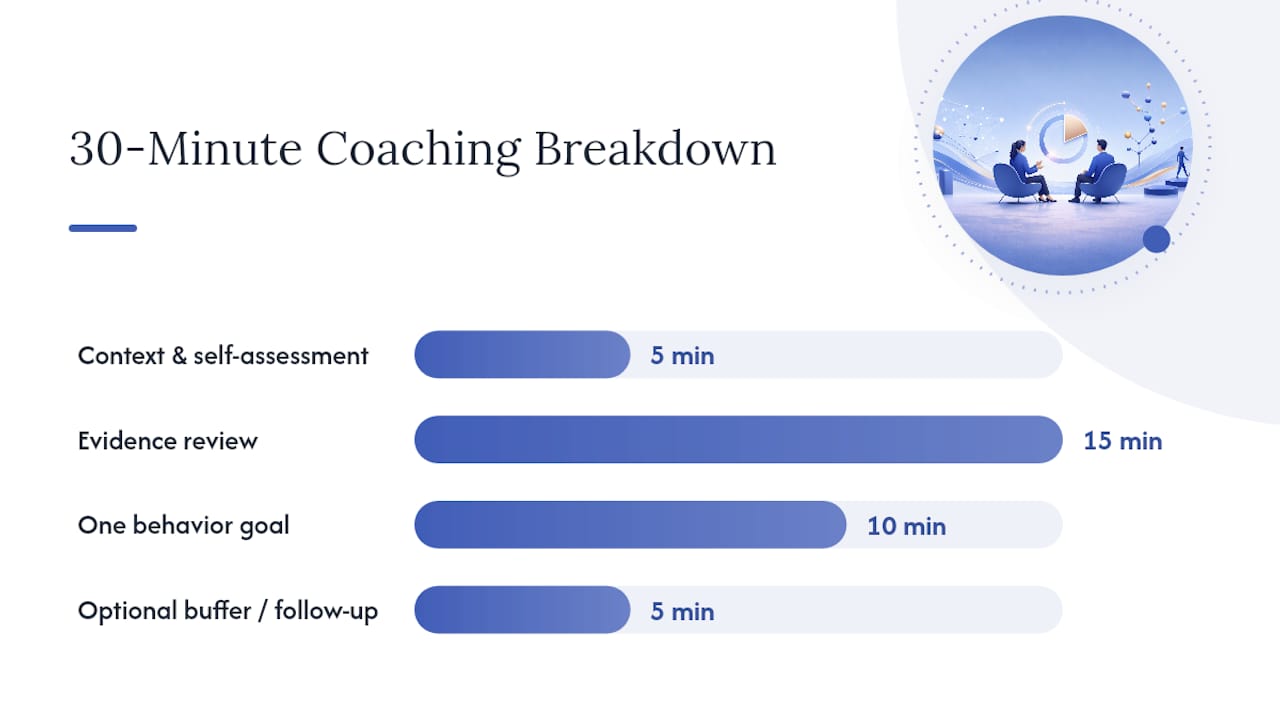
- Minutes 0 to 5: Quick context and self-assessment. Ask the rep what they thought went well and where they felt shaky. This surfaces their own blind spots before you name yours.
- Minutes 5 to 20: Evidence review. Play one or two timestamped clips. Ask: “What were you trying to accomplish right here?” and “What did you notice about how the customer responded?” Questions like these keep the rep talking instead of you lecturing.
- Minutes 20 to 30: Agree on one behavior to change. Not three. One. Write it down together as a SMART goal.
- Minutes 30 to 35 (optional buffer): Confirm the follow-up date and how success will be measured.
Pro Tip: Limit every session to one timestamped clip and one behavior to improve. Managers who try to cover five issues at once report far more defensiveness and far less follow-through than those who narrow the scope, according to EntrepreneurHQ’s coaching research.
Keep your language observational, not evaluative, during the evidence review. “You paused for four seconds after the price objection” lands very differently than “you froze up.” One is a fact the rep can verify on the recording. The other is a judgment they’ll want to argue with.
Which KPIs Actually Belong on a Call Coaching Scorecard?
A scorecard without KPIs attached is just an opinion with a number on it. The core metrics worth tracking alongside your rubric are average handle time (AHT), first call resolution (FCR), customer satisfaction (CSAT), and an internal quality score built from your rubric itself.
Each one tells you something different:
- AHT flags efficiency problems, but a low AHT paired with a low FCR usually means reps are rushing customers off the phone without solving anything.
- FCR shows whether the rep actually fixed the issue, which matters more for support calls than sales calls.
- CSAT captures the customer’s felt experience, which a quality score alone can miss entirely.
- Quality score is your rubric’s numeric output, the one metric you actually control the definition of.
The mistake most managers make is chasing one metric in isolation. A rep who crushes AHT every week might be quietly tanking CSAT. That’s why quality scores and KPI dashboards need to sit side by side, reviewed over a rolling window rather than a single snapshot.
Zoom’s contact center coaching guide recommends tracking scores over 4 to 8 week rolling windows rather than judging a rep off any single week, since call mix and customer difficulty swing week to week regardless of skill.
Most contact centers still review fewer than 5% of calls manually, according to Balto’s research. This means the vast majority of interactions get zero structured feedback at all. That gap is exactly why a repeatable template matters more than a perfect one. A rough scorecard applied to 20 calls a month beats a flawless one applied to two.
How Do You Build a Rubric Reps Trust Instead of Argue With?
The difference between a rubric that works and one that starts arguments is whether every score points to something the rep can hear or read for themselves. “Good rapport” is a guess. “Used the customer’s name twice and referenced their prior ticket at 2:14” is evidence.
A workable rubric item looks like this: a 1 to 5 scale, where a 1 means the behavior was absent, a 3 means it happened but was inconsistent, and a 5 means it happened clearly and consistently, with a required timestamp field next to every score above a 1 or below a 5.
Good rubric categories to score this way include:
- Opening and rapport (did the rep confirm the reason for the call within the first 30 seconds?)
- Discovery or diagnosis (did the rep ask at least two clarifying questions before proposing a solution?)
- Objection or concern handling (did the rep acknowledge the concern before responding to it?)
- Close or resolution (did the rep confirm the customer understood next steps?)
EntrepreneurHQ’s coaching framework points out that tying every score to transcript evidence is what shifts a coaching conversation from opinion to something the rep can actually verify, which is also what makes it easier for the rep to accept the feedback in the first place.
Pro Tip: Once a quarter, have two managers independently score the same three calls and compare results. Where the scores diverge by more than one point, that’s your calibration gap, not the rep’s problem.
A guide on coaching from transcripts and scorecards walks through pulling exact quotes into the rubric so the evidence review takes minutes, not a full replay of the call.
What Goes in the Development Plan and Follow-Up?
The coaching session is worthless if nothing gets written down afterward. A real development plan has five parts:
- One SMART goal, specific and time-bound: “Ask two open discovery questions before pitching, on every call, for the next two weeks.”
- The concrete steps the rep will take to get there, in their own words if possible.
- An owner: almost always the rep, with the manager as the checkpoint.
- A timeline: two weeks for a focused behavior change is typical.
- A success measure: the next quality score, or a specific KPI shift you’ll check against.
Cadence should match performance level. New or struggling reps do best with weekly check-ins; solid mid-tier performers can run on a biweekly cadence; your top performers need monthly touches mostly to keep them engaged, not to fix anything. Zoom’s coaching guide backs this tiered cadence as standard practice across contact centers.
If a goal stalls past two check-ins with no movement, escalate. Add a second manager to the next session, or shorten the review cycle to weekly until you see progress.
A short follow-up email the same day keeps momentum: restate the one behavior, the deadline, and the calendar invite for the next check-in. A sales coaching cadence guide has a template for exactly this kind of follow-up sequence.
Should Sales and Support Teams Use Different Scorecards?
Not entirely different, just differently weighted. A sales call coaching template should push more weight toward discovery quality and value articulation, since those are the behaviors that predict a closed deal. A support-focused call review template weights resolution accuracy, compliance language, and empathy higher, since those predict retention and CSAT more than any pitch skill would.
Two practical tweaks: swap the “close” rubric category for a “resolution confirmed” category on support scorecards, and add a mandatory compliance checkbox for any regulated industry, insurance, healthcare, or financial services calls in particular.
If sales and support sit under the same manager or the same QA program, calibrate scoring definitions across both teams quarterly. Otherwise a “4” on one team quietly means something different than a “4” on the other, and that gap shows up the first time someone compares reports. A discovery call coaching breakdown is a useful reference for exactly what to prioritize on the sales side.
How Do Managers Combine Role-Play, Transcripts, and Scored Reports?
The most efficient coaching cycle looks like this: a rep practices a tough scenario in a role-play, gets a scored report back immediately, and the manager reviews that report alongside the actual call transcript before agreeing on one development action.
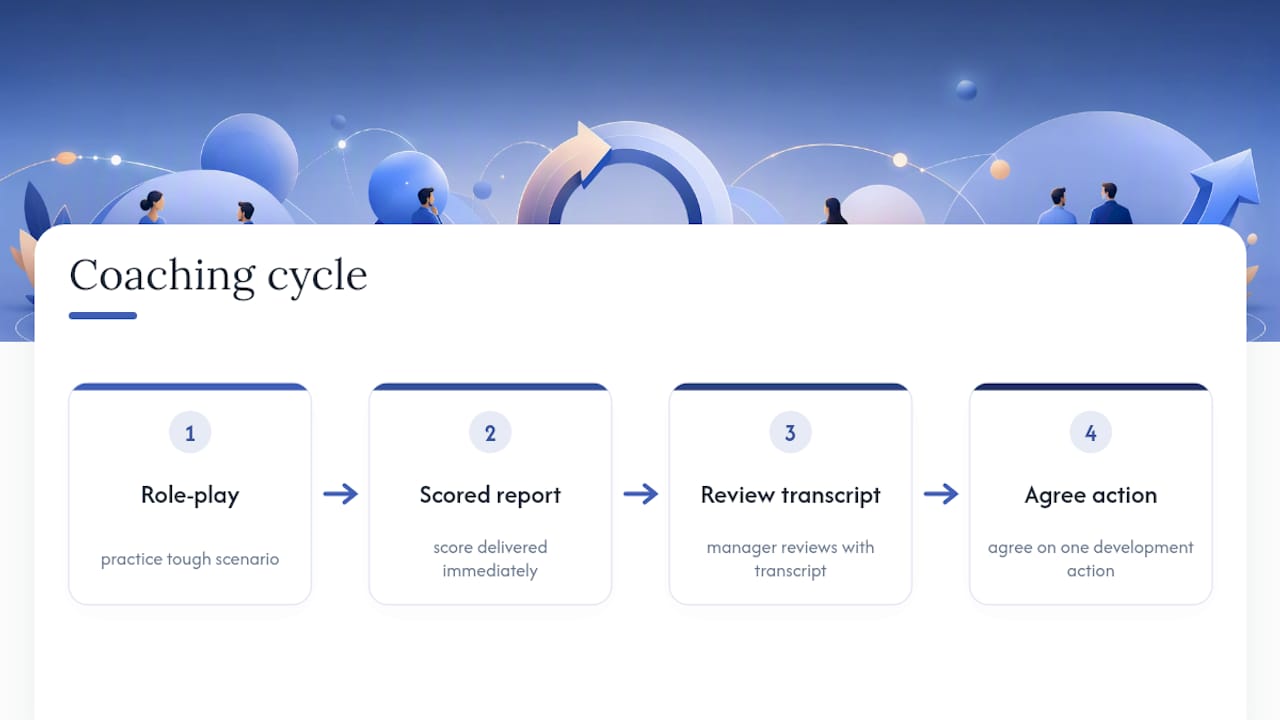
Platforms like XL Roleplay build scored coaching reports directly into the role-play session, so the rubric scoring happens automatically instead of a manager reconstructing it by hand after listening to a recording twice. That shortens calibration time significantly, since two managers reviewing the same scored report start from identical evidence rather than two separate sets of notes.
For teams managing this at scale, a sales leader dashboard that aggregates scored reports across a whole team can turn individual coaching sessions into a picture of where the entire team’s skill gaps actually sit, discovery, objection handling, or closing, rather than guessing from a handful of spot checks.
Templates and Guides Worth Bookmarking
- C2Perform’s call coaching template guide: full template structure and field breakdown.
- Balto’s coaching techniques and templates: session cadence and automation guidance.
- USJ’s telephone coaching toolkit: multi-session protocol and documentation examples.
Start Small, Then Build the Habit
Run one evidence-backed session per rep per month before you try to coach every call. Coverage always loses to consistency. A manager juggling SLAs doesn’t need a perfect QA program on day one, just one real session this week, with one clip, one score, and one SMART goal. Do that four times and you’ll have a habit instead of a project that quietly died in a shared drive.
— Adam
Sources
- Call Center Agent Coaching: Techniques & Templates - Balto
- Sales Call Coaching Method: Techniques, Examples, Template & Scripts - EntrepreneurHQ
- Call Center Coaching: A 2026 Guide for Contact Center Managers | Zoom
- The Ultimate Call Coaching Template & Guide - C2Perform
- USJ Health Coaching Toolkit (Telephone-based coaching protocols)
FAQ
What Are the 5 C’s of Coaching?
Definitions vary across coaching programs, but a common version covers Clarity, Context, Concrete evidence, Collaboration, and Commitment, meaning the feedback is specific, tied to a real call moment, built with the rep rather than delivered at them, and ends with an agreed next step.
What Are the 7 Coaching Questions?
There’s no single fixed list, but effective coaching sessions typically rely on questions like “What were you trying to accomplish here?”, “What did you notice about the customer’s response?”, and “What would you try differently next time?” rather than statements that tell the rep what they did wrong.
What Is the Basic Script for a Call Center?
A basic call center script covers a greeting with the rep’s name and company, a reason-for-call confirmation, identity verification if required, the core issue discussion, a resolution or next steps summary, and a closing that confirms the customer’s satisfaction before ending the call.
How Often Should Coaching Sessions Happen?
Weekly or biweekly sessions work best for reps who are still developing core skills, while monthly check-ins are usually enough for consistent top performers, a cadence supported by Zoom’s contact center coaching guide.