Call Recording Consent States: What Every Business Needs to Know
Call Recording Consent States: What Every Business Needs to Know

Federal law lets you record a call if you’re one of the participants, but that’s not the rule to build your business on. Some states require all-party consent, meaning everyone on the line has to agree before you hit record, and courts sometimes apply the stricter state’s law even when your company sits in a one-party state. The safest default for any business making or receiving customer calls: announce that the call may be recorded and treat continued participation as consent.
Here’s the fast version of what matters:
- Federal baseline: one-party consent under 18 U.S.C. § 2511 — you can record if you’re a party to the call.
- Roughly a dozen states and D.C.-adjacent jurisdictions require all-party consent or have hybrid rules that function the same way in practice, according to Justia’s 50-state survey.
- The operational fix: a short recorded disclosure at the start of every call (“This call may be recorded for quality and training purposes”) plus a documented consent policy.
Quick stat: Civil violations of the federal Wiretap Act can trigger statutory damages that guides commonly cite as $10,000 or more per violation under 18 U.S.C. § 2520, and that’s before you count state-level penalties stacked on top. If your call center handles thousands of calls a month, the math gets ugly fast.
Key Takeaways
Businesses that default to all-party consent notice on every customer call sidestep the state-by-state guesswork that creates most call recording legal exposure.
| Point | Details |
|---|---|
| Default to all-party notice | Give a recorded disclosure on every customer call regardless of headquarters location. |
| Treat hybrid states as all-party | Connecticut, Delaware, Nevada, and Oregon carry judicial or medium-based nuance that increases risk. |
| Know the financial stakes | Federal civil claims under 18 U.S.C. § 2520 commonly cite $10,000 or more in statutory damages per violation. |
| Plan for interstate calls | Courts have applied the stricter state’s law to out-of-state recorders, so verifying caller location isn’t a reliable substitute for notice. |
| Train delivery, not just policy | Role-play rehearsal for agents closes the gap between a written script and what customers actually hear. |
Table of Contents
- Call Recording Consent States: The Federal Baseline and Key Terms
- Call Recording Laws by State: A Practical Compliance Matrix
- Where One-Party Labels Hide Real Legal Risk
- What Illegal Call Recording Actually Costs a Business
- Interstate Calls and Why the Strictest State Usually Wins
- How to Build a Call Recording Consent Policy That Holds Up
- Turning Consent Scripts Into Muscle Memory Through Role-Play
- Recording Calls With Parties Outside the U.S.
- Recording Across Mobile, VoIP, and Call Center Platforms
- Why the One-Party/All-Party Framing Undersells the Real Problem
- Sources
Call Recording Consent States: The Federal Baseline and Key Terms
Every state law sits on top of a federal floor, and that floor is more permissive than most businesses assume. 18 U.S.C. § 2511(2)(d) allows a participant in a call to record it without telling anyone else, as long as the recording isn’t made for a criminal or tortious purpose. That’s the “one-party consent” rule you’ll see referenced constantly in compliance guides.
States are free to raise that bar, and many do. Here’s the vocabulary you need to navigate the rest of this guide:
- One-party consent: Only one person on the call (which can be you, the recorder) needs to agree. Most states use this standard.
- All-party consent (sometimes called two-party consent): Every participant must agree before recording starts. This is the stricter standard.
- Hybrid states: Rules that shift depending on the medium (phone versus in-person) or that carry judicial interpretations layered on top of the statute, making a clean one-party/all-party label misleading.
- Confidential communication: Some all-party statutes only apply when a party has a reasonable expectation of privacy. A public meeting or a call where you’ve already announced recording generally doesn’t qualify.
Violating a stricter state statute doesn’t erase your federal compliance. It stacks a separate state-level claim on top, and 18 U.S.C. § 2520 gives plaintiffs a civil remedy that many state laws mirror or exceed. A company that’s federally compliant but ignoring California’s all-party rule is still exposed.
Call Recording Laws by State: A Practical Compliance Matrix
The table below groups states by their practical rule for phone calls, not just the textbook classification. Several states labeled “one-party” in older guides have case law or medium-specific carve-outs that functionally require notice. Where a state is flagged as hybrid, treat it as all-party until your counsel confirms otherwise, a position supported by Recording Law’s state-by-state guide.
| State | Practical Rule | Note | What to Do |
|---|---|---|---|
| Alabama | One-party | Standard federal-aligned rule | OK to record with one party’s consent |
| Alaska | One-party | Standard rule | OK to record with one party’s consent |
| Arizona | One-party | Standard rule | OK to record with one party’s consent |
| Arkansas | One-party | Standard rule | OK to record with one party’s consent |
| California | All-party | Applies to confidential communications | Notify all parties before recording |
| Colorado | One-party | Standard rule | OK to record with one party’s consent |
| Connecticut | Hybrid | Civil suits require all-party consent; criminal exposure differs | Treat as all-party; verify with counsel |
| Delaware | Hybrid | Statutory language is ambiguous across sources | Treat as all-party for business calls |
| Florida | All-party | Applies where privacy is reasonably expected | Notify all parties before recording |
| Georgia | One-party | Standard rule | OK to record with one party’s consent |
| Hawaii | Hybrid | Rules vary by medium and setting | Treat as all-party; verify with counsel |
| Idaho | One-party | Standard rule | OK to record with one party’s consent |
| Illinois | All-party | Rewritten after prior statute was struck down | Notify all parties before recording |
| Indiana | One-party | Standard rule | OK to record with one party’s consent |
| Iowa | One-party | Standard rule | OK to record with one party’s consent |
| Kansas | One-party | Standard rule | OK to record with one party’s consent |
| Kentucky | One-party | Standard rule | OK to record with one party’s consent |
| Louisiana | One-party | Standard rule | OK to record with one party’s consent |
| Maine | Hybrid | Judicial gloss on the statute creates ambiguity | Treat as all-party; verify with counsel |
| Maryland | All-party | Applies to private conversations | Notify all parties before recording |
| Massachusetts | All-party | Secret recording is a criminal offense outright | Notify all parties before recording |
| Michigan | One-party (with wrinkles) | Some courts read an all-party requirement into eavesdropping law | Verify with counsel; default to notice |
| Minnesota | One-party | Standard rule | OK to record with one party’s consent |
| Mississippi | One-party | Standard rule | OK to record with one party’s consent |
| Missouri | One-party | Standard rule | OK to record with one party’s consent |
| Montana | All-party | Requires notice at start of call | Notify all parties before recording |
| Nebraska | One-party | Standard rule | OK to record with one party’s consent |
| Nevada | Hybrid | Phone calls have been interpreted as all-party by state courts; in-person differs | Treat phone calls as all-party |
| New Hampshire | All-party | Applies to telephone and in-person conversations | Notify all parties before recording |
| New Jersey | One-party | Standard rule | OK to record with one party’s consent |
| New Mexico | One-party | Standard rule | OK to record with one party’s consent |
| New York | One-party | Standard rule | OK to record with one party’s consent |
| North Carolina | One-party | Standard rule | OK to record with one party’s consent |
| North Dakota | One-party | Standard rule | OK to record with one party’s consent |
| Ohio | One-party | Standard rule | OK to record with one party’s consent |
| Oklahoma | One-party | Standard rule | OK to record with one party’s consent |
| Oregon | Hybrid | Telephone calls require notice; in-person rules differ | Treat phone calls as all-party |
| Pennsylvania | All-party | Broadly applied to wire and oral communications | Notify all parties before recording |
| Rhode Island | One-party | Standard rule | OK to record with one party’s consent |
| South Carolina | One-party | Standard rule | OK to record with one party’s consent |
| South Dakota | One-party | Standard rule | OK to record with one party’s consent |
| Tennessee | One-party | Standard rule | OK to record with one party’s consent |
| Texas | One-party | Standard rule | OK to record with one party’s consent |
| Utah | One-party | Standard rule | OK to record with one party’s consent |
| Vermont | No statute (common law) | No specific wiretap statute; courts apply common-law privacy standards | Default to notice absent clear statute |
| Virginia | One-party | Standard rule | OK to record with one party’s consent |
| Washington | All-party | One of the strictest statutes; covers private conversations broadly | Notify all parties before recording |
| West Virginia | One-party | Standard rule | OK to record with one party’s consent |
| Wisconsin | One-party | Standard rule | OK to record with one party’s consent |
| Wyoming | One-party | Standard rule | OK to record with one party’s consent |
| District of Columbia | One-party | Standard rule | OK to record with one party’s consent |
Statutes get amended and reinterpreted by courts more often than most compliance calendars account for. Treat this matrix as a starting point for policy design, and confirm the current statutory text through your own counsel or a state statute hub before finalizing a script that skips notice.
Where One-Party Labels Hide Real Legal Risk
A “one-party consent” label on a 50-state chart tells you almost nothing about actual litigation exposure in a handful of states. Four examples show why the simple binary breaks down.
Connecticut splits its treatment by proceeding type. Criminal statutes and civil statutes don’t align cleanly, so a recording that avoids criminal liability can still expose a business to a civil claim. Businesses that record Connecticut customers without notice are betting on a distinction that isn’t as protective as it looks.
Delaware has statutory language that different legal guides interpret differently, according to Recording Law’s survey. When two respected sources can’t agree on how a state statute reads, that’s not a technicality. That’s your cue to default to the stricter posture rather than gamble on which interpretation a Delaware court adopts.
Nevada courts have read the state’s wiretap statute as requiring all-party consent for telephone calls specifically, even though the underlying statute reads closer to one-party on its face. In-person conversations in Nevada follow a different analysis entirely. A business that records Nevada customers using a one-party assumption is relying on the statute’s text while ignoring how state courts have actually applied it.
Massachusetts doesn’t bother with a consent framework at all in the way most states do. Secret recording is itself the criminal offense under the state’s wiretap statute, regardless of whether one party consented. The Massachusetts approach makes upfront notice not just good practice but the only way to avoid criminal exposure entirely.
Oregon ties its rule to the medium of the conversation. Telephone calls require notice; in-person conversations follow different logic, and the line between the two has generated real litigation over hybrid situations like video calls with an audio-only component.
Pro Tip: Build your compliance policy around the state where litigation is most likely to be filed, not the state where your call center sits. Plaintiffs’ attorneys pick the forum. You don’t get to.
What Illegal Call Recording Actually Costs a Business
The dollar figures attached to call recording violations surprise most operations leaders, mostly because they’ve never had to price it out. Civil suits under 18 U.S.C. § 2520 allow recovery of actual damages or statutory damages, and compliance guides commonly cite statutory damages of up to $10,000 or more per violation as the practical exposure. That’s per call, not per case, when a plaintiff’s attorney can show a pattern across your customer base.
State statutes layer additional exposure on top of the federal floor, and the range runs wide:
- Several states classify unlawful recording as a criminal misdemeanor, carrying fines and the possibility of short-term imprisonment.
- A smaller group of states treat it as a felony under certain circumstances, particularly where the recording is used to commit or facilitate another crime.
- Civil remedies vary by state but frequently mirror or exceed the federal statutory damages framework, according to Justia’s survey of state recording laws.
The real financial danger for most businesses isn’t a single angry customer. It’s the class-action structure. If your call center used a single non-compliant script across thousands of calls in an all-party state, every one of those calls is potentially a separate violation with its own statutory damages claim. Plaintiffs’ firms have built entire practice areas around exactly this fact pattern, because the underlying proof (your own call logs and recorded scripts) is usually sitting in your own system, ready to be subpoenaed.
Regulatory risk compounds the civil exposure. A pattern of non-compliant recordings across a large customer base can draw attention from state attorneys general independent of any private lawsuit, particularly in states where call recording violations intersect with consumer protection statutes.
Interstate Calls and Why the Strictest State Usually Wins
Most business calls today cross state lines without anyone noticing. Your agent sits in Texas, your customer’s area code says Ohio, but their cell phone is registered to a California carrier because they moved and never changed the number. Which state’s law applies?
Courts have generally leaned toward applying the stricter jurisdiction’s law when a recording touches a state with a higher consent standard. The leading example is Kearney v. Salomon Smith Barney, Inc., where California courts required an out-of-state company to comply with California’s all-party consent statute because the call reached a California resident, a pattern confirmed across multiple state surveys. The company’s home-state law being one-party consent didn’t matter once a California party was on the line.
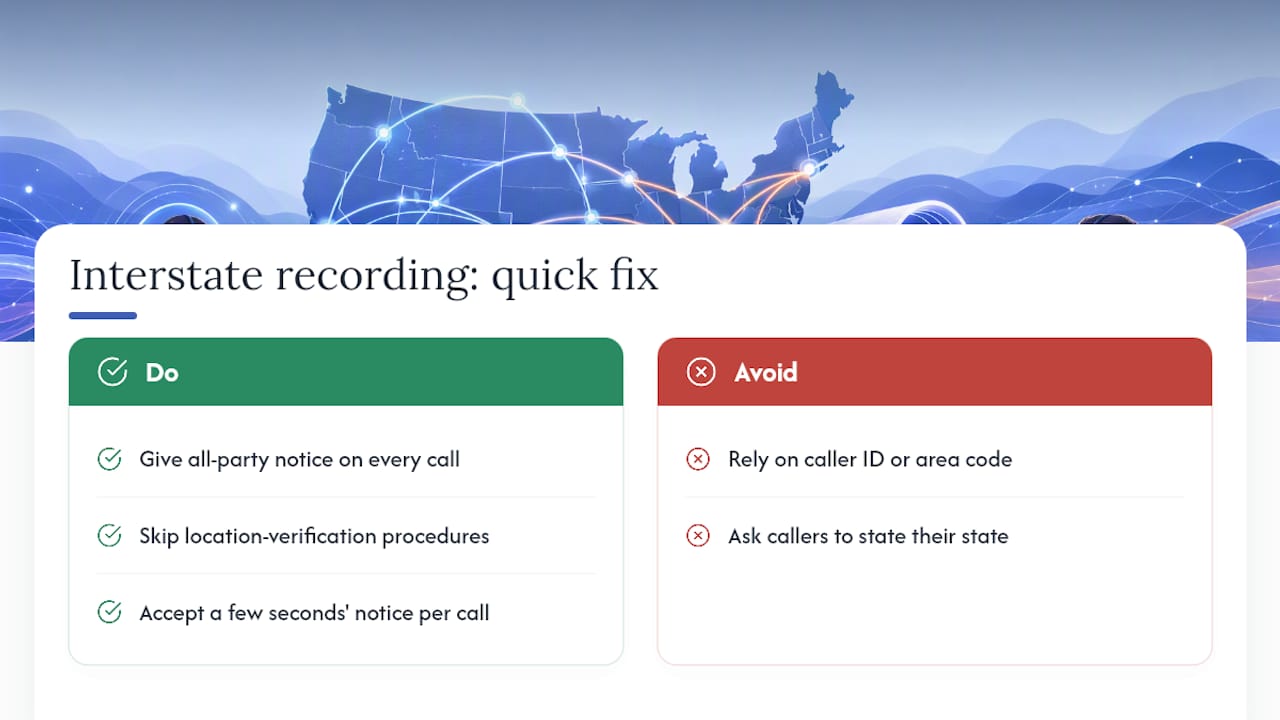
That precedent creates a genuine operational problem. Area codes don’t reliably indicate physical location anymore, and number portability means a customer can carry a California number to Texas or a Vermont number to Florida. You can’t verify location from caller ID with any real confidence, and asking every caller to state their state before you record is awkward at best.
The practical fix most compliance teams land on is to skip the location-verification puzzle entirely and give all-party notice on every customer-facing call. It costs you a few seconds per call and it makes the choice-of-law question irrelevant, because you’ve already met the strictest standard anyone could apply.
How to Build a Call Recording Consent Policy That Holds Up
Getting compliant isn’t a legal research project. It’s an operations project with a legal foundation. Here’s the sequence that works:
- Choose your posture. Default to all-party notice for every outbound and inbound customer call, regardless of where your business is headquartered.
- Write the policy down. Document who can record, what triggers the disclosure, and where recordings are stored. A verbal norm isn’t a policy; it’s a liability waiting to be deposed.
- Build the disclosure into your system. Automated IVR greetings and agent scripts should deliver the notice before any substantive conversation happens, not buried in a terms-of-service page nobody reads.
- Log consent, not just the recording. Timestamp the disclosure playback or the agent’s spoken notice separately from the recording itself, so you can prove notice was given even if a specific recording is later challenged.
- Set retention and access rules. Limit who can pull recordings, how long you keep them, and audit access logs the way you would for any sensitive customer data.
- Audit regularly. Spot-check calls quarterly to confirm agents are actually delivering the script, not just that the script exists in a training manual somewhere.
Sample notice language, adaptable across channels:
That single line, delivered before substantive conversation begins, covers the automated IVR greeting, the outbound sales opener, and the inbound support opener with only minor tweaks in delivery. An outbound sales rep might say it as the first line after introducing themselves. An inbound support agent might weave it into the standard greeting: “Thanks for calling, this call may be recorded for quality purposes. How can I help you today?”
Implied consent by continued participation is recognized in states where notice has been given, according to industry compliance guidance, meaning a customer who stays on the line after hearing the disclosure has generally consented. Build in a clear path for revocation too. If a customer objects, stop recording immediately and note the objection in your CRM, and keep recording scope limited to the business purpose stated in your notice rather than sweeping in unrelated conversation.
Pro Tip: Don’t rely on a written policy alone. The gap between what your handbook says and what your agents actually say on live calls is where most compliance failures happen, and it’s invisible until a plaintiff’s attorney pulls the recording.
Turning Consent Scripts Into Muscle Memory Through Role-Play
A written script only protects your business if agents deliver it consistently under real call pressure, not just during onboarding week. That’s where simulated call practice earns its keep. Running new hires through recorded role-play sessions before they touch a live customer call surfaces the moments where a disclosure gets rushed, skipped, or buried mid-sentence.
Xl builds this kind of rehearsal directly into training. Sales and customer service reps practice against AI-driven buyer personas that simulate the pressure of a real call, including the awkward instinct to skip the recording disclosure when a customer sounds impatient. Coaching reports score each session against your organization’s own compliance script, not a generic template, and transcripts give managers a documented record of exactly what was said and when.
Practical uses for consent training specifically:
- New customer service hires can rehearse the IVR handoff and verbal disclosure through customer service role-play scenarios before their first live call.
- Sales teams can build the disclosure into outbound call role-play sessions so it becomes reflexive rather than an afterthought bolted onto a pitch.
- Managers get scored transcripts they can audit for compliance gaps the same way they’d audit for discovery or objection handling.
Consent shouldn’t be evidence you patch together after the fact. It should show up the same way in call after call, and that consistency is trained, not assumed.
Recording Calls With Parties Outside the U.S.
U.S. wiretap statutes govern conduct that touches U.S. jurisdiction, but a call to a customer or vendor outside the country introduces a second legal system into the equation. The other country’s own recording and privacy laws apply to that call independent of what U.S. law says, and many jurisdictions outside the U.S., including the European Union under GDPR, treat call recording as a form of personal data processing that requires an affirmative legal basis, not just notice.
The practical complication: your U.S. all-party notice script satisfies U.S. law but may not satisfy a foreign jurisdiction’s consent or data-processing requirements on its own. A business regularly calling customers in the EU, for example, needs to think about GDPR’s consent and data-retention rules on top of whatever U.S. state law applies to the U.S.-based leg of the call.
There’s no single global script that covers every jurisdiction, so the safest approach for businesses with meaningful international call volume is treating each country’s rules as a separate compliance layer rather than assuming U.S. notice language travels automatically. If your call volume to a specific country is high enough to matter, that’s worth a direct conversation with counsel familiar with that jurisdiction’s telecom and privacy law, rather than extending your domestic policy by assumption.
Recording Across Mobile, VoIP, and Call Center Platforms
The legal consent rules stay the same regardless of what technology carries the call, but the compliance mechanics shift depending on the platform. A mobile call recorded through a smartphone app puts the compliance burden on whoever installs and operates that app, and many carriers and device makers build in their own disclosure requirements independent of state law.
VoIP and cloud-based call center platforms typically handle disclosure through the system itself rather than relying on individual agents to remember a script. That’s an advantage: a centrally configured IVR greeting delivers the same notice on every call without depending on human consistency. It also means a misconfigured system setting can silently disable your disclosure across every call routed through it, so verifying the actual audio a customer hears, not just the platform’s settings panel, matters as part of any audit.
Call centers running blended teams across multiple platforms, mobile devices for field reps, VoIP desk phones for inside sales, and a separate system for support, need a consent policy that survives the handoff between systems. A customer transferred from an IVR-disclosed line to a mobile callback shouldn’t lose that disclosure in the transition. Building disclosure into every entry point, rather than just the primary call center software, closes the gap that platform-hopping tends to open.
Why the One-Party/All-Party Framing Undersells the Real Problem
Most compliance guides treat this as a lookup problem: find your state, check a box, move on. That framing undersells how many businesses operate across state lines without realizing it, and how little a “one-party consent” label protects you once a court decides to apply a stricter state’s statute to your call anyway.
The conventional advice, check your home state and comply with that standard, works fine for a business that only ever talks to customers within its own borders. Almost nobody fits that description anymore. A support line, a sales team working a national territory, a call center routing through VoIP: all of these reach customers in states you didn’t pick and often can’t verify. The Nevada and Oregon examples in this guide aren’t edge cases. They’re a preview of how often a clean statutory label hides a messier judicial reality.
What actually reduces risk isn’t legal research. It’s operational discipline: give notice every time, log it every time, and train agents until the disclosure is automatic rather than optional. Get the habit right and the state-by-state chart becomes a reference document instead of a daily decision.
— Adam
This article is general information, not a substitute for advice from a qualified lawyer. Consult a qualified legal professional about your own circumstances before acting on anything here.
Sources
- 18 U.S.C. § 2511 — Interception and disclosure of wire, oral, or electronic communications generally
- 18 U.S.C. § 2520 — Civil remedies and attorney’s fees
- Recording phone calls and conversations — 50-state survey (Justia)
- US recording laws by state (Recording Law)