Coaching Feedback Examples That Actually Change Behavior
Coaching Feedback Examples That Actually Change Behavior

The most effective coaching feedback is brief, behavior-specific, and ends with a next step or question that creates ownership. Skip the lengthy preamble. Here are five scripts you can use in the next 60 seconds.
Copy-and-paste scripts:
- Positive (individual win): “In yesterday’s client call, you paused after the objection and asked a clarifying question before responding. That kept the conversation open. Keep doing that.”
- Positive (team contribution): “You flagged the data error before the report went out. That saved the team an embarrassing correction. I want you to know that kind of attention matters here.”
- Coaching (skill gap): “I noticed you moved to the solution before confirming the client’s budget. What do you think would have happened if you’d asked one more discovery question first?”
- Corrective (missed deadline): “The report was due Monday and came in Wednesday. That delayed the client review. What got in the way, and what would help you flag it earlier next time?”
- Corrective (call handling): “On the last three calls, you’ve cut the customer off before they finished explaining the issue. I want to work on that with you. Can we listen to one recording together?”
Usage note: Use positive scripts within 24 hours of the behavior. For corrective feedback, gather a transcript or metric first so the conversation stays anchored in observable fact, not impression. Keep your tone curious, not prosecutorial.
Key Takeaways
Effective coaching feedback is behavior-specific, future-focused, and followed by a documented action plan with a clear next step.
| Point | Details |
|---|---|
| Specificity beats volume | One precise, behavior-anchored script per conversation outperforms five vague comments. |
| Use SBI or CDA as your default | Structure every feedback conversation around observable situation, behavior, and impact, then ask an action question. |
| Questions build ownership | Asking “what would you do differently?” produces more commitment than telling someone what to change. |
| Follow up in writing | Send a short email after every coaching conversation confirming the SMART goal and next check-in date. |
| Xl accelerates skill-building | Xl’s scored role-play sessions let managers rehearse feedback delivery and review transcripts before real conversations. |
Table of Contents
- Why specific coaching feedback drives better performance
- How to structure any feedback conversation
- Positive feedback examples you can use right now
- Constructive feedback examples that keep the relationship intact
- Coaching questions that build ownership
- Scripts for the situations you face most often
- How to deliver feedback so it actually gets heard
- Turning feedback into a measurable development plan
- What the research actually says about coaching feedback
- What most managers get wrong about coaching feedback
- Practice your coaching scripts with realistic role-play
- Sources
Why specific coaching feedback drives better performance
Generic praise (“great job”) and vague criticism (“you need to improve your communication”) share the same flaw: neither tells the recipient what to do differently. According to Gallup’s coaching research, quality and specificity of feedback matter more than volume, and strengths-based recognition tends to drive better performance than unfocused criticism.
The neuroscience behind this is practical. Vague criticism activates a threat response. The brain’s defensive circuitry kicks in, and the employee stops processing the content of what you’re saying. Behavior-specific feedback sidesteps that reaction because it describes an event, not a character flaw. “You interrupted the client twice in the first two minutes” is something a person can act on. “You’re not a good listener” is something they can only feel bad about.
Stat callout: Gallup’s research consistently shows that employees who receive regular, strengths-focused recognition are more engaged and productive than those who receive only corrective feedback, and that the quality of each feedback interaction outweighs the raw frequency.
The CIPD’s evidence review on performance feedback reinforces this: strengths-based and feed-forward approaches predict better performance outcomes months later compared with deficit-only conversations. The practical implication is that you don’t need to give more feedback. You need to give better feedback, anchored in observable behavior and pointed toward a specific future action.
How to structure any feedback conversation
Three frameworks cover nearly every situation you’ll face. You don’t need to memorize all three. Pick one and use it until it’s automatic.
SBI: the default structure
Situation → Behavior → Impact, then an action question.
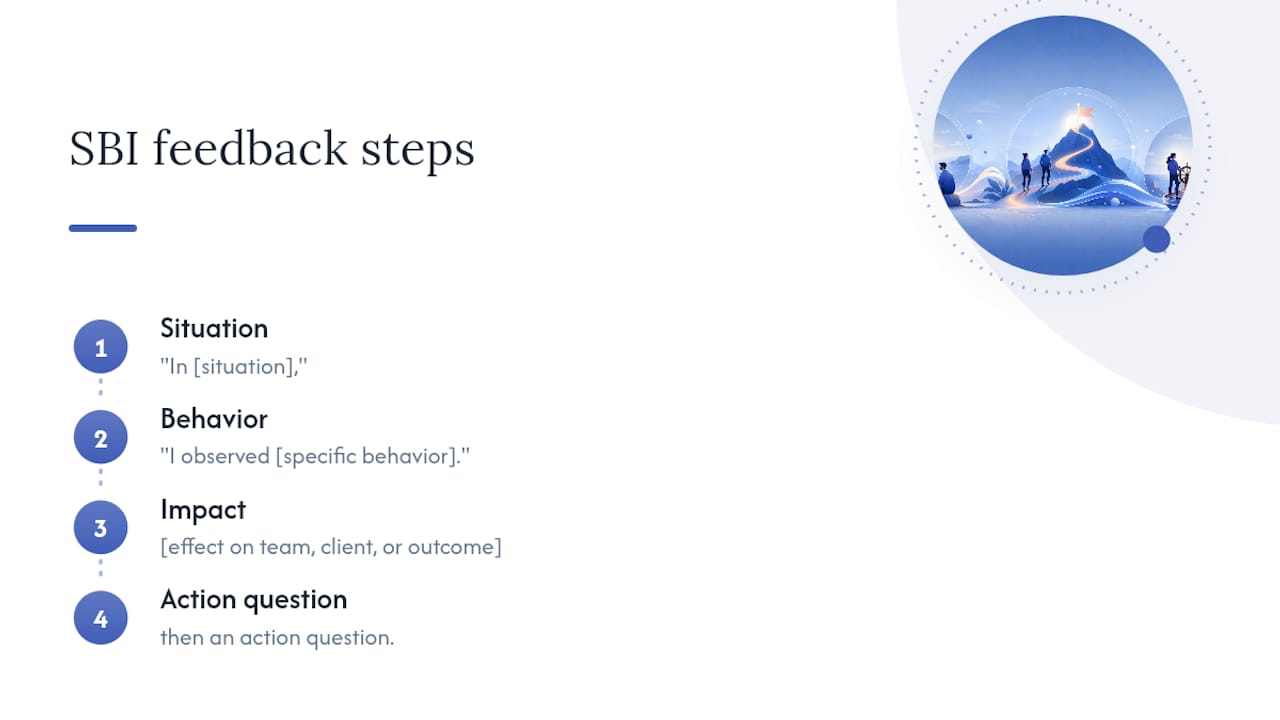
Template: “In [situation], I observed [specific behavior]. The impact was [effect on team, client, or outcome]. What do you think about that, and what would you do differently?”
SBI works because it separates the observable event from the interpretation. You’re not saying the person is careless; you’re saying that in Tuesday’s meeting, they presented slides without the updated figures, and the client asked three clarifying questions that slowed the decision.
CDA: when you need permission first
Contract → Data → Action pairs naturally with SBI and is especially useful for corrective conversations where the employee might be defensive. Coaching Focus describes this approach as a way to create conditions where feedback lands as learning rather than judgment.
Template: “I’d like to share some observations from last week’s calls. Is now a good time?” [Contract] → “I noticed that on three occasions you moved to pricing before confirming the client’s timeline.” [Data, using SBI] → “What’s one thing you could try differently in the next call?” [Action]
DESC: for corrective conversations with a clear behavior change needed
Describe → Express → Specify → Consequences.
Template: “I’ve noticed [describe behavior]. That affects [express impact]. Going forward, I’d like you to [specify the change]. If we get that right, [positive consequence].”
Pro Tip: Use a question-led approach (SBI + action question) when the employee has the experience to self-diagnose. Switch to a direct directive (DESC) when the behavior is safety-critical, time-sensitive, or when the person genuinely doesn’t know what the right behavior looks like.
Positive feedback examples you can use right now
Positive feedback does more than make people feel good. It signals which behaviors to repeat, and it builds the psychological safety that makes corrective feedback easier to receive later. The key is specificity: praise the behavior, name the impact, and deliver it close to the event.
Individual wins:
- “You came into the negotiation with three alternatives ready. That gave you flexibility when the client pushed back on price, and you closed without discounting. That’s exactly the preparation I want to see.”
- “Your project update email on Friday was clear and concise. The team knew exactly what was done, what was pending, and what they needed to decide. That’s the standard.”
- “You caught the compliance gap before it went to legal. That saved us at minimum two weeks of back-and-forth. Well done.”
Team contributions:
- “When the system went down mid-demo, you kept the client calm and pivoted to a whiteboard walkthrough without missing a beat. The rest of the team followed your lead. That kind of composure is contagious.”
- “You shared your objection-handling notes with the new reps without being asked. That’s the kind of behavior that makes this team better faster.”
Customer-facing excellence:
- “The customer left a five-star review specifically mentioning your name and the fact that you followed up the next day. That’s not luck. That’s a habit worth keeping.”
- “You de-escalated that complaint call in under four minutes and the customer ended the call satisfied. Walk me through what you did, because I want you to teach that to the team.”
On personalization: Add one specific detail you actually observed, and match the delivery method to the person. Some people want public recognition in a team meeting; others find it uncomfortable and respond better to a direct message or a private word. Ask once, remember the answer, and use it every time.
Constructive feedback examples that keep the relationship intact
Corrective feedback fails most often for one of two reasons: it’s too vague to act on, or it’s delivered in a way that triggers defensiveness. The fix for both is the same. Anchor the feedback in an observable event, use neutral language, and move quickly to a forward-looking question or suggestion.
Copy-and-paste corrective scripts:
- “On the call recording from Thursday, you gave the pricing before the client confirmed their budget. That puts you in a weaker negotiating position. Next time, try holding the number until you’ve confirmed their range. Want to role-play that scenario before your next call?”
- “Some recent project updates were submitted later than expected. That creates a bottleneck for the rest of the team. What’s making it hard to hit the Thursday cutoff?”
- “In this morning’s team meeting, you interrupted two colleagues before they finished their points. I don’t think you noticed it, but it shut down the conversation. What would help you catch that in the moment?”
What to avoid:
- Personality labels: “You’re disorganized” → replace with “The last three deliverables were missing the summary section.”
- Vague criticism: “You need to communicate better” → replace with “In the client email on Tuesday, the action items weren’t numbered or assigned. Let’s fix that format.”
- Public correction: save corrective feedback for private conversations unless a safety issue requires immediate intervention.
Research from Berkeley’s California Management Review makes the point directly: feedback that specifies a future improvement action and identifies the concrete skill gap is significantly more likely to produce behavior change than critique alone. The corrective message is necessary; the forward-looking path is what makes it land.
Coaching questions that build ownership
Telling someone what to do produces compliance. Asking the right question produces commitment. A question-led coaching style, where you shift from directive to reflective, is more likely to generate self-driven development because the employee arrives at the answer themselves.
Reflection questions:
- “What do you think went well in that conversation?”
- “Where did you feel the momentum shift?”
- “If you were the client in that moment, what would you have been thinking?”
Planning questions:
- “What’s one thing you’d do differently if you ran that call again?”
- “What would ‘great’ look like in that situation?”
- “What’s the first step you’d take to close that gap?”
Barrier questions:
- “What’s getting in the way of hitting that target consistently?”
- “What would need to be true for this to work?”
- “What support do you need from me?”
Strengths questions:
- “When have you handled a situation like this well before?”
- “What did you do in that case that you could apply here?”
A short dialogue showing how this works in practice:
Manager: “How do you think the discovery call went?” Rep: “Honestly, I felt like I lost control when they asked about pricing early.” Manager: “What do you think caused that?” Rep: “I didn’t have a good way to redirect without sounding evasive.” Manager: “What could you say next time to acknowledge the question and buy yourself time?” Rep: “Maybe something like, ‘I want to make sure I give you the right number, so can I ask a couple of questions first?’” Manager: “That’s a solid redirect. Let’s practice it.”
The rep generated the solution. The manager’s job was to ask the right questions and confirm the answer. That conversation takes three minutes and produces more commitment than a five-minute lecture on discovery technique.
When to use questions vs. direct guidance: Use questions when the employee has enough experience to self-diagnose and the situation isn’t urgent. Use direct guidance when they’re new, when the stakes are high and time is short, or when they’ve already tried to solve the problem and are stuck.
Scripts for the situations you face most often
Onboarding check-in (week 2–4)
Situation: New hire is technically capable but hesitant to speak up in team meetings.
Script: “I’ve noticed you have strong ideas in our one-on-ones but you’ve been quieter in the team meetings. I want to hear your perspective in those rooms. In this week’s meeting, I’d like you to share at least one observation. What would make that feel comfortable?”
Follow-up: After the meeting, acknowledge the contribution specifically. “You raised the timeline concern in the meeting today. That was exactly the kind of input we needed.”
Performance 1:1 (underperforming rep)
Situation: Rep’s close rate has dropped over the past two months.
Script: “Your close rate has declined noticeably over the past weeks. I want to understand what’s changed. Walk me through your last three deals that didn’t close. What happened at the decision stage?”
Follow-up: Agree on one specific behavior to change, set a two-week checkpoint, and document it.
Remote collaboration misstep
Situation: Team member is slow to respond on shared projects, creating bottlenecks.
Follow-up: Agree on a simple signal (a Slack message, a status update) and check in after one week.
Call-center or client-call example
Situation: Rep is resolving the surface issue but not addressing the underlying customer frustration.
Script: “I listened to Tuesday’s call. You solved the billing error quickly, which was great. But the customer said twice that they felt like no one had listened to them before. You moved past that to the fix. Next time, try acknowledging the frustration before you go to the solution. Something like, ‘I can hear this has been frustrating, and I want to fix it right now.’ Want to try that on the next call and debrief afterward?”
On gathering evidence: Before any corrective conversation, pull the transcript, recording, or metric. Using session transcripts and scorecards to anchor feedback in observable data removes the “I don’t remember it that way” dynamic and keeps the conversation focused on behavior rather than perception.

How to deliver feedback so it actually gets heard
The best script in the world fails if the delivery is off. These are the mechanics that determine whether feedback lands or triggers a wall.
Delivery checklist:
- Ask permission first. “I have some observations from last week. Is now a good time?” This is the Contract step in CDA, and it matters more than it sounds.
- One issue per conversation. Stacking three problems in one session dilutes all of them. Pick the one that will have the most impact.
- Be specific and brief. State the behavior, the impact, and the ask. Then stop talking.
- Stay future-focused. The past is evidence; the future is the point.
- End with a question or a next step. “What do you think?” or “Let’s check in on this in two weeks” keeps the conversation open.
Common mistakes to avoid:
- The feedback sandwich. Praise, critique, praise. Research is clear that this structure causes the recipient to miss the corrective message. The brain anchors on the praise and dismisses the middle. Be direct about the issue, then move to collaborative problem-solving.
- Vague criticism. “You need to be more proactive” tells someone nothing. “I’d like you to send a status update every Thursday by noon” tells them exactly what to do.
- Waiting too long. Feedback given two weeks after the event is nearly useless. The behavior is gone from memory, and the connection between action and consequence disappears.
- Public correction. Corrective feedback in front of peers is humiliating, not instructive. It damages trust and makes the whole team more guarded.
On cadence: Positive recognition works best when it’s frequent and close to the behavior, ideally within 24 hours. Corrective feedback should be timely but private. Formal performance conversations belong on a regular schedule (monthly or quarterly), but informal coaching moments should happen whenever you observe something worth addressing. A sustainable coaching cadence is one you’ll actually keep, not one that looks good on paper.
Turning feedback into a measurable development plan
A feedback conversation without a follow-up plan is just a conversation. Here’s how to convert it into something trackable.
| Feedback type | Suggested metric | Sample SMART goal | Follow-up interval |
|---|---|---|---|
| Discovery skills | Discovery questions asked per call | Ask open discovery questions consistently over several weeks | Weekly call review |
| Written communication | On-time report submission rate | Submit all weekly reports by the agreed deadline for consecutive weeks | Weekly check-in |
| Objection handling | Objection-to-close conversion rate | Improve close rate steadily over several weeks | Bi-weekly 1:1 |
| Customer empathy | Post-call CSAT score | Achieve high customer satisfaction over multiple calls | Monthly review |
| Meeting participation | Contributions per team meeting | Share at least one observation per weekly meeting for 4 weeks | End-of-meeting note |
Short email template to confirm the coaching plan after a 1:1:
Subject: Our coaching plan from today
Hi [Name],
Thanks for the conversation today. Here’s what we agreed on:
Focus area: [Specific skill or behavior] What success looks like: [Metric or observable behavior] Your goal: [SMART goal] Next check-in: [Date and format]
Let me know if anything is unclear or if you need anything from me before then.
[Your name]
Keep it short. The goal is a shared record, not a performance document. Berkeley HR’s coaching guide recommends documenting the conversation and scheduling the follow-up as part of the coaching process itself, not as an afterthought.
What the research actually says about coaching feedback
Three findings from the evidence base are worth knowing because they directly shape which techniques work.
Quality over quantity. Gallup’s research shows that the specificity and quality of feedback matter more than how often it’s given. A manager who gives one precise, behavior-anchored piece of feedback per week will outperform one who gives five vague comments. This is why the scripts in this article are short and specific by design.
Future focus reduces defensiveness. Berkeley’s California Management Review found that feedback pointing toward a future improvement action, rather than dwelling on past failure, increases the likelihood of behavior change. Framing feedback as preparation for the next high-stakes scenario rather than a post-mortem on the last one makes the benefit of change concrete and immediate.
Stat callout: The CIPD’s evidence review found that strengths-based and feed-forward approaches predict better performance outcomes months later compared with deficit-focused conversations, a finding that holds across industries and seniority levels.
Strengths-based approaches compound. The CIPD evidence review found that starting from positive episodes, identifying the conditions that produced them, and helping employees replicate those conditions predicts sustained performance improvement. This doesn’t mean avoiding corrective feedback. It means the ratio matters, and most managers give too little positive feedback relative to corrective.
A note on study limits: most feedback research is conducted in organizational settings with self-reported outcomes. The directional findings are consistent and replicated, but the exact effect sizes vary by context, role, and manager skill. Use these findings as directional guidance, not precise formulas.
What most managers get wrong about coaching feedback
The conventional wisdom says feedback should be balanced, frequent, and delivered in a structured format. That’s mostly right, but it misses the thing that actually determines whether feedback produces change: whether the employee leaves the conversation with a clear, specific picture of one behavior to change and a genuine belief that they can change it.
Most managers give too much feedback at once. They’ve been saving observations for the monthly 1:1 and they deliver six points in twenty minutes. The employee nods, takes notes, and changes nothing because they don’t know where to start. One behavior, one conversation. That’s the rule.
The second mistake is confusing documentation with coaching. Writing up a performance issue in a system of record is not the same as having a coaching conversation. The paperwork matters for HR purposes, but it doesn’t develop anyone. The conversation is the intervention.
There’s also a tendency to avoid corrective feedback entirely with high performers, on the assumption that they’re fine. High performers often have the most to gain from specific, behavior-anchored feedback because they’re already motivated to act on it. Skipping that conversation is a missed development opportunity, not a kindness.
The managers who get this right share one habit: they treat every feedback conversation as a rehearsal for the next one. They use role-play drills to practice delivering scripts before a real conversation, the same way a rep practices a pitch before a live call. The feedback gets sharper, the delivery gets more natural, and the employee gets a better experience every time.
Practice your coaching scripts with realistic role-play
Reading feedback scripts is a start. Delivering them under pressure, when a rep pushes back or goes quiet, is where the skill actually develops. Xl’s AI-driven role-play platform lets managers and reps rehearse exactly these conversations before they happen in real life.
Two things make it worth trying: first, every session produces a scored coaching report tied to your organization’s methodology, so you can see exactly where the delivery broke down, not just that it felt awkward. Second, the session transcripts give you the same kind of observable evidence you’d use in a real feedback conversation, so you’re practicing the whole loop: observe, name the behavior, ask the question, follow up.
If you lead a sales or customer service team and want to build coaching feedback into a repeatable skill, see how Xl works for sales leaders and start a free trial.
Sources
- Give Feedback Like a Coach
- Action required: the missing component in developmental performance feedback
- A practical guide to giving feedback that people embrace
- Performance feedback: an evidence review, Practice summary
- Coaching with feedback
- Coaching feedback