4 Copy Ready Coaching Report Examples Managers Use with SBI Evidence
4 Copy Ready Coaching Report Examples Managers Use with SBI Evidence

Use a short session note template after every meeting, a monthly progress report for stakeholders, and a competency report when you need validated, evidence-backed development decisions. A coaching report is simply a written record that summarizes a session or a stretch of sessions, tracks measurable progress, and outlines what happens next. Pick the format that matches your audience, then copy one of the templates below and start filling it in after your next call.
TL;DR:
- A coaching report must include client data, session details, progress evidence, action items with owners, and a summary to maintain credibility and usefulness.
- Different formats suit various audiences, with brief decision-ready reports for executives and detailed competency scores for development plans.
- Reports should be corroborated with the coachee beforehand, focus on observable behaviors, and avoid vague language or unverified impressions.
- Consistent documentation, such as weekly notes and transcript-linked scoring, significantly improves coaching impact and ensures progress tracking over time.
- Specialized tools, like platform-based scoring and evidence linking, help automate report generation and enhance the defensibility of competency assessments.
Table of Contents
- What Are Coaching Report Examples and Why Do They Matter?
- Four Copy-and-Paste Coaching Report Examples
- Canonical Structure: Fields Every Coaching Report Should Include
- Choosing the Right Coaching Report Format for Your Audience
- How to Implement and Share Coaching Reports
- What Makes a Coaching Report Defensible
- Common Mistakes to Avoid When Creating Coaching Reports
- Recommendations for Tools or Software to Create and Manage Coaching Reports
- Why Consistent Reports Scale Coaching Impact
- See How XL Roleplay Turns Practice Into Ready-Made Reports
- Sources
- FAQ
What Are Coaching Report Examples and Why Do They Matter?
A coaching report documents what happened in a session or program, what changed, and what comes next. That’s the whole job. The format varies (a one-page note, a quarterly summary, a scored competency profile) but the purpose stays constant across sales, executive, and life coaching alike.
Coaching report templates exist because memory is unreliable and stakeholders need proof, not impressions. A sales manager reviewing six reps a week cannot rely on gut feel about who improved. A sponsor funding a leadership coaching engagement wants to see a trend line, not a vague “things are going well.” Reports built around client information, session details, progress analysis, action items, and a summary give everyone a shared, checkable record instead of a fuzzy memory of a conversation.
Four Copy-and-Paste Coaching Report Examples
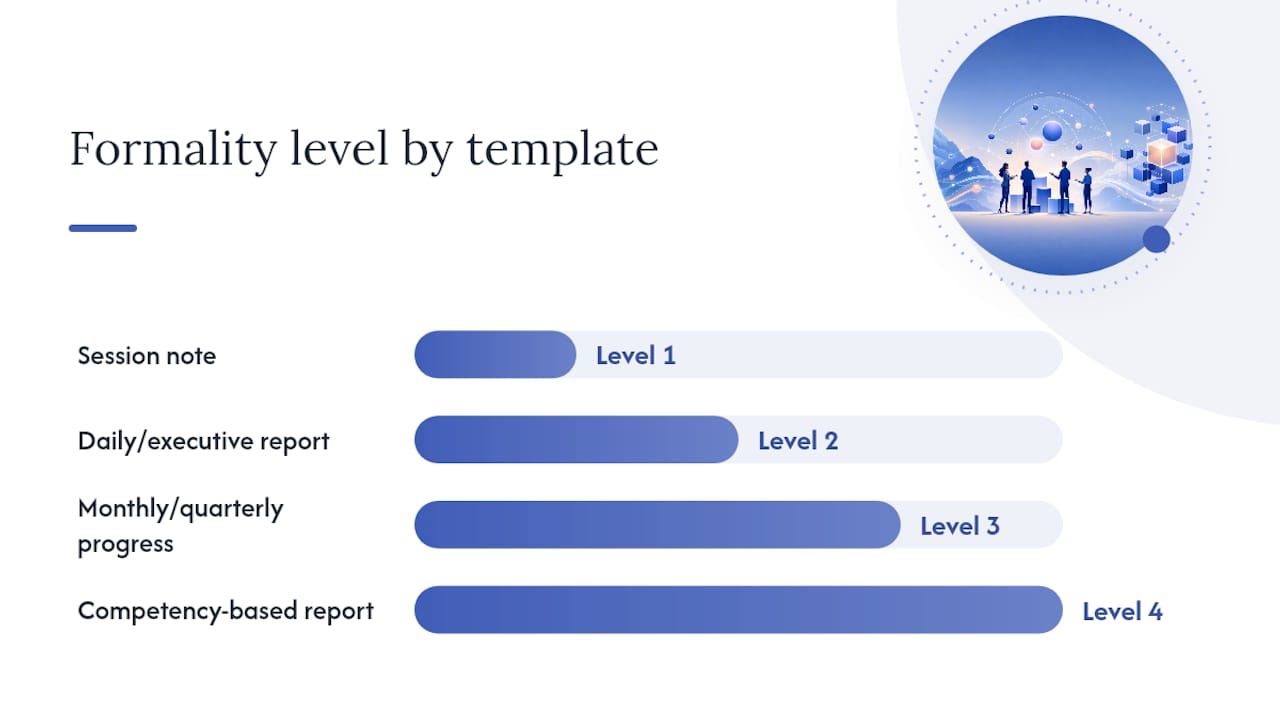
Here are four mini-templates you can adapt today, ordered from lightest to most formal.
1. Session note (use after every meeting)
- Coachee name, coach name, date, session length
- Focus area (e.g., “objection handling on price pushback”)
- What was observed (specific behavior, not a general impression)
- Progress since last session
- One or two action items with owner and due date
2. Daily/executive report (for managers who skim) This variant borrows its structure from formats like the Jotform Daily Executive Coaching Report template, which captures coach and coachee names, session date, focus area, and next steps in a format built for quick review. Keep it to five lines: who, when, what was worked on, the single biggest win or gap, and the next commitment. This is the version that gets read on a phone between meetings.
3. Monthly or quarterly progress report Structure it in four parts: a two-sentence summary, three to five metrics with trend arrows (call volume, close rate, discovery question count), a running action tracker showing what was assigned and what got done, and a short recommendation for the next period. This is the report a sales director actually forwards to their VP.
4. Competency-based report Following the structure used in sample reports like the Psytech competency coaching report, this format lists each competency, a numeric or scaled score, supporting evidence, and a development plan. Critically, it also flags that scores must be discussed with the person before any development action is taken. A score without a conversation is just a guess with a number attached.
Canonical Structure: Fields Every Coaching Report Should Include
Most well-built coaching reports, regardless of industry, share five fields. Missing any one of them is usually why a report feels thin or gets ignored.
- Client/admin data: name, role, date, coach, program or cohort
- Session details: what was covered, methods used, duration
- Progress analysis: what changed since the baseline or last check-in, backed by specific evidence
- Action items: concrete next steps, each with an owner and a date
- Summary/recommendations: a short close that ties the session back to the original goal
The FACET coaching report format from Indiana University follows this same logic in a peer-review context: a review of the original concerns, a description of the process used, recommendations, results, and a closing summary pointing to further resources. That structure transfers cleanly to sales and executive coaching because the underlying need is identical: show the starting point, show the work, show the result.
Pro Tip: Keep your summary section short on purpose. If a claim in the summary can’t be traced back to a note, a transcript, or a metric in the body of the report, cut the claim or add the evidence. Interpretation without evidence is where reports lose credibility.
Choosing the Right Coaching Report Format for Your Audience
Not every coaching relationship needs the same paperwork. Match the format to who is reading it and how often they need to see it.
- Executive coaching: short, decision-ready reports work best. Executives don’t need a play-by-play; they need to know what shifted and what’s next.
- Team or district aggregates: these roll up individual session notes into totals: hours coached, number of reps engaged, average score movement across the group. Sponsors funding a program at scale care about this rollup more than any single session.
- Competency reports: these carry the most weight and the most risk. A score suggesting a development gap has to be checked against the person’s own read on the situation before anyone builds a remediation plan around it.
- Life or performance coaching: somewhere in between; expect more narrative detail on mindset and behavior change than a sales report would carry, but still anchored to specific, observable moments.
Trim the format down for whoever reads it least often, and keep the full detail in the underlying session notes so nothing gets lost when you summarize up.
How to Implement and Share Coaching Reports
A workable cadence matters more than a perfect template. Follow a repeatable sequence:
- Write the session note within 24 hours, while details are fresh.
- Corroborate anything interpretive with the coachee before it goes in a shared report. This step alone prevents most disputes later.
- Roll individual notes into a weekly highlight for direct managers and a monthly or quarterly report for sponsors.
- Share reports through a format the recipient will actually open (a shared doc or a coaching platform beats a buried email attachment).
- Schedule the next check-in before you close the current report, so follow-up isn’t optional.
Get consent before sharing anything beyond the coachee’s immediate manager, especially for competency scores.
What Makes a Coaching Report Defensible
The most reliable structure for observation is SBI: Situation, Behavior, Impact. State when and where something happened, describe the specific observable behavior, and name the consequence. According to the SBI feedback model, keeping “Behavior” strictly observable and “Impact” tied to a real outcome removes guesswork about intent. Example: “In yesterday’s discovery call (Situation), you moved to pricing before confirming budget authority (Behavior), which let the prospect stall the conversation for two weeks (Impact).”
For competency reports specifically, corroboration isn’t optional. The Psytech sample competency report instructs coaches to discuss hypotheses with the respondent before starting any development intervention. A checklist worth keeping on hand:
- Quote the coachee’s own stated goal near the top of the report
- Map every recommendation to a specific piece of evidence, not a general impression
- Assign an owner and a date to each action item
- Confirm competency scores with the person before building a plan around them
Feedback built this way tends to hold up better under scrutiny; structured feedback loops are linked to measurable revenue outcomes when organizations act on them consistently rather than filing them away.
Common Mistakes to Avoid When Creating Coaching Reports
The most common failure is vague language: “good energy,” “needs to improve communication,” “solid effort.” None of that is checkable, and none of it tells the next coach what actually happened. Replace adjectives with specific, timestamped behavior.
The second mistake is skipping corroboration on anything that reads as a judgment about someone’s competency or character. A report that says “shows low resilience under pressure” without ever discussing that read with the person is a liability, not a tool.
Third, reports that mix observation and interpretation in the same sentence become hard to trust. Write what happened, then separately note what you think it means, so a reader can agree with the fact even if they’d interpret it differently.

Fourth, inconsistent cadence kills the whole system. A report written once after three months of silence can’t show a trend, only a snapshot. Weekly or per-session notes are what make a monthly rollup meaningful.
Finally, watch for reports with no owner on the action items. “Follow up on pricing objections” with no name and no date is a wish, not a plan. Every action item needs both.
Recommendations for Tools or Software to Create and Manage Coaching Reports
For solo coaches or small teams, a shared document template (Google Docs or a structured form tool) is enough as long as everyone uses the same fields every time. Form-based tools like Jotform work well for standardizing the daily/executive variant because they force consistent fields instead of letting each coach freelance the layout.
For sales and customer service teams specifically, the harder problem isn’t the template. It’s generating consistent, comparable evidence across dozens of reps without a coach sitting in on every call. That’s where a platform that scores sessions against your own methodology and links every score back to a transcript earns its keep: the report writes itself from evidence that already exists, instead of a coach reconstructing what happened from memory. Look for any tool that lets you export a rubric-based score alongside the underlying transcript, since that pairing is what makes a competency claim defensible later.
Why Consistent Reports Scale Coaching Impact
The gap between coaching that sticks and coaching that fades usually comes down to documentation discipline, not talent. Reps forget verbal feedback within days. A transcript-linked, scored report shortens the loop between a mistake and a manager catching it, because the evidence is already attached instead of buried in memory. That’s the difference between coaching that compounds and coaching that repeats the same correction every quarter.
— Adam
See How XL Roleplay Turns Practice Into Ready-Made Reports
XL is the alternative to relying on a manager’s memory for coaching evidence: every practice session with an AI buyer generates a scored report tied directly to a transcript, built against your own sales methodology instead of a generic rubric.
That means the templates above stop being blank forms you fill in by hand. A rep runs a roleplay against a realistic objection scenario, and the platform produces the session note, the competency-style scoring, and the evidence trail in one pass, ready for a manager to review or forward upward. Teams get live debriefing tools built for exactly the kind of stakeholder reporting covered above. Plans start with Individual access at $99 per month or Business at $599 per month, with extra seats available at $54.95 per month each. If you’d rather test the workflow with your own team first, the XL Roleplay pilot is the place to start.
Sources
- FACET coaching report format (Indiana University)
- COACHING REPORT (COMPETENCY MODEL) — Psytech sample report
- Daily Executive Coaching Report Form Template | Jotform
FAQ
What are some good examples of coaching in the workplace?
Common examples include a manager giving SBI-structured feedback after a client call, a peer coaching session documented with a short note template, and formal competency coaching tied to a development plan, like the report examples above.
What is the 70/30 rule in coaching?
Definitions vary by organization, but it’s commonly used to describe a coaching conversation split where most of the talking comes from the coachee and the coach primarily asks questions rather than giving answers.
What are the 5 C’s of coaching?
There’s no single agreed-upon definition of the “5 C’s” across the coaching field, so treat any specific list you see with caution and focus instead on documented, evidence-based practices like the ones covered here.
Can you provide an example of coaching feedback?
Using SBI: “During the demo (Situation), you skipped the discovery recap before pricing (Behavior), which gave the prospect room to negotiate down before value was established (Impact).” Report templates built around Xl’s transcript-linked scoring generate this kind of feedback automatically from actual roleplay sessions.