Coaching Score Calibration in 60–120 Minutes for School Teams
Coaching Score Calibration in 60–120 Minutes for School Teams

Coaching score calibration is a short, facilitator-led process where multiple educators independently score the same student work with a common rubric, discuss the evidence, and agree on anchor papers. Start by forming a small cohort and bringing an existing rubric, or a draft, to your first session. From there, a facilitator and a set of anchor papers carry the process forward.
TL;DR:
- Use a 60 to 120 minute session, assign a facilitator, recorder, and timekeeper, and have scorers review the rubric and sample papers beforehand.
- Choose analytic rubrics for feedback on separate skills and holistic scoring for quick checks; include borderline samples and annotate anchors with evidence tied to descriptors.
- Have scorers rate papers independently, discuss outliers by citing rubric language, then record consensus; unresolved splits can become new anchors, not forced averages.
- Review anchors during each scoring window, double score one paper every 10 to 20 papers, and track exact agreement plus average score gaps.
- Recalibrate whenever the rubric changes or a rater joins; high stakes programs should assess individual rater effects, since agreement rates can hide systematic severity.
Table of Contents
- Form the calibration cohort and set logistics
- Choose or adapt a rubric and assemble anchor papers
- Run a calibration session: step-by-step facilitator protocol
- Document anchors, roll out calibrated scoring, and maintain calibration
- Monitor reliability and use evidence
- Facilitator best practices for evidence-based discussion
- Calibration as professional learning, not just quality control
- How a training platform helps evidence outlast the calibration meeting
- FAQ
- Sources
- Primary protocols and studies for templates and methods
Form the calibration cohort and set logistics
A calibration session works best with people who actually share the grading load: content or grade-alike teachers, an assessment lead, and ideally an instructional coach who can keep discussion tied to evidence rather than opinion. A smaller subgroup can draft anchor papers first, then bring them to a larger group for norming. That two-step structure saves time because the full team isn’t debating from scratch.
Assign roles before the room fills up:
- A facilitator who keeps the discussion grounded in rubric language and manages time.
- A recorder who logs consensus scores and the reasoning behind them.
- A timekeeper who protects the schedule, especially during the discussion phase.
- Scorers who come prepared with the rubric and, ideally, a few sample papers already reviewed.
Sessions typically run 60 to 120 minutes depending on how many papers you plan to score and how much the group has calibrated before, according to the Scoring and Norming with Anchors Protocol. Ask participants to bring printed or digital copies of the rubric and whatever samples the facilitator has preselected.
Pro Tip: Send the rubric and sample papers ahead of time so scorers arrive with a first-pass score already in mind, not cold.
Choose or adapt a rubric and assemble anchor papers
Analytic rubrics break performance into separate criteria, each scored on its own scale, which works well when you want diagnostic feedback on distinct skills. Holistic rubrics assign a single overall score and tend to move faster when the goal is a quick consistency check rather than detailed feedback. Most school teams use analytic rubrics for coaching and instructional purposes, then shift to holistic scoring only for quick spot checks.

Scale choice matters more than it seems. A 4 point scale forces clearer distinctions between levels, while a 6 point scale allows finer gradations but demands sharper descriptor language, or scorers will drift. Whatever scale you choose, descriptors need to describe observable features of the work, not vague judgments like “strong” or “weak.”
Anchor papers turn rubric language into visible examples. Pick samples across the full range, including papers that sit right at the boundary between two score points, since those are the ones that generate the most disagreement later. Annotate each anchor with brief notes tying specific phrases or sections to the rubric language that justified the score.
- Select anchors across the full performance range, not just the top and bottom.
- Include at least one borderline case between adjacent score points.
- Annotate anchors with short rationale notes linking evidence to rubric wording.
- Store anchors digitally so the whole team can reference them later.
A 2025 university engineering-mathematics study found that rubric-guided peer review reduced peer-grading error by 3 to 5 points across reviewer-target combinations, in a sample of 38 first-year students, suggesting that clear rubric language paired with structured review meaningfully tightens scoring accuracy even among relatively inexperienced reviewers.
Run a calibration session: step-by-step facilitator protocol
A calibration session follows a repeatable sequence, whatever the number of papers being scored.
- Score independently and silently. Each scorer reads the paper and assigns a score using the rubric, writing down the specific evidence that drove the decision.
- Reveal scores together. Use a show of hands, sticky notes, or a shared chart so everyone sees the spread at once, including any outliers.
- Discuss the outliers first. Ask scorers who landed outside the main cluster to point to the exact passage and rubric phrase that shaped their score.
- Reach consensus. Agree on a single score for that paper, or flag it as a new anchor if the discussion clarified something the rubric didn’t capture well.
- Record the rationale. The recorder logs the consensus score and a short note on why, so future scorers can reference the decision.
- Move to the next sample, repeating the cycle until the group’s scores converge without much discussion.
Double scoring, where two scorers independently rate the same paper without conferring, works well as a spot check partway through a session to confirm the group hasn’t drifted. If scores on a double-scored paper are still far apart, that’s a signal to slow down and revisit the rubric language rather than push forward.
Pro Tip: When the group splits roughly in half on a paper, treat that paper as a strong candidate for a new anchor rather than a one-off disagreement.
Document anchors, roll out calibrated scoring, and maintain calibration
Once a session produces agreed scores, the real work is making sure that agreement survives contact with routine grading. Build a shared anchor bank, stored somewhere every grader can reach, with clear rules about who can add or edit entries. An anchor bank that only the facilitator can access gets stale fast.
Decide how scoring will actually happen day to day: some teams score every paper in a group session, which is accurate but slow, while others distribute scoring and only double-score a sample afterward. The Calibration Protocol for Scoring Student Work frames both approaches as valid depending on volume and stakes.
- Publish the anchor bank where every grader can see it, with version notes when descriptors change.
- Require one double-score for every set of papers, commonly every 10 to 20, as a routine spot check.
- Schedule quick recalibration check-ins during active scoring windows, not just once per term.
- Run a full recalibration session whenever the rubric changes or a new rater joins the team.
A short refresh reviewing anchor papers can help keep scoring from drifting over time.
Monitor reliability and use evidence
Calibration isn’t a one-time event you can declare finished. A few simple metrics tell you whether scoring is holding steady: percent exact agreement across raters, average absolute difference between scores on the same paper, and how often any single rater lands as an outlier. None of these require statistical software, just a shared spreadsheet and consistent sampling.
- Track percent exact agreement on double-scored papers each scoring window.
- Track average absolute difference, not just whether scores matched exactly.
- Watch for one rater consistently landing high or low compared to the group.
Large-scale peer-assessment research recommends 3 to 5 raters per document and finds that reliability depends heavily on document-quality variability and rubric detail, meaning your sample set should deliberately include a range of strong, middling, and weak work rather than only clear-cut cases.
For a single classroom or school team, these simple checks are enough. For program-level or high-stakes assessment involving many raters, simple agreement rates can hide systematic rater severity, and that’s when models like generalizability theory or the hierarchical rater model become worth the added complexity, since they estimate individual rater effects rather than just overall agreement.
Facilitator best practices for evidence-based discussion
The facilitator’s job is mostly about redirecting conversation back to the paper, not the opinion. A few prompts do most of the work: “Show me the part of the paper that matches this descriptor” and “Which rubric phrase guided your score?” Both questions force scorers to point at text instead of defending a gut reaction.
- Ask scorers to cite the specific rubric phrase, not just a score, when explaining their reasoning.
- Document any rubric wording that caused confusion, so it can be revised before the next session.
- Keep disagreement focused on evidence, and table personality-driven debates for later.
- Note instructional patterns that surface during discussion, since they often point to a teaching gap, not just a scoring one.
Pro Tip: If a disagreement keeps circling without resolution, write down both interpretations and move on. Resolve the rubric language gap after the session, not in front of a stalled room.
A sales rubric calibration guide built for managers outlines a similar discussion structure, which suggests these facilitator moves generalize well beyond classrooms into any setting where scoring consistency matters.
Calibration as professional learning, not just quality control
Calibration sessions do more than produce consistent scores. They surface how teachers actually read student work, which rubric phrases cause confusion, and where instruction left gaps the rubric exposed. The discussion itself, not just the final consensus score, is often the most valuable part of the meeting.
That’s also where scored, evidence-linked coaching becomes useful beyond the classroom. In sales and service training, we see the same pattern: a rep self-scoring guide that asks reps to score their own performance before a coach reviews it mirrors the independent-scoring step educators use before group discussion. Transcript-linked scoring reports, like the ones our platform generates, give coaches the same kind of evidence a calibration session relies on: a specific moment in the conversation tied to a specific rubric criterion.
— Adam
How a training platform helps evidence outlast the calibration meeting
Calibration sessions solve the agreement problem for a moment in time. Keeping that agreement alive through weeks of routine scoring and coaching is the harder, ongoing part, and it’s where we built XL Roleplay to help sales and service teams specifically.
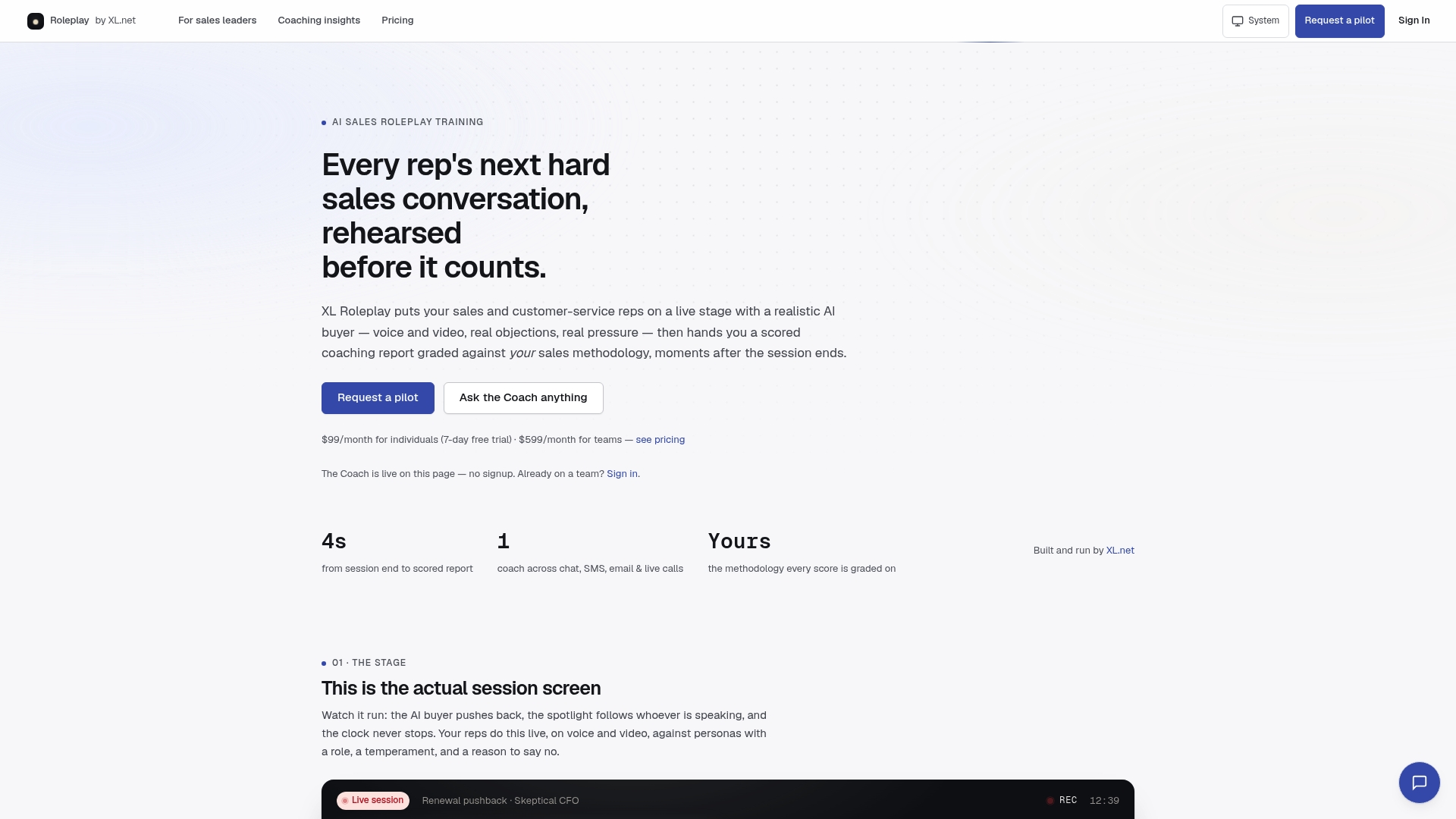
Our platform scores every practice conversation against your organization’s own sales methodology, not a generic standard, so managers reviewing performance are working from the same rubric language every time. Each session produces a transcript linked directly to the score, which means a coach can point to the exact moment that earned a particular rating, the same evidence-based move a good calibration facilitator uses.
- Rubric-linked scoring tied to your own methodology, not a one-size-fits-all model.
- Full session transcripts that connect each score to the specific exchange that produced it.
- Manager-ready reports that make double-scoring or spot-checking a rep’s practice sessions straightforward.
If your team is rolling out calibrated scoring for coaching conversations and wants a way to centralize anchor examples and hold scoring steady over time, our pricing page outlines the Individual and Business plans, and our pilot gives a team a practical way to trial scored role-play sessions before committing.
FAQ
What does calibration mean?
In an educational context, calibration means multiple scorers independently evaluate the same piece of work using a shared rubric, then discuss their reasoning until they reach a consistent, agreed-upon score. It is not averaging different scores together; it requires actual discussion grounded in rubric evidence before a shared interpretation is applied to routine grading.
What are the 7 qualities of an effective coach?
There isn’t a single agreed-upon list of qualities that research or standards bodies treat as canonical, so fixed trait lists should be treated with caution. What the coaching effectiveness literature does support is that structured evaluation, combining measures like satisfaction scales with observable behavior change, gives a far more reliable read on coaching quality than relying on a fixed trait list.
What is the ISO standard for calibration?
ISO 5725-1:2023 addresses the accuracy, trueness, and precision of continuous measurement methods, but it’s a measurement-science standard, not an education-specific rubric calibration framework. Educators running a rubric calibration session shouldn’t claim ISO 5725 compliance; inter-rater reliability and validity evidence are the more relevant concepts for classroom and program-level scoring.
Can I calibrate my own scales?
If you mean physical measurement scales, that falls outside rubric-based scoring and typically requires equipment-specific calibration procedures and certified reference standards, not the facilitator-led protocol described here. If you mean grading scales or rubrics, yes: a small cohort can calibrate a scoring rubric by independently scoring shared samples, discussing the evidence, and agreeing on anchor papers, as outlined in the Calibration Protocol for Scoring Student Work.
How often should a team refresh calibration?
A quick check during each active scoring window, plus a full recalibration session whenever the rubric changes or a new rater joins, keeps scoring from drifting over a semester. Teams that skip refreshes tend to see scores creep apart gradually rather than all at once, which makes periodic spot checks more useful than waiting for an obvious problem.
Primary protocols and studies for templates and methods
Consult the Norming for Program-level Assessment guide and the measurement systems analysis primer for deeper statistical grounding and ready-to-use templates.