B2B Competitor Objections: 68% Have a Favorite; Rehearse the Match
B2B Competitor Objections: 68% Have a Favorite; Rehearse the Match

When a prospect cites a competitor, acknowledge the comment, ask one diagnostic question, and reframe the conversation around outcomes rather than features. That sequence keeps you curious instead of defensive, and it treats the objection as a signal worth decoding rather than a verdict you need to fight.
TL;DR:
- Forrester reports that B2B buyers begin with a preferred vendor 68% of the time, so competitor mentions often reveal a preference, not a lost deal.
- When buyers define their needs clearly, use factual answers; when they are still exploring, frame the discussion around value and outcomes.
- Acknowledge the comparison, ask one open diagnostic question, reflect the answer, then connect the buyer’s concern to a desired outcome and one relevant proof point.
- If the concern is switching risk or implementation proof, offer a pilot, reference call, or focused demo; do not answer with another feature list.
- Rehearse realistic competitor objections in roleplay sessions lasting 20 to 45 minutes, scoring confidence, question quality, and outcome focus before an immediate debrief.
Table of Contents
- What a competitor objection actually looks like
- Why prospects bring up competitors in the first place
- A response framework you can use live
- Scripts for the objections you’ll hear most often
- Diagnostic questions that surface the real objection
- Turning scripts into skill through practice
- What leaders should prioritize, and what to avoid
- How to rehearse these tactics with XL Roleplay
- FAQ
- Sources
- Key research and reports cited
What a competitor objection actually looks like
A competitor objection is any moment a prospect brings another vendor into the conversation, whether as a comparison, a threat, or a simple statement of fact. It can sound like “we’re already talking to someone else,” “your competitor is cheaper,” or “we’ve used [another provider] for years and it works fine.” These statements rarely mean the deal is lost. They usually mean the buyer is testing your response, weighing tradeoffs out loud, or looking for a reason to justify a switch they’re already leaning toward.
The form the objection takes tells you something about what’s actually driving it:
- Price-based: “They quoted us 20% less” signals a value conversation, not necessarily a budget ceiling.
- Feature-based: “They have a feature you don’t” often means the buyer hasn’t connected your offering to their actual use case yet.
- Incumbent-based: “We already work with them” points to switching costs, risk aversion, or simple inertia.
- Timing-based: “We’re still comparing options” suggests the decision isn’t finalized, which is an opening, not a wall.
Each of these deserves a different follow-up, but they share a common root: the buyer is talking, which means they’re still engaged. A prospect who has mentally checked out rarely bothers to explain who else they’re considering. Mentioning a competitor by name, citing a specific feature gap, or quoting a price takes effort, and that effort is usually a sign the buyer wants you to respond well. Forrester’s research on B2B buyer preference backs this up: buyers often arrive with an early-formed preference, and raising a competitor is frequently part of how they validate or challenge that preference out loud. Treating the mention as a closed door, rather than an invitation to clarify, is the most common mistake reps make at this stage.
Why prospects bring up competitors in the first place
Buyer psychology explains most of what looks like competitive pressure on the surface. According to Forrester, B2B buyers start their journey with a preferred vendor 68% of the time, and that preferred vendor wins the deal in a majority of cases. A competitor mention often isn’t a threat to your deal. It’s a reflection of where the buyer’s preference currently sits, and your response at that moment can shift it.
Buyers already favor someone before the first call often decides the outcome, according to Forrester. That makes early conversations less about pitching and more about surfacing and reshaping preference while it’s still forming.
Academic research adds a second layer: how you respond matters as much as what you say. Research on the “match strategy” shows that aligning your message style, informational versus emotional, to the buyer’s shopping goal specificity increases processing fluency and improves purchase outcomes. A buyer who knows exactly what they need responds better to specific, data-driven answers. A buyer still exploring options responds better to value and outcome framing. Mismatching the two, like launching into a feature comparison when the buyer is still forming their criteria, can make your pitch feel harder to process and easier to dismiss.
Competitor mentions can also mask something else entirely: a frozen budget, an unspoken approval chain, or simple risk aversion dressed up as “we’re comparing vendors.” Your diagnostic question in the opening sequence exists precisely to surface which of these is really at play.
Pro Tip: Before responding to a competitor mention, silently ask yourself whether the buyer sounds curious, defensive, or rehearsed. Each tone points to a different underlying concern.

A response framework you can use live
Having a repeatable structure removes the guesswork in the moment and keeps your tone steady, even under pressure. The sequence below works across price, feature, and incumbent objections because it starts with listening rather than rebutting.
- Acknowledge. Validate the comment without agreeing or conceding ground: “That’s a fair thing to bring up.”
- Probe. Ask a specific, open question that targets the real concern: “What’s most important to you in that comparison, cost, outcomes, or something else?”
- Validate. Reflect back what you heard so the buyer feels understood, not managed: “So the switching risk is the bigger worry than the price difference.”
- Reframe. Shift the conversation from features to the result the buyer is trying to achieve: “Let’s set the comparison aside for a second. What does success look like for your team in six months?”
- Evidence or next step. Offer one specific proof point or propose a clear next action, like a demo focused on the buyer’s stated priority.
Tone matters as much as structure. Rushing through the probe step to get to your rebuttal defeats the purpose. Slow down, let the buyer finish their thought, and resist the urge to interrupt with a counterpoint the moment you hear a competitor’s name. If the buyer’s concern turns out to be about risk or proof rather than price or features, that’s the signal to escalate: offer a pilot, a reference call, or a focused demo rather than more talking.
Pro Tip: Keep your reframe question short and open-ended. A long, multi-part question gives the buyer an easy way to answer only the easiest part and avoid the real issue.
Here’s how the sequence might sound in practice, condensed:
“That makes sense, a lot of teams look at both of us.” (acknowledge) “What’s driving the comparison, is it price, functionality, or something about how we’d fit your process?” (probe) “Got it, so the integration piece is the real question.” (validate) “If integration worked exactly the way you needed, how would that change your timeline?” (reframe) “Let me show you how a similar team handled that exact setup.” (evidence)
Scripts for the objections you’ll hear most often
Short, adaptable lines work better than memorized paragraphs because they leave room for the buyer’s actual answer. Use these as starting points, not verbatim scripts.
- “They’re cheaper.” “Price matters, and I want to make sure you’re comparing the full picture. What’s included in their quote beyond the sticker price?”
- “They have a feature you don’t.” “That’s a feature some teams use heavily and others rarely touch. Where does that fit into how your team would actually work day to day?”
- “We already work with them.” “Makes sense, switching anything carries real friction. What would need to be true for a change to be worth that effort?”
- “We’re comparing a few options.” “Smart move. As you compare, what’s the one thing that would make this an easy yes for your team?”
Add a single supporting fact or customer outcome only after the buyer has answered your probe, not before. Leading with a stat before you understand their priority wastes the proof point on the wrong concern. If the buyer cares about implementation risk, a one-line mention of a similar customer’s rollout timeline lands harder than a generic feature list.
The variants shift slightly by call type. On a cold call, keep the acknowledge and probe steps brief since you haven’t earned much airtime yet: one question, one short validation, then a request for a follow-up conversation. In a discovery or demo setting, where you already have more context and trust, you can go deeper on the reframe step and tie the buyer’s answer directly to a part of the product you’re about to show them.
Pro Tip: Write your two or three best rebuttal lines on a sticky note near your desk during your first month of calls. Muscle memory beats recall when a buyer catches you off guard.
Diagnostic questions that surface the real objection
The goal of discovery here is figuring out whether the buyer has a specific, well-defined need (high shopping goal specificity) or is still exploring broadly (low shopping goal specificity), since that distinction should shape your next move.
- Ask early: “What’s prompted you to look at solutions now?” to gauge urgency and specificity.
- Follow with: “Who else is involved in this decision, and what matters most to them?” to locate hidden stakeholders.
- Probe for criteria: “If you had to pick the top two things that would make this decision easy, what would they be?”
- Clarify timeline: “Is there a date this needs to be resolved by, or is it more open-ended?”
- Near the close, confirm: “Based on everything we’ve covered, what’s still unclear or unresolved for you?”
A buyer who answers these with precise details is showing high specificity, and deserves informational, data-backed responses. A buyer who answers vaguely is still exploring, and responds better to outcome and value framing.
Turning scripts into skill through practice
Scripts only help if they hold up under real pressure, and that takes repetition most reps don’t get on live calls. A short roleplay protocol, run in 20 to 45 minutes, closes that gap: pick a realistic scenario (a price objection from a mid-funnel buyer, for example), run a timed call against a partner or an AI persona, score it against a simple rubric, then debrief immediately while details are fresh.
- Measure confidence: did the rep sound steady or rattled when the competitor came up?
- Measure question quality: did the probe uncover a real concern or just restate the objection?
- Measure outcome focus: did the conversation move toward the buyer’s goals or stay stuck on feature comparisons?
Simulated roleplay, including AI-driven roleplay that lets a rep practice against a realistic buyer persona on demand, shortens the distance between knowing a framework and executing it live. Reps who rehearse the acknowledge, probe, validate, reframe sequence repeatedly tend to sound less scripted and more natural when a real buyer brings up a competitor, because the structure has become reflex rather than something they’re reaching for mid-call. Structuring this kind of objection-handling training program around specific drills, rather than general coaching, tends to produce faster improvement.
What leaders should prioritize, and what to avoid
Diagnosing intent matters more than winning a feature-by-feature debate. A rep who jumps straight into correcting a buyer’s facts about a competitor usually loses the thread of what the buyer actually needs. Avoid reflexive discounting; it trains buyers to expect a lower price every time a competitor’s name comes up, and it rarely addresses the real concern. Trade value, not margin, for commitments. Build in regular roleplay practice with quick scorecards so the framework becomes habit rather than theory revisited only after a lost deal.
— Adam
How to rehearse these tactics with XL Roleplay
Reading a framework and executing it under pressure are different skills, and the gap between them is where deals get lost. With XL Roleplay, your team practices against realistic AI buyers who raise competitor objections similar to those your reps encounter, then receives a scored coaching report tailored to your sales methodology rather than a generic rubric.
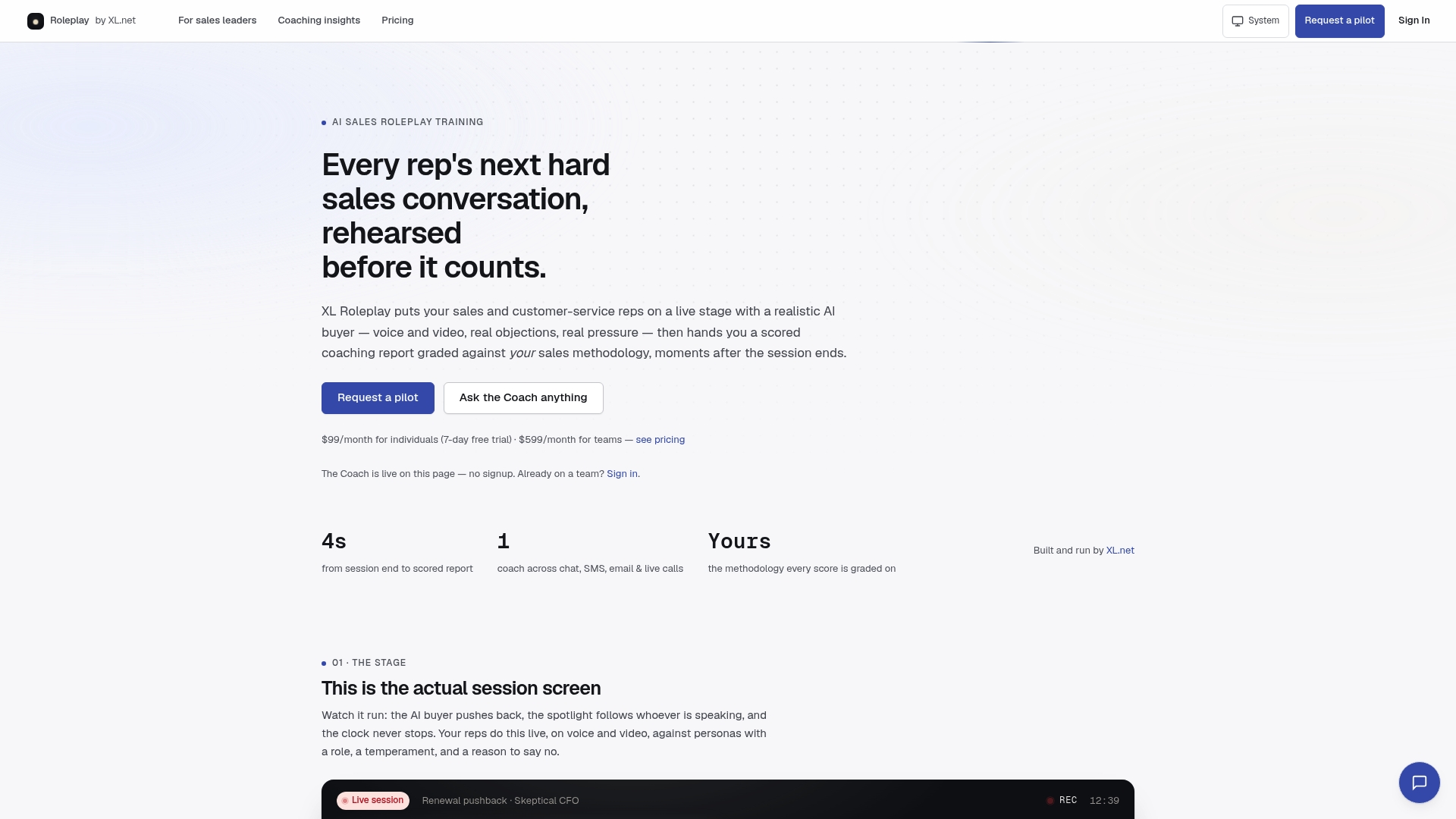
- Sessions generate detailed transcripts so managers can review exactly where a rep’s acknowledge-probe-reframe sequence held up or broke down.
- Scoring ties back to your organization’s specific playbook, not a one-size-fits-all standard.
- Teams can start with a focused pilot to test the approach before rolling it out broadly.
If your team wants to build this kind of practice into a regular habit, our pricing page outlines Individual and Business plans so you can get reps rehearsing competitor objections this week.
FAQ
How do you handle objections in a sales call?
Acknowledge the objection without conceding ground, ask a specific question to find the real concern behind it, then reframe the conversation toward the outcome the buyer is trying to achieve. This keeps the exchange collaborative instead of turning it into a debate you have to win on the spot.
What are the four types of objections?
Objections typically fall into price, feature or product fit, timing, and trust or risk (including incumbent relationships). Competitor mentions can touch any of these categories, which is why a diagnostic question matters more than a prepared rebuttal.
What does objection handling mean in the sales process?
Objection handling is the practice of responding to a buyer’s hesitations or concerns in a way that uncovers the real issue and moves the conversation forward, rather than simply overcoming resistance with a counterargument. It relies on listening and questioning at least as much as on persuasive speaking.
What are the major three objection categories?
Most frameworks group objections into price, product or feature fit, and trust or risk, with timing sometimes treated as a fourth category. A competitor objection can surface under any of these, depending on whether the buyer’s real concern is cost, capability, or the risk of switching.
Sources
- Building preference is the key to winning B2B buyers | Forrester
- The Listening Advantage: Match Your Message to the Buyer’s Shopping Goal
Key research and reports cited
- The Listening Advantage: Match Your Message to the Buyer’s Shopping Goal
- Building preference is the key to winning B2B buyers | Forrester