Conversation Intelligence vs. Role-Play: Which Builds Skill?
Conversation Intelligence vs. Role-Play: Which Builds Skill?

Conversation intelligence and role-play do different jobs. Conversation intelligence turns calls that already happened into searchable evidence. Role-play gives reps a safe place to practice the next call before a buyer is on the line. Most teams do not have to pick one: the calls show you what to fix, and role-play is where reps fix it.
This guide explains what each approach does, where each one falls short on its own, how both compare with static e-learning, and how to connect them. It also covers the recording and privacy questions that come with analyzing real conversations.
TL;DR
- Conversation intelligence is retrospective: it captures, transcribes and analyzes real conversations so managers can see what happened.
- Role-play is rehearsal: reps practice objections, discovery and tough moments in a controlled setting before they matter.
- Use call evidence to decide what to practice, and use role-play to build the habit of doing it well.
- Role-play also differs from e-learning: it is interactive and repeatable, while static modules are watched or read once.
- Recording real customers carries legal and consent duties that vary by state. Practice sessions with AI buyers involve no customer data at all.
Table of Contents
- The short answer: review versus rehearsal
- What conversation intelligence does
- What role-play does
- Side-by-side comparison
- When conversation intelligence should come first
- When role-play should come first
- Role-play versus e-learning
- How to connect call evidence to practice
- Measure with evidence, not just scores
- Recording, consent and customer data
- Our perspective
- Put practice behind what your calls tell you
- FAQ
- Sources
The short answer: review versus rehearsal
Think of a sports team. Game film shows what happened on Saturday. Practice is where players run the play again until it is automatic. Film without practice produces well-informed players who still make the same mistake. Practice without film produces drills that may not match the real game.
Conversation intelligence is the film. Role-play is the practice field. Neither replaces the other, but they answer different questions:
- Conversation intelligence asks: What did buyers actually say, and how did our reps respond?
- Role-play asks: Can this rep handle that objection cleanly the next time it comes up?
If you only have budget or attention for one first step, the right one depends on your situation. We cover that below.
What conversation intelligence does
Conversation intelligence is a category of software and workflow. One vendor-published explainer describes it as turning permitted calls, meetings or messages into searchable evidence and reviewable signals through capture, transcription, speaker separation, language analysis, aggregation across conversations and human review.
A real-world example shows how it works in practice. A January 2025 federal court opinion describes a call-center system that recorded, transcribed and classified calls into a searchable database so the provider could understand callers’ questions and concerns and adjust content and representative scripts.
In a sales or support team, that typically means:
- Searching across hundreds of calls for how often a competitor, a price concern or a specific objection comes up.
- Spotting patterns, such as talk-time ratios or topics that appear in won versus lost deals.
- Giving managers a way to review calls without listening to every minute.
- Surfacing real language buyers use, which makes scripts and messaging more accurate.
Its strength is breadth and realism. It reflects what is really happening in the market, at scale. Its limit is timing: by the time a call is analyzed, the conversation is over, and the rep has not yet rehearsed a better answer. Analysis tells a rep what to change. It does not by itself give the rep a repetition.
What role-play does
Role-play puts a rep into a simulated conversation with a buyer or customer and lets them respond in real time. The buyer can be a manager, a peer, a professional actor or, increasingly, an AI persona that raises objections and applies pressure.
The research on structured role-play is encouraging. A University of Nebraska Omaha study compared 55 students who did a live appointment-setting call exercise with 42 control students. The exercise group reported significantly greater confidence and actual learning in responding to customer objections. In that design, learners practiced scripts and objections, got immediate feedback, were scored on introduction, rapport, objection handling and closing, and then reflected on the experience.
AI-based practice follows a similar pattern. Old Dominion University reported in July 2026 that its AI buyer simulations offer controlled practice, adaptive responses and rubric scoring, and that students significantly improved their scores after six to seven interactions, according to the university’s own account.
The design principles behind effective simulation are consistent across studies. One academic paper on simulation-based sales training describes a workshop built on authentic client cases, reflective participation and a psychologically safe learning environment. That last point matters. A rep who is afraid of losing a real deal will not try a new approach on a live call. In a rehearsal, they can.

Role-play’s strength is that it produces repetitions on demand, with feedback while the attempt is fresh. Its limit is relevance: if the scenarios are generic, reps practice situations that do not match their buyers. That is exactly where call evidence helps.
Side-by-side comparison
| Question | Conversation intelligence | Role-play (human or AI) |
|---|---|---|
| When does it happen? | After the real conversation | Before the real conversation |
| What does it give you? | Evidence: transcripts, patterns, searchable calls | Repetitions: practice with feedback |
| Who is on the other side? | Real customers | A manager, peer or AI buyer |
| Main output | Insight into what is happening | Skill and confidence in handling it |
| Risk to a live deal | None added, but mistakes already happened | Low: mistakes happen in rehearsal |
| Customer data involved | Yes, recorded real conversations | None needed for simulated buyers |
| Best for | Diagnosing gaps and finding patterns | Closing gaps and building habits |
When conversation intelligence should come first
Start with call evidence when:
- You do not yet know what is going wrong. If win rates are slipping and nobody can say why, listening to real calls will point you to the stage or the objection that matters.
- You are building scenarios from scratch. Real buyer language makes simulated buyers more believable.
- You have a large volume of calls. At scale, no manager can sample enough calls by ear.
- You need to check that messaging is being used. Search can show whether reps are saying what the playbook says.
The catch is that insight alone rarely changes behavior. After a review, someone still has to turn the finding into practice.
When role-play should come first
Start with rehearsal when:
- Reps are new. A new hire has few real calls to analyze, and the cost of learning on live prospects is high. Practice lets them get through their first awkward attempts in private.
- You are launching something new. A new product, pricing model or pitch has no call history yet.
- You know the gap but not the habit. If everyone agrees reps struggle with price objections, repetitions beat more analysis.
- Your team handles high-stakes conversations. Renewals, escalations and executive meetings are moments where you want preparation, not a post-mortem.
- You are standardizing a methodology. Role-play with scoring against a shared rubric shows whether reps actually apply the approach you trained them on.
Customer service teams fit here too. De-escalation, refund denials and retention conversations are hard to learn from a slide deck and costly to learn from an angry customer.
Role-play versus e-learning
Some readers are really asking a third question: why not just assign online modules? E-learning has a place. It is efficient for product knowledge, policy and process, anything where the goal is to know something.
Selling and service conversations are about doing something under pressure, and that needs practice. Training Industry reported in May 2025 that AI role-play is interactive and repeatable, unlike static e-learning, and suits scenarios such as objection handling, customer concerns and explaining complex products. The same article cites PwC research claiming that learners using interactive simulation were 275% more confident applying what they learned and finished training four times faster than classroom learners. Treat those as claims reported by the publication, but the direction fits what the academic studies above describe.
A useful split:
| Skill type | Better fit |
|---|---|
| Product specs, compliance rules, process steps | E-learning |
| Discovery questions, objection handling, tone under pressure | Role-play |
| Finding which of those skills need work | Conversation intelligence |
The approaches stack: e-learning for knowledge, call analysis for diagnosis, role-play for skill.
How to connect call evidence to practice
The strongest programs use real calls to decide what reps rehearse, then check later calls to see if it changed. Here is a workable loop.
- Pull a sample of real calls. Pick a stage or topic, such as discovery or pricing, rather than reviewing everything.
- Name the three most common breakdowns. For example: reps skip budget questions, reps discount at the first objection, reps cannot explain a key differentiator.
- Turn each into a scenario. Keep the buyer’s real wording, the pressure and the context. Our guide on building sales role-play scenarios from real calls walks through this step by step. Remove names and identifying details first.
- Define what good looks like. Write a rubric tied to your methodology: what a strong answer includes, what it avoids.
- Practice until the rubric score is stable. The Nebraska Omaha design combined observation, peer or expert feedback, self-assessment and reflection, and that mix is a good template for debriefs.
- Check the next batch of real calls. If the pattern shrinks, the loop worked. If not, adjust the scenario.
For more examples to start from, browse our articles on sales role-play scenarios and role-play exercises for sales.
Teams that also use AI-powered wholesale outreach to start more buyer conversations will find that the objections coming back from those buyers make strong practice material.
Measure with evidence, not just scores
Whether you analyze calls or score practice sessions, a number alone proves little. One guide on conversation analytics recommends linking every label or score to the underlying speaker turn, timestamp and transcript span, allowing for uncertainty and human review, and testing across accents, noise conditions, roles and edge cases.
Apply the same discipline to role-play:
- Read the transcript behind a score before acting on it.
- Have a manager review a sample of scored sessions to confirm the rubric matches their judgment.
- Track change over time per rep and per scenario, not a single snapshot.
- Look for transfer: does a rep who scores well in practice also handle the same moment better on real calls?
Recording, consent and customer data
This is where the two approaches differ most for compliance. Conversation intelligence works on recordings of real people, so consent and disclosure matter. Role-play with a simulated buyer does not involve a customer’s data.
U.S. rules depend on the context and the state. In Tate v. VITAS, a January 2025 California federal ruling, the court allowed claims to proceed where callers were allegedly not told that a third-party software provider recorded and analyzed calls and could use the data for its own purposes. It is a case-specific ruling, not a nationwide consent rule, but it shows why disclosure and vendor terms deserve attention.
State guidance can be stricter. Maryland’s technology department tells agencies to decide actively whether to record instead of recording by default, to avoid capturing sensitive information, and to obtain consent from all participants, noting that notice is required because of the state’s two-party consent requirement. That page is written for state agencies, but the principles are a sensible starting point for any team.
Practical steps before you analyze real calls:
- Ask your legal counsel which consent rules apply in every state where your customers are located.
- Disclose recording clearly at the start of calls.
- Read vendor terms on whether your data can be used for the vendor’s own purposes.
- Limit access to recordings and set retention periods.
- Strip names and account details before turning a real call into a practice scenario.
Our perspective
We built XL Roleplay around a simple observation: most teams already know what their reps should do better. What they lack is a safe place to do it again and again before it counts.
Call review is valuable, and we encourage teams to use what they hear on real calls. But a finding in a dashboard does not change what a rep says on Tuesday morning. Practice does, and practice only works if it feels like the real thing.
That is why our sessions are live voice and video conversations with AI buyers who present typical objections and pressure. Each session ends with a scored coaching report. We designed those reports to be based on your organization’s own sales methodology, not a generic standard, so a rep is coached on the way your company sells.
Managers get the transcript and the rubric behind every score, so coaching conversations start from what was actually said. We also aim for one persistent AI coach with shared memory across channels, so feedback builds on previous sessions instead of starting over.
Our advice: let your real calls tell you what to practice, then put reps in front of a realistic buyer until the skill holds.
Adam
Put practice behind what your calls tell you
If your calls have shown you the gap, XL Roleplay is how reps close it. They run live voice and video sessions against AI buyers, then get a scored coaching report tied to your methodology, with transcripts and rubrics managers can review. Our pricing page lists an Individual plan at $99 per month and a Business plan at $599 per month. Extra seats are $54.95 per month per seat, and extra video is $16.99 per hour.
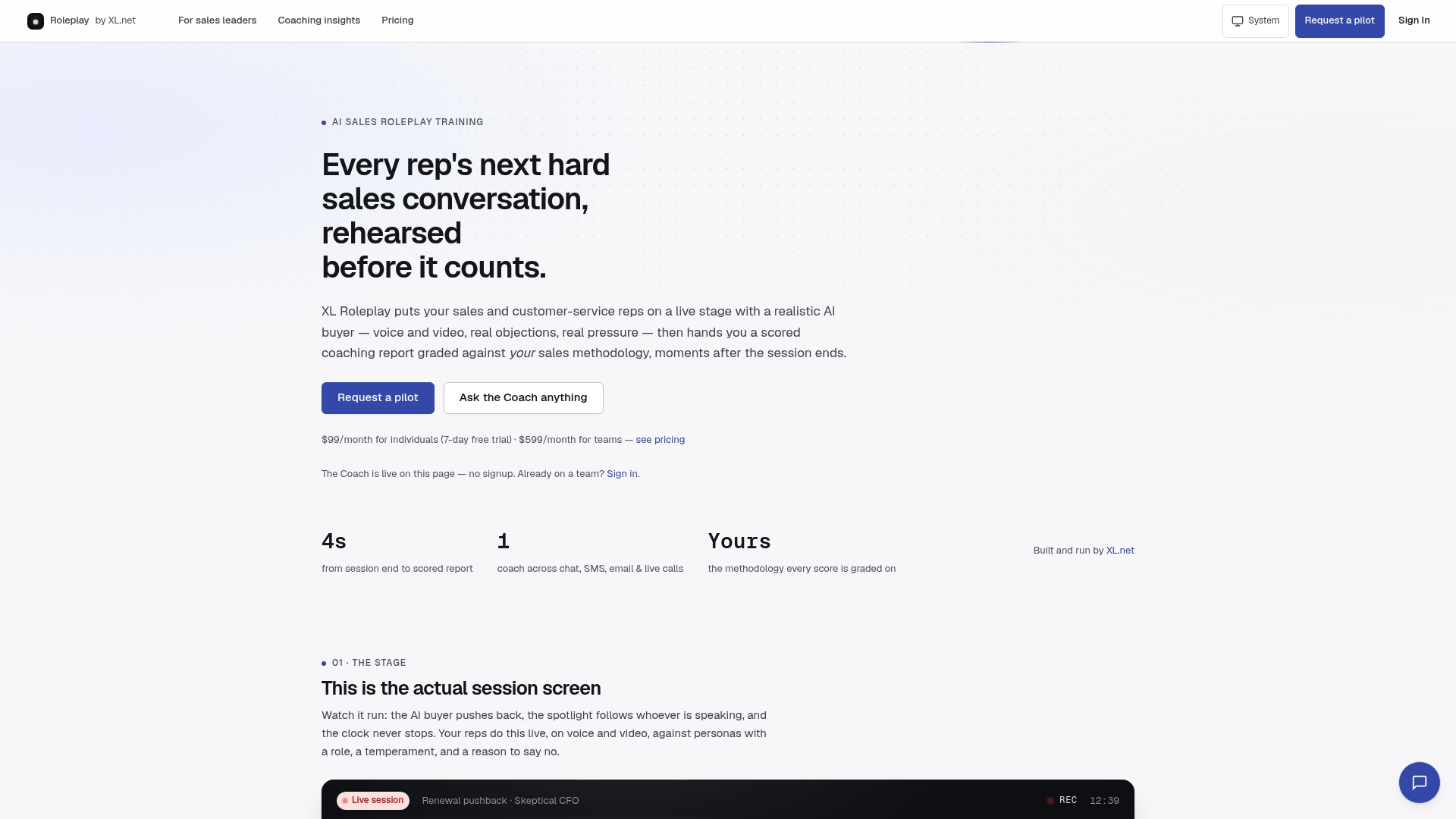
If you want to test the approach with a team first, look at the XL Roleplay pilot. Sales leaders can also see how the platform fits a coaching program on our page for sales leaders.
FAQ
Is conversation intelligence the same as AI role-play?
No. Conversation intelligence analyzes real calls after they end. AI role-play simulates a buyer so reps can practice before the real call. One gives you evidence about past performance, the other gives reps repetitions to improve future performance.
Do I need conversation intelligence before I start role-play?
Not necessarily. Call evidence helps you pick the right scenarios, but new hires, product launches and known weak spots like price objections are good reasons to start practicing right away. Many teams also build scenarios from the objections their managers already hear most often.
Is role-play better than e-learning for sales training?
They do different jobs. E-learning suits knowledge such as product details and policies. Role-play suits skills like discovery and objection handling, because it is interactive and repeatable. Training Industry’s 2025 coverage of AI role-play makes the same distinction, and many teams use both.
Are there privacy concerns with role-play?
Far fewer than with call recording. A session with a simulated buyer does not capture a customer’s conversation. If you build scenarios from real calls, remove names and identifying details first, and check recording and consent rules with counsel for the states you sell in.
How do I know whether practice is working?
Track rubric scores over time for each rep and scenario, read the transcripts behind the scores, and check whether the same objection is handled better on real calls. Improvement that shows up only in practice has not yet transferred.
Sources
- Conversation Intelligence: Workflow, Uses & QA
- Federal court opinion, Case 2:24-cv-01327 (Tate v. VITAS), January 8, 2025
- Objection Practice Using a Live Appointment-Setting Call, University of Nebraska Omaha
- ODU Professor Uses AI to Prepare Students for Real-World Sales Success
- Theoretical Principles of Simulation-Based Sales Training
- Why AI Role-Play Is the Future of Sales and Service Training, Training Industry
- AI Governance Card: AI-Powered Call Recording and Transcription Tools, Maryland DoIT