Cross Sell Role Play for Trainers: Scored Scripts, Rubric, AI Prompts
Cross Sell Role Play for Trainers: Scored Scripts, Rubric, AI Prompts

Use these scored, ready-to-run cross-sell role-plays and AI/human prompts to practice expansion conversations that earn low-friction next steps. Start with the QBR expansion scenario below: it mirrors the most common real-world setup, a satisfied but under-penetrated account. Run it live, score it against the rubric in this guide, and repeat with AI buyers on a platform like XL Roleplay for volume.
TL;DR:
- Practice scenarios should focus on discovering real customer needs before proposing any adjacent products to ensure relevance and build trust.
- Running role-plays with different persona temperaments helps reps develop flexibility and handle objections more effectively in real conversations.
- A successful cross-sell call ends with a specific, low-friction next step like a demo or stakeholder follow-up, not an immediate purchase, especially during onboarding or renewal.
- Scoring should prioritize behaviors such as fact-finding, need confirmation, objection handling, and clear next steps, with evidence documented from actual transaction points.
- XL Roleplay provides scored AI-driven practice sessions tailored to various sales scenarios, helping reps refine skills and improve live account performance.
Table of Contents
- Ready-to-run cross-sell scenario briefs
- Full scripts and dialogue variants you can run or record
- Scoring rubric and evaluation criteria for cross-sell practice
- How to run role-play sessions and coach the debrief
- AI prompts and human actor briefs for realistic buyer behavior
- How XL Roleplay operationalizes these practices
- Examples of successful cross-sell role play outcomes
- Why the best cross-sell reps aim lower on purpose
- Run these exact scored simulations with XL Roleplay
- Templates and instructor resources used in this guide
- Sources
- FAQ
Ready-to-run cross-sell scenario briefs
A good scenario brief takes less than a minute to read and gives the rep everything needed to walk into the room cold: who they’re talking to, what the account looks like, and what a win sounds like. Below are three briefs you can hand to a rep or feed into an AI role-play tool with no editing.
QBR expansion scenario. The buyer is a happy customer nearing contract renewal who has never used a second product line. Objective: secure a pilot, demo, or a specific stakeholder follow-up, not a signed order. Timebox: 12 minutes. Opening line for the rep: “Before we get into renewal numbers, I wanted to ask how the rollout’s gone for the ops team since Q2.”
Skeptical existing-account scenario. The buyer likes the core product but has been burned before by an upsell that didn’t fit. Objective: earn permission to explore an adjacent offer, nothing more. This only works as a legitimate cross-sell drill when the rep first acknowledges the value the customer already gets, then uncovers a real gap before naming any second product, a sequence MangoApps’ ethical cross-sell template builds the entire scenario around. Skip straight to a pitch and the drill stops teaching cross-sell and starts teaching a cold pitch instead.
Onboarding transactional add-on scenario. The buyer just signed and is mid-implementation. Objective: secure a low-friction next step, such as a 15-minute add-on demo, without derailing onboarding momentum.
When you pick a scenario, match difficulty to the rep’s experience:
- New reps: give them the onboarding add-on scenario first since the buyer starts warm and receptive.
- Mid-level reps: run the QBR expansion scenario with a neutral-to-friendly persona temperament.
- Senior reps or those prepping for a specific account: run the skeptical scenario with a cool, guarded persona and add one hard price objection.
- Anyone prepping for a renewal call: pair the QBR scenario with a persona who has a competing vendor already circling.
Persona temperament is the easiest lever to adjust and the one trainers underuse. A “warm” persona nods along and asks clarifying questions. A “neutral” persona answers questions but volunteers nothing. A “cold” persona pushes back on the premise of the call itself, questions why the rep is bringing up anything beyond renewal, and makes the rep earn every piece of information. Running the same scenario brief across all three temperatures turns one scenario into three distinct drills without writing new material.
For teams pulling scenarios from actual call recordings rather than building them from scratch, there’s a useful walkthrough on building role-play scenarios from real calls that covers how to anonymize and adapt live conversations into repeatable drills. If your team runs a dedicated expansion or upsell motion separately from new-logo sales, a library of expansion and upsell drills is worth building alongside general cross-sell practice, since the buyer psychology and objection patterns differ slightly between the two motions.
One detail matters more than any persona setting: the scenario should never let the rep present the adjacent offer before some evidence of need exists. Consultative sales training built around structured discovery, including Northern Arizona University’s role-play materials on discovering customer needs, treats needs discovery as its own exercise that has to happen before any solution gets proposed, sometimes at a separate appointment entirely for complex deals. Build that discipline into the scenario brief itself: no add-on mention until the buyer has said something, fact-based or feeling-based, that justifies it.
Full scripts and dialogue variants you can run or record
Scenario briefs tell a rep what to do. Scripts show them what it sounds like. Use these three as written for a first pass, then strip the rep’s lines and hand only the buyer’s side to whoever is running the AI persona or playing the buyer.
- QBR expansion, satisfied but under-penetrated buyer. Rep opens with the rollout question above. Buyer responds positively: “Honestly, it’s been smooth. The team barely thinks about it anymore, which is what we wanted.” Rep probes for a feeling-based signal: “That’s great to hear. Is there anything that still feels manual or annoying, even if it’s minor?” If the buyer names a gap (a manual reporting step, a workaround another team built), the rep connects it to the adjacent product in one sentence and asks for a follow-up: “That’s actually close to what our reporting module handles. Would a 15-minute look make sense before your renewal call?” Instructor note: pause the scene right after the buyer names the gap and ask the rep what question they’d ask next before letting the scene continue. That pause is where most reps either nail the discovery-to-offer bridge or skip straight to pitching.
- Ethical cross-sell to a skeptical small-business buyer. Buyer opens guarded: “We’ve had vendors push add-ons on us before that didn’t do anything.” Rep should not defend the pitch yet. Instead: “That’s fair, and I’d rather not waste your time either. Can I ask what happened last time?” Buyer raises a source objection (“the last one came from a account manager who clearly had a quota to hit”). Rep addresses it by grounding the conversation in the buyer’s own data, not a sales target. Buyer then raises timing (“we’re mid-quarter, bad time to change anything”). Rep should handle source and timing before any mention of price, which matches the sequencing NAU’s negotiation model recommends for staged resistance. Only after both objections are handled does the buyer raise price, at which point the rep uses a feel-felt-found response tied to the specific gap already surfaced. Close with a low-pressure ask: “Would it make sense to just see the module in action, no commitment, before you decide anything?”
- Onboarding add-on, low-friction next step. Buyer is mid-implementation and slightly overwhelmed. Rep should not add cognitive load: “I know you’ve got a lot going on right now, so I’ll keep this short.” Rep names one adjacent capability in plain language, ties it to something already in the onboarding plan, and offers a specific, bounded next step: “Once you’re through week two, want me to send a 10-minute recording of how teams like yours usually set this up?” Buyer accepts or defers, either is a fine outcome. Instructor note: score this script on restraint as much as skill. A rep who pushes for a same-call yes here should lose points even if the buyer eventually says yes.
Branching variants and channel adaptations. Each script above works differently by channel. On the phone, reps lose visual cues entirely, so they have to verbalize pauses and confirm understanding out loud more than they would on video. On video, watch for the buyer’s engagement signals (checking phone, one-word answers) as a cue to shorten the pitch. In chat or asynchronous messaging, the entire discovery sequence has to happen in fewer, denser messages, so cut the small talk and get to the diagnostic question faster. For a harder branch, have the buyer accept the low-friction next step, then immediately try to renegotiate it into a bigger ask (“actually, can you just include this in our current contract at no extra cost?”), which tests whether the rep holds the boundary they agreed to.
Scoring rubric and evaluation criteria for cross-sell practice
Score behavior, not vibes. A rep can sound confident and still skip discovery entirely, and a nervous rep can still hit every required behavior. The dimensions below come from how collegiate sales programs structure competitive evaluation, which favors observable actions tied to transcript evidence over subjective impressions.
- Opening and rapport: did the rep reference something specific to the account rather than a generic greeting?
- Fact-finding: did the rep ask at least one question that surfaced a concrete detail (usage, team size, workflow)?
- Feel-finding: did the rep ask a question aimed at motivation or frustration, not just facts?
- Need confirmation: did the rep restate the gap in the buyer’s own words before proposing anything?
- Benefit-to-need match: did the adjacent offer connect directly to the confirmed gap, with no generic feature dump?
- Transparency: did the rep disclose cost or change implications without being asked?
- Objection handling: did the rep address source and timing concerns before price, and without getting defensive?
- Clear next step: did the call end with a specific, scheduled, low-friction action rather than a vague “let’s circle back”?
Use a mix of scales. Some behaviors are pass or fail: either the rep asked permission to explore the adjacent offer or they didn’t. Others need nuance, so score fact-finding and feel-finding on a 1 to 4 scale anchored to examples, where a 1 means no probing question was asked and a 4 means the rep asked a follow-up question based on the buyer’s prior answer. Collegiate sales competition formats commonly run this kind of scoring inside a timed 12-minute call, which keeps evaluation consistent across reps and simulates the time pressure of a real conversation.
Record evidence as you score, not after. Note the timestamp and a short quote for each dimension (“2:40, rep asked ‘what feels manual’ after buyer mentioned the reporting workaround”) so feedback in the debrief points to a specific moment instead of a general impression. Scoring on transcript evidence rather than overall confidence is the difference between a rubric that trains reps and one that just ranks them.

How to run role-play sessions and coach the debrief
The session format matters as much as the script. A well-written scenario run badly still produces weak skill transfer, while a modest scenario run with a tight structure and sharp debrief can move the needle fast.
- Set the format before the room fills up. A 12-minute timed call with a scored observer works well for skeptical-buyer scenarios that need pressure. Paired drills, where two reps alternate buyer and rep roles, work better for onboarding add-on scenarios where the goal is reps practicing restraint. AI-simulated buyers work well for repetition: run the same scenario five times in an afternoon to build muscle memory on discovery questions before ever putting a rep in front of a live account.
- Debrief on one behavior at a time. Pick the single weakest dimension from the rubric, name it specifically (“you jumped to the offer before confirming the gap”), and have the rep re-run just that portion of the scene immediately. This one behavior, re-run approach produces faster improvement than a broad “good job, a few things to work on” summary, and it mirrors the structure covered in XL Roleplay’s debrief guide.
- Give SMART feedback tied to the transcript. Instead of “ask better questions,” say “at minute 3, ask a follow-up to the buyer’s answer about the manual workaround instead of moving to the pitch.” Link the feedback to the exact moment it applies.
- Rotate roles and personas across the group. Don’t let the same two reps pair every session. Rotating who plays buyer versus rep, and rotating persona temperament, exposes each rep to more objection patterns over fewer total sessions.
Pro Tip: Re-run the last 90 seconds of a weak role-play immediately after the debrief note, not at the next session, while the correction is still fresh.
Three pitfalls show up constantly. Overcoaching stalls a session when a trainer interrupts every small stumble instead of letting the rep recover mid-scene, which is a skill reps need live. Letting scripts run uncontrolled, with no timebox and no rubric, turns practice into theater with no measurable output. And failing to tie the practice to a concrete next step, inside the scenario itself, teaches reps to treat cross-sell as a pitch rather than a negotiated outcome. For broader guidance on structuring sessions reps actually want to attend, this guide to running sales role-play training covers format and engagement in more depth.
AI prompts and human actor briefs for realistic buyer behavior
A scenario brief is only as good as the persona behind it. Whether you’re running the buyer through an AI platform or briefing a colleague to play the role, the persona needs specific triggers, not just a job title.
- Skeptical CFO persona: background in cost control, triggers on any mention of “upgrade” or “additional investment,” responds to ROI framed in the account’s own numbers, de-escalates only when the rep names a specific, bounded cost.
- Operations lead persona: cares about implementation friction more than price, triggers on vague claims like “it’s easy to set up,” responds well to a rep who names exactly what setup involves.
- Internal champion persona: already likes the core product, triggers positively on being asked for their opinion before being pitched, will volunteer objections other stakeholders might raise if asked directly.
Human actor cue cards should give the same specificity: “raise a price objection only after the rep confirms a specific gap” or “if the rep pushes for a same-call commitment, get noticeably less receptive.” That sequencing, source and timing objections before price, keeps the drill realistic rather than letting the buyer object at random.
When reviewing an AI-generated transcript, trust the structural signals (did the rep ask permission before pitching, did they confirm the need in the buyer’s words) and treat small wording oddities in the AI’s phrasing as noise. The rubric dimensions matter more than whether the simulated buyer’s sentence sounded perfectly human.
How XL Roleplay operationalizes these practices
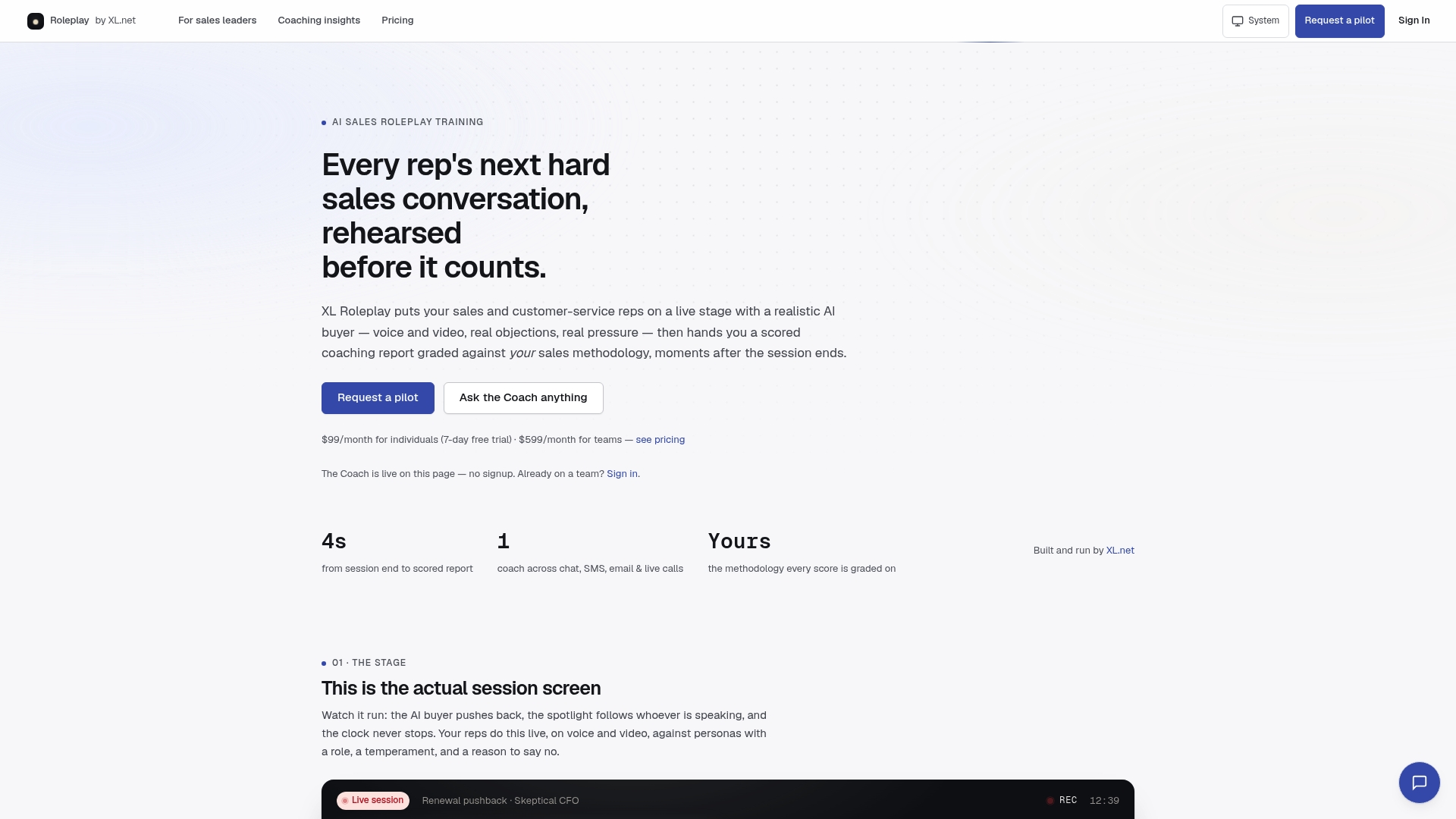
XL Roleplay runs the scenarios above as live voice and video sessions against AI buyers built to hold source, timing, and price objections in sequence rather than random order. Reps get a scored coaching report immediately after each session, built against the rubric dimensions covered here, opening, fact-finding, feel-finding, need confirmation, objection handling, and next-step clarity. Every session produces a full transcript, so managers can pull the exact quote a rubric score is based on rather than relying on a trainer’s memory of the call. Reports are scored against each organization’s own sales methodology rather than a generic standard, which matters for cross-sell specifically, since what counts as an acceptable next step varies by account type and industry.
Examples of successful cross-sell role play outcomes
The clearest signal that a cross-sell role-play is working isn’t a rep landing a same-call upsell, it’s a rep walking out of practice able to name the gap before naming the product. In the QBR expansion scenario, a successful run looks like the rep asking two or three feeling-based questions, letting the buyer name a specific frustration unprompted, and then proposing a bounded next step, a short demo or a stakeholder introduction, rather than a purchase decision on the spot. In the skeptical-buyer scenario, success looks like the rep handling a source objection without getting defensive and earning a “sure, show me” instead of a hard no.
Teams that measure outcomes this way, and tie role-play practice explicitly to a concrete next step such as a pilot, a demo, or a second meeting, tend to see that discipline carry over into live accounts more reliably than teams that treat role-play as a rehearsal for closing on the spot. That’s consistent with what ethical cross-sell templates emphasize: relevance and trust, not pressure, produce the outcomes worth repeating.
Why the best cross-sell reps aim lower on purpose
The instinct to push for a signed upsell in the room is the biggest thing holding cross-sell training back. A pilot, a demo, or a specific follow-up is a better target in most scenarios, because it matches what the buyer can actually say yes to without new procurement or budget approval. Reps who practice asking for the small, real yes build trust that compounds across renewals. Reps trained to chase the big yes burn trust the first time they guess wrong about timing.
— Adam
Run these exact scored simulations with XL Roleplay
Everything in this guide, the QBR script, the skeptical-buyer sequence, the rubric dimensions, works as a live session inside XL Roleplay, where AI buyers hold objections in the source-then-timing-then-price order and every call ends with a scored report tied to your own methodology instead of a generic standard.
- Individual plan runs $99 per month for reps practicing solo against AI buyers, priced on the pricing page.
- Business plans are available that include shared scenario libraries and manager review across reps.
- Teams that want a short proof-of-value run before committing can start with the XL Roleplay pilot.
Sales leaders evaluating this for a full team should start on the page built for sales leaders, which covers manager-side reporting and rollout details beyond what an individual rep sees.
Templates and instructor resources used in this guide
- MangoApps’ ethical cross-sell template for structuring a skeptical-buyer scenario from goal to next step.
- NAU’s consultative role-play scripts on separating discovery from proposal.
- Kansas State’s collegiate sales evaluation framework for timed, rubric-based scoring.
- Callflow’s cross-sell training playbook for additional scenario ideas and drill structures.
Sources
- Ethical Cross-Sell to a Skeptical Customer Template — Sell with trust | MangoApps
- Role-Play III — Discovering Customer Needs (Buying Conditions) — Northern Arizona University
- Collegiate sales competition / evaluation guidance — Kansas State University (College of Business Administration)
FAQ
What is the 3-3-3 rule in sales?
Definitions of the 3-3-3 rule vary by trainer and organization, and no single source in this guide defines a canonical version. Rather than force a fit, focus on the structure covered above: discovery before proposal, staged objection handling, and a clear next step, which applies regardless of which naming convention a team uses.
What does role-playing in sales actually involve?
Sales role-play is a rehearsal exercise where a rep practices a real conversation type, like a cross-sell or an objection-heavy call, against a simulated buyer, either a human colleague following a cue card or an AI persona. The goal is to build the conversation skills, like discovery questions and objection sequencing, before the rep faces a live account with the same pattern.
What are some examples of cross-selling?
Cross-selling means offering a customer an additional, related product alongside what they already use, such as suggesting a reporting module to a customer already using a core platform for daily operations. The MangoApps cross-sell template frames a strong example as one plausible adjacent offer tied to a gap the customer has already confirmed, not a stack of unrelated add-ons.
Is there a free AI sales role-play platform?
Free options and trial tiers exist across the category, and availability changes often, so check current offerings directly with each provider. XL Roleplay offers a free trial and a pilot program for teams that want to test scored AI role-play sessions before committing to a paid plan, detailed on its pilot page.