Customer Service Readiness Score: What It Measures and How to Build One
Customer Service Readiness Score: What It Measures and How to Build One

A customer service readiness score is a single number, built from observable behaviors in realistic conversations, that tells you whether a rep is prepared to handle real customers. It is not a customer health score, and it is not a satisfaction survey. It looks at the rep, before the customer is ever at risk. The strongest scores come from scored practice on realistic scenarios, graded against one rubric that matches how your team is supposed to sell and serve. That is the approach XL Roleplay is built around: AI buyers and personas, live voice and video sessions, and scored coaching reports tied to your own methodology.
This guide shows what goes into the score, how to weight it, where to set the passing bar, and how to turn the result into coaching.
TL;DR
- A readiness score measures a rep’s preparedness for live conversations: discovery, objection handling, empathy, accuracy and resolution. It does not measure account health.
- Build it from a short rubric with observable behaviors, weighted by what matters most in your calls, and scored on scenarios every rep faces the same way.
- Set a passing threshold and a few automatic-fail items, as contact centers do in their evaluation forms.
- Check that the score predicts results by comparing it with QA scores, CSAT and escalations over 60 to 90 days.
- Scored practice with transcripts lets managers coach from evidence instead of impressions.
Table of Contents
- What a customer service readiness score actually measures
- The metrics that show a rep is ready
- How to calculate the score
- Interpreting the score
- Proving the score predicts real performance
- Why scored practice beats other ways to assess readiness
- Turning scores into coaching
- How XL Roleplay fits
- Our perspective
- Common mistakes when building a readiness score
- FAQ
- Sources
What a customer service readiness score actually measures
Readiness answers one question: if this rep took the call today, would they handle it the way you need them to? The score is a summary of how a rep performed across practice conversations, expressed as points, a percentage, or a band such as ready, nearly ready, not yet.
That makes it different from the metrics people often confuse it with.
Readiness versus customer health
A customer health score combines signals such as product usage, engagement, support activity and renewal behavior to judge the state of an account, predict retention risk and spot expansion opportunities. It describes a customer. A readiness score describes your people.
The two formats look alike. A health score can be expressed as points from 1 to 100, letter grades, or green, yellow and red colors, and a readiness score can use the same formats. What differs is the input: account data for health, rep behavior for readiness.
There is also a useful lesson to borrow. The ChurnZero handbook advises balancing quantitative and qualitative data, because hard numbers alone miss customer needs and motives, while leaning only on subjective sentiment invites bias. A readiness score has the same trap. Call counts and quiz results are easy to collect, but they say little about how a rep sounds when a customer pushes back. Behavior in a realistic conversation, scored against clear criteria, is the signal that matters.
Readiness versus outcome metrics
CSAT, first-contact resolution and handle time are outcome metrics. They tell you what happened after a rep met real customers. A readiness score is a leading indicator: it shows whether the rep can do the job before outcomes are at stake. For a new hire, that gap is where the cost of learning on live customers sits.
The metrics that show a rep is ready
A good rubric scores what you can hear and read in the conversation. Four to six criteria are enough for most teams. These are the ones that separate prepared reps from unprepared ones.
- Opening and verification. Does the rep greet clearly, confirm identity where required, and set the agenda for the call?
- Discovery or issue diagnosis. Does the rep ask questions that uncover the real problem, rather than the first one the customer mentions?
- Objection handling. Does the rep listen fully, clarify the underlying concern, answer with relevant information, and keep the conversation moving?
- Empathy and communication. Tone, pacing, plain language, and acknowledgment of the customer’s situation.
- Accuracy and process knowledge. Correct policy, correct answers, correct next steps.
- Resolution or escalation. Does the call end with a clear outcome, or a clean handoff?
Published QA templates show how teams weight these. One July 2026 call QA scorecard guide splits sales calls into opening 10%, discovery 25%, value presentation 20%, objection handling 15% and closing 20%. For support calls it uses opening and verification 15%, issue diagnosis 20%, empathy and communication 20%, accuracy and process knowledge 20%, and resolution or escalation 15%. Treat these as a starting point, not a standard. Your weights should reflect where your calls are won or lost.
Objection handling deserves its own line
Objections are where scripts stop helping. A customer who says the price is too high, the policy is unfair, or that they want a manager is testing judgment. If objection handling is buried inside a general “communication” score, a rep can pass while failing the hardest moments. Give it a separate line and score it on specific behaviors: let the customer finish, name the concern back to them, answer it, and move forward.
How to calculate the score
The arithmetic is simple. The hard part is making the inputs trustworthy.
Step 1: Pick the scenarios
Choose five to ten situations that reflect your real call mix: a routine request, a billing dispute, an angry caller, a request outside policy, a customer who asks something the rep does not know. Every rep practices the same set, so scores are comparable. For service teams, the difficult customer scenarios and angry customer role-play articles on our site are a good place to build that list.
Step 2: Write the rubric
Use observable behaviors, not personality labels. “Restates the customer’s concern before answering” can be scored by anyone reading the transcript. “Seems caring” cannot. A simple three-level scale per behavior (missed, partial, met) keeps graders consistent. If you want templates to start from, see our QA scorecard templates collection.
Step 3: Weight and total
Give each criterion a weight, score each behavior, and combine. A worked example with four criteria:
| Criterion | Weight | Rep’s rating | Points |
|---|---|---|---|
| Accuracy and process | 30% | Met (full) | 30 |
| Issue diagnosis | 30% | Partial (half) | 15 |
| Empathy and communication | 20% | Met (full) | 20 |
| Objection handling | 20% | Partial (half) | 10 |
| Readiness score | 100% | 75% |
The rep scores 75%. The total hides the useful part: the weak spots are diagnosis and objection handling, and those are what the next practice session should target.
Step 4: Add pass bars and automatic fails
A total alone can mislead, because a strong score in one area can cover a serious miss in another. Contact centers solve this with gates. Amazon’s Connect evaluation forms workshop shows a worked form with Compliance and Security at 30%, Agent Behavior 25%, Transaction Handling 25% and Customer Experience 20%. It sets a 70% passing threshold and makes failed identity verification an automatic fail. It also includes specific rules, such as scoring zero when silence runs 45 seconds or longer.
You can copy the structure without copying the numbers: choose a pass mark, then name the two or three behaviors that fail a rep regardless of total, such as skipping verification or promising something policy forbids.
Interpreting the score
Points and bands only matter if everyone reads them the same way. A workable scheme:
- Ready: at or above the pass mark with no automatic fails. The rep can take live calls.
- Nearly ready: within a set margin of the pass mark. Targeted practice on the lowest criteria, then re-score.
- Not yet: below the margin or any automatic fail. Structured practice and coaching before live calls.
Two cautions keep the score honest. First, one session is a snapshot. Look at the trend across several scenarios and several days, since a rep can have a good or bad run. Second, a score is only as good as the rubric behind it. If two managers would grade the same transcript differently, tighten the behavior descriptions before you trust the number.
Proving the score predicts real performance
A readiness score earns trust when it lines up with results. The Kirkpatrick model applied to customer service training gives a clear path. Scenario-based testing (how would you respond if a customer says this) measures learning and predicts on-the-job behavior better than multiple-choice recall. Behavior can then be checked by comparing QA scores of trained employees against a control group, or against their own scores before and after, over 60 to 90 days. Results show up in CSAT, first-contact resolution, handle time, complaint volume, escalation rates, NPS and retention.
In practice, that means tracking three things side by side: readiness scores in practice, QA scores on live calls, and outcome metrics. If reps who score high in practice also score high on live QA and escalate less, the score is doing its job. If not, revisit the scenarios and the rubric.

Why scored practice beats other ways to assess readiness
There are several ways to decide a rep is ready. Time in seat is the weakest, because it measures the calendar and not the person. Quizzes measure recall, and they miss how a rep sounds under pressure. Asking reps whether they feel ready measures confidence. Shadowing and live observation show real behavior, but they put customers in the loop and depend on which calls happen to come in.
Scored role-play puts the rep in a realistic conversation with the same scenario, same pressure and same rubric as every other rep. Nobody’s customer is at risk, and the manager gets a transcript to point at. This is the part XL Roleplay handles. Reps hold live voice or video conversations with AI buyers and personas that raise typical objections and pressures, and each session produces a scored coaching report. Because the report follows your organization’s own methodology, the score reflects how your team is meant to sell or serve, not a generic standard.

Managers see the evidence
Every session comes with a transcript and a rubric, so a manager reviews what the rep said, not a summary of it. Coaching conversations become specific: here is the moment you accepted the objection instead of clarifying it, here is how it scored. Readiness scoring and evidence-based tracking for individuals and teams show who is progressing, who is stuck, and who is ready for live conversations.
Turning scores into coaching
A score is only useful if it changes what happens next. A simple loop:
- Score the rep on a standard scenario set.
- Pick the lowest-weighted gap, not the lowest raw score. A small miss on a heavily weighted criterion matters more.
- Practice that behavior in a new scenario that stresses it.
- Debrief with the transcript, one behavior at a time.
- Re-score and record the trend.
For teams working on tough calls, our articles on handling difficult customers and practice for difficult customers walk through the specific behaviors worth drilling.
How XL Roleplay fits
If you want a readiness score without building the scenarios, graders and reporting yourself, XL Roleplay gives you the pieces in one place: customized scenario libraries, live voice and video sessions, scored coaching reports based on your methodology, transcripts, readiness scoring and live debriefing tools.
The Individual plan is $99 per month, which suits a single rep or a manager who wants to try the approach. The Business plan is $599 per month for teams, with extra seats at $54.95 per month per seat and extra video at $16.99 per hour. You can see all of it on the pricing page. Leaders who want to test it with a group first can look at the XL Roleplay pilot, and the page for sales leaders explains how teams use it to standardize methodology.
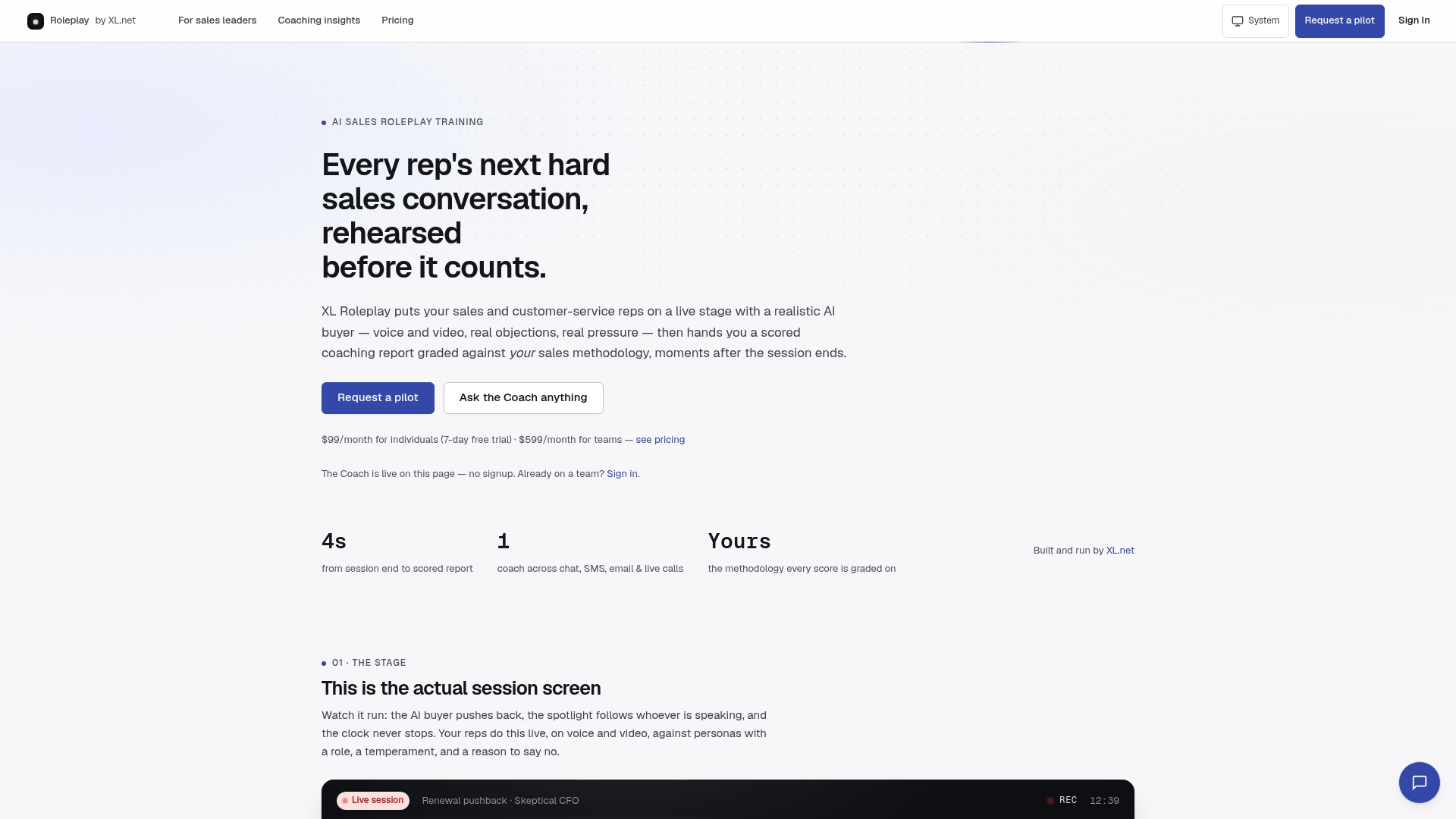
Because the platform keeps one persistent AI coach with shared memory across channels, a rep’s practice history informs the next session. You can also text with the XL Roleplay Coach between sessions.
Our perspective
Most readiness programs fail the same way: the number is easy to produce and hard to believe. A score built on quiz results or manager impressions gives a rep a grade, but it does not give anyone a conversation to learn from.
We build XL Roleplay on the opposite idea. Readiness should come from what a rep actually says to a realistic buyer or customer, graded against your playbook, with a transcript behind every point. When the rubric is your own methodology, the score tells a manager something they can act on, and it tells a rep exactly what to practice next.
That is also why we keep a persistent coach with shared memory instead of one-off exercises. Readiness is a trend, not a test, and a coach that remembers last week’s session can push on the same weakness until it is fixed.
Adam
Common mistakes when building a readiness score
- Too many criteria. Past six or seven, graders lose focus and scores blur. Keep the rubric short.
- Vague descriptors. If a criterion cannot be scored from a transcript, rewrite it as a behavior.
- One scenario only. A single call tells you about that call. Use a set that covers your real mix.
- Ignoring the gates. A high total with a compliance miss is not ready.
- Never checking against outcomes. Compare scores with live QA and customer metrics at 60 to 90 days, and adjust.
FAQ
What is a good customer service readiness score?
It depends on your rubric, so set the pass mark yourself. Many contact center evaluation forms use a threshold around 70%, as in Amazon’s worked example, together with automatic-fail items. Start there, then adjust after you compare practice scores with live QA results.
Is a readiness score the same as a customer health score?
No. A customer health score describes the state of a customer relationship across several dimensions. A readiness score describes whether a rep is prepared for conversations. Use health scores to decide which accounts need attention and readiness scores to decide who is ready to handle them.
How often should reps be re-scored?
Score every rep on the standard scenario set before they take live calls, then again after each coaching cycle. For tenured reps, a regular cadence on fresh scenarios keeps skills current. Watch the trend across sessions rather than a single result.
Can new reps use a readiness score before their first live call?
Yes, and that is where it helps most. Scored practice on realistic scenarios gives a new rep a clear bar to reach and gives the manager evidence for the go-live decision, rather than relying on the calendar.
Sources
- Customer health score: Everything you need to know
- The customer health score handbook
- Customer health score: models, metrics and how to calculate
- Call Quality Assurance Scorecard: Template + Examples
- Amazon Connect: Evaluation Forms Workshop
- How to Measure Customer Service Training Effectiveness