Sales Managers: Start Data Driven Coaching With One 15 Minute Session
Sales Managers: Start Data Driven Coaching With One 15 Minute Session

Data-driven sales coaching turns call recordings, CRM activity, and conversation scores into specific, repeatable coaching actions instead of gut-feel feedback. The outcome managers should expect is measurable: reps close more deals, ramp faster, and skills like discovery and objection handling improve on a documented timeline. Expect three artifacts to anchor the work — a per-call conversation score, a rolling coaching score for each rep, and a talk-time ratio that flags who’s actually running the conversation.
TL;DR:
- Managers should focus on two to three key metrics, such as conversation score, talk-time ratio, or discovery depth, that directly link to desired sales outcomes.
- Weekly coaching sessions should be short, structured, and centered on one metric at a time, following the 5–10–10–5 format to ensure consistency.
- Most coaching programs see measurable improvements within two to four weeks for activity metrics and require up to 90 days to observe significant impact on deal win rates and ramp times.
- Using scoreable roleplay exercises against AI buyers helps generate reliable, repeatable data and concrete feedback, reducing reliance on live calls.
- Avoid pitfalls like punishing reps, tracking too many metrics, skipping action plans, or inconsistent coaching; standardization and framing feedback as development prevent these issues.
Table of Contents
- How Do You Build a Data-Driven Coaching Program?
- Which Metrics Actually Belong on a Manager’s Scorecard?
- What Does a Weekly Coaching Conversation Look Like?
- How Do You Measure Coaching ROI at the Program Level?
- What Mistakes Sink Data-Driven Coaching Programs?
- How Roleplay Data Makes Coaching Concrete
- A Manager’s Take: Start With One Session, Not One System
- Turning the Playbook Into Practice With XL Roleplay
- Sources
- FAQ
How Do You Build a Data-Driven Coaching Program?
You don’t need a data science team to start. You need a short list of priorities, a baseline, and the discipline to run the same process every week.
Here’s a six-step sequence that works for most B2B sales teams:
- Align on outcomes (sales leadership, week 1): Pick the business result coaching needs to move, whether that’s win rate, ramp time, or average deal size.
- Pick 2 to 3 KPIs (sales ops + managers, week 1): Choose metrics that map directly to that outcome, not everything your CRM can report.
- Baseline current performance (managers, week 1 to 2): Pull 30 to 60 days of history so you have a “before” to compare against later.
- Run timeboxed one-on-ones (managers, ongoing): Weekly, structured, tied to the KPIs you picked.
- Run small experiments (managers, ongoing): Test one coaching intervention per rep at a time so you know what caused the change.
- Review and adjust (leadership, every 30 days): Check whether the metrics are moving and whether the coaching approach needs to change.
For tooling, you don’t need an enterprise stack on day one. The minimum viable setup includes:
- Conversation analytics or call recording with scoring
- Your existing CRM for activity and pipeline data
- A simple log of coaching sessions and follow-up actions
Gartner’s guidance on sales metrics makes a point that’s easy to miss here: the bottleneck usually isn’t the data, it’s translating it into a coaching action a manager knows how to run. Build that translation step into every stage above, or the dashboards become wallpaper.
Which Metrics Actually Belong on a Manager’s Scorecard?
Most sales teams track too much and act on too little. A manager’s scorecard works better with a handful of metrics that tie directly to behavior, not a wall of vanity numbers.
The core set worth tracking:
- Conversation score: A rubric-based rating of a call against your methodology, usually scored on discovery, objection handling, and next steps.
- Talk-time ratio: The share of the call the rep spends talking versus listening. A ratio above 60% often signals the rep is pitching instead of discovering.
- Discovery depth: The number and quality of open-ended questions asked before any pitch begins.
- Close attempts: How often and how directly the rep asks for the business.
- Deal velocity: How fast opportunities move between pipeline stages.
- Win rate: Closed-won deals as a share of qualified opportunities.
- Ramp time: How long a new rep takes to reach full quota productivity.
Pro Tip: If a rep’s talk-time ratio drops substantially over a month but win rate hasn’t moved yet, that’s not necessarily a failure. It usually means the discovery habit is forming before the revenue outcome catches up.
Pick 2 to 3 primary metrics per coaching cycle. Mindtickle’s research on data-driven coaching points out that generic, one-size-fits-all coaching moves behavior less effectively than coaching tied to a rep’s specific gap. Metric overload just recreates the same generic problem with more dashboards.
What Does a Weekly Coaching Conversation Look Like?
Consistency beats intensity. A short, structured weekly session run the same way every time beats a sprawling monthly review that covers everything and fixes nothing.
The format that scales across managers is a 5–10–10–5 session, built around one metric at a time:
- Open (5 minutes): State the single metric you’re focused on this week and why it matters to the rep’s goals.
- Review the data (10 minutes): Walk through one or two call excerpts tied to that metric, letting the rep self-assess first.
- Plan the fix (10 minutes): Agree on one specific behavior change to try in the next five calls.
- Commit (5 minutes): Confirm the follow-up date and what “improvement” will look like on the scorecard.
Managers should prep by picking call excerpts in advance, not scrambling during the session, and by setting a target that’s specific enough to check next week (“ask three open discovery questions before pitching,” not “improve discovery”). BlueEye Advisory’s framework for this rhythm specifically warns against stacking multiple metrics into one conversation. One metric, one fix, one week.
How Do You Measure Coaching ROI at the Program Level?
Manager-level coaching shows up fast: a talk-time ratio or conversation score can shift within two or three weekly sessions. Program-level outcomes take longer. Win rate and ramp time typically need a full quarter of data before the trend is trustworthy.
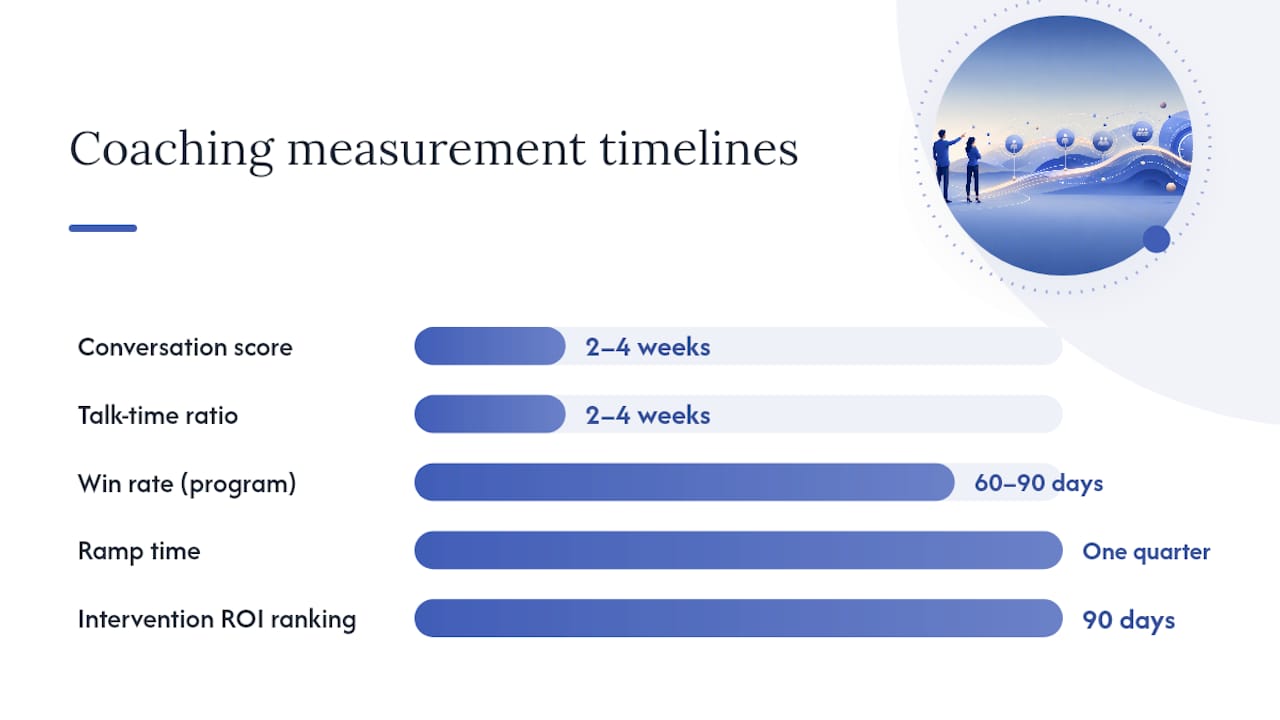
That gap is where most coaching programs lose executive support. Revenue notes that most organizations report coaching activity (sessions held, hours logged) instead of outcomes, and that habit makes budgets vulnerable when finance asks what coaching actually bought.
Intervention ROI fixes that. Calculate it as score improvement per hour of coaching invested, then compare that number across managers to build an effectiveness ranking:
| Measurement | Level | Typical timeline |
|---|---|---|
| Conversation score trend | Manager | 2 to 4 weeks |
| Talk-time ratio change | Manager | 2 to 4 weeks |
| Coached vs. uncoached win rate | Program | 60 to 90 days |
| Ramp time comparison | Program | One quarter |
| Intervention ROI ranking | Program | 90 days |
A 90-day review works well as the checkpoint where intervention ROI becomes meaningful, according to Revenue.io’s analysis of coaching program measurement. For that review, bring:
- Cohort comparison: coached reps versus a control group on win rate and deal velocity
- Manager-effectiveness ranking by score improvement per hour coached
- Two or three qualitative excerpts (a call clip plus a rep’s own reflection) alongside the numbers
That combination of quantitative scorecards and qualitative evidence matters more than either alone. A literature review on coaching impact frameworks found that systematic approaches mixing both data types produce more reliable estimates of what coaching actually changed.
What Mistakes Sink Data-Driven Coaching Programs?
The tooling rarely kills these programs. The rollout does.
- Using data punitively. The moment a scorecard becomes a weapon in a performance review, reps stop being honest in coaching conversations and start managing the metric instead of the skill.
- Tracking too many metrics. Ten KPIs on a dashboard means no KPI gets acted on. Cut to two or three per cycle.
- Skipping the action plan. Reviewing a call score without agreeing on one specific change wastes the session; the data becomes a report, not a coaching tool.
- Inconsistent manager skill. If one manager runs sharp, focused sessions and another rambles through a call recording with no structure, reps notice, and trust in the whole program erodes fast.
The fix for all four is the same: standardize the 5–10–10–5 format across every manager, review manager-level ROI the same way you review rep performance, and frame every session as development, never discipline.
How Roleplay Data Makes Coaching Concrete

Coaching data is only as useful as the conversations it comes from, and most managers don’t have enough recorded live calls to build a reliable scorecard for every rep every week. Practice sessions fill that gap. A rep running structured roleplay against a realistic AI buyer generates a scoreable conversation on demand, without waiting for a live call that may or may not surface the exact objection you’re coaching toward.
That approach gives managers a few concrete advantages over relying on live-call data alone:
- Repeatable scenarios mean you can measure the same skill (say, handling a pricing objection) across the whole team under identical conditions.
- Scored reports tied to your own sales methodology turn a subjective “that call went okay” into a rubric-based number you can track over time.
- Detailed transcripts let managers point to the exact sentence where a rep missed a discovery question, rather than relying on memory after the call ends.
A coaching session built around a transcript and a rubric score removes the guesswork from “how did that call go.” The manager and the rep are looking at the same evidence, line by line, instead of arguing over impressions.
This is exactly the kind of structured data BlueEye Advisory’s coaching framework assumes exists before a manager sits down for a 5–10–10–5 session. If you want to see how teams build these practice scenarios from real call patterns, this breakdown of building roleplay scenarios walks through the process in more detail.
A Manager’s Take: Start With One Session, Not One System
Data-driven coaching works when it’s framed as development, not surveillance. Reps who feel measured for punishment stop giving you honest calls to coach from.
Skip the full rollout. This week, run one 15-minute session using the 5–10–10–5 format, built around a single KPI you actually care about. Watch what happens before you build anything bigger.
— Adam
Turning the Playbook Into Practice With XL Roleplay
Every step in this playbook depends on having enough scoreable conversations to coach from, and that’s the gap XL Roleplay is built to close. Reps run live voice and video sessions against AI buyers using a scenario library, and each session comes back with a coaching report scored against an organization’s specific methodology.
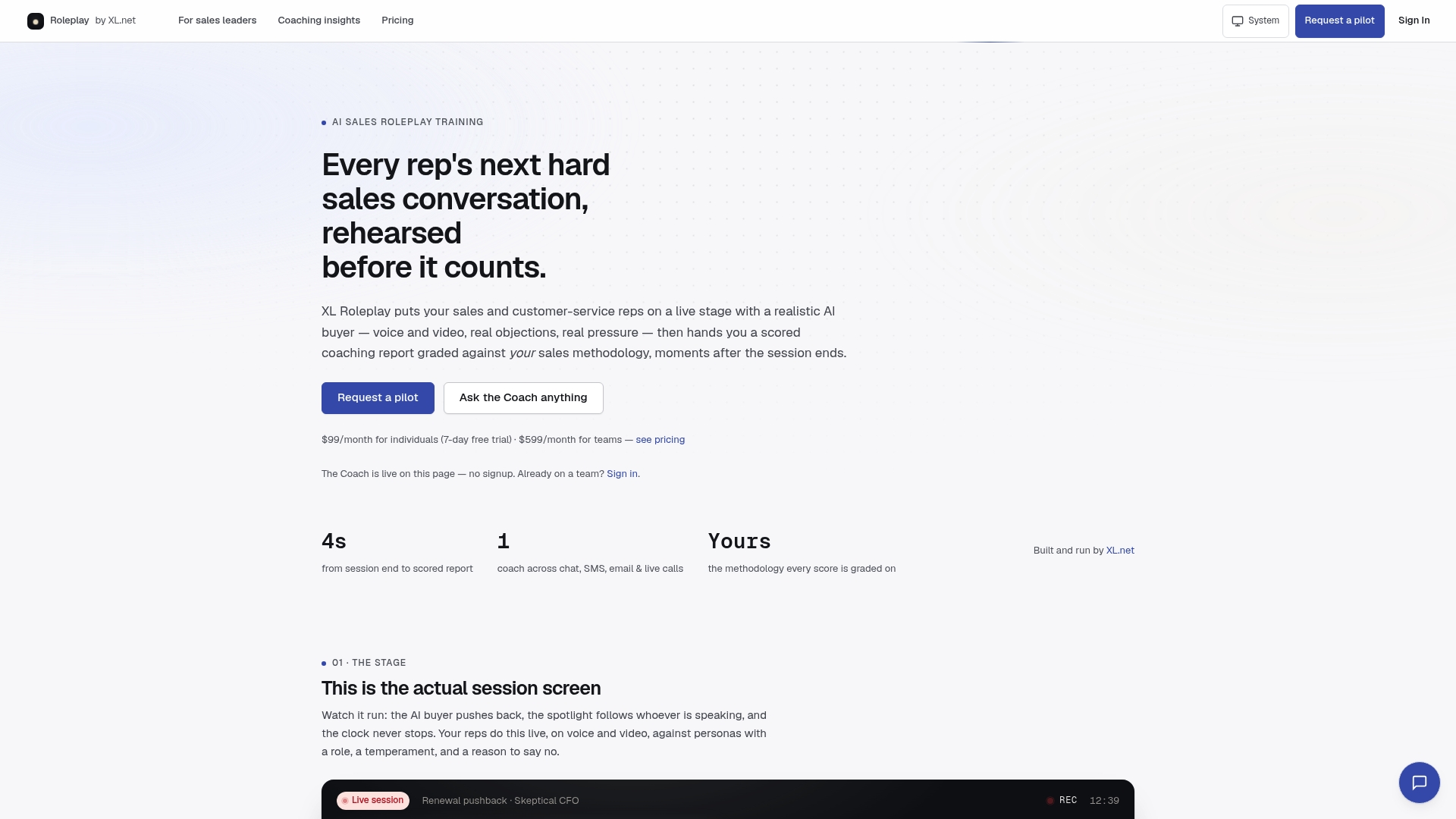
That means the artifacts this article recommends—conversation scores, discovery-depth data, and transcript-linked feedback—are available on demand rather than assembled after the fact from whatever calls happened to get recorded. Managers get transcripts they can point to line by line during a 5–10–10–5 session, and reps get a low-stakes way to practice the exact skill being coached.
If you’re rolling out a data-driven coaching program and need a faster way to generate the underlying data, the XL Roleplay pilot is a practical starting point for teams that want to test scored roleplay sessions before committing. Plan and pricing details, including Individual and Business tiers, are on the pricing page.
Sources
For deeper detail on the frameworks referenced above, Gartner’s guidance on sales metrics and Revenue.io’s coaching ROI research cover measurement design in more depth. On the learning-science side, feedback loop design for engagement offers useful parallels for structuring coaching feedback cycles.
- How to Use Sales Metrics for Data-Driven Coaching
- How to Measure Whether Your Sales Coaching Program Is Actually Working | Revenue
- Frameworks for assessing the impact of coaching (literature review)
- The Manager’s Guide to Data-Driven Coaching Conversations | BlueEye Advisory
FAQ
What Are the 5 C’s of Coaching?
Definitions vary across coaching frameworks, but a common version centers on clarity, connection, curiosity, commitment, and consistency in how a manager runs a coaching conversation. Applied to data-driven sales coaching, clarity means picking one metric per session, and consistency means running the same format, like the 5–10–10–5 structure, every week.
Who Are the Top Sales Coaches to Learn From?
Rather than three individual names, the strongest signal comes from organizations publishing research on coaching methodology, including Gartner, Revenue.io, and enablement platforms like Mindtickle. Following the frameworks these groups publish tends to be more useful than following a single guru’s method.
What Is the 70/30 Rule in Coaching?
The 70/30 rule generally refers to a coaching conversation where the rep talks roughly 70% of the time and the manager talks 30%, keeping the session collaborative rather than a lecture. It mirrors the same talk-time principle sales reps are coached on with buyers, applied to the coaching relationship itself.
What Are the Steps of Data-Driven Decision Making in Sales Coaching?
The core sequence is: define the outcome you want, pick the metrics that predict it, collect a baseline, run a focused intervention, and review the result before deciding what to change next. This mirrors the six-step playbook above, and it’s the same loop BlueEye Advisory’s coaching framework recommends running every week rather than once a quarter.
How Much Does XL Roleplay Cost?
XL Roleplay’s Individual plan is $99 per month and the Business plan is $599 per month, both listed on the pricing page. Extra seats and additional video hours are available as add-ons at published per-seat and per-hour rates on that same page.