De-Escalation Techniques That Actually Work Under Pressure
De-Escalation Techniques That Actually Work Under Pressure

The fastest way to safely defuse most tense situations is to combine calm self-regulation, empathic listening, and simple boundary-setting. That’s the core claim, and everything else in this guide builds on it.
Before anything else: if you see a weapon, hear a direct threat, or sense imminent physical harm, stop and call 911. No technique is worth your safety.
Here are the five techniques you can remember under stress:
- Slow your voice. Drop your pace and lower your pitch before you say anything else.
- Give space. Give space to maintain a safe and comfortable distance and angle your body slightly rather than squaring up.
- Name the emotion. “You sound really frustrated” lands faster than any logical argument.
- Paraphrase. Repeat back what you heard in your own words to show you’re listening.
- Offer a choice. “Would you prefer to talk here or somewhere quieter?” gives back a sense of control.
Key Takeaways
Effective de-escalation requires combining self-regulation, empathic listening, and clear limit-setting, with a firm rule to disengage and call for help when physical safety is at risk.
| Point | Details |
|---|---|
| Self-regulation comes first | Your voice, pace, and posture regulate the other person’s arousal before any phrase does. |
| Use SPACE under pressure | Slow yourself, position safely, acknowledge emotion, clarify, then explore options. |
| Scripts matter less than delivery | Tone and pace carry more weight than exact wording during peak escalation. |
| Practice beats theory | Scenario-based roleplay with scored feedback builds durable skill; reading alone does not. |
| Xl Roleplay for teams | Xl’s AI platform provides realistic de-escalation scenarios, scored reports, and manager review tools for customer service teams. |
Table of Contents
- What de-escalation techniques actually involve verbally
- How your body language and the environment either calm or escalate
- How to recognize warning signs and decide when to stop
- A step-by-step process you can follow in real time
- What to say and what to avoid: scripts and phrases that work
- Applying these techniques across common settings
- How to build real de-escalation skill through practice
- Why most de-escalation training misses the hardest part
- Practice de-escalation skills with scored, realistic roleplay
- Sources
What de-escalation techniques actually involve verbally
Words matter, but how you say them matters more. Tone and pace directly affect the other person’s arousal level. A clipped, fast response signals urgency and threat; a slow, even delivery signals safety. That’s the foundation of co-regulation: your nervous system can act as an external anchor for someone who can’t self-regulate in the moment.

According to Children’s Hospital of Philadelphia’s clinical pathway, a calm, slow voice combined with controlled body language is one of the most reliable initial tactics available. When someone is at peak emotional escalation, logical arguments don’t land. The brain’s processing narrows under stress. Start with validation and short, clear steps. Problem-solving comes later.
Empathic statements and reflective listening
You don’t need to agree with someone to validate them. Empathic statements acknowledge the feeling without endorsing the behavior.
- “I can see this has been incredibly frustrating.”
- “It sounds like you’ve been dealing with this for a long time.”
- “That makes sense given what you’ve been through.”
Reflective listening means feeding back what you heard. “So what I’m hearing is that you feel like no one has taken this seriously — is that right?” That one move does two things: it slows the conversation, and it signals that you’re actually paying attention.
Paraphrase and emotional labeling
Paraphrasing is faster than most people think. You don’t need to summarize everything. Pick the emotional core and reflect it back. “It sounds like you’re feeling dismissed” is more effective than a three-sentence recap of the facts.
Emotional labeling, a technique developed in FBI hostage negotiation and taught widely in conflict resolution training, names the emotion you observe. “You seem angry” can backfire if the person doesn’t feel heard. “You seem really hurt by this” tends to open a door. The difference is specificity and empathy rather than diagnosis.
Question types: open vs. closed
Open questions (“What happened before this started?”) invite the person to tell their story and slow the pace naturally. Closed questions (“Did you call the office?”) are useful once you need to gather specific facts or redirect. During active escalation, lean heavily on open questions. They communicate interest and give the person a sense of agency.
Setting limits and offering choices
Limit-setting is not a threat. It’s a clear statement of what will happen next if behavior continues, delivered without anger. “I want to help you, and I can do that better if we can keep the conversation calm” is a limit. “If you continue shouting, I’ll need to end this call and have a supervisor follow up” is a limit with a consequence. Both are firm. Neither is a threat.
Pro Tip: When you’re listening, do only that. Don’t type, don’t glance at your screen, don’t draft your response while the other person is still talking. Multitasking while someone is venting is one of the fastest ways to destroy rapport. Full attention is the technique.
How your body language and the environment either calm or escalate
You can say all the right words and still escalate a situation with your posture. Nonverbal signals account for a significant share of what the other person perceives, especially when they’re already on edge.
The AAACN workplace toolkit outlines the core nonverbal best practices:
- Open posture. Arms uncrossed, hands visible, shoulders relaxed.
- Angled body. Stand at a slight angle rather than directly face-to-face. Full frontal positioning reads as confrontational.
- Arm’s-length distance. Close enough to communicate care, far enough to avoid triggering a threat response.
- Soft, intermittent eye contact. A sustained stare signals dominance or aggression. Looking away entirely signals disinterest or fear. Aim for natural, warm eye contact with occasional breaks.
Environmental adjustments you can make immediately
The room itself is a variable. Noise, lighting, and the number of people present all affect arousal levels.
- Reduce background noise if possible (close a door, move to a quieter space).
- Dim harsh overhead lighting when you have the option.
- Limit bystanders. An audience raises the stakes for everyone. CHOP’s clinical guidance specifically recommends having only one person speak and minimizing additional staff during de-escalation.
- Remove interruptions: phones, overhead announcements, foot traffic.
Where you stand in a room also matters. Position yourself so neither of you is blocking the other’s exit. Blocking a door, even accidentally, can trigger a fight-or-flight response. Stand to the side of the room’s natural exit path, not in front of it.
Pro Tip: Slow your own movements deliberately. Sudden gestures, fast approaches, or abrupt changes in position can startle someone who is already hypervigilant. Move as if you have all the time in the world, even when you don’t.
How to recognize warning signs and decide when to stop
Not every situation is safe to de-escalate. Knowing when to attempt verbal intervention and when to withdraw is as important as knowing what to say.
Behavioral warning signs to watch for
- Verbal threats, even indirect ones (“You’ll regret this”)
- Pacing, clenched fists, or a rigid jaw
- Escalating volume or a sudden drop to a very quiet, flat tone
- Incoherent or disorganized speech
- Invading personal space repeatedly despite redirection
- Signs of intoxication or acute psychiatric distress
These signals don’t automatically mean de-escalation is impossible. They mean your risk assessment needs to happen before you commit to a verbal approach.
Simple decision rules
The CISA De-escalation Action Guide frames this as a three-part sequence: recognize, assess, de-escalate. The assess step is where most people rush. Take it seriously.
If a weapon is visible, if violence appears imminent, or if the person is unresponsive to any verbal contact, disengage immediately and call 911. De-escalation is not appropriate when physical safety is at immediate risk.
A practical decision tree:
- If the person is making direct threats or displaying a weapon → disengage, create distance, call 911.
- If the person is agitated but responsive to your voice → attempt verbal de-escalation with a single speaker.
- If the situation stabilizes → continue; document what happened and report through your organization’s protocol.
- If the situation worsens despite your efforts → stop, exit safely, call for backup or emergency services.
Reporting matters beyond the immediate incident. Documentation creates patterns that help organizations prevent future escalations. Don’t skip it because the situation resolved.
A step-by-step process you can follow in real time
The VUMC 11-step verbal de-escalation framework is one of the most cited structured approaches in workplace violence prevention. The sequence below distills the core logic into five steps you can rehearse and recall under pressure.
A peer-reviewed clinical review published on PubMed supports this kind of staged, noncoercive engagement, describing a three-stage model (engage, collaborate, verbally de-escalate) that reduces the need for coercive measures when applied consistently.
Memory aid: SPACE
- S — Slow yourself first. Regulate your own breathing and voice before you speak. If you’re activated, you’ll activate them.
- P — Position safely. Open stance, angled body, arm’s-length distance, no blocked exits.
- A — Acknowledge the emotion. Name what you observe without judgment. “You seem really upset right now.”
- C — Clarify and listen. Ask an open question. Paraphrase what you hear. Don’t rush to fix anything yet.
- E — Explore options. Offer a choice or a next step. “What would help most right now?” or “Here’s what I can do.”
If safety signals change at any point, step back to Step 1 and reassess. The process is not linear when conditions shift.
Quick mental drill: Before a difficult conversation, run through SPACE in your head. Thirty seconds of preparation changes how you enter the room.
What to say and what to avoid: scripts and phrases that work
The UCI de-escalation handout compiles intervention statements and a clear do/don’t framework. The table below captures the most common contrasts.
| Say This | Avoid This | Why It Matters |
|---|---|---|
| “I hear you. That sounds really difficult.” | “Calm down.” | Telling someone to calm down invalidates the feeling and rarely works. |
| “Help me understand what happened.” | “You’re wrong about that.” | Correcting facts mid-escalation shuts down dialogue. |
| “I want to help you resolve this.” | “That’s not my problem.” | Dismissal triggers defensiveness and escalates fast. |
| “Here are two options you have right now.” | “You have to do it this way.” | Removing choice increases resistance; offering it reduces it. |
| “I can see this matters a lot to you.” | “You’re overreacting.” | Labeling the reaction as excessive is one of the fastest escalation triggers. |
Intervention statements for breaking up conflict
These are short phrases designed to redirect attention or interrupt a spiral:
- “Let’s take a breath and start from the beginning.”
- “I’m going to stay here with you until we figure this out.”
- “I want to make sure I understand. Can you tell me more about what happened first?”
Use simple, short sentences. During high arousal, long explanations don’t register. The UCI handout specifically recommends limiting the number of people speaking and using concise directions.
If/then phrasing for limit-setting
“If you can lower your voice, I can stay and work through this with you.” “If this continues, I’ll need to pause our conversation and have a manager follow up.”
The if/then structure is clear, non-threatening, and gives the person agency. It states a consequence without issuing an ultimatum.
Applying these techniques across common settings
Customer service and retail
When a caller or customer is angry, the first goal is to absorb the frustration without matching it. Let them finish before you respond. Don’t interrupt to correct facts. Once they’ve vented, reflect back: “It sounds like this has been going on for a while and you haven’t gotten a straight answer. Let me see what I can do right now.”
Scenario-based de-escalation training consistently shows better frontline outcomes than theory-only approaches, including fewer escalations and higher customer satisfaction. The skill is learnable, but it requires practice in realistic conditions, not just reading about it.
At home or with children and family
Co-regulation is especially powerful with children. A calm adult voice and slow, deliberate movement can shift a child’s arousal faster than any instruction. PBIS research supports offering choices and redirecting attention early, before a situation reaches crisis level. With adults in the family, the same principles apply: validate before you problem-solve, and avoid the urge to win the argument.
Public spaces
Safety comes first. If you’re a bystander, don’t insert yourself into a physical altercation. If the situation is verbal and you can help, position yourself at a safe distance, speak calmly, and avoid taking sides. Reducing the audience often reduces the stakes for everyone involved.
Virtual and phone de-escalation
On a call, your voice is your only tool. Slow your pace, lower your pitch, and resist the urge to fill silence. If the call needs to be transferred, explain exactly what will happen next: “I’m going to connect you with my supervisor. I’ll stay on the line until she picks up.” Uncertainty during a transfer spikes frustration. The AAACN workplace toolkit includes phone-specific scripts and tactics for exactly this scenario.
How to build real de-escalation skill through practice
Reading about de-escalation techniques is a start. Retaining them under pressure is a different problem entirely. When you’re stressed, you default to what you’ve rehearsed, not what you’ve read.
Scenario-based training produces faster skill gains than lecture-only approaches because it forces you to retrieve and apply techniques in conditions that approximate real stress. That retrieval process is what builds durable skill.
Practice formats that work
- 2–5 minute script roleplays. Pick one scenario (angry customer, escalating family member) and run through it with a partner or out loud alone. Focus on one technique per session.
- Recorded practice. Record yourself handling a simulated scenario. Watch it back and note where your voice sped up, where you interrupted, where you defaulted to defensiveness.
- Spaced repetition. Short, frequent practice sessions beat a single long training day. Ten minutes three times a week outperforms a two-hour workshop once a month.
- Objective rubrics. Behavior-specific feedback (“you interrupted twice before they finished” vs. “good job”) accelerates improvement. Vague praise doesn’t tell you what to change.
How managers can run team drills
Assign one scenario per week. Have reps practice in pairs, then debrief with three specific observations: what worked, what escalated the situation, and what one thing they’d change. Keep it short. The goal is repetition and feedback, not a formal training event.
Pro Tip: Track one metric per practice session: time to first empathic statement, number of interruptions, or whether you offered a choice before setting a limit. One measurable behavior per session is more useful than trying to improve everything at once. You can explore customer service roleplay training approaches that use scored rubrics to make this feedback automatic.
Why most de-escalation training misses the hardest part
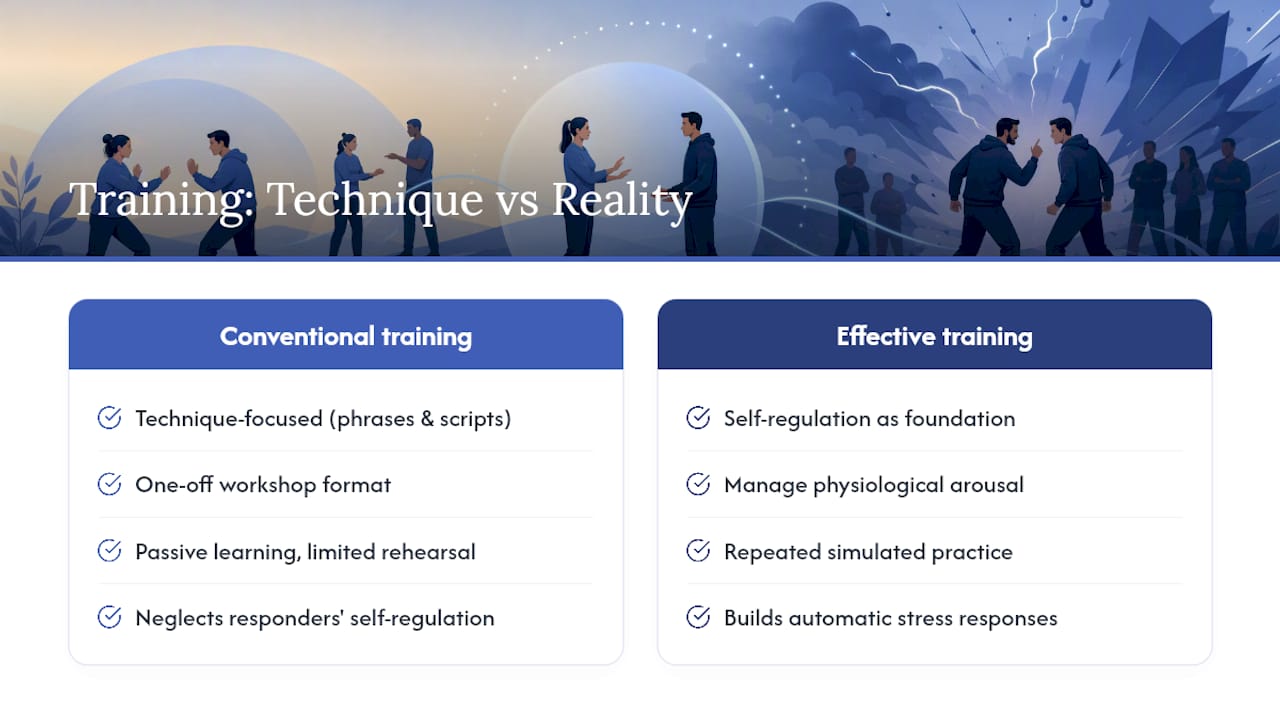
The conventional wisdom on de-escalation training focuses almost entirely on technique: learn the phrases, memorize the steps, practice the scripts. That’s necessary. It’s also insufficient.
The hardest part of de-escalation is not knowing what to say. It’s managing your own physiological response while someone is yelling at you, threatening you, or saying something that triggers a personal reaction. Self-regulation by the responder is the foundation for every other technique. If your arousal is high, your voice, breathing, and micro-expressions will communicate threat regardless of the words you choose. You can say “I hear you” in a clipped, tense voice and make things worse.
This is why one-off training rarely sticks. A workshop teaches you the vocabulary. Repeated practice under simulated pressure is what builds the automatic response you’ll actually use when it counts. The research on this is consistent: staged, rehearsed engagement, not passive learning, is what changes behavior under stress.
There’s also a cultural dimension that most training programs underweight. What reads as respectful eye contact in one cultural context reads as aggressive in another. What feels like an appropriate distance in one community feels invasive in another. Effective de-escalation requires adapting your approach to the person in front of you, not applying a universal script. That adaptation is a skill, and it only develops through varied, realistic practice with diverse scenarios.
The legal and ethical dimension deserves a mention too. In professional contexts, particularly healthcare, law enforcement, and social services, de-escalation is not just a communication preference. It’s increasingly a professional and legal standard. Documenting your approach, following organizational protocols, and knowing when to escalate to a supervisor or emergency services are not optional add-ons. They’re part of what responsible practice looks like.
Practice de-escalation skills with scored, realistic roleplay
Knowing the techniques is step one. Performing them under pressure, with a distressed customer or a volatile situation unfolding in real time, is where most people discover the gap between understanding and skill.
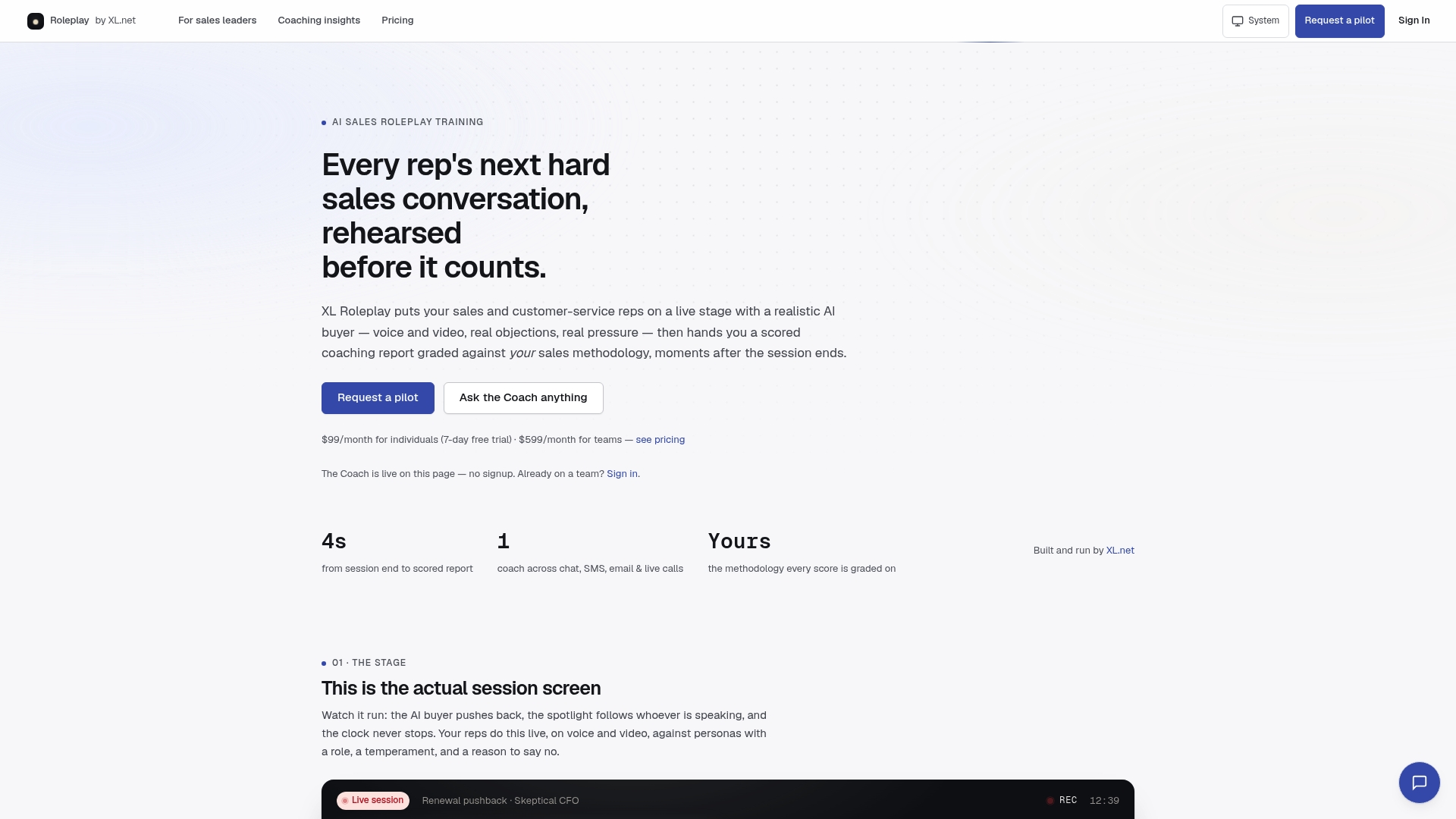
Xl’s AI-driven roleplay platform closes that gap with live voice and video sessions against realistic AI personas that push back, escalate, and respond the way real people do. For customer service teams and managers, that means reps can rehearse de-escalation scenarios repeatedly before they face them live, with scored coaching reports that flag exactly where the conversation went sideways.
Three reasons it fits what this article covers:
- Realistic pressure. AI personas present genuine objections and emotional escalation, not scripted softballs.
- Scored feedback. Every session generates a coaching report tied to your organization’s specific standards, so feedback is behavior-specific, not generic.
- Manager visibility. Session transcripts and rubrics let team leads review performance and run targeted debriefs.
Start a trial or explore team plans at Xl Roleplay or review options for sales and service leaders who want to build this skill across their teams.
Sources
The following sources informed this guide and offer deeper reading on each area covered:
- CISA De-escalation Action Guide
- Behavioral Escalations Clinical Pathway – De-escalation Strategies | Children’s Hospital of Philadelphia
- De-Escalation Tips & Response (AAACN workplace toolkit)
- Clinical review on verbal de-escalation and noncoercive approaches (PubMed)
- De-escalation tactics and tools (UCI handout)
- 11 Steps of Verbal De-Escalation | Workplace Violence Prevention (VUMC)
- Slow the Climb: 4 De-escalation Strategies to Keep Behavior from Going Downhill (PBIS)
- De-Escalation Training for Customer Service - Defuse