10–15 Minute Deal Inspections: Deal Review Framework for Sales Leaders
10–15 Minute Deal Inspections: Deal Review Framework for Sales Leaders

A deal review framework is a repeatable process for inspecting pipeline opportunities against documented evidence instead of rep opinion, and it delivers three measurable outcomes: tighter qualification, more accurate forecasting, and sharper rep coaching. Methodologies like MEDDPICC supply the inspection criteria, while tools such as XL Roleplay let reps rehearse the evidence-gathering conversations before they ever reach a deal review.
TL;DR:
- Consistent deal inspection relies on a prepared team, a structured checklist, and a centralized platform to track evidence and scores.
- Deep review should be limited to key opportunities, focusing on evidence of stakeholder engagement, decision process, risks, and next actions within 10 to 15 minutes per deal.
- Regular inspection scores and metrics such as pipeline coverage, win rate, and sales cycle length help identify stale deals and improve forecast accuracy.
- Reviewing only the most critical deals frequently ensures the sales team aligns with strategy while avoiding unnecessary work on less impactful opportunities.
- Supplementing deal review with targeted rehearsals and feedback enhances reps’ ability to handle pressure-test conversations with real buyers.
Table of Contents
- The three pillars: people, process, and platform
- The deal inspection checklist managers actually use
- How often to review, and who owns what
- Scoring deals and the metrics that keep forecasts honest
- Running the deal-review meeting step by step
- Common pitfalls in deal review and how to avoid them
- Tools and software to support deal review processes
- Customizing the framework for your sales motion
- Training and coaching methods to improve deal review effectiveness
- Keep inspection and coaching separate, and both get sharper
- Practicing the conversations your deal review exposes
- FAQ
- Sources
The three pillars: people, process, and platform
A working framework rests on three pillars, and most reviews that fail are missing one of them. The people pillar means the right participants show up prepared: the rep with evidence, the manager ready to challenge it, and RevOps keeping the data clean. The process pillar is the checklist and cadence that make reviews repeatable instead of improvised. The platform pillar is wherever that evidence lives and gets scored, whether that is a CRM field, a shared document, or a coaching report.
The distinction that separates a useful review from a status meeting is inspection versus qualification. Qualification happens once, early, to decide whether a deal deserves time. Inspection is continuous: it asks, at every stage, whether the evidence still supports where the deal sits. Opportunity inspection treats stakeholder engagement, decision criteria, competitive position, progression evidence, and risk as five dimensions to recheck on every priority deal, not a box ticked once at the top of the funnel.
- Right people: rep brings evidence, manager challenges it, RevOps protects data quality.
- Right process: a fixed checklist applied consistently across every inspected deal.
- Right platform: a single place where evidence, scores, and actions are recorded and visible to the team.
When inspection is consistent, it feeds directly into forecasting and keeps sales aligned with the broader go-to-market plan instead of running as a parallel, disconnected ritual.
The deal inspection checklist managers actually use
A good inspection does not ask “what’s new on this deal.” It asks whether the evidence for advancement actually exists, and it does that fast. Pipeline review guidance recommends spending roughly 10 to 15 minutes per deal and inspecting only a small number of priority opportunities deeply rather than skimming the entire pipeline.
- Context: why this account, why now, and what changed since the last touch.
- Qualification: run the MEDDPICC fields, metrics, economic buyer, decision criteria, decision process, paper process, identified pain, champion, and competition, and note which are confirmed versus assumed.
- Buyer actions: what the buyer has done, not promised, since the last review (meetings taken, documents reviewed, internal emails forwarded).
- Stakeholders: who is engaged, who is missing, and whether the champion has demonstrated real internal influence rather than friendliness.
- Paper process: procurement, legal, and security steps identified with owners and realistic timing.
- Risks: named obstacles, not vague caution, with a plan to address each one.
- Next actions: one or two dated actions, each with a single owner.
A champion who likes the rep but has never set up an internal meeting is not a champion, according to MEDDPICC guidance from sales practitioners, which ties the label to active influence rather than warmth. The same source notes that late-stage deals missing a named economic buyer or a documented decision process are commonly overstated in forecast stage, which is reason enough to demote a deal rather than let it ride.
Pro Tip: Cap every inspection at two action items; a long list of tasks creates the feeling of progress without changing the deal’s outcome.
How often to review, and who owns what
Cadence should match the sales motion rather than copy a generic calendar. Forecast cadence guidance separates weekly operating rhythm, which keeps data current, from the forecast conversation itself, which should focus on commit decisions and exceptions rather than re-litigating every deal.
A workable rhythm looks like this:
- Weekly 1:1s between rep and manager for coaching and light inspection on active deals.
- Biweekly team reviews where the manager and peers spot patterns across the book, like slipping dates or stalled paper process.
- Monthly forecast commits where leadership rolls up inspected deals into a defensible number.
Responsibilities need to be explicit or reviews turn into finger-pointing. The rep arrives with evidence already gathered, not discovered live in the meeting. The manager validates that evidence and coaches the gaps rather than just recording updates. RevOps keeps stage definitions, close dates, and activity logs clean so nobody argues about data instead of strategy. Splitting inspection scope this way, light touch weekly, deeper biweekly, strategic monthly, avoids redoing the same work three times on the same deal.
Scoring deals and the metrics that keep forecasts honest
A simple 0 to 5 health score, built from the same inspection dimensions every time, turns a manager’s gut feeling into something a team can compare across a pipeline. Opportunity inspection guidance recommends scoring stakeholder engagement, decision criteria clarity, competitive position, progression evidence, and risk consistently, so that a 4 means the same thing on every rep’s deals rather than reflecting how optimistic that rep happens to be. Weight buyer actions, meetings taken, documents reviewed, more heavily than buyer promises, which tend to inflate scores without matching reality.
A disciplined review cadence that ties inspection to revenue strategy catches stale deals, pushed close dates, and missing activity before they distort the forecast.
Five metrics anchor whether that forecast holds up: pipeline coverage (how many dollars of pipeline exist relative to the target), win rate, average deal size, sales cycle length, and pipeline velocity. Tracking these over time shows whether qualification is tightening or whether reps are padding the pipeline with deals that never had a real chance.
- Pipeline coverage tells you if there’s enough raw material to hit the number.
- Win rate and average deal size tell you whether the deals that do close are worth closing.
- Sales cycle length and velocity tell you whether deals are moving or stalling.
Once each deal carries a health score, sorting into commit, likely, and unlikely buckets becomes mechanical: high scores with confirmed economic buyer and paper process go to commit, moderate scores with open risks go to likely, and anything missing core MEDDPICC evidence drops to unlikely regardless of what stage the CRM shows.
Running the deal-review meeting step by step
A review meeting should run 60 to 90 minutes and inspect only the handful of deals that matter most to the quarter, not the entire pipeline. Reps should arrive with evidence already documented, not discovering gaps live in front of the group.
- Prework (before the meeting): reps update stage, close date, and MEDDPICC fields with evidence, not guesses, for every deal on the agenda.
- Opening (5 minutes): confirm which deals get deep inspection versus a quick status check.
- Deep inspection (10 to 15 minutes per deal): walk the checklist, challenge weak evidence, and ask what the buyer has actually done since the last review.
- Risk and paper process check (5 minutes per deal): confirm procurement and legal steps have owners and dates.
- Action capture (2 minutes per deal): record one or two actions, each with an owner and a due date.
- Wrap-up (5 to 10 minutes): recap commit-bucket changes for the forecast roll-up.
The manager’s script should sound like genuine curiosity, not interrogation: “Who confirmed the budget number, and when did you last hear it from them directly?” or “Walk me through what happens after legal gets the redline.” These questions pressure-test assumptions without dictating the rep’s next move, which keeps the session coaching-oriented rather than micromanaging. Document every action the same way every time: owner, due date, and the reason it matters, so a skipped action is visible instead of quietly forgotten.
Pro Tip: If a rep can’t answer who the economic buyer is without checking notes, that’s the next action, not a side note.

Common pitfalls in deal review and how to avoid them
The most common failure is reviewing every deal instead of the ones that matter, which turns a 90-minute meeting into a status report nobody absorbs. Fix this by limiting deep inspection to a short priority list and handling the rest with a quick stage check.
A second pitfall is accepting verbal assurances as evidence. “They love us” or “it’s basically done” are not answers to who the economic buyer is or what the paper process requires. Reviews that accept these as qualification tend to produce forecasts that collapse in the final two weeks of the quarter.
A third pitfall is treating the review as a status update rather than an inspection tied to go-to-market strategy, which is a known failure mode even in organizations that run reviews regularly. Research on pipeline review notes that companies running structured reviews tend to see stronger win rates, but many reviews still fail because they track updates instead of inspecting evidence against the quarter’s plan.
A fourth pitfall is piling on action items. A review that ends with eight tasks for one deal produces none of them; a review that ends with one clear, owned, dated action produces that one.
Finally, reviews that blur coaching and inspection into one unstructured conversation tend to do both badly: the rep feels judged instead of coached, and the manager never gets a clean read on deal health. Separating the two, even briefly, protects both purposes.

Tools and software to support deal review processes
Most teams already have a CRM that can hold stage, close date, and custom MEDDPICC fields, and that should be the single source of truth for inspection data rather than a spreadsheet that drifts out of sync. Forecasting and revenue intelligence tools can layer engagement signals, like email response patterns or meeting frequency, on top of CRM data to flag deals where reported stage and actual buyer behavior disagree.
AI-powered inspection tools are increasingly used to scale what a manager cannot do by hand across a large pipeline, surfacing pattern-based risk scores and engagement signals automatically rather than waiting for a rep to self-report. For the coaching side of deal review, rather than the data side, platforms like XL Roleplay let reps rehearse the actual commit and objection-handling conversations a deal review surfaces as weak, so the next real conversation with the buyer isn’t the first time the rep has said the words out loud.
Whatever tools a team chooses, the test is simple: does the tool make evidence easier to capture and verify, or does it just add another place to type updates. A tool that duplicates CRM data entry without adding signal is overhead, not infrastructure.
Customizing the framework for your sales motion
MEDDPICC fits complex, multi-stakeholder B2B sales well, but a transactional or product-led motion with short cycles may only need a lighter qualification check, like confirming budget and a single decision-maker, rather than the full eight-field inspection. The underlying discipline, evidence over opinion, stays the same even when the checklist shrinks.
Industries with long procurement cycles, like enterprise software or regulated services, should weight the paper process and risk dimensions more heavily, since those are where deals typically stall for months. Industries with shorter cycles and lower average deal size can compress inspection time per deal and spend more of the meeting on pattern-spotting across a larger number of opportunities.
Teams running a consultative or value-based methodology can map their own stage-exit criteria onto the same five inspection dimensions, context, qualification, stakeholders, risk, and next actions, rather than adopting MEDDPICC’s exact terminology. What matters is that every stage advancement requires documented evidence, whatever the framework calls that evidence. A team new to structured review should start with a shorter checklist and expand it once reps are comfortable bringing evidence to the table instead of updates.
Training and coaching methods to improve deal review effectiveness
Reviews improve fastest when coaching happens in short, specific bursts tied to a real gap, not a general lecture on sales skills after the meeting ends. If a rep consistently cannot answer who the economic buyer is, that is a discovery skill gap worth a dedicated coaching session, separate from the review itself.
Role-play rehearsal before high-stakes conversations, like a commit call or a final objection-handling meeting, helps reps practice the specific language a deal needs rather than improvising live with the buyer. Reviewing call transcripts against the MEDDPICC checklist after the fact also shows a rep exactly where a question was skipped or an assumption went unchallenged, which is more concrete feedback than a general “push harder on qualification.”
Peer-based coaching, where reps observe or shadow each other’s inspection prep, spreads strong habits faster than manager coaching alone, since reps often learn more from seeing a peer’s evidence-gathering process than from being told what to do differently.
Keep inspection and coaching separate, and both get sharper
Inspection and coaching want different things from the same meeting: inspection wants fast, evidence-based judgment, and coaching wants room to slow down and develop a skill. Mixing them live produces a rep who feels judged and a manager who never gets a clean read on the deal. When a real skill gap surfaces mid-review, name it, timebox it to a minute, and move the full coaching conversation to the 1:1 where it belongs.
Protecting psychological safety during the review matters more than it gets credit for. A rep who expects to be put on the spot stops bringing honest evidence and starts bringing a performance instead, which quietly destroys the forecast accuracy the whole framework exists to protect. For more on where this line sits, see separating coaching from deal review.
— Adam
Practicing the conversations your deal review exposes
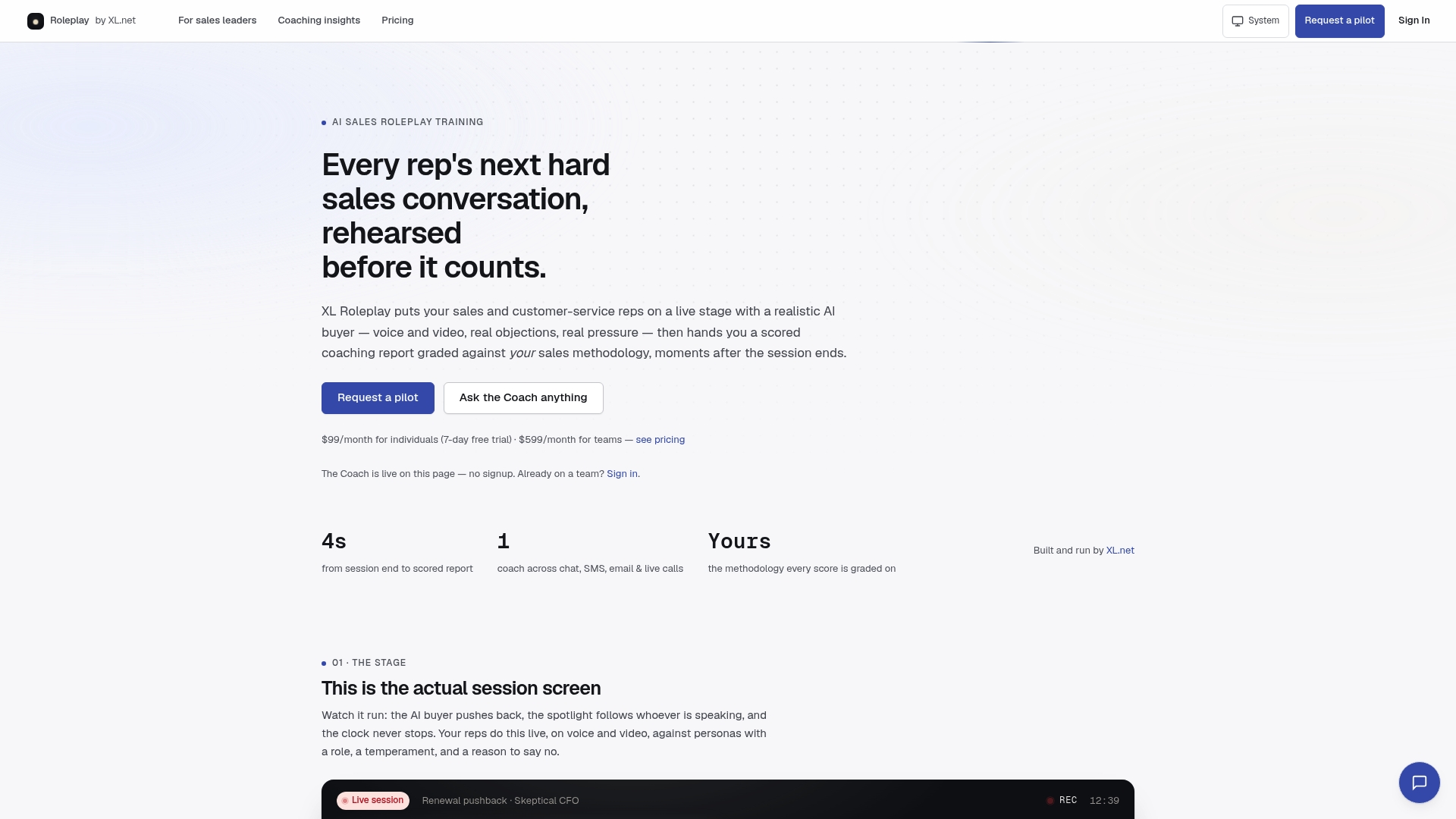
Once a review surfaces that a rep can’t clearly articulate the economic buyer or hasn’t pressure-tested the paper process, the next step is practicing that exact conversation before it happens with a real buyer. That’s the gap we built XL Roleplay to close: live voice and video sessions with AI buyers that push back with the objections and pressure a real commit call brings, scored against your own sales methodology instead of a generic rubric.
- Rehearse ask and commit conversations before the real one, so the rep’s first attempt isn’t live.
- Capture buyer evidence in detailed, transcript-linked session reports managers can review alongside the deal checklist.
- Score readiness against your organization’s own playbook, not a one-size-fits-all standard.
These sessions produce the same kind of documented evidence a deal review checklist asks for: who said what, which objections came up, and how the rep responded, mapped directly to prework and documentation standards instead of sitting outside them. If a pilot with your own sales motion makes sense, our pricing page outlines Individual and Business plans, and our pilot program is built for testing the platform with a small team before a wider rollout.
FAQ
What is a deal review framework in sales?
A deal review framework is a repeatable process for inspecting pipeline opportunities against documented evidence, covering context, qualification, stakeholder engagement, risk, and next actions, rather than relying on rep self-reporting. It typically uses a qualification method like MEDDPICC to structure what counts as evidence at each stage.
How long should a deal review meeting take?
A full team review typically runs 60 to 90 minutes, with 10 to 15 minutes spent on each deal selected for deep inspection rather than every open opportunity. Limiting deep inspection to a short priority list keeps the meeting focused and prevents it from turning into a status report.
How is deal inspection different from deal qualification?
Qualification is typically a one-time judgment on whether a deal is worth pursuing, while inspection is continuous and rechecks the same evidence dimensions, like stakeholder engagement and progression evidence, at every later stage. A deal can pass qualification early and still fail inspection later if the evidence stops supporting its stage.
What metrics should a sales leader track for forecast accuracy?
Five metrics anchor most forecasting conversations: pipeline coverage, win rate, average deal size, sales cycle length, and pipeline velocity. Rolling the forecast from individually inspected deals, rather than aggregated rep confidence, tends to produce a more defensible number.
Can deal review coaching happen in the same meeting as inspection?
Brief, targeted coaching can happen inside a review when a specific skill gap surfaces, but it should be timeboxed so it doesn’t derail the inspection agenda. Deeper coaching, including rehearsing a specific conversation, is better handled separately, such as in a 1:1 or a roleplay session built around that exact gap.
Sources
- Pipeline Review: Cadence, Structure, and Best Practices (2026)
- Opportunity Inspection: A RevOps Guide to Forecast Accuracy - Fullcast
- ScaleUp Your Sales Forecast Cadence | Insight Partners
- Inside the MEDDPICC methodology — insights from the sales pros who use it