3–7 Day Rehearsal: Demo Dry Run Checklist for Reps and AI Roleplay
3–7 Day Rehearsal: Demo Dry Run Checklist for Reps and AI Roleplay

A demo dry run is a full-speed rehearsal of your presentation, sales demo, or event, done in advance to catch technical, content, and timing problems before an audience sees them. The single best practice: run the entire sequence at real performance pace, record it, and assign an owner to every technical piece. Schedule it 3 to 7 days before the live event, so there’s still time to fix what breaks.
TL;DR:
- Running a full-speed dry run 3 to 7 days before the event allows enough time to fix technical issues, timing gaps, and content misalignments.
- A documented run-of-show and assigned technical owners improve coordination and reduce failures during the rehearsal.
- Virtual dry runs require testing all platform features and verifying internet stability from every presenter, while in-person ones focus on stage cues and equipment checks.
- Most dry run failures stem from process errors like inadequate preparation, lack of documentation, and missing backup plans rather than technical faults.
- Combining dry runs with roleplay practice enhances both production quality and reps’ ability to handle objections and pressure during live presentations.
Table of Contents
- What Is a Demo Dry Run and Why Does It Matter?
- When Should You Schedule Your Dry Run?
- How Do You Run an Effective Dry Run Step by Step?
- Virtual vs In-Person Dry Runs: What Changes?
- What Mistakes Derail Most Dry Runs?
- How Roleplay Practice Extends What a Dry Run Catches
- How Do You Turn Dry Run Feedback Into a Better Live Event?
- What Rehearsal Discipline Actually Buys You
- Make Rehearsal Repeatable With XL Roleplay
- Sources
- FAQ
What Is a Demo Dry Run and Why Does It Matter?
A dry run is a diagnostic rehearsal. You test flow, timing, technology, and content together, in a setting where a mistake costs you nothing but a little embarrassment in front of teammates. That’s the whole point: find the failure points while the stakes are low, according to the CSPS facilitation quick reference.
Run one well and you’ll typically catch a broken screen share, an awkward handoff between speakers, a slide that runs three minutes long, or a demo environment that lags under load. Skip it, and your prospect or your boss finds those problems for you, live.
Think of it like a product demo rehearsal, an event’s dress rehearsal, or the “dry-run mode” some software tools use to simulate an action without actually executing it, such as writing to a database, so you can verify logic is safe before it goes live. Same idea, different stakes.
When Should You Schedule Your Dry Run?
Timing matters more than most teams admit. Hold your dry run at least 3 days before the event, and ideally 5 to 7 days out, according to Pega Academy’s guidance on executing a successful dry run. That window gives you room to fix what’s broken, not just document it.
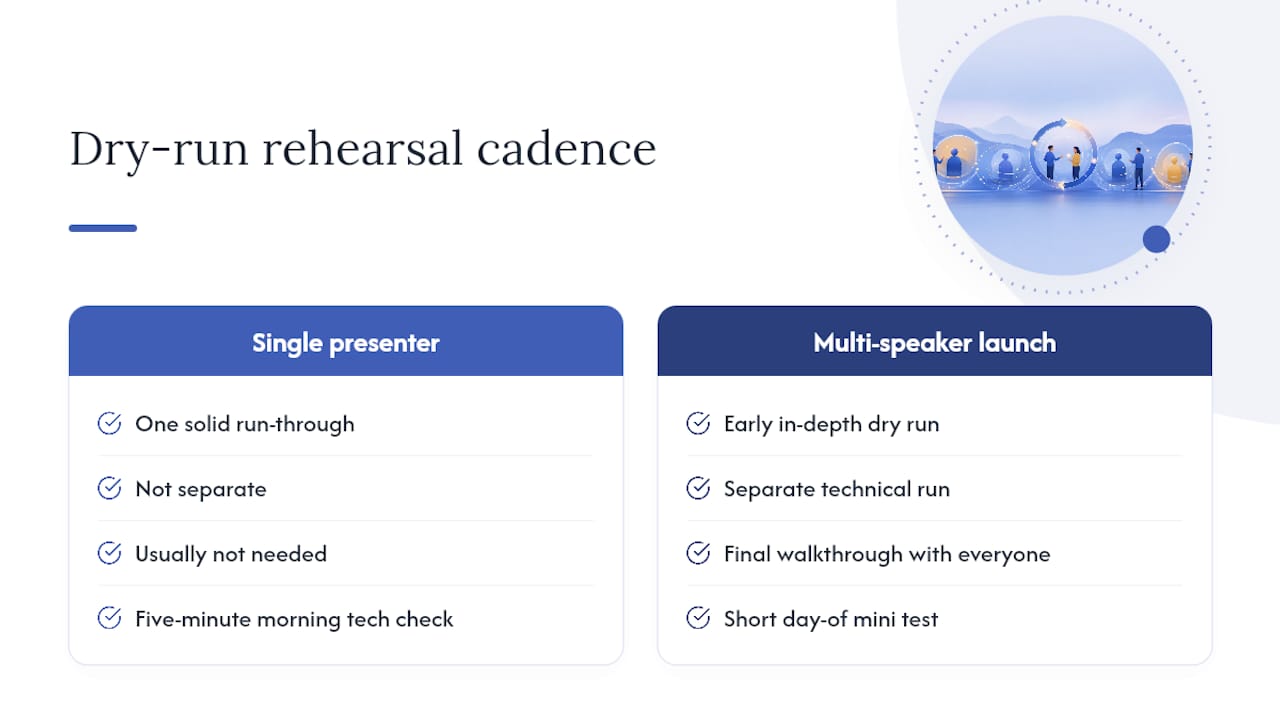
For bigger events, one pass isn’t enough. Plan an early, in-depth dry run to catch structural issues, then a shorter day-of mini test to confirm nothing shifted overnight, a setup CSPS specifically recommends for anything with real production complexity.
Match your cadence to the stakes. A single-presenter sales demo might need one solid run-through and a five-minute tech check the morning of. A multi-speaker product launch or conference keynote needs a full content rehearsal, a separate technical run, and a final walkthrough with everyone in the room or on the call.
How Do You Run an Effective Dry Run Step by Step?
Treat this as a sequence, not a vibe. Skipping steps is how teams end up “rehearsing” in their heads instead of on their feet.
Before the run:
- Build a run-of-show document listing every segment, speaker, timestamp, and cue. Don’t rely on memory. AV Land’s event production team points out that a documented run-of-show reduces failures in transitions far more than verbal coordination does.
- Assign an owner to each technical area: slides, AV, live demo environment, backup materials, and chat or Q&A if it’s virtual.
- Distribute the run-of-show to everyone involved at least a day before you rehearse, so no one is seeing their role for the first time mid-run.
During the run:
- Run the whole thing at real performance pace. No pausing to “just check something quickly.” A rushed or paused rehearsal hides exactly the timing problems you’re trying to expose.
- Test every technical path: screen share, video playback, microphones, remote clicker, and any live software you’ll demo.
- Rehearse transitions between speakers or between talking and demoing. This is where most live fumbles actually happen.
- Exercise interactive elements, polls, live Q&A, breakout rooms, exactly as they’ll run live.
After the run:
- Record the session. It becomes both a coaching tool and evidence of what actually happened, not what people remember happening.
- Collect feedback immediately, while details are fresh, and rank issues by how much damage they’d do live.
- Fix the highest-priority items first, then re-test just those pieces rather than rerunning everything from scratch.
Pro Tip: For anything you can’t fully test until the last minute, sensitive UIs, live customer data, a feature still in staging, build a fallback asset now: a screenshot, a recorded clip, or a local copy of the demo. If the real thing breaks live, you swap in the backup without missing a beat, a tactic Pega Academy specifically recommends for high-stakes sessions.
Virtual vs In-Person Dry Runs: What Changes?
The checklist shifts depending on where your audience is sitting.
Virtual specifics:
- Test every platform feature you’ll actually use: screen share, breakout rooms, polls, chat.
- Assign a producer role separate from the presenter, someone watching chat, monitoring bandwidth, and managing the queue.
- Check connection quality from every presenter’s actual location, not just the office network.
In-person specifics:
- Run a full mic check, including handoffs between speakers.
- Confirm sightlines from the back of the room and test projector or laptop hookups with the exact cables you’ll use.
- Walk through stage movement and print any physical handouts in advance.
Hybrid events need both lists run simultaneously, with a clear handoff plan between the in-room team and the remote producer.
Pro Tip: Running separate tech-only and content-only rehearsals for virtual events surfaces different problems faster. Mixing both into one run means a content stumble can mask a real technical issue, as the CSPS quick reference notes.
What Mistakes Derail Most Dry Runs?
Most dry run failures aren’t technical. They’re process failures that let technical problems slip through unnoticed.
- Relying on memory instead of a living document. Cues and transitions drift every time you rehearse without writing them down.
- Rehearsing at half-speed or stopping to fix things mid-run. This hides exactly the timing and pacing issues a dry run exists to catch.
- Skipping the recording. Without it, you’re relying on everyone’s memory of what happened, and memories disagree.
- No assigned owners. When everyone assumes someone else is watching the tech, no one actually is.
- No backup plan. If your live demo environment goes down and you have no fallback screenshot or recording ready, you’re improvising in front of your audience.
How Roleplay Practice Extends What a Dry Run Catches
A dry run tests your event or presentation as a whole. It won’t necessarily tell you whether a rep can handle a tough pricing objection mid-demo or recover smoothly when a prospect interrupts with a curveball question. That’s a different kind of rehearsal, one built around pressure, not production.
This is where scored roleplay practice fills the gap. XL Roleplay’s demo certification approach lets reps run through realistic objections and pressure scenarios against an AI buyer, then get scored feedback tied to their organization’s own sales methodology. Instead of a subjective “that went fine,” managers get a transcript and a rubric showing exactly where discovery or objection handling broke down.
Pressure-testing a demo this way gives you an objective readiness signal before a rep ever gets in front of a real customer, a different kind of evidence than a run-of-show checklist provides. Combine both, and you’re rehearsing the production and the conversation.
How Do You Turn Dry Run Feedback Into a Better Live Event?
The dry run itself is only half the work. What you do with what it surfaces determines whether the live event actually improves.
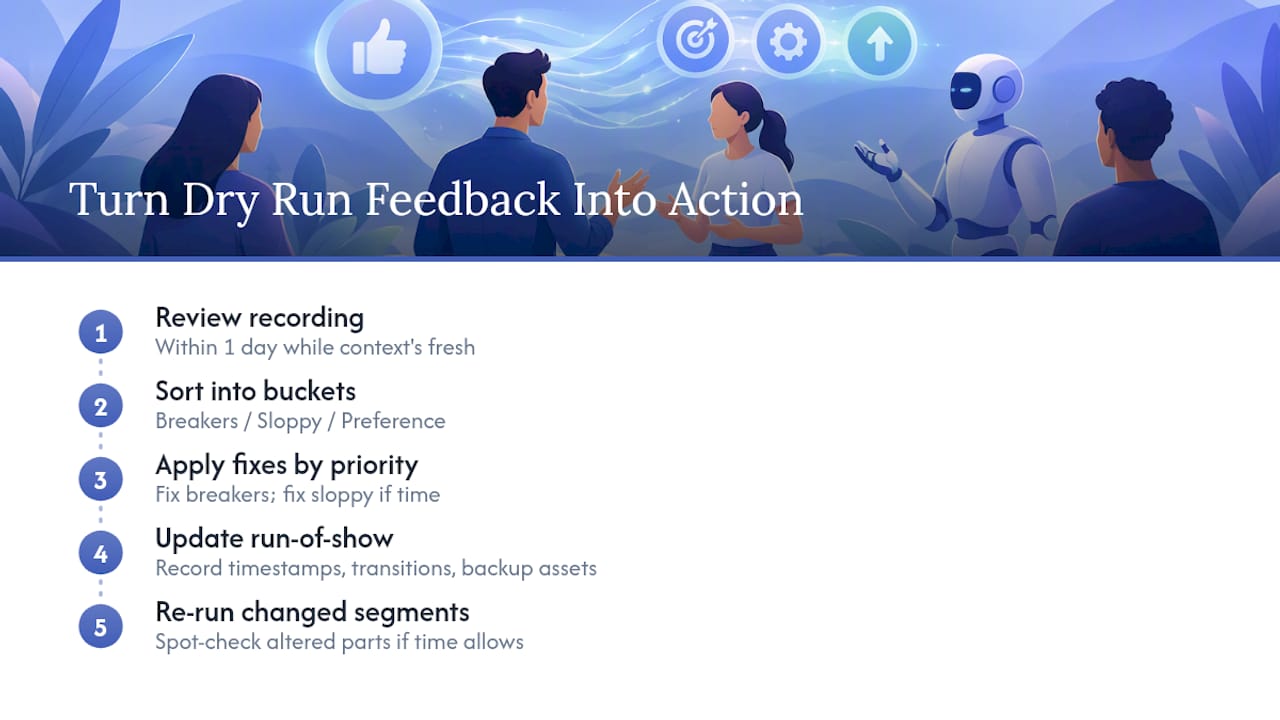
Start by reviewing the recording within a day, while context is still fresh. Watching it back almost always reveals things live observers missed: a slide that lingered too long, a transition that felt clunky on camera even though it seemed fine in the room, a pause that read as dead air on the recording.
Sort every issue into three buckets: things that will break the demo if left unfixed, things that will look sloppy but won’t derail anything, and things that are just personal preference. Fix the first bucket without exception. Fix the second bucket if time allows. Ignore the third bucket unless it’s genuinely quick.
Update your run-of-show document immediately, not the morning of the live event. If a transition changed, a timestamp shifted, or a backup asset got swapped in, write it down right away. A living cues document with exact trigger points prevents the team from reverting to vague, memory-based cues when it matters most.
If your dry run revealed a content or messaging gap, not just a technical one, this is also the moment to sharpen how the material lands. A demo that’s technically flawless but doesn’t map to what the buyer actually cares about still underperforms. Aligning your talking points with the audience’s actual buyer journey stage often matters as much as fixing a glitchy screen share.
Finally, if time allows before the live event, re-run just the segments that changed. You don’t need a full second dry run for a two-minute fix, but you do need proof the fix actually works under real pacing.
What Rehearsal Discipline Actually Buys You
Teams that treat dry runs as optional tend to discover their biggest problems in front of the people they were trying to impress. Teams that treat them as non-negotiable tend to look, oddly, unremarkable. The demo just works. Nobody notices a flawless transition; they only notice a broken one.
The most common improvement after a disciplined dry run isn’t dramatic. It’s usually a small thing: a demo environment that needed a fresh login token, a slide transition that ran eleven seconds longer than anyone realized, a handoff line that sounded natural in someone’s head but clunky out loud. Catch it at rehearsal, and it disappears from the record entirely. Catch it live, and it becomes the thing your prospect remembers.
The math on this is simple even without a formal study to cite: an hour of rehearsal costs you an hour. A broken live demo can cost you a deal, or a room full of attendees’ attention. Rehearsing isn’t a nice-to-have step tucked before the real event. It is the last checkpoint where you still control the outcome.
— Adam
Make Rehearsal Repeatable With XL Roleplay
A dry run tests your event. It doesn’t fully test your rep under pressure, how they handle a sharp objection, an off-script question, or a buyer who pushes back three times in a row. That’s the gap XL Roleplay was built to close, giving reps a way to rehearse the conversation itself, not just the slides, as many times as needed before a real prospect is on the line.
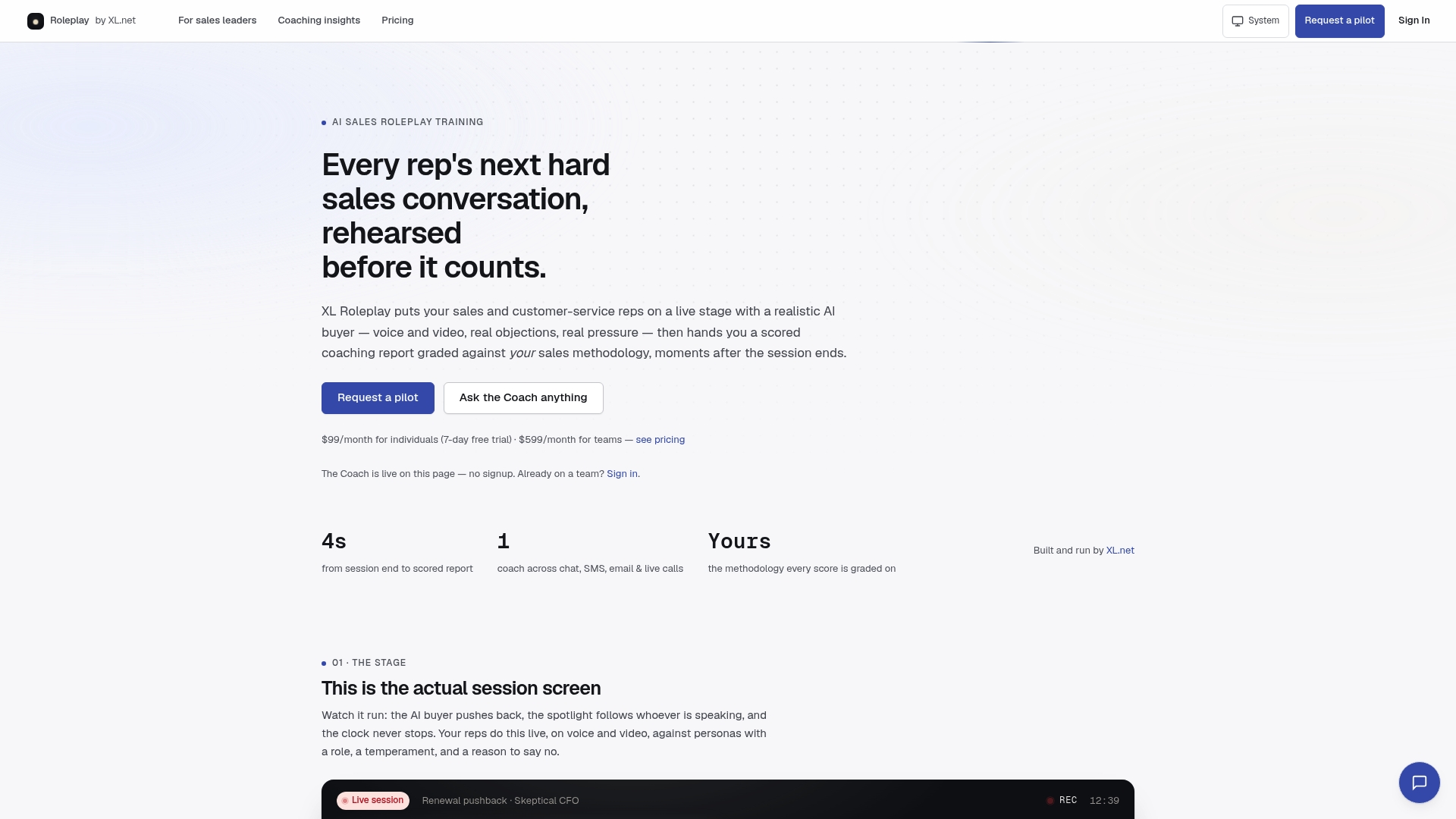
With XL Roleplay, reps run live voice and video sessions against AI buyers built around your organization’s actual objections and methodology, then get a scored coaching report and a full transcript a manager can review. It’s a natural complement to a production dry run, one covers the show, the other covers the conversation inside it. Plans start with Individual access at $99 per month, with a Business plan at $599 per month for teams that need shared visibility across reps. If you want to test the approach first, check out the XL Roleplay pilot program before committing to a plan.
Sources
- Execution of a successful dry run session | Pega Academy
- Facilitation essentials: Dry run quick reference (CSPS)
- Essential event production checklists (StageTimer)
- AV Land event services & best practices
FAQ
What Is a Dry Run Demo?
A dry run demo is a full rehearsal of a product demonstration or presentation, run at real pace before the live event to catch technical, timing, and content problems. It’s meant to be diagnostic rather than perfect, so teams pause, note issues, and fix them, according to CSPS’s dry run guidance.
What Does “Dry Run” Mean in Testing?
In software or technical testing, a dry run means simulating an action without triggering real side effects, such as writing to a database or sending a live transaction. This lets teams validate logic safely before anything actually executes.
What Is a Dry Run for a Meeting?
For a meeting or presentation, a dry run is a rehearsal that tests flow, timing, and content in a low-stakes setting before the real audience shows up. Hold it 3 to 7 days ahead of the live meeting or event so there’s time to fix what surfaces.
What Does “Dry Run” Mean in Business?
In a business context, a dry run typically refers to rehearsing a sales demo, pitch, or internal presentation before it goes in front of a client or leadership. Beyond production rehearsal, tools like XL Roleplay’s scored roleplay sessions let sales teams pressure-test the actual conversation, not just the slides, before a live customer meeting.