Discovery Questions List: 11–15 Live Qs, Precall & Roleplay for Reps
Discovery Questions List: 11–15 Live Qs, Precall & Roleplay for Reps

Collect the facts before the call, and save the meeting for what only a conversation can surface. Gather account basics, tech stack, and team size through an async pre-call form, then use your live time for 11 to 15 focused questions that dig into priority, budget reality, and decision process. That range comes from analysis of recorded sales calls, and it holds up because it forces you to ask questions that matter instead of burning the clock on facts you could have gotten by email. Below is the shortlist to use tomorrow, plus the full categorized library behind it.
TL;DR:
- Asking 11 to 15 high-leverage discovery questions focused on implications and priorities maximizes deal understanding within 20 minutes.
- Pre-call async forms should gather 30 factual items, reserving live calls for targeted, reaction-based questions to avoid fatigue.
- Using structured frameworks like BANT, MEDDIC, or SPIN depends on deal complexity, with simpler approaches for SMB and more detailed ones for enterprise deals.
- Asking questions in the correct sequence and following up on vague or weak answers uncovers true urgency, decision process, and internal blockers.
- Practicing discovery through role-play and call review helps reps avoid common pitfalls like checklist reading, asking closed questions, or rushing budget and decision questions.
Table of Contents
- High-Leverage Discovery Questions To Ask On Every Call
- The Full Discovery Questions List By Category
- How Many Discovery Questions To Ask, And When
- Discovery Frameworks: BANT, MEDDIC, And SPIN
- Running Discovery Live: Sequencing, Transitions, And Red Flags
- Practicing Discovery Questions Through Role-Play
- How To Analyze And Record Discovery Call Answers
- Common Mistakes Reps Make With Discovery Questions
- Ineffective Discovery Questions And How To Fix Them
- A Working Checklist For Better Discovery
- Practice Discovery Before It Costs You A Deal
- Sources
High-Leverage Discovery Questions To Ask On Every Call
You don’t need forty questions memorized. You need nine or ten that consistently open doors, and the discipline to ask real follow-ups instead of moving to the next item on your script. These work across industries because they target implication and priority, not product fit.
- “Walk me through how your team handles this today.” You learn the current workflow and where the friction actually lives, not where the prospect assumes it lives. Follow up with: “How long has it worked that way?”
- “What happens if this problem doesn’t get solved this quarter?”"** This surfaces urgency and cost of inaction. Follow up: “Who else feels that impact besides you?”
- “How are you measuring success on this today?” You find out if there’s even a metric in place. Follow up: “What would need to change for that number to move?”
- “Who else is involved in evaluating a change like this?” This is a decision-process question disguised as small talk. Follow up: “Have they already looked at other options?”
- “What’s driving the timing now, versus six months ago?” Weak buyers say “just exploring.” Strong buyers name a trigger event. Follow up: “What happens if you don’t hit that date?”
- “If budget wasn’t a constraint, what would the ideal outcome look like?” This separates real pain from wish-list thinking. Follow up: “How far is that from where you are now?”
- “Has budget been allocated for this, or does it still need approval?” A direct budget-and-timing question that most reps ask too softly. Follow up: “Who approves it?”
- “What’s stopped you from fixing this already?” This exposes internal blockers, political risk, or a failed prior attempt. Follow up: “What would need to be different this time?”
- “What does a good vendor relationship look like to you, based on past experience?” This is a disguised competition question. Follow up: “What went wrong with that last vendor?”
- “If we solve this well, what does that make possible for you personally?” Champion-motivation questions get skipped constantly, and they’re often the reason a deal gets internal push.
Ask these live, in this rough order, and you’ll cover current state, pain, budget, decision process, and champion motivation in under 20 minutes.
The Full Discovery Questions List By Category
A categorized discovery questions list works better than a single long script because it lets you pull the right six to ten questions for the deal in front of you instead of asking everyone the same twenty-five. Practitioner guides consistently group discovery questions into current state, pain, goals, decision process, budget, and closing, and that structure maps cleanly onto how buyers actually think through a purchase.
Current state questions
These establish the baseline. Most work as async intake since they’re factual, not exploratory.
- “What tools or process are you using for this today?” (async) — a strong answer names specific tools; a weak one is vague, signaling low urgency or shallow research.
- “How long have you been using your current approach?” (async)
- “How many people on your team touch this process?” (async)
- “What’s your team’s current workflow from start to finish?” (live) — strong answers reveal specific bottlenecks; weak ones are generic descriptions with no friction points named.
- “What’s working fine, and what isn’t?” (live)
- “How did you end up with the setup you have now?” (live) — this often reveals a prior failed initiative worth knowing about.
Problem and pain questions
This is where you separate a real deal from a tire-kicker. A category-based approach to problem questions helps you choose the two or three that fit the stage instead of interrogating every prospect equally.
- “What prompted you to start looking into this now?” (live) — a specific trigger event is a strong signal; “just being proactive” usually means low urgency.
- “What’s the cost of this problem staying unsolved for another quarter?” (live)
- “Who feels this pain most acutely on your team?” (live)
- “Have you tried to fix this before? What happened?” (live) — a detailed answer about a failed attempt is gold; a shrug means you’re not talking to someone close enough to the problem.
- “On a scale of one to ten, how urgent is solving this?” (async, verified live)
- “What’s the risk if leadership decides this isn’t a priority this year?” (live)
Goals and future-state questions
These questions get skipped more than any other category, and that’s a mistake, because they tell you what the prospect is actually buying toward.
- “What does success look like twelve months from now?” (live)
- “If we solved this perfectly, what would change in your day-to-day?” (live) — strong answers are specific and personal; weak ones repeat marketing language back at you.
- “What metrics would you point to as proof this worked?” (live)
- “Is this tied to a broader company initiative or goal this year?” (async, confirmed live)
- “What would make this a clear win for you personally, not just the team?” (live)
- “Where do you want your process to be in a year that it isn’t today?” (live)
Decision process questions
Skipping this category is the single most common reason deals stall in “verbal yes” purgatory for months.
- “Who else needs to be involved in this decision?” (async, confirmed live)
- “What does your evaluation and approval process typically look like?” (live)
- “Have you bought something like this before? How did that process go?” (live)
- “Is there a formal RFP or procurement step involved?” (async)
- “What would need to happen for you to get internal sign-off?” (live) — a specific answer with named steps is strong; “I’d just tell my boss” from someone who isn’t the boss is a warning sign.
- “Who’s the final decision maker if this moves forward?” (async, confirmed live)
Budget and timing questions
These are the questions reps soften into oblivion. Ask them directly.
- “Has budget already been set aside for this, or does it need to be created?” (live)
- “What’s the range you’ve budgeted, if any?” (live)
- “What’s driving the timeline you mentioned?” (live)
- “What happens if this slips to next quarter?” (live)
- “Is this budget line new, or is it coming out of an existing tool’s renewal?” (async, confirmed live)
- “Who controls the budget for this category?” (async)
Stakeholder and champion questions
Understanding the room matters more than most reps admit, especially past the SMB deal size.
- “Who’s the biggest skeptic likely to be in this decision?” (live) — a name and reason is a strong signal of a self-aware buyer; “everyone’s on board” often isn’t true.
- “How would you describe your role in getting this across the line internally?” (live)
- “Who has the most to gain if this goes well?” (live)
- “Has anyone tried something like this before and had it rejected? Why?” (live)
- “Who outside your immediate team will this affect?” (async, confirmed live)
Competition and alternatives questions
Direct competitive questions still work better than the roundabout version most training decks teach.
- “What else are you evaluating right now?” (live)
- “What did you like or dislike about a previous vendor in this space?” (live)
- “If you do nothing, what’s the fallback plan?” (live) — “we’d just keep doing what we’re doing” is a real answer worth taking seriously, not brushing past.
- “What would make you choose someone else over us?” (live)
Closing and next-step questions
The category most reps rush, right when precision matters most.
- “Based on what we’ve covered, does this feel like a priority worth solving this quarter?” (live)
- “What would you need to see from us to move forward?” (live)
- “Who should be on the next call?” (live)
- “What’s a realistic timeline for a decision on your end?” (live)
- “Is there anything that would stop this from moving forward that we haven’t discussed?” (live)
How Many Discovery Questions To Ask, And When
The arithmetic behind good discovery is simpler than most sales training makes it sound. Analysis of recorded sales calls found that top-performing reps ask roughly 11 to 15 questions during a live discovery call, and both fewer and significantly more correlate with lower win rates. Ask too few, and you’re pitching before you understand the problem. Ask too many, and the call feels like an interrogation, plus you’re wasting live minutes on facts you could have collected beforehand.
The fix is splitting your question list into two buckets. Send an async pre-call form to collect the roughly 30 factual, low-stakes items, things like team size, current tools, and reporting structure. Save the live call for the 9 to 12 questions that require a human reaction: implication, priority trade-offs, political risk, and whether the budget is actually funded. One practical framework recommends this exact split: roughly 30 facts gathered async, 9 high-leverage questions saved for live conversation.
| Call length | Time on facts/rapport | Time on live probing questions | Approx. live questions |
|---|---|---|---|
| 30 minutes | 5 minutes | 20 minutes | 9–11 |
| 20 minutes | 8 minutes | 30 minutes | 12–15 |
A simple pre-call form template covers four sections: company facts (headcount, industry, current tools), problem facts (what triggered the search, who raised it internally), decision facts (who’s involved, rough timeline), and one open text field asking what they most want to get out of the call. Sending this 24 to 48 hours ahead does two things: it filters out prospects who won’t bother filling it out, and it means you walk into the call already knowing the boring stuff.
Discovery Frameworks: BANT, MEDDIC, And SPIN
Every category above maps onto an established qualification framework, and picking the right one depends more on deal complexity than personal preference. Framework-based question sets remain widely used across B2B sales teams, each built around a different theory of what actually predicts a closed deal.
- BANT (Budget, Authority, Need, Timing) is the fastest framework to run and fits SMB or transactional deals well. Example questions: “Has budget been allocated?”, “Are you the final approver?”, “What’s driving your timeline?” It’s blunt by design, which is exactly why it works on shorter sales cycles and fails on complex enterprise ones.
- MEDDIC/MEDDPICC (Metrics, Economic Buyer, Decision Criteria, Decision Process, Identify Pain, Champion, Competition, Paper Process) suits enterprise and mid-market deals with multiple stakeholders. Example questions: “What metric will your economic buyer look at to judge this?”, “Who’s your champion internally, and how much influence do they have?”, “What’s your formal decision criteria?” It’s heavier to run, but it’s built for the exact political complexity that kills large deals in the dark.
- SPIN (Situation, Problem, Implication, Need-payoff) fits consultative selling where the buyer hasn’t fully diagnosed their own problem yet. Example questions: “What’s your current situation with X?”, “What problems does that create?”, “What would solving it actually mean for the business?” SPIN’s strength is the implication step, which most reps skip straight past on their way to pitching.
For SMB, run BANT. For mid-market, blend BANT with a light MEDDIC pass on decision criteria. For enterprise, run full MEDDPICC and expect discovery to span more than one call.
Running Discovery Live: Sequencing, Transitions, And Red Flags
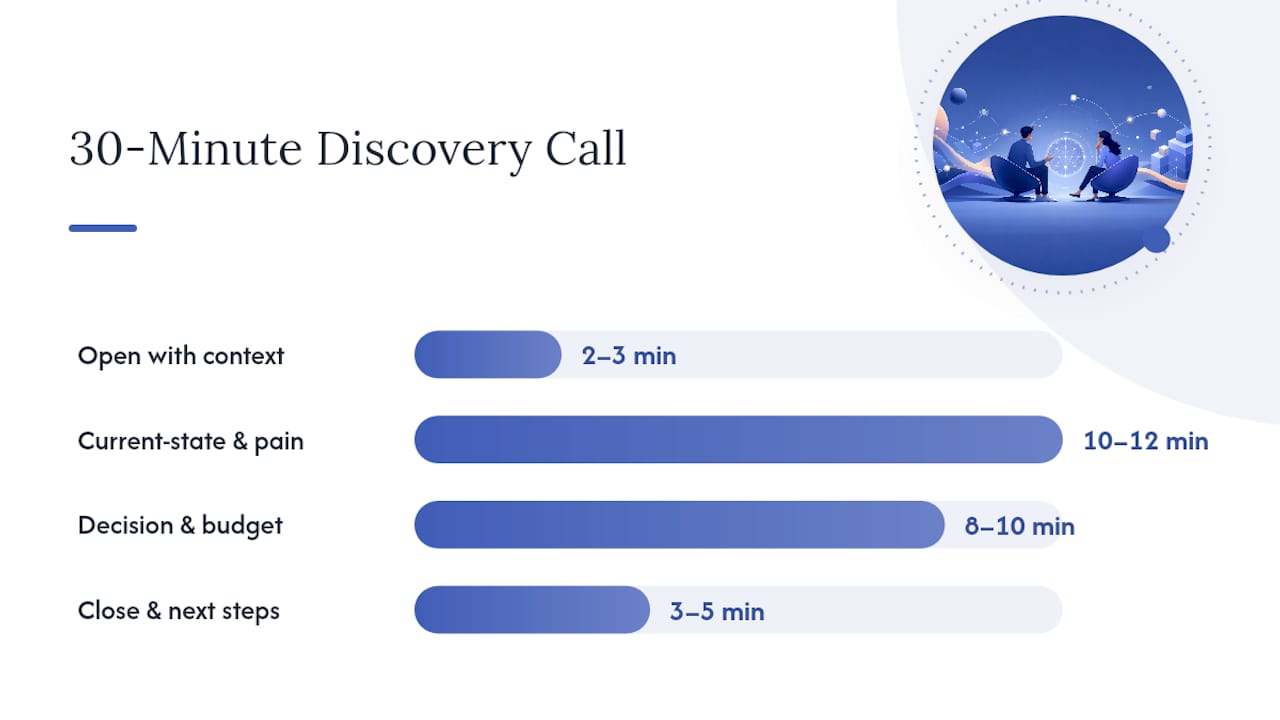
A discovery call falls apart when questions get asked in the wrong order, not when the wrong questions get asked. Here’s a repeatable sequence for a standard 30-minute call.
- Open with context, not questions (2 to 3 minutes). Confirm what you already know from the async form, and ask permission to dig deeper: “I saw from your form that you’re using [tool] today. Mind if I ask a few questions about how that’s working?”
- Run current-state and pain probes (10 to 12 minutes). Start broad, then narrow. “Walk me through your process” leads naturally into “What’s the cost of that friction?”
- Move into decision process and budget (8 to 10 minutes). Transition with something like: “That’s helpful. Shifting gears a bit, who else typically weighs in on a decision like this?”
- Close with next steps (3 to 5 minutes). Summarize what you heard in your own words, confirm it’s accurate, and propose a specific next step tied to what you learned.
Good transitions sound conversational, not scripted: “That makes sense, and it actually leads into something I wanted to ask about…” Follow-ups matter more than the original question. If a prospect says “it’s a priority,” don’t accept it. Ask “priority compared to what else on your plate right now?”
Watch for red-flag answers that should slow you down rather than speed you up. “We’re just exploring options” with no trigger event named usually means no real urgency. “I’ll need to check with my team” from someone who claimed to be the decision maker means your decision-process questions weren’t sharp enough. Vague budget answers repeated twice in a row usually mean there isn’t one yet. When you hear these, don’t push through to a next step. Go back and ask a direct clarifying question instead: “It sounds like this might not be fully prioritized yet. Is that fair to say?”
Pro Tip: Record your own discovery calls and count your live questions against the transcript afterward. Most reps who think they’re asking 15 questions are actually asking 22, because they don’t count the small clarifying ones. That gap is usually where calls start to drag.
Practicing Discovery Questions Through Role-Play
Reading a discovery questions list is not the same skill as asking those questions under pressure, adjusting when an answer is vague, and steering back on track without sounding like you’re reading from a script. Simulation-based practice and coached role-play measurably improve conversational sales skills, because reps build pattern recognition for weak answers in a setting where a bad rep doesn’t cost you a real deal.
A useful role-play session structure looks like this:
- Assign a persona with a specific hidden objection or ambiguous budget status, not a cooperative buyer who answers everything cleanly.
- Run the call for the full 20 to 30 minutes, live, with no pausing to “start over.”
- Score the transcript against a rubric: live-question count, follow-up quality, whether budget and decision-process got covered, and whether red flags got addressed instead of ignored.
- Debrief with the rep on two specific moments, not a general “good job” summary.
This is where a platform like XL Roleplay fits into a team’s practice routine: it runs live voice and video simulations against AI buyers, scores the session against your organization’s own methodology, and gives managers a transcript to point to instead of a memory of how the call felt.
How To Analyze And Record Discovery Call Answers
The best discovery questions are wasted if the answers live only in your memory by the time you write the follow-up email. Record every call where the prospect consents to it, and take notes in real time using the same category headers from your discovery list: current state, pain, goals, decision process, budget, stakeholders. This turns your notes into something searchable later instead of a wall of loose sentences.
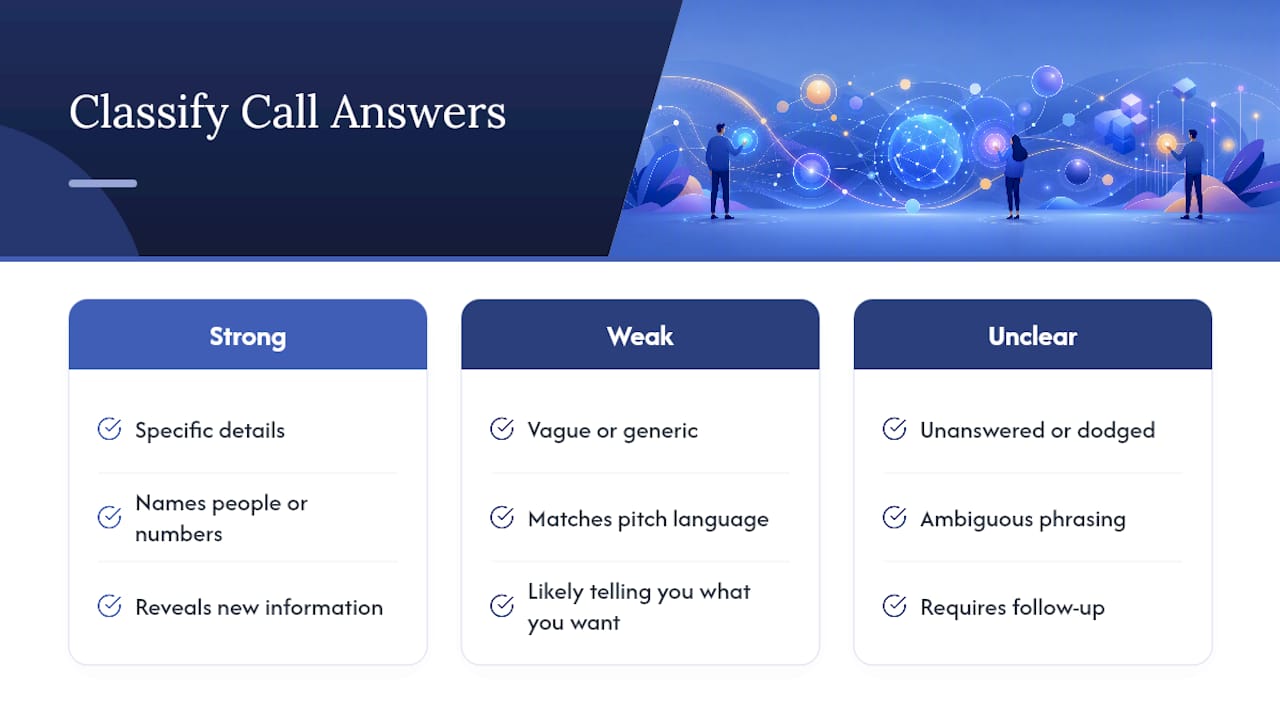
After the call, spend five minutes tagging each answer as strong, weak, or unclear. A strong answer is specific, names a person or number, and reveals something you didn’t already know. A weak answer is vague, generic, or matches language from your own pitch deck, which usually means the prospect is telling you what they think you want to hear.
Log answers directly into your CRM under structured fields rather than a single freeform notes box. If your CRM supports custom fields, mirror your discovery categories exactly, so a manager reviewing the deal later can see budget and decision-process answers without reading a paragraph of prose. Flag any unanswered or dodged questions explicitly. An unanswered budget question is not a neutral data point. It’s a missing qualifier that should show up on your forecast review, not disappear into a “notes” field nobody rereads.
Common Mistakes Reps Make With Discovery Questions
The most common mistake is treating a discovery questions list as a script to read verbatim instead of a menu to pull from. A prospect can tell within minutes when they’re being run through a checklist, and it kills the rapport that makes people give honest answers in the first place.
The second mistake is asking closed-ended questions where open-ended ones would work harder. “Is budget approved?” gets a one-word answer. “Where does budget stand for this right now?” invites a fuller picture, including hesitation that tells you something.
Accepting the first answer without a follow-up is the third mistake, and it’s the costliest one. When a prospect says “this is a priority,” a rep who moves on has learned nothing. A rep who asks “priority compared to what?” often finds out it’s priority number four on a list of six.
Rushing budget and decision-process questions out of politeness is another common failure. Reps soften these into throwaway lines near the end of the call, when they deserve the same direct treatment as pain questions. Finally, many reps stack too many questions into a single live call instead of trusting the async form to carry the factual weight, which burns the 11 to 15 question budget on things that didn’t need a real-time answer at all.
Ineffective Discovery Questions And How To Fix Them
Some questions sound like discovery but produce almost no usable information. Recognizing them is half the fix.
“Are you happy with your current solution?” invites a reflexive “it’s fine,” because most people default to a polite answer. Fix it: “What would you change about your current solution if you could change one thing?” This forces a specific answer instead of a shrug.
“What are your pain points?” is too abstract for most buyers to answer well on the spot. Fix it: “Walk me through the last time this process caused a problem. What happened?” A specific memory produces a specific answer.
“Do you have budget for this?” is a yes/no trap that often gets a defensive “we’ll see.” Fix it: “Where does budget typically come from for something like this, and has that conversation started?”
“Who’s the decision maker?” assumes one person holds the answer, when most B2B purchases involve a committee. Fix it: “Who else besides you will weigh in before a decision gets made?”
“What’s your timeline?” gets a vague “soon” more often than not. Fix it: “What’s driving the timeline, and what happens if this slips a quarter?” Tying the question to a consequence gets a sharper answer every time.
A Working Checklist For Better Discovery
Discovery improves when you stop treating it as a personality trait and start treating it as a repeatable process you can measure. Three rules cover most of what separates strong discovery from weak: prep the boring facts async so live time goes to the questions that matter, hold yourself to the 11 to 15 live-question range instead of drifting into either an interrogation or a pitch disguised as a chat, and debrief every call against a scorecard, not a gut feeling.
The teams that improve fastest aren’t the ones with the best question list. They’re the ones who review their own calls against a rubric often enough to notice patterns, then fix the specific habit that’s costing them deals.
— Adam
Practice Discovery Before It Costs You A Deal
Reading a discovery questions list is the easy part. Asking it live, adjusting when a prospect gives a vague answer, and holding your 11 to 15 question budget under real pressure is the part that actually separates reps who qualify well from reps who wing it. XL Roleplay gives you a way to build that skill before it costs you a real deal, running live voice and video simulations against AI buyers who throw the same vague budget answers and stalling tactics you’ll hit on a real call.
Every session generates a scored coaching report tied to your organization’s own methodology, plus a full transcript managers can review instead of relying on secondhand summaries. Sales leaders use it to standardize how a whole team runs discovery, from the live-questioning approach down to specific follow-up habits. If you want to see how your team’s discovery holds up under a live objection instead of a hypothetical one, start a session and see how your questions actually land.
Sources
- Discovery call questions — Highspot
- Sales Discovery Questions: 40 That Qualify, and When to Ask Them | Perspective AI
- Discovery Call Questions: 30 Best for B2B Sales | Sendspark
- Sales discovery call questions — Articulate
- The new sales imperative — Harvard Business Review