Empathy Statements for Customer Service: Phrases That Work
Empathy Statements for Customer Service: Phrases That Work

An empathy statement is a short, specific phrase that acknowledges how a customer feels and signals you will take responsibility to help. Get the wording wrong and it sounds like a script. Get it right, and it de-escalates tension and moves the conversation toward resolution faster than any policy explanation ever will.
This page gives you grouped, copy-and-paste empathy statements for the situations you handle every day: angry customers, delays, billing disputes, confusion, and closings. You will also get short scripts showing how to sequence a statement with real action, plus the phrases that quietly wreck rapport.
Used well, these lines do two things:
- Lower escalation rates by acknowledging emotion before you explain policy
- Improve CSAT and cut repeat contacts because customers stop feeling like a ticket number
Key Takeaways
Empathy statements work when they follow acknowledge, validate, act, and fail when they stay generic or skip the follow-through.
| Point | Details |
|---|---|
| Use the four-beat structure | Acknowledge, validate, reassure, then act with a concrete next step every time. |
| Personalize every line | Insert one specific detail from the customer’s account to avoid sounding scripted. |
| Match phrase to channel | Warm short sentences work in chat, tone carries phone calls, and structure carries email. |
| Set conservative timelines | Promise refund or fix dates you can beat, not ones you might miss. |
| Practice under pressure | Xl runs live roleplay scenarios with scored transcripts so teams build empathy delivery before facing it live. |
Table of Contents
- What Makes an Empathy Statement Work
- Empathy Statements for Angry or Frustrated Customers
- Empathy Statements for Delays, Waiting, and Urgent Issues
- Empathy Statements for Billing, Refunds, and Money Concerns
- Empathy Statements for Confusion, Follow-Ups, and Closings
- How to Use Empathy Statements Without Sounding Scripted
- Empathy in Action: Three Short Scripts
- Empathy Phrases That Backfire and What to Say Instead
- Why Practiced Empathy Beats Memorized Scripts
- Reading the Room: Matching Language to Emotion
- Phone, Chat, and Email Each Need Different Empathy
- Cultural Nuance Changes How Empathy Lands
- What I’d Fix First If I Were Coaching a Team This Week
- Practice Empathy Delivery Before It Counts on a Live Call
- Frequently Asked Questions
- Sources
What Makes an Empathy Statement Work
A working empathy statement follows a four-beat pattern: acknowledge, validate, reassure, act. You name what happened (“Your order arrived three days late”), validate the feeling (“That’s frustrating, especially when you needed it for an event”), reassure the customer you’re on it, then act with a concrete step. Skip the last beat and you’ve just offered a warm hug with no follow-through, which undermines trust fast.
Empathy and sympathy get confused constantly, but they aren’t the same tool. Sympathy says “I feel sorry for you,” which puts distance between you and the customer. Empathy says “I understand your position,” which keeps you on the same side of the problem and makes cooperation easier.
The mechanics matter more than most agents realize:
- Acknowledge the specific event, not a generic problem
- Validate the emotion without judging it
- Reassure the customer that you’re taking ownership
- Act with a timeline, a fix, or a next step
Short, well-placed empathy statements lower emotional intensity before problem-solving even starts, which is why teams that train for this consistently see fewer repeat contacts.
Empathy Statements for Angry or Frustrated Customers
Angry customers need to feel heard before they’ll listen to a solution. These lines own the problem without deflecting blame onto policy or “the system.”
- “You’re right to be upset. This shouldn’t have happened, and I’m going to fix it.”
- “I hear how frustrating this has been, and I’m sorry we put you in this position.”
- “That’s a fair complaint. Let me take this from here.”
- “I understand why you’re angry. I’d feel the same way.”
- “This isn’t the experience we want you to have, and I want to make it right.”
- “I can tell this has been a real headache. Let’s get it sorted now.”
- “You’ve been more patient than you should have had to be.”
- “I’m sorry this happened twice. That’s on us, not you.”
- “I get why this feels unacceptable. Here’s what I’m doing right now.”
- “Thanks for staying with me while I sort this out. You deserve better.”
Pro Tip: Swap one generic word for a customer-specific detail. “I’m sorry this happened” becomes “I’m sorry your third shipment this month arrived damaged.” That single substitution is what separates an authentic response from a canned one.
Empathy Statements for Delays, Waiting, and Urgent Issues
Customers waiting on a fix don’t need more apologies. They need a timeframe and proof someone owns the problem.
- “I know waiting is the worst part. Here’s exactly where things stand.”
- “Thanks for your patience. I expect this resolved by [specific time].”
- “I understand this is urgent, so I’m prioritizing it right now.”
- “I’m sorry for the delay. I’ll have an update for you by end of day.”
- “You shouldn’t have had to wait this long, and I’m speeding this up.”
- “I know deadlines matter here. I’m treating this as time sensitive.”
Pair every delay statement with a real ETA, not a vague “soon.” If you genuinely don’t know the timeline, say when you’ll follow up instead of guessing. A missed promise does more damage than an honest “I’ll update you by 3 PM tomorrow.”
Empathy Statements for Billing, Refunds, and Money Concerns
Money problems trigger anxiety fast, so validate the concern before you explain the process.
- “I understand seeing an unexpected charge is stressful. Let’s fix this together.”
- “You’re right to question this. I’m reviewing your account now.”
- “I know every dollar counts. I’ll have your refund processed within [timeframe].”
- “That’s a valid concern about your bill, and I want to clear it up today.”
- “I’m sorry this charge caused confusion. Here’s what happened and what I’m doing.”
- “I understand refunds can feel slow. I’m submitting yours right now.”
Keep refund timelines conservative. Promising “24 hours” and missing it erodes more trust than saying “3 to 5 business days” and delivering early.
Empathy Statements for Confusion, Follow-Ups, and Closings
Confused customers often just need clarity, not consolation. A good clarifying statement prevents the callback that would otherwise happen tomorrow.
- “Let me walk through this step by step so it’s clear.”
- “That’s a common question. Here’s exactly how it works for your account.”
- “I want to make sure this makes sense before we finish. Any part you’d like me to explain again?”
- “I’ll send a summary so you have this in writing.”
- “If anything comes up after we hang up, here’s how to reach me directly.”
- “Thanks for your patience today. I’ve noted everything so you won’t have to repeat it.”
- “It was good working through this with you. Reach out anytime if something else comes up.”
Chat and email closings can run slightly warmer than phone closings since there’s no vocal tone to soften the words: “Glad we got this sorted. Feel free to reply here if anything else pops up.”
How to Use Empathy Statements Without Sounding Scripted
The order matters more than the words. Read the emotion first: angry, anxious, confused, or simply rushed. Then choose the phrase group that matches, not the one that’s easiest to type. An anxious billing customer doesn’t need an angry-customer line, and vice versa.
- Identify the emotion behind the words, not just the stated issue
- Select the matching phrase group (angry, delay, billing, confusion)
- Insert one specific detail from the customer’s account or message
- Follow the empathy statement immediately with a concrete action
- Confirm the customer feels heard before moving to next steps
Personalization is the difference between rapport and irritation. Generic phrases read as scripted, while specific ones read as genuine because they prove you actually read the account. Swapping “we” for “I” also helps: “I’m fixing this” carries more accountability than “we’re looking into it,” which can sound like the problem got handed off to a faceless department.
If you’re managing a team, build macros with placeholders instead of finished sentences. A macro that reads “I understand [specific issue] is frustrating, especially since [customer detail]” forces the agent to personalize before sending, rather than pasting a finished script verbatim.
Pro Tip: Coach agents to say the empathy line out loud before typing it. If it sounds like something a robot would say, it probably will read that way to the customer too.
Know when empathy alone isn’t enough. If a customer’s tone escalates after two attempts at validation, or the issue requires a policy exception, hand off to a supervisor rather than repeating the same phrase with more urgency. Repetition without new action reads as stalling, not care.
Empathy in Action: Three Short Scripts
Here’s how the acknowledge, validate, act sequence plays out across channels.
-
Angry phone call. Customer: “This is the third time I’ve called about this!” Agent: “You’re right to be upset, three calls for one issue is too many. [validation] I’m pulling up your case now and staying on the line until it’s fixed. [action]” Follow up within 24 hours to confirm the fix held.
-
Chat escalation. Customer: “I don’t understand why I’m still being charged.” Agent: “I get why that’s confusing. [validation] I can see the duplicate charge on your account. I’m reversing it now and you’ll see it credited within 3 business days. [action]” Send a chat transcript summary before closing.
-
Refund email. Subject: Your refund is on its way. “I understand waiting for a refund is frustrating, especially after a delayed order. Your $84.50 refund was processed today and will post to your card within 5 to 7 business days.”
Each script ties directly to a measurable outcome: fewer repeat calls, higher CSAT scores, and shorter average handle time once agents stop improvising under pressure.
Empathy Phrases That Backfire and What to Say Instead
Some phrases sound empathetic on paper but land as dismissive in practice.
- “I understand your frustration” (no specifics) reads as a placeholder. Say instead: “I understand how frustrating a second delayed shipment must be.”
- “Calm down” or “I know how you feel” can feel condescending. Try: “That sounds genuinely stressful, let’s fix it.”
- “There’s nothing I can do” shuts down the conversation. Try: “Here’s what I can do, and here’s who can help with the rest.”
- “As per our policy” sounds like a wall. Try: “Here’s why that happened, and here’s what I can offer instead.”
Canned lines fail specifically because they’re generic, not because empathy itself doesn’t work. Train agents to replace inherited scripts with detail-driven language during onboarding, not after a customer complaint forces the issue.
Why Practiced Empathy Beats Memorized Scripts
Reading a list of phrases is one thing. Delivering the right one, in the right tone, under real pressure, is another skill entirely. Empathy becomes reliable when it’s trained and coached rather than left to individual personality, which is why teams that rely purely on written guides see inconsistent results across agents.
Roleplay practice closes that gap. Running through an angry-customer scenario, a billing dispute, or a confused first-time caller before it happens live means the phrasing feels natural instead of rehearsed when it counts.
- Realistic scenario practice against typical objections and emotional pressure
- Session transcripts that show exactly which line landed and which fell flat
- Scored rubrics tied to your organization’s own service standards
- Coaching feedback that targets tone, timing, and personalization gaps
Teams that build structured roleplay practice into onboarding report agents reach conversational confidence faster, with fewer costly mistakes happening on live calls instead of in practice.
Reading the Room: Matching Language to Emotion
Not every upset customer needs the same words. Someone who’s angry wants ownership and speed. Someone who’s anxious about money wants reassurance and a clear number. Someone who’s confused wants patience, not more apology.
Start by naming the emotion silently before you speak: is this anger, anxiety, disappointment, or genuine confusion? Anger responds best to direct ownership language (“I’m fixing this now”). Anxiety responds better to specificity (“Your refund of $42 will post by Thursday”) because vague reassurance actually increases worry. Disappointment, common with delayed shipments or missed expectations, often needs acknowledgment of the letdown itself: “I know you were counting on this arriving before the weekend.”

Context matters as much as emotion. A first-time customer having a bad experience needs more reassurance about your reliability than a longtime customer who already trusts you. Referencing history helps: “I know you’ve been with us for a while, and this isn’t the experience you’re used to” personalizes far better than a generic apology.
Watch for mismatched intensity too. Matching a mildly annoyed customer with an over-the-top apology can feel patronizing, while under-responding to genuine distress feels cold. Calibrate the warmth of your language to the size of the customer’s reaction, not to a fixed script tier.
The fastest way to build this instinct is repetition across varied scenarios, since real customers rarely present textbook emotions in isolation. Most conversations blend frustration with confusion, or anxiety with impatience, which is exactly why single-emotion scripts fall short in practice.
Phone, Chat, and Email Each Need Different Empathy
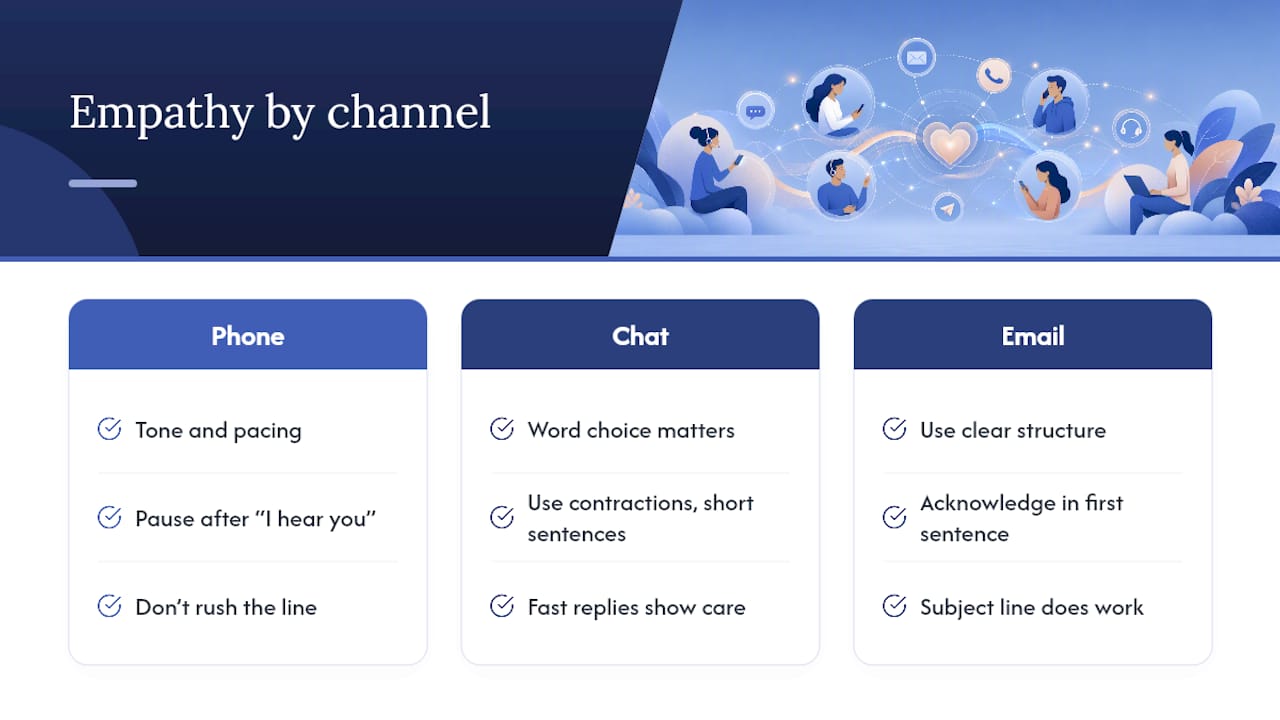
The same sentiment lands differently depending on the channel. Phone empathy relies heavily on tone and pacing. A well-placed pause after “I hear you” often communicates more than the words themselves, and rushing through an empathy line on a call can undo its effect entirely.
Chat empathy needs to work without vocal cues, so word choice carries more weight. Contractions and shorter sentences read as warmer in text: “I get it, that’s annoying” lands better in chat than a longer, formal phrase that would sound natural on a call. Response speed also functions as empathy in chat. A fast reply signals attentiveness even before the words arrive.
Email empathy has the most room for structure but the least room for real-time reassurance, since the customer can’t hear tone or see typing indicators. Open with acknowledgment in the first sentence rather than burying it under a greeting and background explanation. A subject line like “Your refund is on its way” does more emotional work than customers expect from a subject line alone.
One consistent rule across all three channels: never let the channel excuse a shortcut. A rushed chat reply or a template-heavy email reads as cold just as easily as a flat phone tone does. If you’re training multilingual or bilingual support staff, resources like cross-cultural customer service language guides help agents translate not just vocabulary but tone, since a direct translation of an empathy phrase doesn’t always carry the same warmth in another language.
Cultural Nuance Changes How Empathy Lands
Empathy statements that work well in one cultural context can feel intrusive or oddly formal in another. Directness is a good example. In some regions, “I’m sorry this happened” reads as sincere and sufficient. In others, customers expect a more elaborate apology before they’ll accept a resolution, and a short line can feel dismissive even when it’s meant warmly.
Physical touch metaphors and casual warmth (“I’ve got your back,” “no worries at all”) don’t always translate cleanly across languages or generations. What reads as friendly to one customer can read as unprofessional to another. When your support team serves customers across regions or age groups, it helps to keep a slightly more formal empathy phrase in rotation alongside the casual ones, and let agents choose based on the customer’s own tone.
Language sensitivity extends beyond translation. Idioms like “that’s a bummer” or “no biggie” don’t always survive translation into other languages, and a literal translation can come across as confusing or careless. Training multilingual teams to recognize which phrases are culturally flexible and which need a formal substitute prevents empathy statements from backfiring simply due to phrasing choices that don’t travel well.
What I’d Fix First If I Were Coaching a Team This Week
Most coaching plans focus on adding more empathy phrases to a list. The bigger gap is usually delivery under pressure, not vocabulary. Pull three recent transcripts from angry-customer calls and check whether agents personalized the acknowledgment or leaned on a generic line. If most defaulted to generic phrasing, that’s your coaching priority this week, not a longer script.
Practice Empathy Delivery Before It Counts on a Live Call
Reading a list of phrases builds vocabulary. It doesn’t build the instinct to pick the right line, in the right tone, three seconds into an angry call. That gap is where most agents actually stumble, and it’s the gap XL Roleplay was built to close.
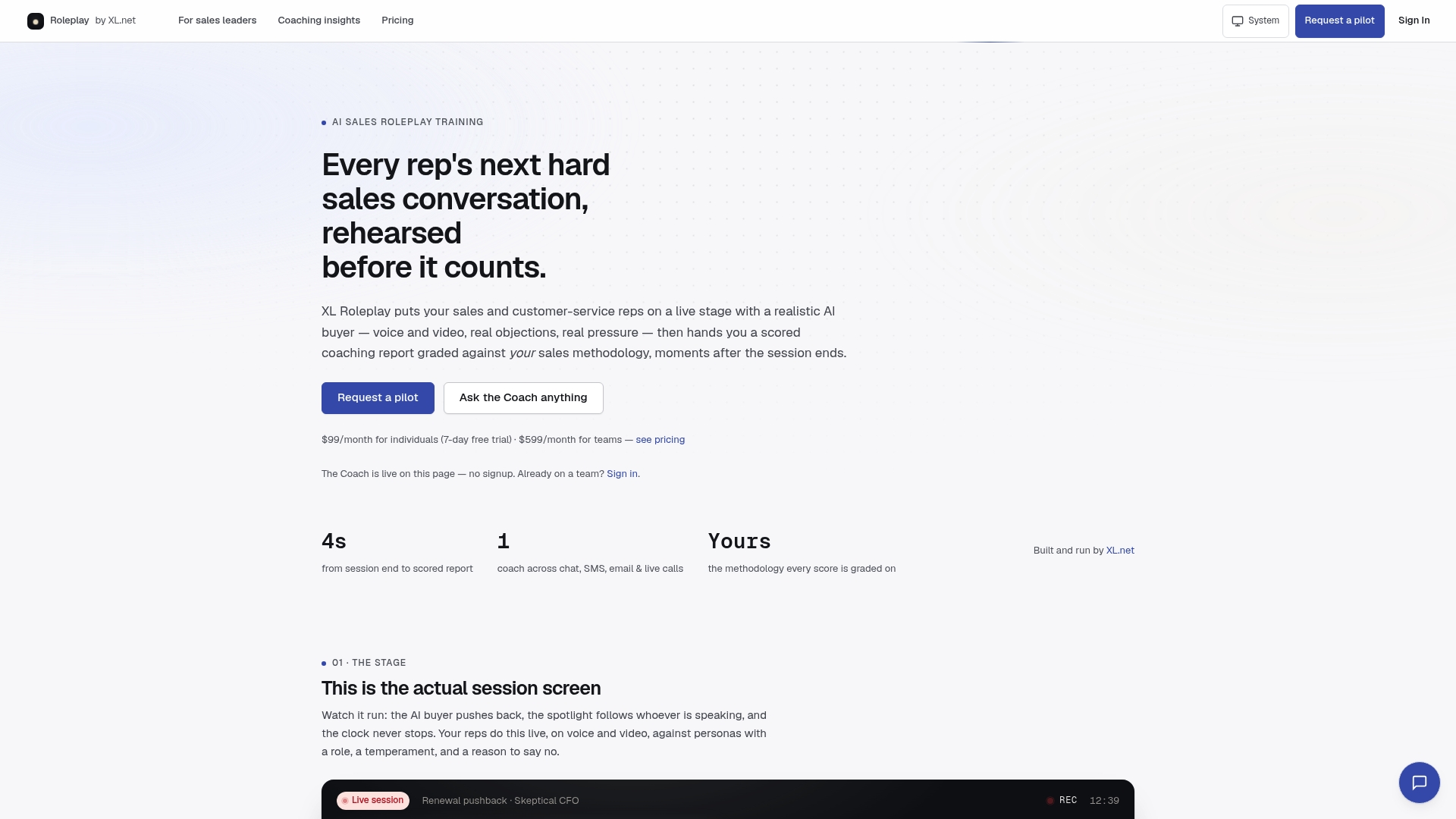
Teams use it to run live voice and video sessions against AI buyers programmed with realistic objections and pressure, including an angry-customer scenario where the AI escalates if the agent’s empathy statement sounds generic or rushed. Every session generates a transcript and a scored coaching report tied to your own service standards, so managers can see exactly where personalization broke down instead of guessing from a spot check. If you’re rolling out these phrase groups to a support team, check out plans for sales and service leaders and run your team’s first practice scenario this week.
Frequently Asked Questions
What is an empathy statement in customer service? It’s a short, specific phrase that acknowledges a customer’s emotion and signals you’re taking responsibility to help, typically followed by a concrete action or timeline.
How do you show empathy to an angry customer without sounding scripted? Insert one detail specific to that customer’s situation into your phrase, use “I” instead of “we,” and follow the statement immediately with a real next step rather than another apology.
What’s the difference between empathy and sympathy in customer service? Empathy aligns with the customer’s perspective and keeps you on their side of the problem, while sympathy can create emotional distance that feels less collaborative.
Do empathy statements actually reduce escalations? Yes. Acknowledging emotion before problem-solving lowers emotional intensity and reduces repeat contacts and escalation rates when used consistently across a team.
Should empathy phrases differ between phone, chat, and email? Yes. Phone relies on tone and pacing, chat benefits from short warm sentences and fast replies, and email needs the acknowledgment placed in the first sentence rather than buried under formalities.
Sources
- Empathable — Validating statements (Empathy statements overview)
- CallCentreHelper — Empathy statements for customer service
- TextExpander — Customer service empathy statements
- Eesel AI — Empathy statements and why canned lines backfire
- Qualtrics — Empathy statements for customer service