48% Skill Gains: Build Evidence Based Sales Coaching for Sales Leaders
48% Skill Gains: Build Evidence Based Sales Coaching for Sales Leaders

Evidence-based sales coaching means anchoring every coaching conversation to a shared performance standard, repeated observation of real calls, and feedback specific enough to change behavior. Coach reps this way and skill scores rise, along with measurable revenue: one large-scale project tracking 1,000,000 minutes of sales coaching found teams receiving quality coaching improved skill scores significantly and saw notable revenue lifts. The rest of this guide breaks down the research and the operational steps to build it.
TL;DR:
- Consistent, high-quality coaching improves skill scores by around 48% and increases revenue by approximately 29%, especially in slow-growth markets.
- Observation volume is critical, with fewer than 20% of eligible calls reviewed, and calibration between managers ensures scoring reliability.
- Focusing on a small set of high-impact observable behaviors and using AI-driven roleplay can exponentially increase coaching volume and effectiveness.
- Manager coaching skill significantly moderates the benefits of coaching frequency, making calibration and skill development for managers essential.
- Early implementation should emphasize building one clear rubric for a single behavior, run ten practice sessions, and prioritize middle performers to see fastest gains.
Table of Contents
- What Is Evidence-Based Sales Coaching, and How Does It Differ From Training?
- What Does the Research Actually Show About Sales Coaching?
- How to Build the Standard, the Observation System, and the Feedback Loop
- How Do You Measure Sales Coaching Effectiveness?
- Which Tactics Actually Produce Behavior Change?
- How Do You Design a Coaching Program That Scales?
- What Are the Biggest Pitfalls in Evidence-Based Sales Coaching?
- How Does XL Roleplay Support the Research-Backed Coaching Model?
- What Should You Actually Do in the First 90 Days?
- Ready to Put Evidence-Based Coaching Into Practice?
- Sources
What Is Evidence-Based Sales Coaching, and How Does It Differ From Training?
Training teaches a concept once, to a group, usually in a room disconnected from real selling conditions. Coaching, done right, is a loop that runs against three moving parts: a standard, an observation stream, and feedback that specifies a next action. Miss any one of the three and the whole system collapses into something that feels like coaching but produces no measurable change.
The standard is a shared rubric defining what a good version of a specific behavior looks like at a specific stage of the sales conversation. Without it, two managers watching the same call disagree about what “good discovery” even means. The observation stream is the raw material: recorded calls, roleplay transcripts, CRM notes tied to actual conversations, not a manager’s memory of a deal from three weeks ago. The feedback is the part most programs get wrong. Feedback that says “be more consultative” gives a rep nothing to practice. Feedback that says “on your next discovery call, ask about budget authority before you pitch pricing” gives them something to test.
This is also why the postmortem deal review, the staple of most sales floors, doesn’t reliably build skill. Reviewing a closed or lost deal after the fact relies on memory, hindsight bias, and whatever the rep chooses to share. It generates opinions about outcomes, not observations of behavior. Evidence-based coaching frameworks treat this as the core failure point: without a steady stream of observed practice, coaching drifts into anecdote.
What does an observable, coachable behavior actually look like? A few examples managers can build rubrics around:
- Asking an open discovery question before presenting any solution
- Explicitly confirming a buyer’s decision criteria in their own words
- Restarting a stalled conversation after an objection instead of abandoning the point
- Asking for a specific next commitment before the call ends
- Naming the buyer’s competing priority instead of ignoring it
- Quantifying the cost of inaction in the buyer’s own terms
- Summarizing agreed next steps with owners and dates
- Handling a price objection without immediately discounting
Each of these can be scored yes or no, or on a short scale, from a transcript. That’s the whole point. If a behavior can’t be observed and scored consistently, it doesn’t belong in the coaching rubric yet.
What Does the Research Actually Show About Sales Coaching?
The strongest data point in this field comes from the SalesDNA project, which analyzed a million minutes of live sales coaching conversations and distilled 172 candidate skills down to 18 high-impact, observable behaviors. Teams that received consistent, quality coaching against those 18 skills saw average skill-score improvements of about 48%, along with year-on-year revenue lifts near 29% in low-growth markets. The study also linked manager-delivered coaching to higher quota attainment and lower rep attrition, which matters more than it sounds: coaching that reduces turnover pays for itself even before it moves a single deal.
Teams coached against a defined set of observable skills saw skill scores rise by roughly 48%, with revenue lifts near 29% in slower-growth markets.
A separate peer-reviewed study of 1,246 reps across 136 teams adds a necessary complication: coaching frequency alone doesn’t help, and can actively hurt. Manager coaching skill moderates the effect of coaching frequency on goal attainment. When a manager’s coaching skill is low, coaching more often correlates with worse outcomes, not better ones. Volume without competence just amplifies bad advice.
More recent research on AI-assisted coaching adds a third layer. A framework built on empirically derived, multimodal communication analysis shows that conversation-structure metrics, scored against real call data, can generate reliable signals for real-time coaching interventions, provided the models are validated and audited for bias rather than treated as a black box.
Three practical takeaways fall out of this research:
- Prioritize a short list of observable, high-leverage skills over a sprawling competency framework nobody can score consistently.
- Plan for observation volume before you plan for coaching hours. A manager with zero recorded calls to review can’t coach against evidence no matter how skilled they are.
- Expect diminishing, even negative, returns once coaching frequency outpaces manager skill. Calibrating managers has to come before scaling their coaching load.
How to Build the Standard, the Observation System, and the Feedback Loop
Each of the three components has a concrete, buildable shape. None of them require exotic tooling, though the observation piece is where most programs quietly fail.
1. Build the rubric first, and keep it small. A usable rubric row names the sales stage, the observable behavior, and two or three scoring anchors. For example: Stage: Discovery. Behavior: Confirms decision criteria. Anchor 1 (weak): Moves on without restating buyer’s priorities. Anchor 2 (strong): Repeats criteria back in the buyer’s own language and asks for confirmation. That’s specific enough for two different managers to score the same call the same way, which is the actual test of a good rubric.
2. Gather observations at volume, and make them traceable. Live call recordings with proper consent, roleplay transcripts, and CRM-logged artifacts all count as evidence. What doesn’t count is a manager’s summary of a call they half-listened to. Every score should trace back to a specific transcript excerpt or timestamped clip. Automated scoring systems are useful for flagging gaps at scale, but the score alone doesn’t explain the gap. The raw artifact does.
3. Write feedback as a testable hypothesis. Instead of “work on objection handling,” write it as: if the rep restates the objection before responding, then objection recovery rate should rise on the next five eligible calls. That’s a practice hypothesis with a built-in transfer test. It also becomes the seed of an evidence pack: the original artifact, the observed fact, the interpretation, and the practice hypothesis, all in one traceable record.
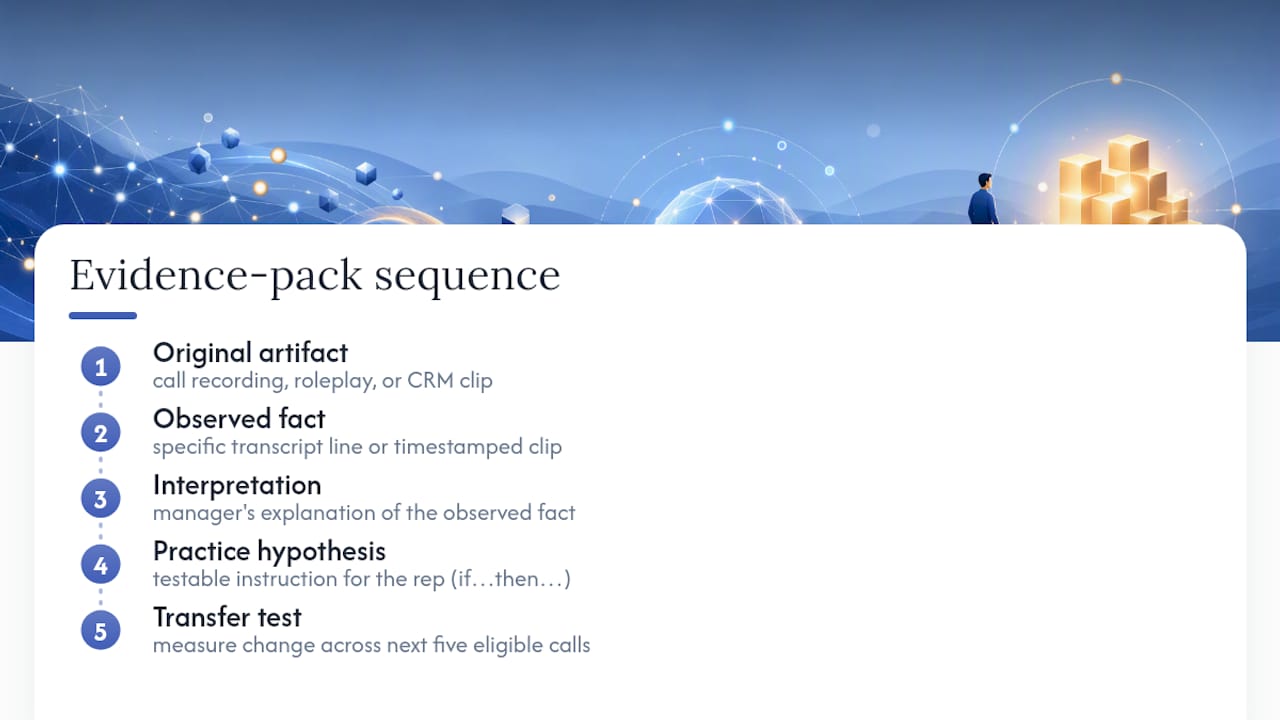
Pro Tip: Never let a coaching note say only “needs work on discovery.” Require every note to cite the exact transcript line or timestamp that triggered the feedback. It forces specificity and makes calibration between managers possible later.
How Do You Measure Sales Coaching Effectiveness?
Revenue is the metric everyone wants to report and the worst one to lead with. Deal cycles are long, multiple variables move at once, and by the time revenue shifts, the coaching that caused it happened months earlier. Leading indicators tell you whether the system is working long before the pipeline does.
The core indicators worth tracking weekly:
| Metric | What it captures | Why it matters |
|---|---|---|
| Eligible opportunities | Calls or interactions where a target behavior could occur | Sets the denominator for every rate calculation |
| Observed opportunities | Eligible interactions actually reviewed | Reveals observation coverage, the most common failure point |
| Behavior present/absent | Whether the target behavior showed up | The raw signal a rubric score is built from |
| Transfer rate | Present-count divided by eligible-count over a defined window | Shows whether coaching is changing behavior, not just being delivered |
| Practice frequency | Roleplay or drill repetitions per rep per week | A leading proxy for skill retention |
| Observation coverage | Observed divided by eligible opportunities | The single number that predicts whether any other metric is trustworthy |
The reporting protocol is simple in structure even if it takes discipline to run: count eligible interactions, count how many were actually observed, count how many showed the target behavior, then calculate a rate. That threshold isn’t arbitrary. Industry reporting suggests fewer than 20% of enablement teams reliably track behavior change at all, which means most programs are reporting activity metrics and calling them outcomes.
Combining that data with structured human conversation matters more than the data alone. Programs that pair performance data with weekly manager one-on-ones see roughly 70% higher behavior change than data reporting by itself. A dashboard nobody discusses out loud doesn’t coach anyone. For a fuller walkthrough of what to include in an upward-facing report, this reporting guide breaks down what leadership actually wants to see versus what enablement teams tend to report.
Avoid the trap of inferring causation from a short observation window. A single strong month after a coaching push could be seasonality, a big renewal, or one lucky rep. Transfer rate, tracked over several weeks against a clear eligible-opportunity denominator, is a far more honest signal than a revenue bump you’re eager to credit to coaching.
Which Tactics Actually Produce Behavior Change?
Roleplay, structured debriefs, and disciplined one-on-ones are the three practices with the clearest line to measurable transfer. Each works because it generates an observable artifact, not just a conversation.
Roleplay design starts with scenario selection pulled from real, difficult calls, not generic hypotheticals. A scenario built from an actual stalled negotiation or a real recurring objection produces more useful practice than an invented one. Building scenarios from real calls keeps the practice grounded in the objections reps genuinely face. Score the roleplay against the same rubric used for live calls, and deliver micro-feedback immediately after, while the moment is still fresh enough for the rep to feel the difference between the weak and strong version of the behavior.
One-on-one structure should never open with “how’s the pipeline looking.” Start with a specific observed artifact: a transcript excerpt or a scored roleplay clip. State the target behavior plainly. Agree on a practice hypothesis together, not as a directive handed down. Then schedule the transfer test, meaning a specific date and a specific number of eligible calls where you’ll check whether the behavior showed up. A structured debrief template built around one behavior at a time, rather than a laundry list of feedback, keeps the conversation focused enough to actually change something.
A few tactics that build observation volume without eating into limited manager hours:
- Weekly peer-practice pods where reps roleplay against each other and self-score with the shared rubric
- Short, five-minute drills targeting one behavior, run before team calls rather than as standalone meetings
- Rotating “reviewer of the week” roles so calibration skill spreads beyond the sales manager
- Recorded call libraries tagged by behavior, so new hires can watch strong and weak examples side by side
Pro Tip: Cap live roleplay debriefs at one target behavior per session. Trying to fix discovery, objection handling, and closing in the same ten-minute conversation guarantees the rep retains none of it.
How Do You Design a Coaching Program That Scales?
A coaching program needs governance the same way a sales process does, or it degrades into whichever manager happens to care most that quarter. The starting document is a coaching charter: who observes what, how often, what confidentiality protections exist for recorded calls, and where escalation happens when a rep isn’t improving. A behavior contract, a short written agreement between rep and manager naming the specific practice hypothesis and the transfer test date, keeps both sides accountable to something concrete instead of a vague “let’s work on it.”
Manager capacity is the constraint most programs underestimate. Coaching well takes real hours: reviewing artifacts, scoring against the rubric, running structured one-on-ones, and following up on transfer tests. A manager coaching more than eight to ten reps actively rarely sustains meaningful observation coverage without help, which is exactly where recorded roleplay and AI-scored practice sessions start to matter, since they generate observation volume a manager alone can’t produce in a normal week.
The minimum recordkeeping structure needs to include:
- An evidence pack per rep: artifact link, observed behavior, interpretation, and the practice hypothesis tied to it
- An observation ledger tracking eligible opportunities, observed opportunities, and behavior present/absent counts over time
- Role-based access so reps see their own evidence while managers and enablement see team-level patterns
- A calibration log recording when two managers scored the same call and whether their scores agreed
Outsourcing parts of the observation load, particularly high-volume roleplay practice, is a legitimate way to protect manager bandwidth for the parts of coaching that genuinely need a human: judgment calls, difficult conversations, and calibration.
What Are the Biggest Pitfalls in Evidence-Based Sales Coaching?
Most programs don’t fail because the concept is wrong. They fail on execution details that are easy to name and fix once you know to look for them.
- Low observation volume: fewer than 20% of eligible calls actually reviewed makes every downstream metric unreliable.
- Uncalibrated scoring: two managers scoring the same call differently means the rubric isn’t specific enough yet.
- Confusing proxies with evidence: an automated score is a flag, not a verdict. It needs to trace back to the raw transcript that produced it, or coaches end up arguing with a number instead of a real moment.
- Manager time pressure: coaching gets skipped first when pipeline pressure rises, which is precisely when reps need it most.
Fix these with regular calibration sessions where managers score the same sample calls and reconcile disagreement, and by preserving counterexamples rather than only saving clips that confirm what a manager already believed. Set a minimum observation coverage threshold, even a modest one, and treat missing it as a program-level alert rather than a footnote. When a rep shows a documented pattern of missed transfer tests across multiple practice hypotheses, that’s the point to escalate from coaching into a formal performance conversation. Coaching addresses skill gaps; it isn’t the tool for a rep who understands the behavior and isn’t applying it.
How Does XL Roleplay Support the Research-Backed Coaching Model?
The research points to a specific bottleneck: managers rarely have enough observed practice to coach against real evidence. AI-driven roleplay closes that gap directly by generating conversations reps can practice on demand, each one producing a scored artifact rather than a vague impression.
An AI-driven platform simulates live buyer conversations, complete with realistic objections and pressure points, and scores each session against the organization’s own methodology rather than a generic template. That structure maps onto the three components this article has walked through:
- Scored coaching reports function as the rubric applied consistently, session after session
- Recorded transcripts give managers the traceable artifact that automated scores alone can’t provide
- Repeatable roleplay sessions generate the observation volume a manager could never gather from live calls alone
- Transcripts and scorecards together support writing behavior contracts and scheduling real transfer tests
None of this replaces manager judgment. It gives managers something concrete to judge, at a volume live call monitoring rarely reaches. A team running weekly scored roleplay sessions against two or three target behaviors builds an evidence trail that would otherwise take months of live-call sampling to accumulate.
What Should You Actually Do in the First 90 Days?
Start smaller than feels comfortable. Write one coaching charter, build exactly one rubric row, and run ten practice sessions against that single behavior before you touch anything else. Resist the instinct to build a twelve-skill framework in week one. Nobody scores twelve behaviors consistently on day one, and an uncalibrated rubric produces worse data than no rubric at all.
Prioritize the middle 50% of your team over your top and bottom performers. Your best reps already have functioning habits, and your weakest reps often need a performance conversation more than a coaching cycle. The middle group is where a well-run transfer test produces the clearest, fastest signal.
The lesson that surprises most new coaching leads: the hard part isn’t designing the rubric. It’s holding the discipline to run calibration sessions before scaling coaching volume. Skip that step, and you’ll have plenty of data and very little you can trust.
— Adam
Ready to Put Evidence-Based Coaching Into Practice?
Building the observation volume this research calls for is the hardest part to do manually. Live call monitoring alone caps out fast, no matter how disciplined the manager. This platform generates that volume directly: reps practice against realistic AI buyers built around your own objections and sales methodology, and every session produces a scored report and full transcript your managers can use the same day.
A typical pilot gives a sales leader a working scorecard against real reps, an early transfer test result, and a snapshot of observation coverage across the team, the exact inputs this article has argued you need before revenue metrics can be trusted. If you manage a team and want a structured way to see this in action, the for sales leaders page walks through how the platform fits into an existing coaching cadence. When you’re ready to see a scored report built from your own methodology, you can start a pilot with XL Roleplay and get your first evidence pack within the week.
Sources
- Evidence from 1,000,000 minutes of sales coaching (Kent Academic Repository)
- Manager coaching skill and team sales goal attainment (Wiley Online Library)
- AI-assisted sales coaching framework: Empirically-derived models for B2B communication analysis (ScienceDirect)
- Evidence-based sales coaching strategies that stick (UMU)