Executive Buyer Role Play: Scenarios, Setup and Scoring
Executive Buyer Role Play: Scenarios, Setup and Scoring

An executive buyer role play is a practice conversation in which a rep sells to a senior decision-maker, such as a CFO, COO or VP, who has little time, thinks in business outcomes and pushes back on anything vague. The version that matters most adds the rest of the buying group, because senior deals are rarely decided by one person. The fastest way to get good at it is repeated, scored practice against realistic buyers before the real meeting, and that is what XL Roleplay is built for: live voice and video sessions with AI buyers, followed by a scored coaching report and a full transcript.
TL;DR
- An executive buyer role play tests whether a rep can open with a business case, ask about priorities and constraints, and hold up under blunt questions in a short meeting.
- Multi-stakeholder practice means rehearsing each person in the buying group separately (economic buyer, champion, technical evaluator, skeptic), then rehearsing how the rep keeps the story consistent across them.
- Run each scenario with a written buyer brief, a time limit, a rubric and a debrief tied to the transcript, not to memory.
- Score behaviors, not impressions: discovery quality, executive-ready language, handling of objections and a clear next step.
- XL Roleplay gives reps AI buyers they can face on demand and gives managers transcripts and rubric-based reports to coach from.
Table of Contents
- What an executive buyer role play is, and how it differs from a standard sales role play
- The skills to practice with an executive buyer
- Six executive-buyer and multi-stakeholder scenarios to run
- How to run an executive buyer role play, step by step
- Practicing multi-stakeholder deals without a room full of actors
- How managers measure whether reps are becoming more prepared
- What this means for different readers
- Our perspective
- Start practicing executive conversations
- FAQ
- Sources
What an executive buyer role play is, and how it differs from a standard sales role play
In a standard role play, a partner plays a prospect who asks for a demo, mentions price and raises a standard objection. The rep’s job is to stay on script and move to the next step.
An executive buyer role play changes four things:
- The clock. An executive gives you 20 minutes, sometimes 10. There is no time for a long company introduction.
- The language. The executive cares about revenue, cost, risk, timing and who is accountable. Features only matter when they tie to one of those.
- The questions. Executives interrupt. They ask “why should I care?” and “what happens if we do nothing?” and expect a direct answer.
- The stakes. They can end the opportunity in one sentence, or they can sponsor it internally. The role play has to feel that consequential.
Academic executive education points the same way. Ohio State’s Fisher College of Business teaches a selling to executive buyers program that builds structured role play and feedback into practice for leading executive conversations with value, using executive-ready language and asking questions that uncover priorities, constraints and decision criteria. That is a useful definition of the skill you are rehearsing.
Where multi-stakeholder role play comes in
A multi-stakeholder role play recreates the fact that a larger purchase involves several people with different goals. The executive wants a result. The finance lead wants a defensible number. The technical evaluator wants to find the flaw. The day-to-day user wants to know whether it will make their week harder.
The rep’s task changes from “convince this person” to “build a story that every one of these people can repeat when you are not in the room.” That is a different skill from objection handling, and it only improves with practice that includes more than one persona.
The skills to practice with an executive buyer
A good executive scenario trains five behaviors. Use them as the backbone of your rubric.
- Leading with value. The first minute states why the meeting matters to the executive’s business, in their terms, not the rep’s product category.
- Asking about priorities, constraints and decision criteria. What is the executive trying to achieve this year? What limits them? How will the decision be made, and by whom? These are the same areas the Fisher program highlights for executive conversations.
- Qualifying honestly. The rep decides during the conversation whether the opportunity is real: is there a problem worth solving, a budget path and a timeline?
- Handling pressure without defensiveness. Executives test confidence. The rep should answer short, concede what is true, and return to the business case.
- Closing on a specific next step. “Let me send some information” is not a next step. A named person, a date and a purpose is.
For new reps, start with the first two. For experienced reps, spend most of the time on the last three.
Six executive-buyer and multi-stakeholder scenarios to run
These scenarios work with a human partner or an AI buyer. Each has a situation, the pressure the buyer applies and what a strong rep does.
1. The ten-minute CFO
Situation: The CFO agreed to a call because a colleague asked. She opens with, “I have ten minutes. What do you want?”
Pressure: She asks about total cost, payback period and what happens if the project slips.
Strong performance: The rep states a one-sentence business case, asks two sharp questions about current cost or risk, and does not recite features.
2. The executive who “already has a solution”
Situation: A VP of operations says the team uses an existing tool and the contract renews in a few months.
Pressure: He is polite but closed. He mentions that switching is painful.
Strong performance: The rep asks what the current setup fails to deliver, quantifies the gap, and earns a smaller next step rather than forcing a decision.
3. The skeptical COO after a bad vendor experience
Situation: A COO had a failed implementation with a previous supplier and is wary of promises.
Pressure: She asks for proof, timelines and who will be accountable on your side.
Strong performance: The rep acknowledges the history, asks what went wrong, and shows how the plan addresses those specific failure points.
4. The champion who cannot reach the executive
Situation: Your day-to-day contact loves the idea but says the CEO “does not do vendor calls.”
Pressure: The champion is nervous about escalating.
Strong performance: The rep coaches the champion on how to frame the case internally and asks what the executive cares about, so the next conversation starts from the executive’s priorities.
5. The buying group with conflicting priorities
Run this as a sequence of short sessions, one persona at a time: the economic buyer wants speed, the finance lead wants lower cost, the technical evaluator wants more security review. Afterward the rep writes a one-paragraph summary that all three could accept.
Strong performance: The rep notices the conflict, names it openly, and proposes a sequence that respects each person’s concern.
6. The late-stage executive review
Situation: The deal looks good. A senior sponsor joins the final meeting and asks, “Why this, why now, and why you?”
Pressure: The sponsor has only skimmed the proposal and asks to cut scope or price.
Strong performance: The rep restates the business case in the sponsor’s words, protects the value instead of discounting immediately, and confirms the decision process.
More examples and scripts are collected in the sales role play scenarios and sales negotiation exercises libraries on our site.

How to run an executive buyer role play, step by step
The routine below works for a team of five or a team of fifty. At each step, the weak point is named, because that is where most role plays fall apart.
Step 1: Write a buyer brief
Give the person or AI playing the buyer a one-page brief: role, company context, what they care about, what they have heard about you, their objections and the one thing that would make them say yes to a next step.
Where it goes wrong: vague briefs. “Play a tough CEO” produces theater. A brief with a real priority and a real constraint produces a conversation. With XL Roleplay, the AI buyers and personas arrive with this built in, and scenario libraries can be customized to your own situations, so a manager does not need to write and act out every brief.
Step 2: Set the rep’s goal and a time limit
Tell the rep the outcome they are aiming for, for example “leave with a second meeting that includes the finance lead.” Set a timer for 10 to 15 minutes. The time pressure is part of the exercise.
Where it goes wrong: no time limit. Without a limit, reps ramble and the exercise stops resembling an executive meeting.
Step 3: Run the conversation live, ideally by voice or video
Speaking out loud matters. Reps who only write their answers do not rehearse tone, pacing or the discomfort of an interruption. XL Roleplay runs live voice and video sessions with AI buyers who raise typical objections and pressures, so the rep practices in real time.
Where it goes wrong: the role-play partner is too friendly. Colleagues soften their pushback. An AI buyer does not worry about hurting anyone’s feelings, which is one reason reps can practice the hard moments more often.

Step 4: Capture the conversation
Record or transcribe the session. Feedback based on memory is vague (“you sounded nervous”). Feedback based on a transcript is specific (“at 4:10 she asked about payback, and you answered with a feature”). XL Roleplay produces detailed session transcripts, and its coaching reports link feedback back to them.
Step 5: Score against a rubric
Use the same behavior-based rubric every time. Guidance from training practitioners suggests managers use the same rubric for role plays and call reviews so feedback is consistent and results can be compared across teams. A simple five-line rubric is enough:
| Behavior | What a strong rep does | Score (1 to 5) |
|---|---|---|
| Opening | States a business-focused reason for the meeting in under 30 seconds | |
| Discovery | Asks about priorities, constraints and decision criteria | |
| Value language | Ties every point to revenue, cost, risk or time | |
| Pressure handling | Answers directly, stays calm, does not discount first | |
| Next step | Secures a named person, date and purpose |
XL Roleplay’s scored coaching reports are based on your organization’s own sales methodology, so the rubric reflects how your team is meant to sell rather than a generic standard.
Step 6: Debrief and repeat
Review the transcript, pick one behavior to improve and run the same scenario again within a day or two. The second run is where the learning shows up. XL Roleplay includes live debriefing tools for managers, and a rep can simply retry the scenario.
Where it goes wrong: one-off sessions. A single role play at a kickoff does not change behavior. A routine does.
Practicing multi-stakeholder deals without a room full of actors
Staging a buying group with five colleagues is hard to schedule and easy to turn into a performance. A more practical method is to break the deal into parts:
- Run one session per persona. Economic buyer, finance, technical evaluator, end user, skeptic. Each gets a different brief and a different priority.
- Keep a stakeholder map. After each session, the rep records what each person cares about, what they said and what they need to hear next.
- Run a consistency session. The rep presents a short summary of the proposal as the executive sponsor would need to repeat it internally. The buyer tests whether the story holds together across all the concerns raised earlier.
- Review the transcripts side by side. Did the rep promise something to one persona that would worry another? Transcripts make this visible.
Because XL Roleplay offers a range of AI buyers and personas, a rep can run these sessions on their own schedule and a manager can review the transcripts afterward without having to join every call.
How managers measure whether reps are becoming more prepared
Practice only counts if you can see it changing outcomes. Three measures work well together:
- Rubric scores over time. Is the same rep’s discovery score rising across sessions?
- Ramp-up time. How long does a new rep take to reach quota-level conversations? Practitioner guidance on AI role play suggests tracking ramp-up time and win rate alongside a scoring rubric for behaviors such as talk-to-listen ratios and value propositions.
- Win rate and stage conversion in real deals. Compare reps who practice regularly with their own prior quarters.
It also helps to train managers to coach from the same rubric reps are scored on. One practitioner source reports that this consistent feedback loop has improved performance, particularly for the middle 60% of a team. XL Roleplay offers readiness scoring and evidence-based performance tracking for both individuals and teams, so a manager can see who has practiced which scenarios and how they scored.
What this means for different readers
- Sales leaders need a repeatable way to prepare the whole team for senior conversations and to see readiness before a big meeting. See what XL Roleplay offers sales leaders.
- New reps need low-risk reps at the first executive call. Practicing against an AI buyer means the first real mistake does not happen in front of a prospect.
- Customer service teams can use the same pattern for escalations: a senior customer, a short fuse and a request that needs a clear commitment.
- Enablement teams standardizing a methodology need every rep to be scored against the same behaviors.
Our perspective
Most teams we talk with already believe in role play. What they struggle with is making it happen often enough, at a quality level that feels real, and tying it to how their own team sells.
That is why we built XL Roleplay around one persistent AI coach with shared memory across channels, with scoring and coaching grounded in each organization’s own sales methodology. Generic feedback on a generic call does not prepare a rep for a skeptical CFO at your company, selling your offer, using your playbook. Sessions and reports that follow your playbook do.
The second thing we care about is evidence. A transcript with feedback linked to the exact moment a rep lost the executive gives a manager something specific to coach. It turns “practice more” into “here is the sentence to change.”
Executive conversations are won or lost in minutes. The best preparation is repeated, realistic and scored.
Adam
Start practicing executive conversations
XL Roleplay offers an Individual plan at $99 per month and a Business plan at $599 per month, with extra seats at $54.95 per month per seat and extra video at $16.99 per hour. Plans are monthly and a free trial is available. Teams that want to test the approach with a defined group can ask about the XL Roleplay pilot, and all plan details are on the pricing page.
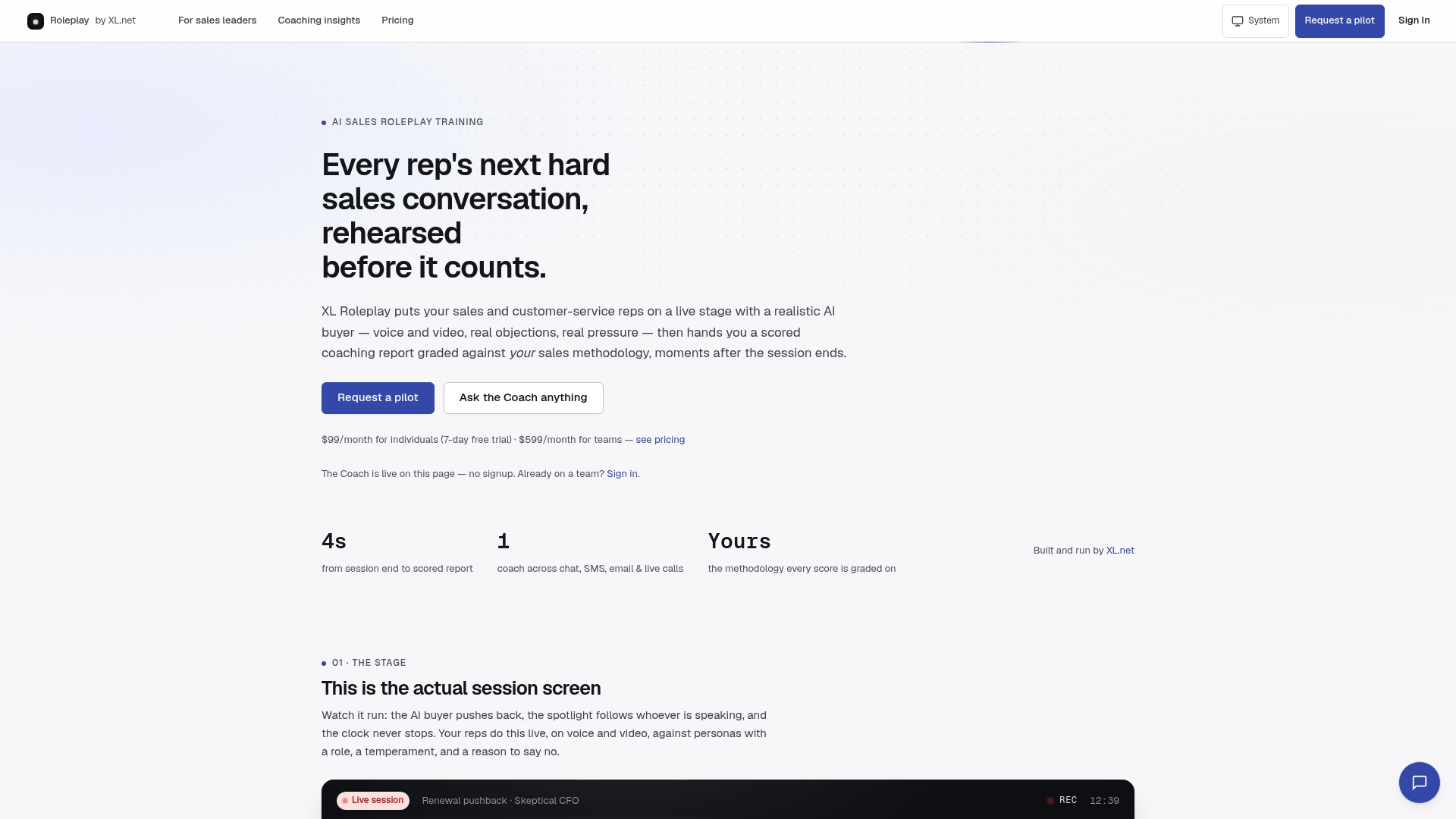
For more drills to pair with executive scenarios, browse our AI sales role play and role play exercises for sales collections.
FAQ
What is an RP in sales?
RP stands for role play: a practice conversation in which one person plays the seller and another plays the buyer. It lets a rep rehearse discovery, objection handling and closing before a real customer is on the line. The more realistic the buyer and the more specific the feedback, the more it transfers to real calls.
How long should an executive buyer role play last?
Ten to fifteen minutes matches how much time an executive typically gives a new vendor, and it keeps the exercise focused. Leave at least as much time again for the debrief, because the transcript review is where most of the learning happens.
How is a multi-stakeholder role play different from a single-buyer one?
In a single-buyer role play the goal is to win one conversation. In a multi-stakeholder one the goal is to build a case that several people with different priorities can support. Practice each persona on its own, then rehearse the summary the executive would repeat internally.
How often should reps practice?
A short session once or twice a week beats a long session once a quarter. Repeat the same scenario after feedback so the rep can apply the change right away, then rotate in a new scenario once the rubric score improves.
Sources
- Selling to Executive Buyers: Leading with Value, Ohio State Fisher College of Business
- Sales training best practices that change how reps sell, Mindstamp
- AI Role-Play: The New Standard in Workforce Training, Auzmor