Handling Sales Stalls: How to Practice Until It's Automatic
Handling Sales Stalls: How to Practice Until It’s Automatic

A stall is the prospect’s way of slowing the conversation without saying no: “Send me an email,” “Call me next quarter,” “I need to think about it.” (This guide is about sales and customer conversations, not aircraft.) Reps handle stalls well when they have rehearsed them out loud, against realistic pushback, and had the attempt scored. Reading a list of rebuttals does not do that. Below you’ll find how to recognize a stall, a response pattern that doesn’t turn pushy, six drills you can run this week, and a simple rubric for judging readiness.
TL;DR
- A stall delays or diverts the conversation. An objection names a barrier. They need different responses.
- The most reliable response is a question, not a rebuttal: find out why the prospect is stalling and what would make them comfortable.
- Practice has to be spoken, recorded and reviewed. Scripts alone don’t build the reflex.
- Score every practice call against the same rubric so managers can judge readiness with evidence, not gut feel.
- Use the same scenarios and rubric across the team so stall handling doesn’t depend on who trained whom.
Table of Contents
- What a stall actually is
- The stalls reps meet most
- How to respond without sounding pushy
- Six drills to practice stall handling
- How managers can judge whether a rep is ready
- Making stall handling consistent across the team
- Our perspective: practice should feel like the real call
- Practice stalls with an AI buyer
- FAQ
- Sources
What a stall actually is
Reps often lump every form of resistance into “objections.” The research separates them, and the distinction changes what you say.
An objection, as described in a 2022 marketing education paper, is an explicit statement from a buyer that a barrier has to be satisfied before they will buy. Price, missing features and contract terms are typical examples. The barrier is named, so you can work on it.
A stall is vaguer. A sales text from Northeast Wisconsin Technical College explains that “I have to think about it” is usually a stall rather than a substantive objection, and that it often masks fear or perceived risk. The real reason is hidden, so a polished rebuttal answers a question nobody asked.
A peer-reviewed study of 159 real B2B cold calls by Humă and Stokoe draws a second line, between blocks and stalls. Blocks hinder and close down the interaction, while stalls delay or divert its progress. The same study reports that stalls commonly postpone future contact, swap direct contact for less direct channels such as email, or make the deal contingent on future developments.
That gives you a working definition. If the prospect names a barrier, it’s an objection. If they close the door, it’s a block. If they keep the door ajar but move the conversation away from now, it’s a stall.

The stalls reps meet most
The table maps familiar stall phrases to the pattern the research describes and the question a rep should have ready. The “possible reason” column is a coaching hypothesis to test in conversation, not a fact about any particular buyer.
| What the prospect says | Pattern | Possible reason underneath | A first question to ask |
|---|---|---|---|
| “Just send me some information.” | Swaps a live conversation for a less direct channel | Wants the call to end, or needs something to show a colleague | “Happy to. So I send the right thing, what would you be looking for in it?” |
| “Call me next quarter.” | Postpones future contact | No urgency, or budget timing | “What changes between now and then that would make it a better time?” |
| “I need to think about it.” | Delays a decision | Fear or perceived risk | “Of course. What’s the part you’d want to think through most?” |
| “I need to run it by my boss.” | Makes the deal contingent on someone else | Not the decision maker, or unsure how to sell it internally | “Helpful to know. What will your boss want to see to feel good about it?” |
| “We’re looking at a few options.” | Diverts attention to a comparison | Early research, or a default vendor already in mind | “That makes sense. What matters most to you in comparing them?” |
| “Let’s revisit after the project wraps up.” | Makes the deal contingent on future developments | A real constraint, or a polite delay | “What does wrapping up look like, and what would you need from a vendor then?” |
Notice that none of the questions argue. Each one gets the prospect to say something more specific than what they just said.
How to respond without sounding pushy
Pushiness is what happens when a rep treats a stall as an obstacle to defeat. The NWTC guidance points the other way: ask questions to identify why the prospect is stalling and what information would make them more comfortable, rather than rebutting the statement right away.
A pattern that follows from that, and that we teach reps to rehearse:
- Acknowledge without agreeing to disappear. “That’s fair, a decision like this deserves some thought.” The goal is to lower defenses, not to accept the stall as final.
- Ask one open question about the reason. “What’s the part you’d want to think through?” Then stop talking. Silence is where the real answer tends to come out.
- Reflect what you heard. “So the worry is getting the team to actually use it.” This confirms you understood and often turns a stall into a named objection.
- Handle the named concern, or offer the information that fits it. Now you’re in objection territory, with a barrier you can address.
- Agree a specific next step with a date. Not “I’ll follow up,” but “I’ll send the rollout plan today, and we’ll talk Thursday at 10 to go through it.” A stall wins when the next step stays vague.
Two things keep this from sliding into pressure. First, one question at a time. Stacking three questions feels like an interrogation. Second, a genuine option for the prospect to decline. If the answer to step 2 is “honestly, it’s not a priority,” that’s valuable to know, and a good rep says so and moves on gracefully.
Where reps go wrong
- Rebutting a stall. Answering “I need to think about it” with a list of benefits assumes you know what they’re worried about. You don’t yet.
- Accepting the first stall. “Sure, I’ll send something over” ends the call with nothing agreed.
- Over-explaining. Long answers signal anxiety. Short questions signal confidence.
- Hiding the reason from the buyer. Asking “is it the price?” leads the prospect toward a convenient excuse. Open questions work better.
- Skipping the next step. Handling the stall well and then leaving without a dated action wastes the work.
Six drills to practice stall handling
The research on objection training is consistent about the form: practice has to involve speaking. One 2022 assignment design has learners write and revise a call script, practice and record calls with peers, submit recordings for peer review, and then practice objection responses in live appointment-setting calls with professionals. The project typically takes three weeks and works in person or online. You can compress the same logic into a team’s weekly routine.
Drill 1: The one-line reset
Take one stall phrase and write three possible first questions. Say each aloud five times, varying tone. The point is to find the version that sounds like you, not like a script. Five minutes, no partner needed.
Drill 2: Stall or objection?
A partner reads ten prospect statements, a mix of stalls, objections and blocks. The rep labels each one before responding. This builds the diagnostic habit that everything else depends on. Misclassifying is the most common failure, and it’s cheap to fix here.
Drill 3: The three-layer stall
The buyer stalls with “let me think about it.” When the rep asks a good question, the buyer gives a second, still vague answer (“it’s just a busy time”). Only a third, well-judged question reaches the real concern. Reps learn that the first answer is rarely the last one, and that patience beats pressure.

Drill 4: Record and replay
Record a five-minute practice call and listen back with the rubric below. Reps are often surprised by how fast they talk after a stall and how rarely they pause. Peer review adds a second view: the same assignment design above has trainees submit recordings for peer review, which gives immediate feedback without waiting for a manager’s calendar.
Drill 5: Escalating pressure
Run the same scenario three times. First, a friendly buyer who stalls gently. Second, a busy buyer who wants off the phone. Third, a skeptical buyer who has been burned by a vendor before. Same rep, same goal, different tone. This is where realistic simulation earns its keep, because a human partner rarely plays the difficult buyer convincingly or consistently.
Drill 6: Close the loop
Practice only the last thirty seconds of the call: turning the handled stall into a dated next step. Many reps handle the conversation well and fumble the ending. Our closing conversation practice guide goes deeper on that moment.
For more scenario ideas, browse our articles on sales role-play scenarios and sales training scenarios. If your reps face receptionists and assistants before they ever reach a buyer, the gatekeeper role-play collection covers that stage.
How managers can judge whether a rep is ready
Practice without feedback repeats mistakes. The question for a manager is what “ready” means, and how to see it without sitting in on every call.
A sales-management teaching project recommends combining closed-ended and open-ended evaluation questions, so feedback is both quantitative and qualitative. The same project uses peer evaluation to give immediate feedback and to help instructors judge whether the training communicated the intended skill. A separate 2022 workplace-learning study evaluated sales consultants with structured measurement scales and checklists against expected capabilities.
Applied to stalls, that suggests a short rubric with a score per line and a comment box. Here is one you can adapt:
| Criterion | What good looks like | Score (1 to 5) |
|---|---|---|
| Diagnosis | Correctly identifies a stall versus an objection or a block | |
| First response | Acknowledges, then asks one open question | |
| Listening | Pauses, doesn’t interrupt, reflects the answer back | |
| Depth | Gets past the first vague answer to the real concern | |
| Handling | Addresses the named concern with relevant information, not a canned pitch | |
| Tone | Calm and curious, no pressure language | |
| Next step | Ends with a specific, dated commitment |
Add two open comments: “What did the rep do best?” and “What is the one thing to change next time?” One change per round is what people can actually act on.
For readiness, avoid a single pass on a single call. A rep who handles the friendly version well but collapses under the skeptical one isn’t ready. Look for consistent scores across several scenarios and several sessions, and use the transcript to point to the exact sentence where a call went well or off track.
Making stall handling consistent across the team
In many teams, stall handling is taught by whoever sits next to the new rep. That produces five different approaches and no way to compare them. Three habits fix it.
Write down your own definition. Decide what your team counts as a stall, which stall phrases are most common in your market, and what your methodology says about each. Generic advice is a starting point. Your discovery framework, qualification criteria and next-step standards should shape what “good” looks like.
Use a shared scenario library. Everyone practices the same core stalls, with the same buyer behaviors, so scores are comparable. Add scenarios from real calls as they come up. Customer service teams can build the same library from the delays and deflections customers raise, such as “let me check with my account manager” or “I’ll call back later.”
Blend live and digital practice. The 2022 workplace-learning study compared traditional, digital and hybrid training. Its hybrid model combined live streaming with office visits where instructors assessed competencies through role-play and problem-solving. The takeaway for a sales floor is to let reps practice on their own schedule, then use manager time for review and for the hard cases. The teaching project mentioned earlier also has student teams deliver 30 to 45 minute training exercises and design their own evaluation tools. Having reps run a short stall clinic for each other is a low-cost way to reinforce learning, since teaching a skill exposes gaps in understanding it.
If you want to see how others structure these programs, our collections on interactive sales training and effective sales conversations are good places to start.
Our perspective: practice should feel like the real call
We built XL Roleplay around a simple observation: reps know what they should say about stalls, and still freeze when a real buyer says “let me think about it.” Knowing and doing are different skills. The gap closes with repetition against a buyer who behaves like a buyer: interrupts, hesitates, gives vague answers and doesn’t hand over the real concern on the first question.
That’s why our AI buyers present the pressures reps actually meet, and why every session ends with a scored coaching report. We think the scoring has to be grounded in your own methodology, not a generic checklist. If your team sells through a specific discovery framework, a stall response that ignores it is the wrong answer, however polished it sounds.
We also think managers deserve evidence, not summaries. A transcript linked to the score shows exactly where a rep asked a good question or talked over the buyer. That makes coaching specific and takes the guesswork out of readiness decisions. And because reps practice privately first, they make their mistakes where the cost is zero, not in front of a prospect who might have bought.
The best stall handling sounds unrehearsed. It only gets there through rehearsal.
— Adam
Practice stalls with an AI buyer
XL Roleplay lets reps run live voice and video role-play against AI buyers and personas, then returns a scored coaching report and a full transcript. Sales leaders can build scenarios from their own playbook, so a stall like “send me an email” is scored against the way your team actually sells.
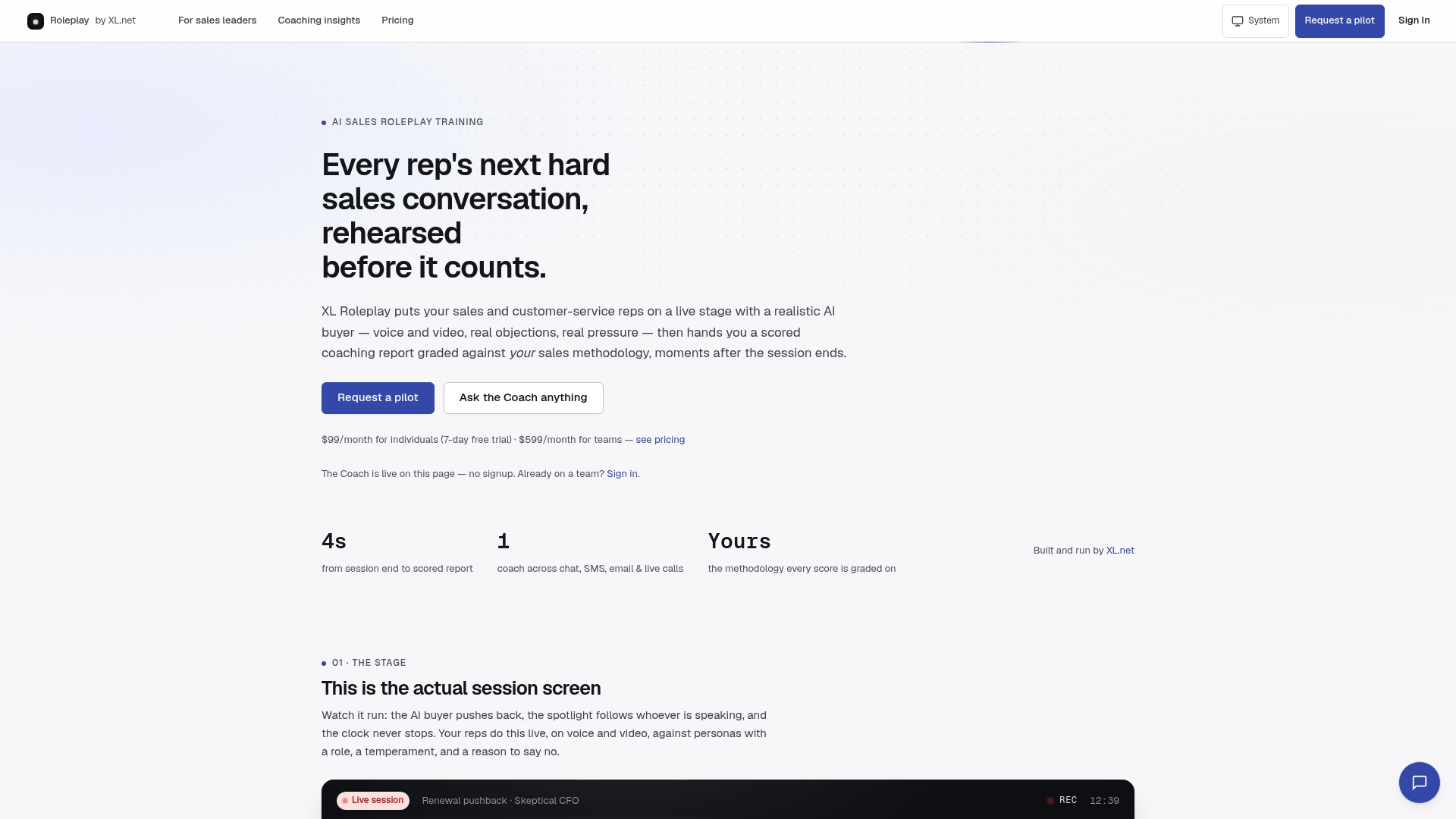
Plans are published on the pricing page: Individual is $99 per month and Business is $599 per month. Extra seats are $54.95 per month per seat, and extra video is $16.99 per hour. If you’d rather test the approach with a group first, the XL Roleplay pilot is a way to start. Leaders who want to see how it fits a team can start at our page for sales leaders.
FAQ
What is the difference between a stall and an objection?
An objection names a barrier the buyer wants resolved before buying, such as price or a missing feature. A stall delays or diverts the conversation without naming a clear reason, like “I need to think about it.” Treat objections by addressing the barrier. Treat stalls by asking questions to find the real concern first.
How do I respond to “I need to think about it”?
Acknowledge it, then ask one open question about what they want to think through. For example: “Of course. What’s the part you’d most like to think over?” Reflect the answer back, address the concern if you can, and agree a dated next step. Avoid listing benefits before you know what the worry is.
How often should reps practice stall handling?
Short and frequent beats long and rare. A few minutes of spoken practice several times a week, plus one reviewed session with a rubric, builds the reflex better than a single workshop. Increase difficulty over time by changing the buyer’s tone and the number of stalls per call.
Can role-play with colleagues replace AI practice?
Peer role-play is useful, and research on sales training supports peer review and recorded calls. Its limits are consistency and availability: colleagues tire, go easy on each other and rarely play a hard buyer the same way twice. Many teams use both, with AI for volume and managers for coaching on the hardest cases.
Do customer service teams face stalls too?
Yes. Customers delay and deflect in their own ways, such as “I’ll call back later” or “let me check with someone first.” The same approach applies: acknowledge, ask an open question, find the real concern and agree a next step. The scenarios should come from your own contact types, not a generic script.
Sources
- Objection Practice Using a Live Appointment-Setting Call, Marketing Education Review (2022)
- Objection Types and How to Handle, Northeast Wisconsin Technical College (2024)
- Resistance in Business-to-Business “Cold” Sales Calls, Humă and Stokoe (2023)
- To master something, teach it: An innovation for a sales management course (2018)
- Innovating workplace learning: training methodology for sales consultants