How to Implement AI Sales Training: Pilot to Rollout
How to Implement AI Sales Training: Pilot to Rollout

To implement AI sales training, start with one skill gap and one small group, build practice scenarios from your own methodology, run a pilot of a few weeks, keep managers in the coaching loop, and measure results against real conversations before you scale to the whole team. The tool matters less than the sequence. Teams that skip the diagnosis or the manager role end up with a platform people log into twice.
This guide walks through that sequence step by step, with a rollout timeline, the pricing logic for planning a budget, and the questions leaders ask most.
TL;DR
- Pick the skills first. Use call and quality data to find recurring failure patterns, and separate skill gaps from process problems.
- Build practice around your own buyers, objections and methodology, not generic scripts.
- Run a time-boxed pilot with one team, then expand only when the evidence supports it.
- Keep managers in the loop. AI handles scale and repetition, while managers handle judgment and development conversations.
- Measure transfer to live selling, not course completions or session counts.
Table of Contents
- What AI sales training is, and how it differs from AI coaching
- Step 1: Decide which skills the training should fix
- Step 2: Choose a tool and design practice that feels real
- Step 3: Run a pilot before you roll out
- Step 4: Get managers to adopt it
- Step 5: Measure whether it works
- A rollout timeline you can adapt
- Budget: what to plan for
- Our perspective
- Try it on your own playbook
- FAQ
- Sources
What AI sales training is, and how it differs from AI coaching
The two terms get mixed up, and the difference shapes your rollout. According to ATD, AI sales training covers things like generated course content, dialog simulations, objection drills, quizzes and knowledge checks with automated grading and feedback. AI coaching, by contrast, analyzes practice sessions and real sales conversations, identifies what is working, and recommends next-best actions.
Put simply: training is mostly practice before a live buyer conversation, and coaching can operate after or during real conversations. Training Industry describes coaching as a continuing cycle: observe, assess, recommend how to improve, then observe again.
A third idea sits next to both. ATD’s view of sales readiness is that finishing a course is not the same as being ready for a buyer. Readiness needs practice, feedback and application to real challenges. That is the gap AI role-play is built to close, and it is the reason a good implementation is about behavior change, not content delivery.
Step 1: Decide which skills the training should fix
Do not start by shopping for software. Start by finding where conversations go wrong.
Mine the data you already have. COPC recommends using quality-assurance and conversation data to find recurring failure patterns, then sorting them into three buckets: what agents need to learn, what supervisors need to coach, and what is really an operational or workflow problem. That last bucket matters. If reps stumble on a pricing question because the discount policy changes weekly, no amount of role-play fixes it.
Pick two or three skills, not ten. Good first candidates for most B2B and service teams:
- Discovery: asking questions that surface the real problem before pitching.
- Objection handling: price, timing, “we already have a vendor” and “send me an email.”
- Pressure moments: negotiation, a skeptical executive, an angry customer.
- Methodology adherence: using your qualification framework consistently.
Check automated scoring against human judgment. COPC also advises calibrating and verifying automated scoring rather than trusting it blindly. In practice, have two managers score the same ten sessions and compare their scores with the platform’s before you rely on the numbers.
Write the target behaviors down. For each skill, write three to five observable behaviors. “Asks at least two follow-up questions on the stated pain before discussing product” can be scored. “Good discovery” cannot.
Step 2: Choose a tool and design practice that feels real
Most platforms in this category look similar in a demo. The differences show up when your reps use them. Evaluate on these criteria:
| Criterion | What to look for |
|---|---|
| Realism | Voice or video conversations with buyers who push back, interrupt and change direction, not scripted branching quizzes |
| Methodology fit | Scoring built on your own framework and playbook, not a generic rubric |
| Scenario control | Ability to build scenarios from your real objections, personas and deal stages |
| Feedback quality | Scored reports tied to specific moments in a transcript |
| Manager visibility | Transcripts, rubrics and team-level views managers can review quickly |
| Cost structure | Clear per-seat and usage pricing you can forecast |
When you design scenarios, work from reality:
- Collect the top ten objections from recent calls, in the buyers’ own words.
- Build three or four buyer personas that differ in role, mood and knowledge: a rushed VP, a skeptical technical evaluator, a friendly buyer with no budget.
- Set one clear goal per scenario: book the next step, uncover the budget owner, de-escalate a complaint.
- Add pressure on purpose. Reps already know how to handle a friendly buyer. Include a buyer who goes quiet, or pushes for a discount in the first two minutes.
- Score against your methodology. The rubric should reflect what your best reps do, in your language.
This is how we think about it at XL Roleplay. Our platform runs live voice and video role-play with AI buyers and personas, with a customized scenario library and coaching reports scored against the organization’s own sales methodology. Whichever tool you choose, hold it to the same test: does it practice your playbook, or someone else’s?
Step 3: Run a pilot before you roll out
A pilot gives you evidence, builds a few internal advocates and exposes problems cheaply. Keep it small and specific.
Scope. One team of roughly five to fifteen people with a manager who wants it. Mix a few strong reps with a few newer ones so you can see who benefits most.

Length. Four to six weeks is enough to see usage patterns and early skill movement. It is not enough to prove revenue impact, so do not promise that.
Cadence. Set a minimum, for example two or three sessions of 10 to 15 minutes per week, placed on the calendar rather than left to willpower. Practice that is optional tends to be skipped by the people who need it most.
Before you start, write down:
- The two or three skills you are targeting and their observable behaviors.
- A baseline: current scores on a call rubric, ramp time for new hires, or conversion at the stage you are targeting.
- What would count as success at the end of the pilot, and what would make you pause.
If you want a guided start, we run an XL Roleplay pilot for teams that want to test the approach on their own playbook. There is no published price for the pilot, so the page is the place to ask about scope.
Step 4: Get managers to adopt it
Adoption fails when managers see AI practice as a replacement for them, or as one more dashboard. It works when they see it as a way to spend their time better.
ATD’s guidance on AI sales coaching at scale is to anchor AI practice to your customers, methodology and language, and to have managers focus on high-impact development conversations and planning while AI handles scale, repetition and objective feedback.
There is research behind keeping humans involved. A Journal of Marketing study, summarized by the American Marketing Association, found that combining AI and human coaching outperformed AI-only and human-only coaching for both lower- and higher-ranked agents in its field experiments. The same summary notes that AI feedback can overwhelm some agents, and that limiting how much feedback bottom-ranked agents received improved their performance.
Turn that into manager habits:
- Review one transcript per rep per week. Pick the moment the report flags, and discuss it in the next one-on-one.
- Limit feedback to one or two focus points per session. A long list of corrections helps nobody. Pick the highest-impact behavior.
- Practice together. Have the manager run a scenario first, and share their own imperfect transcript. It lowers the stakes for everyone else.
- Use practice in team meetings. Replay a tricky objection exchange and ask the team how they would answer.
- Keep it safe. Say clearly whether practice scores feed performance reviews. Most teams get better engagement when early scores are for development only.
The coaching cycle itself is easy to describe: observe, assess, recommend, reassess. If you want to see how others frame that ongoing observation and reassessment loop inside a team’s tool stack, it is a useful way to think about where practice data should live.
Step 5: Measure whether it works
Completion rates and session counts tell you about usage, not skill. Track three layers.
Layer 1: Practice behavior. Sessions per rep per week, scenarios attempted, score trend per skill. This tells you whether people are practicing and improving in the simulation.
Layer 2: Readiness. Can the rep pass a defined bar on your rubric before they take live calls on that topic? For new hires, this becomes a gate in onboarding.
Layer 3: Live performance. This is the one leaders care about: call-quality scores, stage-to-stage conversion, ramp time, resolution rates, customer satisfaction. Compare the pilot group to its own baseline, and to a similar group if you have one.
Set expectations from real evidence. A longitudinal field study at a large U.S. industrial firm, published on SSRN in September 2026, found AI role-play training lifted sales performance by about 2% on average, with larger gains among reps with lower prior performance and high performance goals. The authors also stress that firms need to manage the transfer of learning into real selling. In other words, the gains are real, they are not magic, and they depend on what happens after the session.
A few practical points for transfer:
- Ask reps to name one behavior they will use on a live call this week, and check it in the next one-on-one.
- Link practice scenarios to upcoming deals: rehearse the actual renewal conversation before it happens.
- Look at lower performers first. The research suggests they have the most to gain.
For a deeper look at how to prove training results within two quarters, set a review point at 90 days and decide in advance which metrics you will report.
A rollout timeline you can adapt
| Phase | Typical length | What happens | Decision at the end |
|---|---|---|---|
| Diagnose | 1 to 2 weeks | Review call and QA data, pick two or three skills, write behaviors | Are the target skills clear and scorable? |
| Design | 1 to 2 weeks | Build scenarios and personas, calibrate scoring with managers | Do managers agree with the scores? |
| Pilot | 4 to 6 weeks | One team practices on a set cadence, managers review transcripts | Is usage steady and are scores moving? |
| Expand | 4 to 8 weeks | Add teams, new-hire onboarding and more scenarios | Is practice part of the weekly routine? |
| Embed | Ongoing | Readiness gates, quarterly scenario refresh, results review | Which skills come next? |
These lengths are planning guides, not rules. A small team can compress them, and a regulated or multi-region organization may need more time for the design phase.
Budget: what to plan for
Cost should be easy to forecast. For XL Roleplay, as published on our pricing page:
- The Individual plan is $99 per month.
- The Business plan is $599 per month.
- Extra seats are $54.95 per month per seat.
- Extra video is $16.99 per hour.
A useful way to plan: decide how many reps will practice, how often, and how much of that will be video rather than voice. Then pilot at the smaller scale before committing the whole team.
Our perspective
Most AI training rollouts fail for a human reason, not a technical one. The tool is fine, but nobody decided what good looks like, so the practice drifts toward generic conversations and the feedback feels generic too.
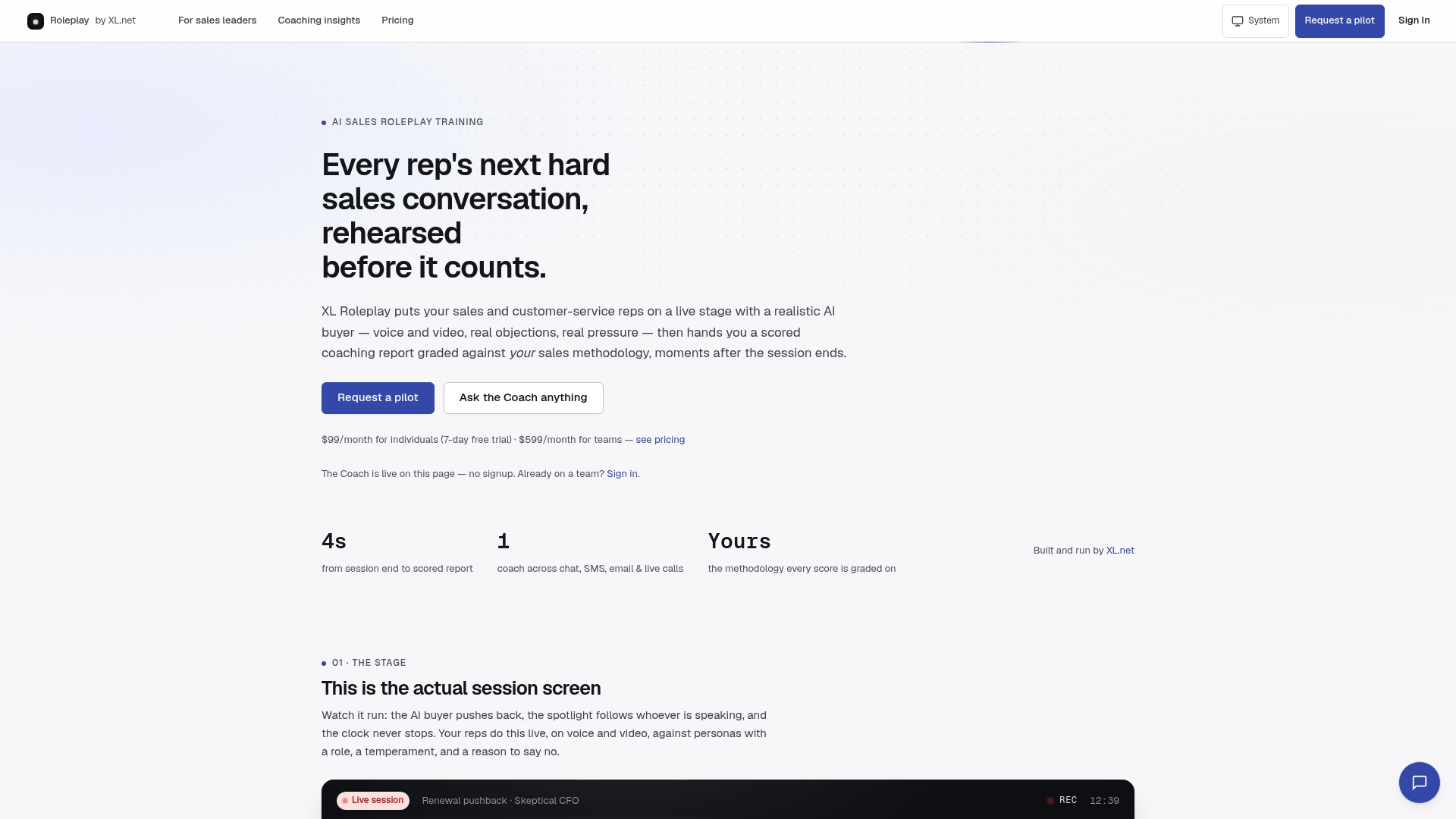
We built XL Roleplay around one idea: practice should be grounded in your own methodology. Reps rehearse live conversations with AI buyers that raise the objections and pressures they will actually face, and the scored coaching report measures them against your playbook, not a generic standard.
We also believe the manager is the point of the system, not an afterthought. Transcripts and rubrics are there so a manager can spend ten minutes on the moment that matters and have a real development conversation. The AI handles the repetition. The manager handles the person.
Our approach is a single persistent AI coach with shared memory across channels, so the practice a rep does today informs the coaching they get tomorrow. If you are starting out, start small, pick one skill, and let the evidence from your own team decide what happens next.
Adam
Try it on your own playbook
If you are a sales leader ready to test this with your team, XL Roleplay gives reps live voice and video role-play with realistic AI buyers, scored coaching reports built on your methodology, and transcripts managers can review. Start with the Individual or Business plan on our pricing page, or see how we support sales leaders.
If you would rather scope a small test first, the pilot page explains how to begin. You can also browse our articles on AI sales role-play for scenario ideas.
FAQ
How long does it take to implement AI sales training?
A focused pilot can be running within two to three weeks of deciding on target skills and building the first scenarios. Plan four to six weeks of pilot practice, then another one to two months to expand across teams. Time-to-value depends mostly on how quickly managers agree on the scoring rubric.
What is the difference between AI sales training and AI sales coaching?
Training is mainly practice before live conversations, such as simulations, objection drills and knowledge checks. Coaching is an ongoing loop that analyzes practice or real conversations, recommends improvements and reassesses progress, according to ATD. Most teams benefit from combining the two.
Will AI replace sales managers as coaches?
No. Research summarized by the American Marketing Association found that AI and human coaching together outperformed either alone. The practical split is AI for scale, repetition and objective feedback, and managers for judgment and development conversations.
Are AI sales courses enough to prepare reps for buyers?
Courses are useful for concepts, frameworks and product knowledge, but ATD’s sales-readiness perspective is that completing training is not the same as being ready. Readiness requires practice and feedback in realistic conversations, which is what role-play adds.
How do I measure ROI from AI sales training?
Track practice behavior, readiness scores and live performance against a baseline you set before the pilot. Expect gradual gains: a large U.S. field study found about a 2% average lift in sales performance. Review at 90 days, starting with your lowest performers.
Sources
- 3 Ways to Use GenAI and Conversation Intelligence to Train Top Sellers (ATD)
- The Future of Sales Training: Unlocking Performance With AI-Powered Coaching and Sales Readiness (ATD)
- From Training to Performance: How AI Is Transforming Sales Coaching at Scale (ATD)
- The Business of Learning, Episode 87: AI-Powered Sales Coaching (Training Industry)
- CX Training and Customer Experience Workflows in the AI Era (COPC)
- Coaching Sales Agents? Use AI and Human Coaches Jointly (American Marketing Association)
- Do AI role plays improve salesperson performance? (SSRN)
- Sales team collaboration tool examples for 2026
- Prove Servant Selling in Two Quarters: A Playbook for Sales Leaders