75% Retention Gap: LMS or Sales Training Platform for Enablement
75% Retention Gap: LMS or Sales Training Platform for Enablement

For onboarding and compliance, an LMS is the right tool. For ongoing coaching and skill-building that shows up in quota attainment, a sales training platform built around practice and feedback wins. One optimizes for content delivery and record-keeping, the other for behavior change on live calls.
TL;DR:
- Sales training platforms focus on practice, coaching, and real-time score feedback, essential for improving performance under pressure, unlike LMSs which only verify content completion.
- Integrating practice tools with CRM systems provides measurable insights into deal outcomes, whereas LMSs primarily track course completion without linking to revenue results.
- AI-enabled coaching and in-workflow microlearning significantly boost engagement, retention, and the ability to operationalize skills on actual calls.
- Successful implementation requires early CRM integration, deliberate content migration, pilot testing, and establishing manager review routines before full rollout.
- Measuring impact effectively involves tracking application and revenue-linked metrics, such as practice frequency and quota attainment, not just course completion rates.
Table of Contents
- What Each Platform Is Built to Do
- A Capability Map to Audit Your Own Needs
- Choosing Between the Two: A Decision Framework
- Rolling Out Either Platform Without Losing Momentum
- Measuring Impact Beyond Completion Rates
- Why Practice and AI Coaching Change Readiness
- What Enablement Leaders Should Prioritize Next
- XL Roleplay: A Pilot Worth Running
- FAQ
- Sources
What Each Platform Is Built to Do
A learning management system was designed to store, assign, and track content. It handles compliance courses, onboarding modules, and certifications, and it logs completion data through standards like SCORM and xAPI so you can prove a rep watched the training and passed the quiz. That record-keeping function matters for audits and new-hire checklists, but it stops at knowledge transfer. An LMS tells you who finished a course, not whether they can run a discovery call.
A sales training platform, sometimes called a sales readiness platform, is built around a different job: closing the gap between knowing the material and performing under pressure. These tools center on role-play, coaching workflows, and deal-linked learning. Instead of a quiz at the end of a video, a rep practices an objection-handling scenario, gets scored against a rubric, and a manager reviews the transcript before the next pipeline review. Many connect to the CRM so practice activity can be tied to deal stage and outcome.
The difference in goals changes everything downstream, including the metrics each platform reports and what vendors prioritize in their roadmaps. An LMS vendor invests in content authoring tools, compliance reporting, and integrations with HR systems. A sales training platform vendor invests in simulation realism, coaching rubrics, and CRM telemetry. Neither is a lesser version of the other: they are built for different jobs, and judging one by the other’s scorecard produces the wrong buying decision.
Two workflows make the contrast concrete:
- Compliance flow: A new hire is assigned a data-privacy course in the LMS, watches it, passes a quiz, and the completion is logged for the audit trail.
- Deal-linked practice flow: A rep facing a tough renewal runs a live role-play against a simulated buyer who raises pricing objections, gets a scored report, and their manager reviews it before the actual call.
Both are legitimate training events. Only one of them changes what happens on the call.
A Capability Map to Audit Your Own Needs
Before shopping, it helps to separate the capability categories so you know which platform type typically leads in each. This isn’t a vendor comparison: it’s a checklist for mapping your own requirements.
- Content authoring and standards: LMS platforms lead here, with mature SCORM/xAPI support and course-building tools for structured curricula, as detailed in the Kajabi vs Thinkific comparison.
- CRM integration and deal telemetry: Sales training platforms lead here, linking practice sessions and coaching scores to pipeline stage and deal outcomes.
- Practice and simulation: Sales training platforms lead here, offering role-play scenarios, AI-driven buyer personas, and scored feedback loops.
- Coaching rubrics and manager review: Sales training platforms lead here, with structured scoring criteria tied to the organization’s own sales methodology.
- Analytics tied to revenue: Sales training platforms lead here, because completion rates don’t predict quota attainment the way practice frequency and rubric scores can.
For each capability, expect concrete outputs, not vague promises. Content authoring should produce versioned courses with completion logs. CRM integration should produce fields you can query, not just a dashboard screenshot. Practice and simulation should produce a transcript and a score, not a self-reported checkbox. A red flag in any category is a vendor who can describe the feature but can’t show you the exported data it generates.
Modern capabilities are reshaping both categories, and AI role-play is the clearest example. According to The Rise of AI in Sales Coaching, organizations using AI-enabled sales coaching report higher engagement, retention, and use of acquired skills compared with organizations relying on traditional coaching methods alone.
AI-enabled coaching also scales better: organizations that combine AI coaching with manager-led coaching report higher ROI and easier scaling than those using manager coaching alone, according to the same TD.org report on AI sales coaching. That matters because it means AI practice isn’t a replacement for manager coaching, it’s a multiplier on it.
In-workflow microlearning, where a rep gets a short practice prompt inside their CRM right before a call, is another capability worth watching. Mordor Intelligence’s analysis of the product-based sales training market identifies blended learning with in-workflow practice as the practical standard, since it reduces context switching and keeps training tied to active deals rather than a separate learning portal.
Choosing Between the Two: A Decision Framework
Rather than comparing feature lists, work through a short set of questions about your own organization’s goals.
- What is the primary goal? If it’s proving regulatory or onboarding compliance, prioritize an LMS. If it’s improving close rates or ramp time, prioritize a sales training platform.
- How role-specific is the training? Generic company-wide content fits an LMS well. Content specific to objection handling, discovery, or negotiation benefits from a practice environment.
- How often do reps need to rehearse, not just review? A once-a-year certification is an LMS job. Weekly or monthly rehearsal of live scenarios needs a practice platform.
- Do you need to attribute training activity to revenue? If leadership wants to see a line between coaching and quota attainment, you need CRM-linked telemetry, which most LMS platforms don’t offer natively.
- What share of your training content is compliance versus skill-building? A rough rule of thumb: if more than half your training hours are compliance-driven, an LMS should anchor your stack, with a sales training platform layered on top for the skill-building portion.
When you talk to vendors, ask direct questions: Can you export raw session data, not just summary dashboards? How does the platform map practice activity to CRM fields like opportunity stage? What does a manager’s weekly coaching workflow look like inside the tool, and how long does it take?
Pro Tip: Ask every vendor to show you a real transcript or scored report from a pilot customer, not a demo script. If they can’t, the coaching workflow probably isn’t built out yet.
Rolling Out Either Platform Without Losing Momentum
Implementation risk is less about the software and more about integration and habit-building. A few priorities reduce friction early.
- CRM and SSO first: Connect the platform to your CRM and single sign-on before launch so adoption data and deal telemetry start flowing from day one.
- Migrate content deliberately: Bring over SCORM or xAPI packages and existing scenario libraries with version control, so reps aren’t training on outdated material.
- Pilot with a defined cohort: Run a small pilot, often one team or region, for a fixed window before a full rollout.
- Build manager cadence early: Decide how often managers will review transcripts or scores and put it on the calendar before launch, not after.
- Align stakeholders on what success looks like: Sales leadership, enablement, and L&D should agree on the metrics that define a successful pilot before it starts.
Content migration deserves particular care. If you’re moving scenario libraries from an older tool or building them from scratch, grounding them in real call transcripts produces more realistic practice than generic scripts, and it shortens the time it takes reps to see the exercises as relevant to their actual deals.
Change management is the part most rollouts underfund. According to ATD’s research on sales training accountability, a lack of accountability for applying learned skills in the field is a primary reason fewer than half of organizations say their sales training meaningfully helps them hit sales goals. Accountability doesn’t mean more content. It means someone checking, consistently, whether the skill shows up in the field.

Measuring Impact Beyond Completion Rates
Completion rates tell you who showed up. They don’t tell you who got better. The standard framework for training measurement runs five levels: reaction, learning, application, impact, and ROI, and most organizations stop at level two. ROI measurement guidance from TD/ASTD recommends collecting data at all five levels and converting impact measures into monetary value to calculate program ROI.
Level 3, application, is where sales training earns its keep. That means tracking whether reps actually use the skill on real calls, not just whether they passed a quiz about it.
| Metric | What it measures | Typical source |
|---|---|---|
| Time-to-ramp | Days until a new rep hits full quota | CRM + HR data |
| Quota attainment | Percent of reps hitting target | CRM |
| Win rate | Closed-won deals as a share of qualified pipeline | CRM |
| Coaching adoption | Share of managers running weekly reviews | Training platform |
| Practice frequency | Role-plays completed per rep per month | Training platform |
| Rubric scores | Scored performance on skill criteria | Training platform |
To attribute change to the training itself rather than market conditions or seasonality, use matched cohorts, comparing a trained group against a similar untrained group, and define a fixed measurement window, commonly 90 days, before and after the program.
Say a team of 20 reps runs a 90-day pilot and the average deal size is $10,000. That’s illustrative math, not a guaranteed outcome, but it shows the kind of calculation that turns a training budget line into a revenue argument. For more on building that case upward, see how to report training ROI to leadership.
The retention gap between practice and lecture is the clearest statistic in this field: role-play and active practice produce roughly 75% retention compared with about 5% retention from lecture-style learning, according to ATD’s analysis of role-play effectiveness.
Why Practice and AI Coaching Change Readiness
That 75% versus 5% retention gap isn’t just a statistic, it’s the reason role-play keeps showing up in sales training discussions where lecture-based courses don’t. The same ATD research on role-play retention found that embedding role-play into manager routines, backed by standardized rubrics, increases coaching consistency and turns training into something that actually operationalizes in the field. It also identifies manager enablement as the most common bottleneck: managers need to be trained on the rubric itself and given short review artifacts, like transcripts and scored highlights, so coaching a rep each week doesn’t take an hour of prep.
In practice, this looks like a rep running a scored role-play against an AI buyer, a manager pulling up the transcript and rubric score before the next one-on-one, and both of them discussing one specific moment instead of a vague “good job on that call.” Some sales training platforms build this loop around session transcripts, scored coaching reports mapped to a client’s methodology, and manager-facing summaries, which keeps the feedback specific rather than generic.
- Structured rubrics tied to transcripts give managers something concrete to coach against, not a vague impression.
- Scored reports surface the same skill gaps across a team, making patterns visible that a single call review would miss.
- Weekly review cadences, supported by short artifacts, keep coaching from becoming an occasional event instead of a habit.
What Enablement Leaders Should Prioritize Next
The platforms that move quota aren’t the ones with the most content, they’re the ones that force practice, score it consistently, and put the results in front of a manager on a predictable schedule. If you do one thing this month, audit your current stack against that standard, then pilot a practice workflow with a single team before rolling it out wider.
— Adam
XL Roleplay: A Pilot Worth Running
If your audit shows a gap between what reps know and what they do on calls, a sales training platform built around live voice and video role-plays against realistic AI buyers can help close that gap. Reps can get scored coaching reports based on their sales methodology, and managers receive transcripts and rubrics usable in one-on-ones instead of generic completion logs.
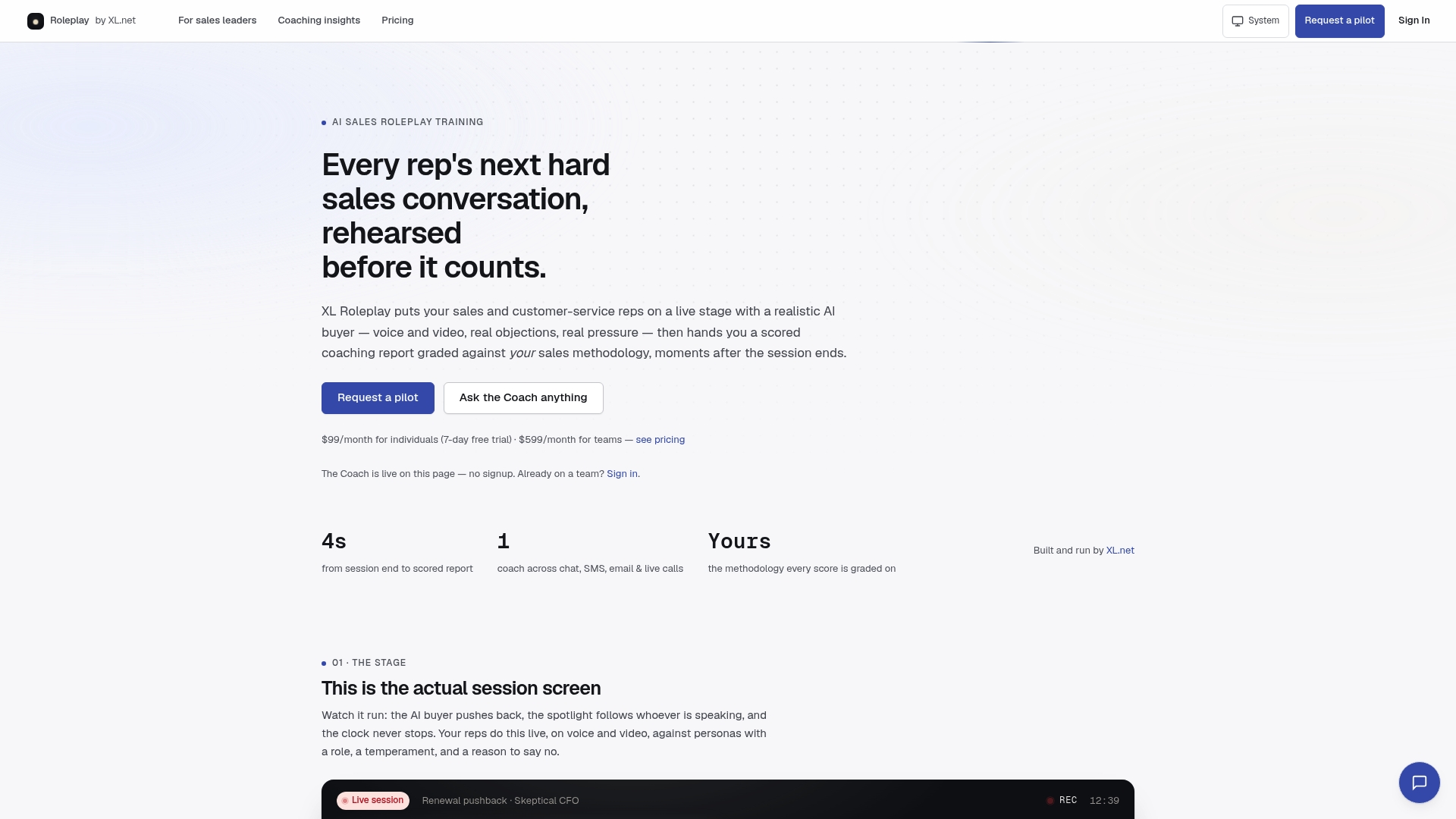
Plans start with Individual at $99 per month for a single rep, and Business at $599 per month for team access, with extra seats and extra video hours available as needed. If you want to test the approach with your own scenarios before committing, the XL Roleplay pilot walks you through a proof of concept with your team. You can also see how it applies specifically for sales leaders managing coaching across a larger team.
FAQ
What are the top 5 LMS platforms?
This article does not rank or recommend specific LMS vendors, since the right fit depends on your compliance requirements, integrations, and content library. Evaluate candidates against the capability map above, focusing on content authoring, standards support (SCORM/xAPI), and reporting rather than brand names.
Is Salesforce an LMS?
Salesforce is primarily a customer relationship management (CRM) platform, not a learning management system, though it offers integrations and add-ons that can connect to training tools. Its core function is managing customer and deal data, not delivering or tracking structured courses.
What is an LMS training platform?
An LMS training platform is software that stores, assigns, and tracks completion of training content, often used for onboarding, compliance, and certification courses. It typically reports on who completed a course and when, using standards like SCORM or xAPI, rather than measuring applied skill.
What is CRM and LMS?
A CRM (customer relationship management) system manages customer and deal data such as pipeline stage and contact history, while an LMS (learning management system) manages training content and completion records. Some sales training platforms bridge the two by linking practice activity and coaching scores to CRM deal data.
How do I know if my team needs a sales training platform instead of an LMS?
If your main challenge is proving reps can apply a skill, like objection handling or discovery, under realistic pressure, a sales training platform with role-play and coaching features addresses that gap better than course completion tracking. Signs include high ramp times, inconsistent coaching across managers, or training that doesn’t show up in quota numbers.
Sources
- The Rise of AI in Sales Coaching (TD.org)
- ATD press release: Lack of accountability hinders sales training efficacy (ATD)