Six Manager Coaching Skills to Practice Weekly for Faster Team Growth
Six Manager Coaching Skills to Practice Weekly for Faster Team Growth

Manager coaching skills are the specific conversational habits, active listening, powerful questioning, and tightly scoped feedback, that let a manager grow someone’s ability instead of just directing their next task. Add goal-setting that the employee actually owns, plus regular practice through role-play, and you have the core toolkit. Most managers see measurable change within a few weeks if they practice deliberately rather than just meaning to coach more.
TL;DR:
- Managers should practice active listening and open questions regularly to uncover the true problems and avoid defaulting to problem-solving or directions.
- Using frameworks like GROW or PRAISE and coaching artifacts during consistent, short sessions improve skill development and accountability.
- AI-driven transcript review and role-play enable rapid, specific feedback and reduce the time gap between coaching and behavior change.
- Giving feedback with the SBI model and separating coaching from judgment helps minimize defensiveness and fosters trust.
- Behavior-based metrics over time provide a clearer picture of coaching effectiveness than subjective feelings or surface-level observations.
Table of Contents
- What Manager Coaching Skills Actually Look Like Day to Day
- How to Build These Skills Through Practice, Not Just Theory
- Frameworks That Make Coaching Repeatable
- Why AI Role-Play Shortens the Feedback Loop
- Giving Constructive Feedback Without Deflating the Room
- When to Coach and When to Just Give the Answer
- Building Trust Before You Try to Coach Anyone
- Emotional Intelligence Is What Makes the Skills Land
- Handling Resistance Without Escalating It
- How to Know Coaching Is Actually Working
- An Honest Take on What Actually Changes Behavior
- Put These Skills Into Practice With Real Reps, Not Theory
- Sources
What Manager Coaching Skills Actually Look Like Day to Day
Most managers think they’re coaching when they’re really just problem-solving out loud. There’s a difference, and it shows up in how a 1:1 conversation actually sounds. Coaching pulls the answer out of the employee; directing hands them one. Both have their place, but if every conversation defaults to the second one, you’re not building a team, you’re building a queue of people waiting for your input.
Here’s what the research-backed skill set actually includes, based on frameworks used across manager coaching development:
- Active listening means paraphrasing what you heard before responding. In practice: “So the client pushed back on price twice, and you’re not sure whether to hold firm or flex, is that right?” Do this three times a week in real 1:1s and you’ll notice how often your first assumption about the problem was wrong.
- Powerful questioning replaces closed yes/no prompts with open ones. Instead of “Did you try following up?” ask “What have you tried so far, and what did you notice?” Before every 1:1, write down three open questions in advance. Reps and direct reports answer differently when a question can’t be answered in one word.
- Specific feedback works best through the SBI model: Situation, Behavior, Impact. “In yesterday’s demo (situation), you jumped straight to pricing before confirming the client’s timeline (behavior), which meant they anchored on cost instead of value (impact).” Cap yourself at one to three improvement points per conversation. Five action items after a single call is not feedback, it’s a punishment.
- Goal-setting and accountability only works when the employee sets the goal in their own words. If you write it, it’s your goal. Ask them to state the target and the date, then follow up with a short check-in ritual, not a surprise audit three weeks later.
- Accountability without rescue means resisting the urge to solve the problem the moment someone stalls. A useful follow-up script: “What’s the blocker, and what have you already tried?” If they haven’t tried anything, that’s useful information too, don’t jump in and do it for them.
- Holding silence and pacing is the most underrated skill on this list. After you ask a real question, count to five before saying anything else. Most managers talk over the answer they’re waiting for. Watch your talk to listen ratio, if you’re talking more than the person you’re coaching, you’re probably not coaching.
- Empathy and adaptability show up in reading whether someone’s stuck on a skill gap or a confidence gap, and adjusting your approach accordingly. The same objection handling script lands differently with a nervous new hire versus a burned-out veteran.
- Self-awareness is the skill managers skip. Ask two direct reports, point blank, what your coaching style feels like from their seat. You will not like everything you hear, and that’s the point.
Career development research groups these into six core buckets: active listening, powerful questioning, goal setting, accountability, feedback, and motivation. That’s a good checklist to keep near your calendar.
How to Build These Skills Through Practice, Not Just Theory
Reading about active listening changes nothing. Practicing it in front of another person, then watching yourself do it, changes quite a bit. A structured skill-building program that actually works looks less like a workshop and more like a rehearsal schedule.
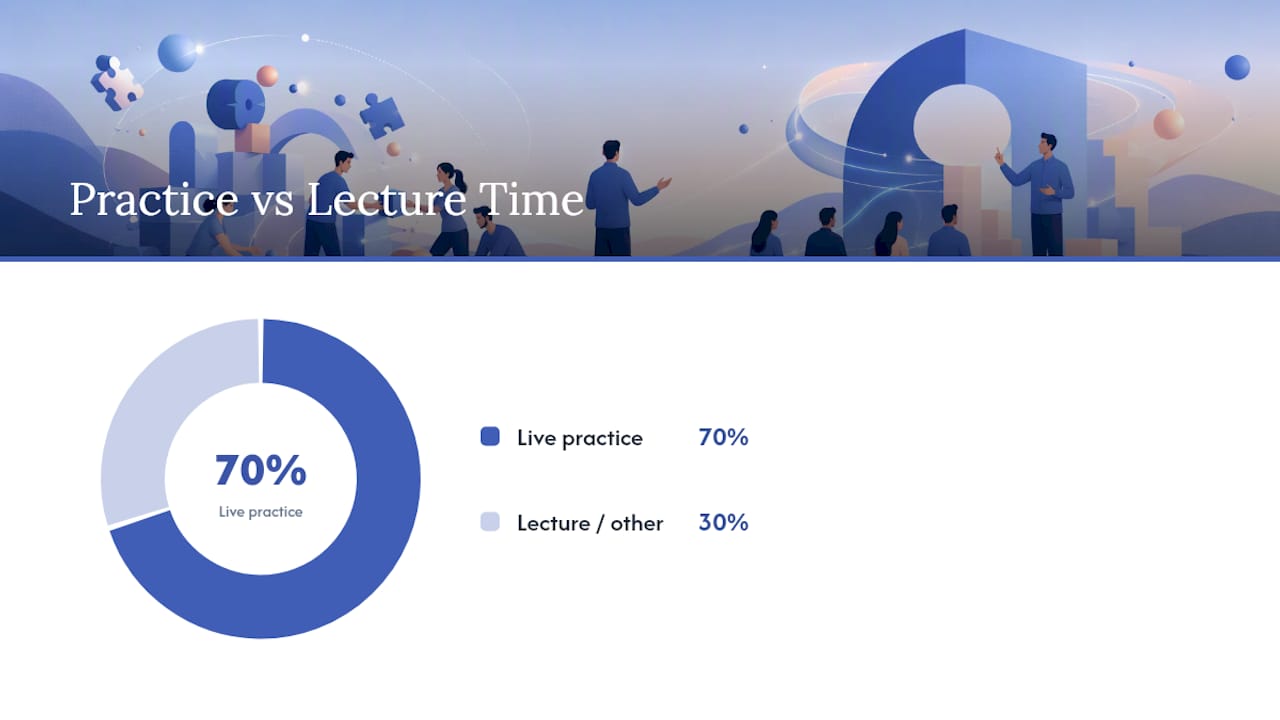
- Design short, focused sessions. Teach two skills per session, not five. Spend roughly 70% of the time on live practice rather than lecture, in-house coaching programs that skip repeated practice rarely produce lasting capability, no matter how good the slide deck was.
- Run role-play with real feedback. Pair managers up, assign one a resistant employee persona, and have the other practice the SBI feedback model out loud. Awkward the first time. Useful by the third.
- Record and review actual conversations. Pull a real 1:1 or sales call and replay it together. Managers who hear their own talk ratio on a recording change their behavior faster than managers who are just told about it.
- Set observation checkpoints. Sit in on a coaching conversation, or review a transcript, at the six-week mark to check whether the skill actually stuck or quietly reverted.
- Track behavior-based metrics, not attendance. Ramp time for new hires, follow-through rate on commitments made in 1:1s, and skill-specific win rates tell you more than a post-workshop survey ever will.
Pro Tip: Pick one skill, just one, and commit to practicing it in every 1:1 for two weeks straight before adding a second. Stacking five new habits at once is how none of them stick.
A low-cost starter experiment: this week, record (with consent) one coaching conversation, listen back, and count how many questions you asked versus how many statements you made. That ratio alone tells you where you stand.
Frameworks That Make Coaching Repeatable
Ad-hoc coaching, the kind that happens whenever a manager remembers to do it, produces ad-hoc results. A framework and a fixed cadence turn coaching into something a team can actually count on.
The GROW model is the simplest starting point:
- Goal: “What does success look like here?”
- Reality: “Where are things right now?”
- Options: “What could you try?”
- Will: “What will you actually commit to, and by when?”
PRAISE works well for feedback-heavy conversations: Purpose, Reality, Alternatives, Impact, Summary, End with commitment. Pick GROW when the conversation is forward-looking and goal-driven; pick PRAISE when you’re addressing a specific behavior that already happened.
On cadence, weekly, artifact-anchored sessions of 30 to 60 minutes per direct report beat scattered check-ins, and pipeline reviews should stay separate from actual coaching time. Anchor every session to something concrete:
- A call recording or video role-play clip
- A specific deal note or account plan
- A demo transcript with a highlighted moment
A copyable 30-minute agenda: five minutes on wins, ten minutes reviewing one artifact against one skill, ten minutes of live practice or role-play, five minutes setting the next commitment. Consistency matters more than length, and a realistic coaching cadence beats an ambitious one nobody keeps.
Why AI Role-Play Shortens the Feedback Loop
The biggest gap in most manager coaching isn’t intent, it’s speed. By the time a manager reviews a call from last week, the moment worth coaching has gone cold. AI-driven role-play and transcript review close that gap by surfacing the exact verbatim moment that mattered, not a vague recollection of it.
- Re-runs on demand: a rep can replay the same objection scenario immediately after getting feedback, instead of waiting for the next live call.
- Rubric-based scoring: transcripts get scored against the organization’s own methodology, so feedback stays consistent across managers.
- Talk ratio and pacing metrics: call metrics like talk-to-listen ratio turn a vague “you talked too much” into a specific, trackable number.
Managers can coach directly from transcripts and scorecards instead of relying on memory, which is where most feedback quality gets lost.
Giving Constructive Feedback Without Deflating the Room
Feedback fails for one of two reasons: it’s too vague to act on, or it lands as an attack instead of information. The SBI structure solves the first problem. Solving the second is about sequencing and restraint.
Start with what actually happened, not your interpretation of it. “You cut off the client twice” is observable. “You don’t respect the client’s time” is a judgment, and judgments trigger defensiveness before the person even hears your point. Keep the conversation to one or two behaviors max, delivered close to when they happened. Feedback from three weeks ago has lost its teeth and its context.
Ask before you tell. “What did you think happened in that moment?” often surfaces the same issue you wanted to raise, and it lands differently coming from them. If they miss it entirely, that’s when you name it directly using SBI. End every feedback conversation with a forward-looking question, not a lecture: “What would you try differently next time?” That single question turns a critique into a plan, and it’s the difference between feedback that changes behavior and feedback that just makes someone feel bad for an afternoon.
When to Coach and When to Just Give the Answer
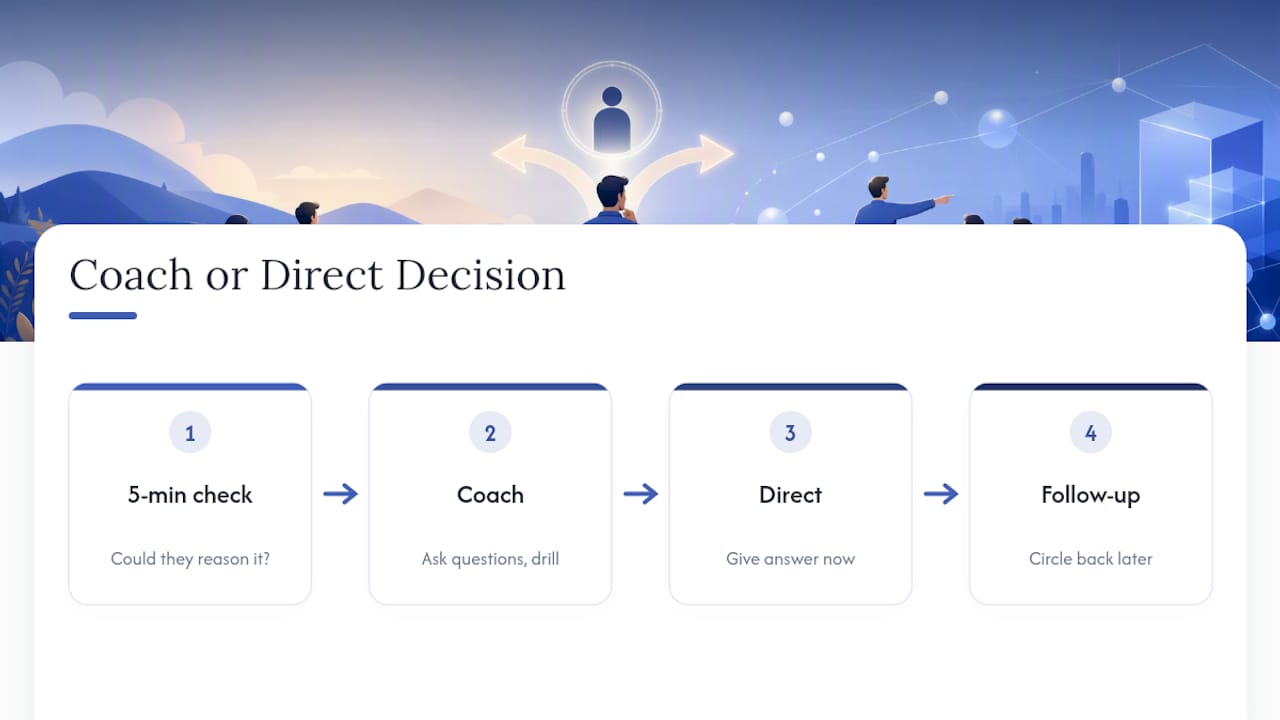
Coaching every single moment is a mistake almost as common as never coaching at all. If a new hire doesn’t know your CRM’s field names, coaching them toward the answer wastes everyone’s time, just tell them. Direction is the right call when there’s a hard deadline, a safety or compliance issue, or a genuine skills gap where the person has no foundation to reason from yet.
Coaching earns its place when the person already has the raw ability and the real gap is judgment, confidence, or habit. If a rep knows how to handle objections in theory but freezes under real pressure, drilling them with questions builds the muscle. Telling them the “right” answer builds dependency instead.
A quick gut check: ask yourself whether the person could get to a reasonable answer on their own with five more minutes of thought. If yes, coach it. If no, and the clock is running, direct it and circle back to the skill gap later when the pressure’s off. Managers who coach everything burn out their team’s patience; managers who direct everything stunt their team’s growth. The line moves person to person, and it’s worth reassessing it every few months as people grow.
Building Trust Before You Try to Coach Anyone
No one accepts coaching from someone they don’t trust, they just nod and wait for the conversation to end. Trust gets built in the boring moments, not the big ones: showing up to every scheduled 1:1 even when the week is chaotic, remembering what someone told you last time, and following through on the small thing you said you’d check on.
Consistency beats charisma here. A manager who’s warm in meetings but flaky on follow-through erodes trust faster than one who’s a little blunt but always does what they said. Rapport also means being willing to admit when your own read on a situation was wrong, employees notice when a manager can say “I was off base on that” without spiraling into over-apology. That kind of honesty makes future feedback land easier, because the employee knows it’s not about ego.
Emotional Intelligence Is What Makes the Skills Land
The same open question can build trust or trigger a shutdown depending entirely on tone, timing, and whether the person’s had a rough week. That’s emotional intelligence, and it’s the layer underneath every coaching technique on this list.
Reading the room starts with noticing what’s not said. Short answers, avoided eye contact, a sudden change in energy, these are signals that the topic might need a softer entry point or a different day entirely. Managers with strong emotional intelligence adjust their pace in real time: slowing down when someone’s overwhelmed, picking up momentum when someone’s ready to problem-solve. Self-regulation matters just as much. If a manager is frustrated walking into a 1:1, that frustration leaks into tone even when the words stay professional, and the employee reads the leak, not the script.
Handling Resistance Without Escalating It
Some employees push back on coaching outright: “I’ve been doing this for ten years, I don’t need this.” Others go quiet and comply on the surface while changing nothing. Both are forms of resistance, and both usually mean the coaching approach, not the employee, needs adjusting.
Direct resistance often responds well to naming it out loud: “It sounds like this feels unnecessary, can you help me understand why?” That question does more than a defensive justification of why the coaching matters. Passive resistance is trickier, watch for the gap between what someone agrees to in the room and what actually changes afterward. If commitments keep slipping, the issue often isn’t laziness, it’s that the goal wasn’t really theirs to begin with. Revisit whose idea the goal was in the first place.
Difficult conversations go better when you separate the behavior from the person’s identity as a performer. “This specific approach isn’t landing with clients” is workable. “You’re bad at sales” ends the conversation before it starts, and it usually isn’t even accurate.
How to Know Coaching Is Actually Working
Most managers measure coaching by how the conversation felt, not by what changed afterward. Feelings are a poor proxy. Behavior-based metrics tell the real story: is ramp time for new hires shrinking, is follow-through on commitments made in 1:1s actually happening, are skill-specific numbers (like objection handling win rate) trending up over six to eight weeks.
Job market data suggests managers who develop strong coaching capability tend to see stronger team performance overall, which tracks with what shows up at the individual level: reps who get consistent, specific feedback close the gap between their current skill and their ceiling faster than reps who get generic encouragement. Set a checkpoint, six weeks out is a reasonable interval, and compare the specific behavior you coached against where it started. If nothing’s moved, the issue is usually cadence or specificity, not the employee’s effort.
An Honest Take on What Actually Changes Behavior
The manager coaching program that worked best in my experience wasn’t the one with the fanciest framework, it was the one where a team anchored every weekly session to one real artifact: a call, a note, a transcript. The pitfall to avoid is treating coaching as a meeting instead of a rehearsal. Try this: pick one real conversation this week and coach against it, not against a hypothetical.
— Adam
Put These Skills Into Practice With Real Reps, Not Theory
Reading about active listening and running it under pressure are two different skills, and the gap between them is where most coaching plans quietly fail. Xl Roleplay closes that gap by giving your team a realistic AI buyer to practice against, then scoring the conversation against your own methodology instead of a generic rubric.
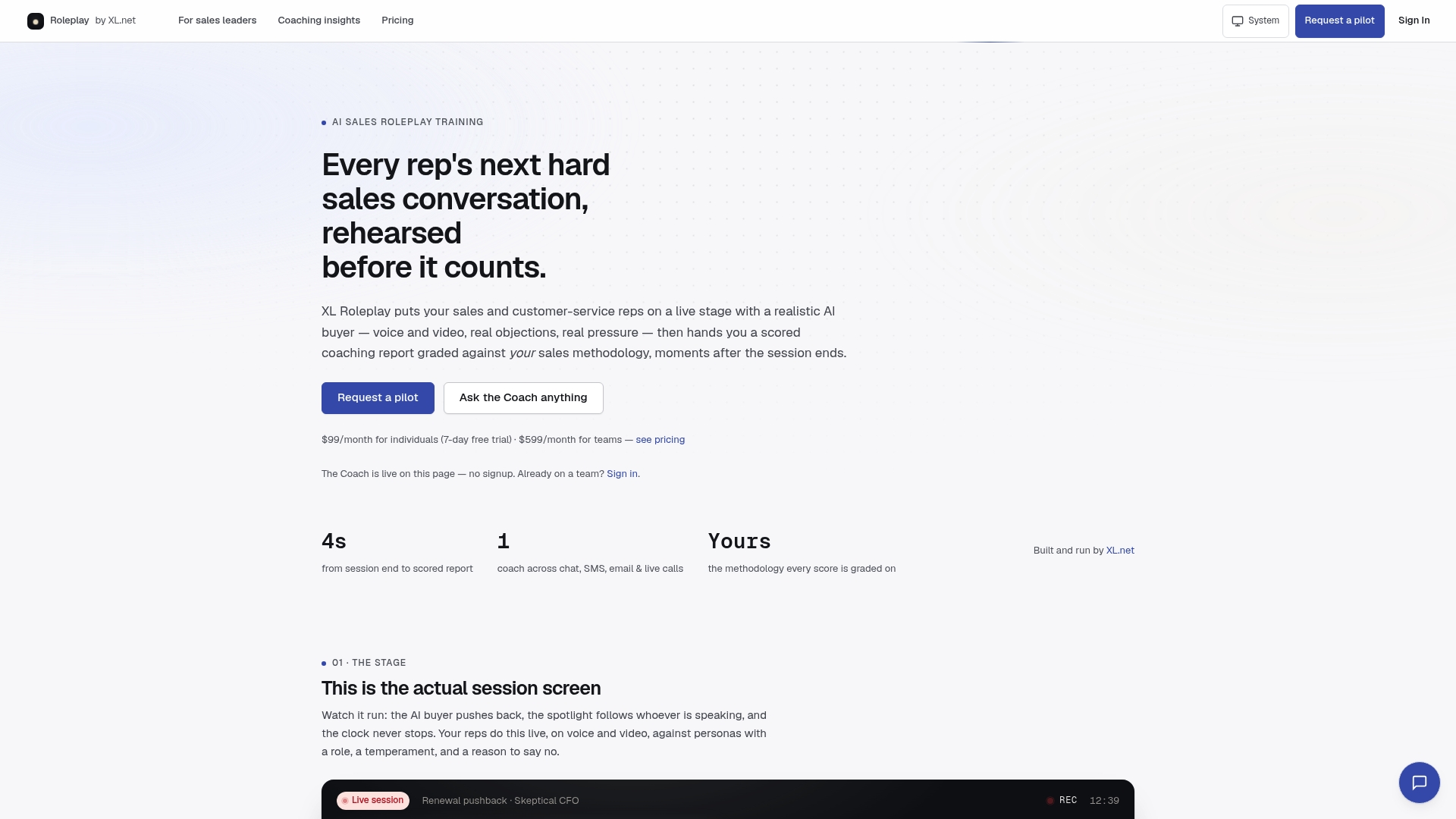
Every skill covered above maps directly to a feature: role-play sessions build the muscle for open questioning and objection handling, scored transcripts turn vague feedback into SBI-specific coaching, and readiness scoring gives you the six-week checkpoint without waiting on a live call to go sideways. Managers get a transcript to coach from within minutes instead of weeks. If you want a repeatable weekly cadence without building it from scratch, the one-on-one coaching template is a solid starting point, or head to the sales leader product page to see how a free trial fits into your existing coaching cadence.
Sources
- Why Do Managers Need Coaching Skills? — Coursera
- Coaching skills for managers: How to build them in-house — Careerminds
- How to Coach Sales Reps in 2026: A Manager’s Playbook — Sales Assembly
- Ultimate guide to successful sales coaching in 2026 — Highspot