5 MEDDPICC Role Play Scenarios Sales Teams Can Run This Week
5 MEDDPICC Role Play Scenarios Sales Teams Can Run This Week

Focused MEDDPICC role-play, short scenario drills paired with a scored debrief, is the fastest way to make the framework stick as an actual sales behavior instead of a slide reps forget by Friday. Prioritize four elements this week: Economic Buyer access, Metrics and Pain quantification, Decision Criteria, and Champion validation. Block 30 to 45 minutes, pick one of those four, and run it before your next pipeline review.
TL;DR:
- Practicing one MEDDPICC element at a time in role-play scenarios improves skill retention and real-world application more effectively than general recitations.
- Short, focused sessions lasting 30 to 45 minutes with a clear objective help reinforce specific skills like decision criteria or champion validation.
- Using real account details and recorded call scenarios makes role-play conversations more authentic and applicable to actual sales calls.
- AI roleplay tools provide unlimited, on-demand practice with consistent feedback, complementing manager-led drills and reducing scheduling barriers.
- Score behaviors with a clear rubric, track progress over weeks, and debrief using timestamped transcripts to turn feedback into actionable coaching.
Table of Contents
- Five Practical MEDDPICC Role-Play Scenarios To Run This Week
- How Do You Run An Efficient MEDDPICC Role-Play Session?
- What Should A MEDDPICC Role-Play Rubric Actually Measure?
- Can AI Roleplay Really Scale MEDDPICC Practice?
- Common Pitfalls In MEDDPICC Role-Play (And How To Fix Them)
- Ready-To-Use Buyer Prompts For Your Next MEDDPICC Drill
- A Sales Manager’s Take: Making Role-Play Part Of The Rhythm
- Scale MEDDPICC Practice With XL Roleplay
- Where To Go Deeper On MEDDPICC Training
- Sources
Five Practical MEDDPICC Role-Play Scenarios To Run This Week
Most MEDDPICC training fails because it stays theoretical. Reps can recite the acronym in a meeting and then freeze the moment a real economic buyer pushes back on price. The fix is narrow, repeatable scenarios, each one targeting a single letter of the framework rather than the whole thing at once.
Here are five that work in almost any B2B sales cycle:
- Identify the Economic Buyer. The “buyer” plays a gatekeeper who insists they have full authority. The seller’s job is to probe for budget ownership without sounding accusatory: “Walk me through who signs off if this goes over $50,000.” Debrief on whether the rep found the real decision maker or accepted a polite deflection.
- Define decision criteria. The buyer gives vague answers like “we just want the best solution.” The seller has to convert that into two or three named, weighted criteria. A strong line here: “When you say ‘best,’ is that measured by implementation speed, total cost, or something your team already flagged?”
- Quantify metrics and pain. The buyer describes a problem in soft terms, “our onboarding takes too long.” The seller must extract a number: days, dollars, headcount. This is the scenario where most reps go silent instead of pushing for specifics.
- Validate the Champion. The buyer claims influence they don’t actually have. The seller tests it directly: “If I sent over pricing today, whose desk does it land on next?” Weak champions dodge; real ones name names.
- Navigate paper and procurement. The buyer raises legal or procurement objections late in the deal. The seller has to show they already mapped the process instead of scrambling.
Pro Tip: Run one scenario per session, never all five. A rep who nails the Champion scenario but has never practiced procurement objections still has a real gap, and mixing them into one long roleplay hides that gap instead of exposing it.
How Do You Run An Efficient MEDDPICC Role-Play Session?
Session length depends on purpose. A focused reinforcement drill runs 30 to 45 minutes and targets one MEDDPICC element. A full onboarding workshop, useful for new hires learning the framework from scratch, can run 90 minutes and touch two or three elements with breaks between rounds. MEDDIC Academy’s certification courses mirror that split: the foundational course runs a couple of hours while the masterclass lasts several hours, which gives you a rough benchmark for how much ground a single sitting can realistically cover.
Every session needs four roles: an actor playing the buyer persona, the seller running the drill, an observer taking notes against the rubric, and a debriefer (often the manager) who runs the wrap-up. In smaller teams, one person can double up as observer and debriefer.
A sample agenda of under an hour looks like this:
- Minutes 0 to 5: State the single objective (“today we’re only testing Metrics quantification”) and set the scenario context.
- Minutes 5 to 20: Run the roleplay live, uninterrupted.
- Minutes 20 to 30: Debrief using the rubric, timestamped notes, and specific quotes from the conversation.
- Minutes 30 to 40: Re-run the same scenario once, applying the fix.
Managers should run the first roleplay themselves, deliberately fumble an objection, and narrate the recovery out loud. Modeling imperfection this way is what actually gets reluctant reps to volunteer for round two. For a repeatable facilitation template, see this step-by-step roleplay training guide.
Pro Tip: Capture a transcript, even a rough one, every time. Without it, debriefs turn into “I think you said” arguments instead of “here’s exactly what you said” coaching.
What Should A MEDDPICC Role-Play Rubric Actually Measure?
A rubric only works if it scores behaviors, not vibes. Vague feedback like “good energy” teaches nothing. Specific, binary or scaled criteria do.
Score these elements directly:
- Metrics: Did the rep get a numeric target stated out loud, not just implied?
- Economic Buyer: Did the rep attempt direct access, or settle for a proxy?
- Decision Criteria: Were at least two named criteria captured, not just “quality” or “fit”?
- Champion: Did the rep get concrete evidence of influence, like a name or a next meeting?
- Paper Process: Did the rep surface procurement or legal steps before being blindsided by them?
A simple 3 to 5 point scale works well: 1 (attempted but failed), 3 (partial, needs follow-up), 5 (clean execution, ready for live deployment). Reps who consistently score below 3 on the same element across multiple sessions have found their actual coaching priority.
Recording session notes against timestamps turns feedback into something a rep can review later without a manager present. A documented, timestamped rubric makes coaching feel evidence-based instead of personal. Track scores over four to six weeks per rep to build a simple readiness trend line rather than judging one session in isolation. For exit-criteria specifics tied to each MEDDPICC letter, the exit criteria coaching guide breaks down pass conditions element by element.
Can AI Roleplay Really Scale MEDDPICC Practice?
AI-driven roleplay doesn’t replace manager-led drills, but it solves the problem managers can’t: availability. A rep stuck on Champion validation at 9 p.m. before a Monday call doesn’t have to wait for their manager’s calendar to open up.
AI roleplay tools bring specific advantages to MEDDPICC practice:
- 24/7 access, so reps can drill before high-stakes calls instead of only during scheduled training blocks.
- Repeatable personas that hold the same objection pattern every time, useful for isolating whether a rep’s skill actually improved or the buyer just went easy on them.
- Adjustable difficulty, letting a new hire practice a cooperative buyer before facing a hostile procurement persona.
- Consistent, objective feedback that doesn’t vary by which manager happens to run the session that week.
Combining realistic scenarios with AI-supplied feedback loops is increasingly how high-performing teams scale practice past what a single sales manager can personally coach. Scored coaching reports and full transcripts shorten the gap between “the rep struggled” and “here’s exactly where and why,” turning what used to be a subjective gut check into something you can point to in a 1:1.
Pro Tip: Treat AI roleplay as reps’ practice gym, not their final exam. Use it for repetition between manager-led sessions, then bring the toughest scenarios back to a human debrief.
Common Pitfalls In MEDDPICC Role-Play (And How To Fix Them)
Treating MEDDPICC as a checklist to recite kills the entire exercise. Effective training pressure-tests the deal instead, forcing reps to defend their qualification data under pushback rather than just naming the eight letters.
- Mixing objectives dilutes learning. Fix: one MEDDPICC element per session, always.
- No psychological safety. Fix: managers model errors first and praise reps for surfacing weak spots, not for performing flawlessly.
- Generic “Acme Corp” scenarios feel fake. Fix: pull real stalled deals from the CRM so the objections match what reps actually face.
- No follow-up drill. Fix: re-run the same scenario in the same session once the fix is applied.
Pro Tip: If a rep gets defensive during debrief, the problem usually isn’t their skill. It’s that the session mixed two objectives, so they don’t know which mistake actually mattered.
Ready-To-Use Buyer Prompts For Your Next MEDDPICC Drill
Copy these directly into your next session:
- Economic Buyer persona: “I’m the CFO. I have twelve minutes and I’ve already seen three vendor decks this week.” Cue: forces the rep to lead with metrics, not features.
- Procurement/legal persona: “Before we go further, I need to know your data residency terms and standard contract redlines.” Cue: tests whether the rep has mapped the paper process.
- Skeptical champion persona: “I like this, but I’ve been burned pushing tools internally before.” Cue: tests whether the rep coaches the champion or leaves them exposed.
- Technical reviewer persona: “Walk me through your API rate limits before I even think about pricing.” Cue: tests whether the rep bridges technical detail back to business metrics.
Pull real account names, past objections, and deal stages from the CRM to swap into these prompts. Building scenarios from actual recorded calls makes the practiced language match what reps hear on real calls, not a sanitized version of it.
A Sales Manager’s Take: Making Role-Play Part Of The Rhythm
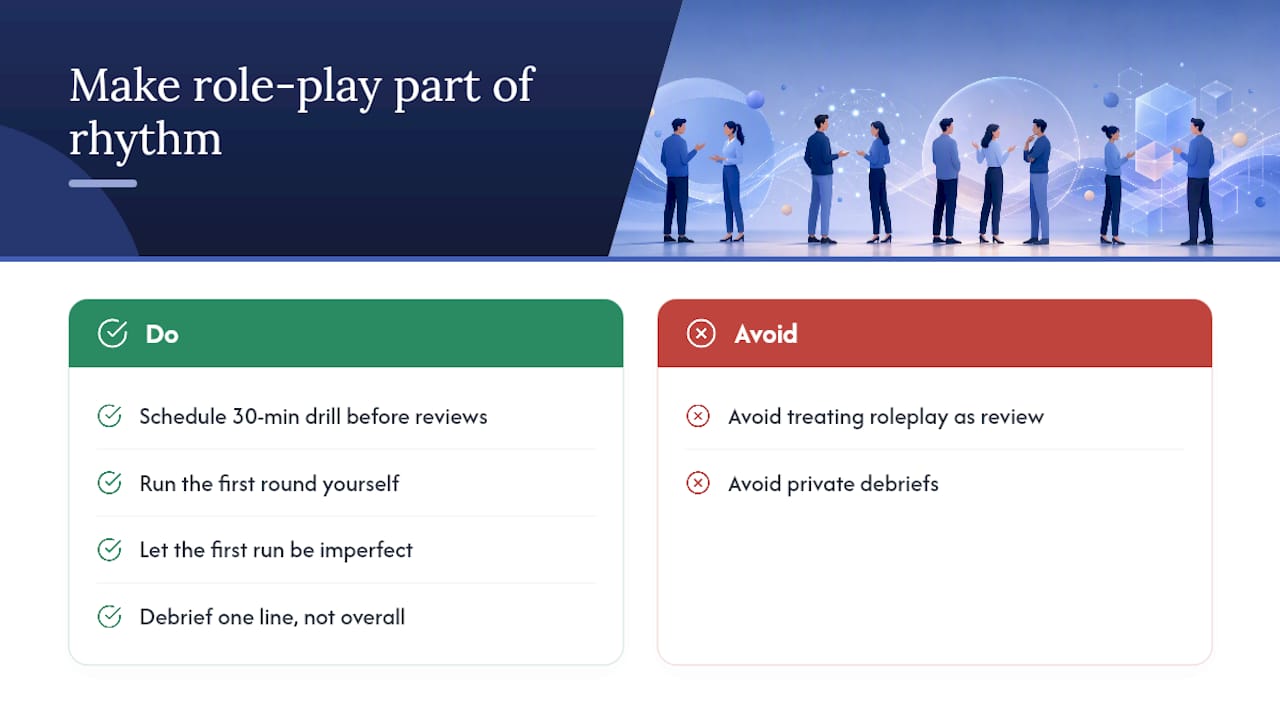
The first roleplay I ran with a team went badly, on purpose. I played a buyer who wouldn’t budge on Economic Buyer access, and the rep I paired with folded fast. We debriefed it in front of the group instead of privately, and that single move changed everything. Reps stopped treating roleplay as a performance review and started treating it as a rehearsal.
Three things to copy next week: schedule one 30-minute drill before it competes with pipeline reviews, run the first round yourself and let it go imperfectly, and debrief on one specific line the rep said, not their overall performance.
— Adam
Scale MEDDPICC Practice With XL Roleplay
Manager-led drills work, but they run into the same wall every sales team hits eventually: managers only have so many hours. XL Roleplay fills the gap between scheduled sessions with AI buyer personas that give reps unlimited repetition on the exact scenarios covered above, Economic Buyer access, Champion validation, procurement pushback, without waiting for a calendar slot to open.
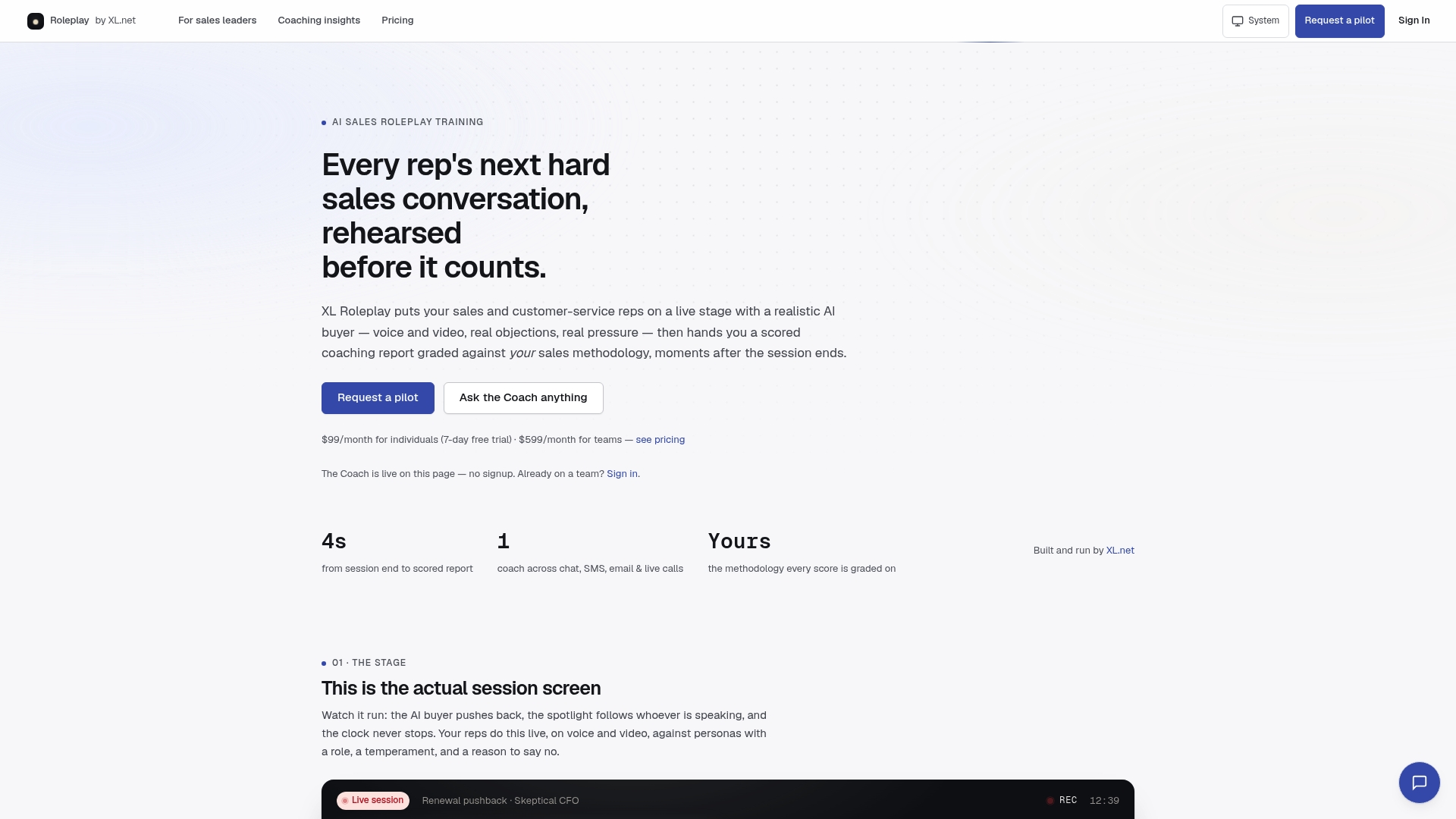
The platform runs live voice and video sessions against AI buyers, then scores each session against a rubric and generates a coaching report with a full transcript your manager can review in minutes instead of sitting through the whole recording. Scenario libraries can be personalized rather than using generic templates, so reps rehearse relevant objections.
A simple pilot: pick one MEDDPICC element your team struggles with most, run it through XL Roleplay for 30 days, and compare readiness scores before and after. If you’re leading a team rather than practicing solo, the sales leader plan is the faster starting point since it includes the manager-facing scoring and transcript review tools out of the box.
Where To Go Deeper On MEDDPICC Training
- MEDDIC Academy’s certification programs: compare foundational and masterclass course lengths before scheduling team training.
- MEDDICC’s official programs page: review masterclass, leadership, and certification options directly from the framework’s originators.
- Highspot’s roleplay exercise breakdown: nine additional exercise formats beyond MEDDPICC-specific drills.
- Qwilr’s MEDDPICC methodology overview: a clear explainer on why checklist-style training underperforms.
Sources
- MEDDIC Academy — Get MEDDIC certified
- Highspot — 9 sales role plays and exercises that boost skills
- Qwilr — MEDDPICC methodology (blog)
- MEDDICC — Programs