Run These Negotiation Role Plays to Build Real Skill
Run These Negotiation Role Plays to Build Real Skill

Run three scenarios in this order: a 10-minute distributive price negotiation, a 20-minute integrative two-party deal, and a 25-minute multi-stakeholder pricing drill with a procurement gatekeeper. That progression builds anchoring resistance, then value-trading instinct, then the ability to manage two competing agendas at once, which is where most reps actually fall apart in live deals.
This guide gives you everything to run that progression today:
- Scenario cards with objectives, roles, timing, and props
- A facilitator setup and scoring checklist
- Copyable script lines for openers, probes, and reframes
- A debrief question bank tied to measurable outcomes
- Guidance on scaling repetition with AI-driven practice
Every scenario below borrows structure from the Program on Negotiation’s Teaching Negotiation Resource Center, which anchors its exercises to concepts like BATNA and ZOPA. Once you’ve run the basics live a few dozen times, a platform like XL Roleplay lets you keep the reps going without booking a partner every time.
Key Takeaways
Effective negotiation skill-building requires progressive scenario complexity, immediate structured debriefs, and repeated practice that live scheduling alone can’t sustain.
| Point | Details |
|---|---|
| Start with distributive, then integrative | Run a 10-minute price negotiation before adding value-trading or multi-stakeholder complexity. |
| Keep role cards to three bullets | Title, pressure, and hidden agenda are enough; more backstory kills natural reactions. |
| Debrief immediately, every time | Use the same three questions (information, emotion, next step) so patterns become visible across runs. |
| Score four dimensions consistently | Track information uncovered, value trading, relationship management, and next-step clarity. |
| Scale repetition with XL Roleplay | Use AI-driven sessions for on-demand practice and scored transcripts between live coaching sessions. |
Where to Find More Scenarios and Templates
- The Program on Negotiation’s TNRC publishes downloadable simulations built around BATNA and ZOPA.
- Harvard’s negotiation resource library indexes additional case studies and teaching exercises.
- Adapt any scenario to your context by swapping the industry detail on the role cards while keeping the hidden agenda structure intact.
Table of Contents
- Negotiation Role Play Scenarios by Skill Level
- How Do You Actually Run a Negotiation Role Play?
- Scripts and Opening Lines You Can Use Today
- What Should You Measure After a Role Play?
- When Should You Add AI-Driven Practice?
- What Trainers Get Wrong in Practice
- Practice More Without Scheduling More
- Frequently Asked Questions
- Sources
Negotiation Role Play Scenarios by Skill Level
Skip the generic “negotiate a used car” prompt. It teaches almost nothing because both sides already know the script. The scenarios below force real decisions because each one has a hidden number, a hidden constraint, or a hidden third party the other side doesn’t see coming.
Beginner: the fixed-budget vendor renewal
Objective: Practice anchoring and resisting a first offer without damaging the relationship.
Two roles, 10 to 15 minutes. One person plays a vendor account manager renewing a software contract at a 12% price increase. The other plays a procurement lead with a budget cap the vendor doesn’t know about. Materials: two half-page role cards, one listing the vendor’s walk-away price, the other listing the buyer’s real ceiling. Recommended group size: pairs, with one observer per pair if you have the headcount.
Debrief questions: What number did the buyer actually reveal? Who anchored first, and did it work? What would you do differently in the next 30 seconds if the run continued?
Pro Tip: Watch for the three-second pause after the first offer. Reps who rush to fill silence usually concede something they didn’t need to. Coach the pause, not the pitch.
Intermediate: the joint-gains renovation deal
Objective: Move past position-based haggling into trading on what each side actually values.
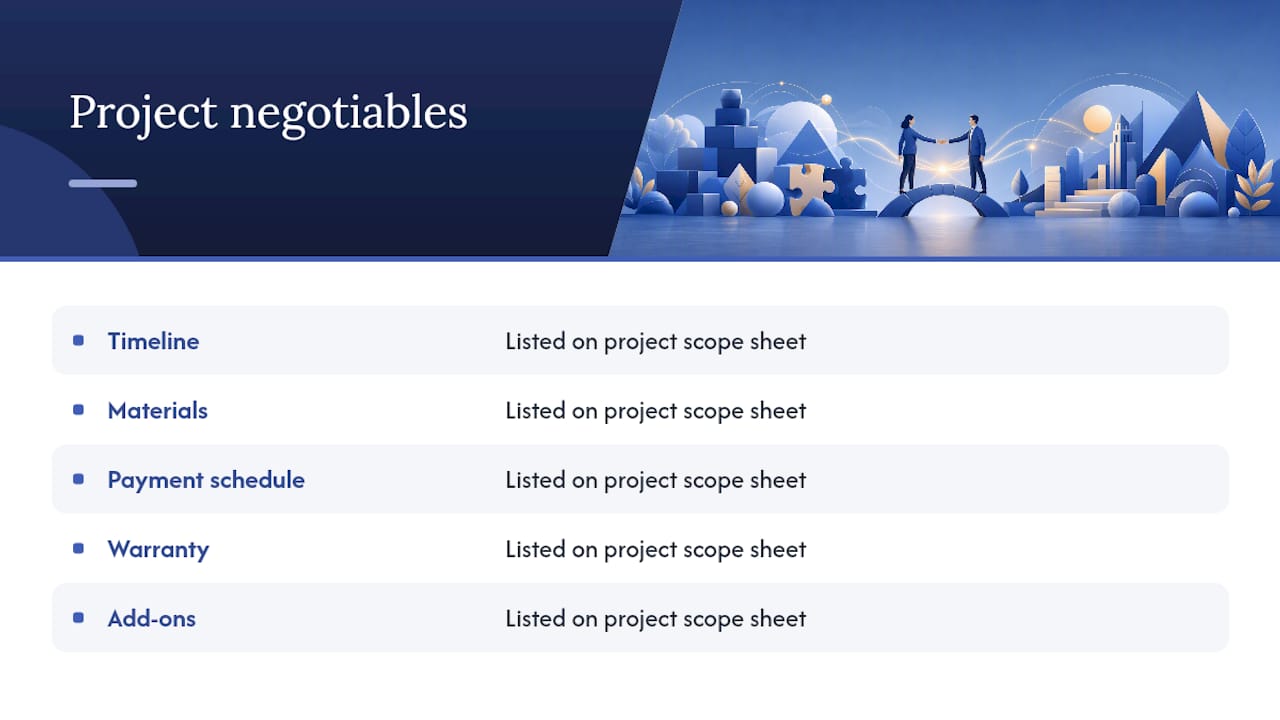
Two roles, 20 minutes. A homeowner wants a kitchen remodel finished before a family event; a contractor has a scheduling conflict but flexible pricing. Neither side’s card mentions the other’s real priority: timeline for one, margin for the other. The learning moment happens when someone asks a discovery question instead of restating their price. Materials: two role cards plus a shared “project scope” sheet listing five negotiable items (timeline, materials, payment schedule, warranty, add-ons).
Debrief questions: Which item turned out to be a trade instead of a trade-off? What question actually surfaced the other side’s real constraint?
This format works especially well as a base for sales negotiation roleplay scenarios built around protecting margin instead of discounting to close.
Advanced: buyer plus procurement, two-on-one
Objective: Practice managing two decision-makers with different agendas in the same conversation.
Three roles, 25 minutes: a sales rep, a champion who wants the deal to happen, and a procurement lead whose only mandate is cost reduction. The champion and procurement lead get separate hidden agendas that sometimes conflict with each other, not just with the seller. Recommended group size: three active roles plus one or two observers tracking specific behaviors (one tracks question quality, one tracks concession pattern).

Debrief questions: Did the seller address both agendas separately or collapse them into one pitch? Where did procurement and the champion disagree, and did the seller notice?
For remote delivery, run this over video with role cards shared privately via chat rather than screen share, so no one sees the other cards by accident. For larger groups, run it as a fishbowl: one trio negotiates while the rest of the room scores using the same rubric.
How Do You Actually Run a Negotiation Role Play?
A scenario card alone doesn’t teach anything. The facilitation around it does. Here’s the process that turns a 20-minute exercise into a behavior change instead of a fun diversion.
Before you start, confirm five things: the single learning objective for this run, who plays which role, what each hidden agenda is, what props or role cards you need printed or shared, and who’s observing. Decide your success metric before anyone opens their mouth. “Did they close the deal” is a weak metric. “Did they uncover the other side’s real constraint before offering a concession” is a strong one.
- Brief the room. State the objective out loud, not just on the card. Tell observers exactly what to watch for.
- Assign roles and hand out cards privately. Give participants two minutes of silent read time before anyone talks.
- Run it live. Set a hard stop time and stick to it, even mid-sentence.
- Pause at the teachable moment. If you see anchoring, a missed cue, or a premature concession, stop the clock and name it right there instead of waiting for the run to end.
- Debrief immediately, using the same three or four questions every time so learners start recognizing the pattern themselves.
- Close with one action commitment per participant: a specific behavior to try in their next real conversation.
Score each run against a short rubric with four dimensions: information uncovered, value trading (did they propose more than one variable to trade), relationship management, and clarity of the next step. Rate each low, medium, or high. A “low” on information uncovered might look like accepting the first number offered; a “high” looks like a specific follow-up question that changes the offer on the table.
Pro Tip: Give observers a job, not just a seat. An observer with nothing to track drifts into watching the clock. An observer tracking “count the open-ended questions asked” stays engaged and gives sharper debrief input.
Psychological safety matters more than most facilitators admit. If a participant fumbles a scenario in front of peers, the debrief should focus on the pattern, not the person. Say “anchoring hard right out of the gate is a common first move” instead of naming who did it weakest.
Scripts and Opening Lines You Can Use Today
Over-scripting kills a role play faster than no script at all. If a role card runs longer than three bullet points (title, pressure, hidden agenda), participants start reading instead of reacting. Keep the props tight and let the language stay loose.
Opening lines for the seller, distributive mode:
- “Before we talk numbers, walk me through what’s driving the timeline on your end.”
- “I want to get to a number that works. What does ‘working’ look like for you beyond price?”
Opening lines for the buyer, distributive mode:
- “Your number is higher than what we budgeted. Help me understand what’s built into that.”
- “What would need to be true for you to move on this?”
Integrative mode, option generation:
- “What if we kept the price where it is but adjusted the payment schedule instead?”
- “Is there a version of this where you get the timeline you need and I get the terms I need?”
Multi-stakeholder mode, two-on-one:
- “It sounds like you two aren’t fully aligned on priority. Can we separate the cost question from the timeline question?”
- “Let me make sure I understand both of your constraints before I respond to either one.”
Escalation prompts a facilitator can drop in mid-run: “Your manager just called and needs an answer in five minutes.” “The other side just revealed a budget number you didn’t expect.” Both force a decision instead of letting the conversation drift.
Pro Tip: *Write hidden agendas as a single sentence, not a paragraph.
What Should You Measure After a Role Play?
A role play without a measurement plan is just improv. Tie every debrief to the objective you set before the run, and track results across sessions so a learner can see whether behavior actually shifts.
Metrics worth tracking, matched to common objectives:
- Budget or constraint range uncovered (did they get a number, or just a “somewhere around”)
- Number of distinct value trades proposed, not just price moves
- Whether a concrete next step got secured before the conversation ended
- Rubric score trend across repeated runs of the same scenario type
A three-question debrief works well for short sessions:
- What information did you uncover, and how did you get it?
- Which moment shifted the emotional tone of the conversation, and what caused it?
- What is the one concrete next step from here?
After the debrief, have each participant write a short action plan: one specific behavior to test in their next real negotiation, plus a date to report back on it. “Ask about approval criteria before naming a price” is testable. “Communicate better” is not.
Use rubric scores to prioritize coaching, not to rank people. If three reps all score low on “value trading,” that’s your next training session topic, not three individual performance conversations.
When Should You Add AI-Driven Practice?
Live role plays with a partner and an observer build the deepest learning, but they’re hard to schedule repeatedly. That’s the gap AI-driven tools like XL Roleplay fill: on-demand repetition against a consistent, calibrated persona instead of waiting for a colleague’s free hour.
A basic workflow: select a scenario close to what you covered live, calibrate the AI persona’s pressure points and hidden agenda to match, run the session, then review the scored coaching report and transcript before deciding what to practice next.
Benefits worth naming:
- Repetition on demand, no scheduling two people’s calendars
- Consistent challenge level across every rep on a team
- Objective transcripts and scores instead of a manager’s memory of how it went
- Faster iteration between attempts on the same weak skill
Limits to respect: AI practice shouldn’t replace human coaching for the highest-stakes soft skills, like reading a live client’s frustration in real time. Validate that the AI persona’s objections match how real buyers actually push back before trusting it as a benchmark, and keep a human in the loop for the debrief that follows a run.
Pro Tip: Run the AI session first, then bring the transcript to a human coach for five minutes of targeted feedback. That combination beats either one alone.
What Trainers Get Wrong in Practice
Over-scripting is the most common mistake. A role card with two paragraphs of backstory kills spontaneity, and the exercise becomes a reading exercise instead of a negotiation. Cut it to three bullets.
The second mistake is skipping the immediate debrief because time ran short. That’s where the actual learning happens; running the drill without it just burns the clock. Increase complexity gradually, and only add a second stakeholder once a group handles two-party scenarios cleanly, since a third agenda too early just creates noise instead of insight.
Practice More Without Scheduling More
Booking a role-play partner for every rep, every week, doesn’t scale. Once you’ve run the live scenarios above a few times, the bottleneck becomes calendar time, not skill development. XL Roleplay gives reps a way to keep practicing against a realistic AI buyer on their own schedule, with a scored coaching report and transcript waiting the moment they finish.
Picture a rep rehearsing a final pricing call the night before, running the objection three different ways until the reframe actually lands. Or a sales manager running the same multi-stakeholder drill across a full team in one afternoon, comparing rubric scores instead of guessing who needs coaching. Both scenarios turn into dashboard data a manager can act on instead of anecdotes.
Take one of the scenario cards from this guide, load it into a free trial of XL Roleplay, and run it against an AI buyer today to see how the scored report compares to your own read of the conversation.
Frequently Asked Questions
What is a negotiation role play, exactly? It’s a structured practice exercise where two or more people act out a negotiation scenario using assigned roles, hidden agendas, and a set objective, followed by a debrief that turns the run into a learning moment instead of just a conversation.
How long should a negotiation role-play session run? Beginner distributive scenarios work well at 10 to 15 minutes. Integrative and multi-stakeholder scenarios need 20 to 25 minutes to let value-trading actually surface.
How many people do you need for a negotiation role-play exercise? Two for a basic scenario, three for advanced multi-stakeholder drills, plus one or two observers if you want structured scoring feedback.
Can you run negotiation role play alone, without a partner? Yes. AI-driven platforms like XL Roleplay simulate the counterpart, which is useful for repetition between scheduled live sessions with a human partner.
What’s the difference between distributive and integrative role-play scenarios? Distributive scenarios focus on dividing a fixed resource, usually price. Integrative scenarios introduce multiple negotiable variables so both sides can trade on what they value differently, creating joint gains instead of a single winner.
How do you debrief a negotiation role play effectively? Ask what information got uncovered, what moment shifted the emotional tone, and what the concrete next step is. Keep the same three questions across sessions so learners recognize their own patterns over time.
Sources
- Teaching the Fundamentals: The Best Introductory Negotiation Role Play Simulations - PON - Program on Negotiation at Harvard Law School
- Negotiation