New Rep Practice Scenarios: 12 to Run Before the First Live Call
New Rep Practice Scenarios: 12 to Run Before the First Live Call

The best practice scenarios for a new rep are short, specific and scored: a realistic buyer, one clear objective, one moment that usually goes wrong, and a rubric that says what good looks like. Start with discovery, the “we already have a vendor” objection, early pricing questions and a stalled deal. Then grow a tagged library so every new hire practices the same moments in the same order.
This guide gives you 12 scenarios to start with, a one-page format for writing them, a way to organize the library, and a simple method for judging readiness afterward.
TL;DR
- A useful scenario has a persona, a situation, an objective for the rep, a hidden buyer concern and a scoring rubric. Without all five, practice turns into chatting.
- Start new reps on discovery, then the four or five objections they will hear in their first month, then pricing and next-step conversations.
- Keep the library tagged by role, stage, segment, vertical and competitor, with a named owner and a review schedule.
- Score every run against the same rubric and read the transcript, not just the score, before you call a rep ready.
- Write scenarios from your own playbook and real calls so reps practice your sales methodology, not a generic one.
Table of Contents
- What makes a practice scenario worth running
- 12 scenarios new reps should practice first
- Write each scenario on one page
- Build the scenario library so it stays usable
- Adapt scenarios to your customers and methodology
- Judge readiness and give feedback
- Our perspective
- Run these scenarios with XL Roleplay
- FAQ
- Sources
What makes a practice scenario worth running
Most scenario lists fail because they describe a topic (“handle objections”) instead of a moment (“the buyer says your price is double what they pay today, and you have not yet shown them why”). A new rep cannot rehearse a topic. They can rehearse a moment.
A scenario that earns a spot in the library has these parts:
- A persona. Title, company size, what they care about and how they talk. A busy operations director who answers in short sentences behaves differently from a curious analyst who asks ten questions.
- A situation. Where this call sits in the deal: first call, follow-up, procurement stage, renewal.
- A rep objective. One thing the rep must accomplish, such as uncovering the cost of the current process or securing a dated next step.
- A hidden concern. What the buyer will only reveal if the rep asks well. This is what separates discovery practice from reading a script.
- A rubric. Three to five observable behaviors, each scored, such as “asks at least two open questions about impact” or “names a next step with a date.”
Keep the scenario to one skill at a time. A scenario that tests discovery, objection handling and closing in ten minutes tells you nothing about which one failed.
12 scenarios new reps should practice first
The order below follows how a new rep’s first weeks usually go: open the conversation, learn about the buyer, face resistance, then move the deal forward. Each scenario is a moment, with a note on what to score.
Opening and discovery
1. The cold open with a skeptical buyer. The buyer picks up and says they have thirty seconds. Score: does the rep state a relevant reason for the call in one or two sentences and ask a question rather than pitch?
2. The first discovery call with a friendly, vague buyer. The buyer is pleasant but says things like “we are just looking around.” Score: does the rep ask about the problem, the impact and who else is involved, instead of accepting vague answers?
3. The buyer who wants a demo immediately. They ask to see the product before saying what they need. Score: does the rep earn a few discovery questions first without sounding evasive?
4. The multi-stakeholder call. Two buyers disagree on priorities. Score: does the rep keep both engaged and identify who owns the decision?
Common objections
5. “We already work with someone.” The most common early objection. Score: does the rep ask what is working and what is not, rather than attacking the incumbent?
6. “Send me some information.” Often a polite exit. Score: does the rep find out what the buyer would look for in the material and secure a follow-up time?
7. “This is too expensive.” Score: does the rep separate a real budget limit from a value gap, and tie the price back to something the buyer said earlier?
8. “Now is not a good time.” Score: does the rep learn what changes the timing and agree on a specific reconnect point?
Pricing, progress and recovery
9. Pricing before qualification. The buyer asks for a number in the first five minutes. Score: does the rep answer honestly, give context and keep discovery going?
10. The deal that went quiet. The buyer has not replied in two weeks. Score: does the rep write or say something specific and useful, not “just checking in”?
11. The champion who cannot get budget. A friendly contact likes the product but cannot sign. Score: does the rep help them build an internal case and meet the real approver?
12. The manager asks why the deal slipped. A internal-facing scenario in which the rep explains a lost or delayed deal honestly. Score: does the rep state facts, own their part and propose a next move?
Customer service teams can adapt the same shapes: the angry caller who wants a refund, the customer who threatens to cancel, the one who asks for a manager. The structure (persona, situation, objective, hidden concern, rubric) stays identical.
Write each scenario on one page
A scenario nobody can find or read in two minutes will not get used. A one-page format works well: the objective, when to run it, the buyer brief, example good answers and the red flags that signal a miss. One research summary on building playbook libraries recommends this same shape, with an objective, timing, script, examples and red flags on a single page.
A practical template:
| Field | What goes in it |
|---|---|
| Title | The moment, in plain words (“Price objection after demo”) |
| Objective | The one thing the rep must achieve |
| Run it when | Week of onboarding, or deal stage |
| Buyer brief | Persona, mood, what they say first, what they hide |
| Strong answers | Two or three examples drawn from real top-performer calls |
| Red flags | Pitching early, accepting vague answers, no next step |
| Rubric | Three to five scored behaviors |
| Owner and version | Who maintains it and when it was last changed |
The “strong answers” field matters most. Pull them from recordings of your best reps, not from a template, so new hires hear what good sounds like in your market.
Build the scenario library so it stays usable
A library of 15 scenarios is easy to manage. A library of 150 becomes a graveyard unless it is organized. Three habits keep it alive.
Tag every scenario. The same research suggests tagging plays by role, stage, segment, vertical and competitor. That lets a manager pull “mid-market, healthcare, evaluation stage, competitor objection” in seconds. Map the stage tags to the stages in your CRM rather than a generic funnel, so what reps practice matches what they see in deals.
Give each scenario an owner and a version. Someone should be responsible for each one. When a pricing change or a new competitor claim appears, the owner updates it, and the version note tells managers what changed.
Review on a schedule. A sensible rhythm is a quarterly review of the whole library, with monthly updates to the scenarios reps run most. Retire scenarios nobody runs. Add new ones whenever a real call exposes a gap.
A good first library has three layers:
- Core skills (about eight scenarios): discovery, the common objections, pricing, next steps. Every rep runs these.
- Segment and vertical variants (add as needed): the same objection with a different buyer, such as a CFO versus a department head.
- Competitor and situational plays: the specific claims you hear against rivals, and rare but costly situations like a late-stage procurement push.
Adapt scenarios to your customers and methodology
Generic scenarios teach generic habits. Three adjustments make them yours.
Use your buyers’ real language. Take objections verbatim from call recordings and CRM notes. If buyers say “we are locked into a contract until Q3,” write that, not “the buyer has a contract.”
Match your methodology. If your team qualifies with a specific framework, the rubric should score those exact steps. A rep who gets praised in practice for a style your managers do not teach is learning the wrong thing.
Vary difficulty. Run the same scenario with a friendly buyer first, then a rushed one, then a hostile one. Reps build confidence on the first and resilience on the third.
Mention your actual product and pricing structure inside the scenarios too. Reps should practice explaining your packaging out loud before a prospect asks.

Judge readiness and give feedback
Practice is only as useful as the feedback attached to it. A manager can keep this simple.
- Set a bar before reps start. For example, a defined rubric score on the core scenarios across more than one attempt, not a single lucky run.
- Read the transcript. A score tells you whether; the transcript tells you why. Look for the exact sentence where the rep lost the thread.
- Give one correction, not five. Pick the highest-impact behavior and have the rep rerun the scenario with that change.
- Rerun to prove improvement. Feedback sticks when the rep immediately applies it.
- Move to live calls gradually. Have the rep shadow, then take lower-risk calls, with the practice scenarios mirroring what they will face next.
For a deeper look at running the conversation that follows practice, this guide on mastering one-on-one meetings for managers covers structuring regular coaching check-ins so feedback does not get lost between sessions.
Our perspective
Most teams we talk to already have scenarios. They live in a slide deck, a wiki page or a manager’s head, and new reps run them with a colleague who is being polite. The scenarios are fine. The practice is not realistic, and nobody scores it the same way twice.
We built XL Roleplay around two ideas. First, the buyer should push back like a real buyer, live, by voice or video, with the objections and pressure reps will actually meet. Second, the feedback should be grounded in your own sales methodology and playbook, not a generic standard, and every score should link to the transcript so a manager can see exactly why.
We also think a rep should work with one coach that remembers what they practiced, so the next scenario builds on the last instead of starting from zero. That is how practice becomes a habit, and how a manager gets evidence of readiness instead of a hunch.
Adam
Run these scenarios with XL Roleplay
If you would rather not play the buyer yourself, XL Roleplay lets reps practice live conversations with AI buyers that raise typical objections and pressure, then returns a scored coaching report tied to your methodology. Managers can review the transcript and rubric for each session.
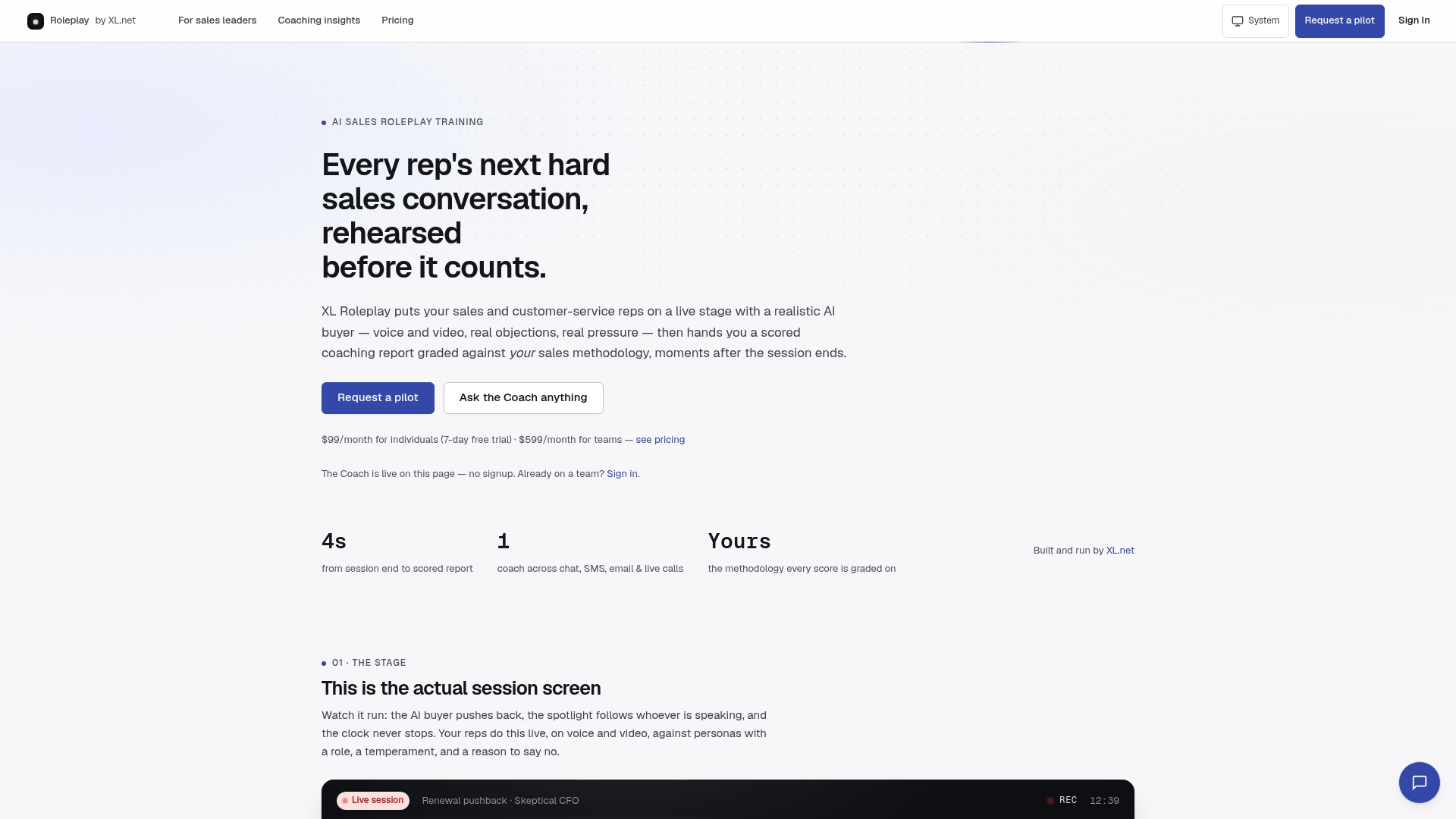
The Individual plan is $99 per month and the Business plan is $599 per month, with extra seats at $54.95 per month per seat and extra video at $16.99 per hour. See the details on the pricing page. If you lead a team and want to test it on your own playbook first, look at the XL Roleplay pilot or the page for sales leaders. You can also browse more sales role-play scenarios and sales conversation examples on our site.
FAQ
How many practice scenarios does a new rep need?
Eight to twelve core scenarios cover the moments that matter in the first month: discovery, the common objections, pricing and next steps. Each should be run more than once, at rising difficulty. Add segment and competitor variants only after the core set is solid.
How long should one scenario run?
Five to ten minutes is enough for most single-skill scenarios. Shorter runs let a rep do several attempts in a session, and they keep the focus on one behavior. Longer, multi-stage role plays work better later in onboarding.
Should scenarios follow a script?
Give the buyer a brief, not a script. The buyer needs a persona, a mood and a hidden concern so the rep has to listen. Keep example strong answers separate as a reference for managers and for review after the run.
How do I make custom scenarios from real calls?
Pick a call where a deal stalled or a top rep handled an objection well. Copy the buyer’s actual wording, note what the rep needed to uncover, and turn the outcome into rubric items. Tag it by stage, segment and competitor so it can be found later.
How do I know a rep is ready for live calls?
Look for consistent rubric scores across several attempts on the core scenarios, plus transcripts that show the rep asking good questions and agreeing on next steps. Set that bar before onboarding starts so every rep is measured the same way.