Behaviorally Scored Objection Handling Exercises for Sales Managers
Behaviorally Scored Objection Handling Exercises for Sales Managers

The fastest way to level up objection handling is short, repeated role-plays scored on observable behavior, not confidence, followed by an immediate evidence-based debrief. This article gives you the exercise catalog, exact timing templates, a scoring rubric, and a process for building a scenario library from real calls. Run it weekly in 30-minute labs and you’ll see behavior change inside a month.
TL;DR:
- Repetition of objection handling drills should include measurable behaviors scored on a 0-2 scale, focusing on asking clarifying questions, summarizing objections, and providing evidence.
- Using real objections from call transcripts or lost deal notes, tagged by objection type and deal stage, improves scenario relevance and transfer to live calls.
- Short, scheduled 30-minute sessions combining role-plays, debriefs, and replay are effective for behavior change, especially when roles rotate and escalation cards are used.
- AI-powered roleplay platforms enable reps to practice extra scenarios independently, generating scored reports that help managers verify skill transfer without additional meeting time.
- Facilitator calibration and structured debriefing based on tangible evidence promote consistent scoring and targeted improvement across sales teams.
Table of Contents
- Objection Handling Exercises and Games You Can Run Today
- How Do You Set Up an Objection Handling Practice Session?
- Scoring Objections: A Behavioral Scorecard That Works
- Building a Scenario Library From Real Calls
- Can You Run These Exercises Remotely?
- A 30-Minute Objection Lab You Can Copy This Week
- Score Behavior, Not Confidence
- Scale These Drills With Scored AI Roleplay
- Facilitator and Reference Resources
- Sources
- FAQ
Objection Handling Exercises and Games You Can Run Today
Most sales teams default to one drill: pair up, run a scenario, move on. That gets stale fast, and it rarely surfaces the specific line that actually closes an objection. A better approach rotates between fast reflex drills, deeper diagnostic role-plays, and a few competitive formats that make practice feel less like homework.
Fast drills for reflexes and confidence
- Rapid Objection Exchange. One rep fires objections rapidly (price, timing, competitor, authority) while a partner responds in 15 to 20 seconds each, no pauses. This builds the muscle memory to respond without freezing, and it works well as a two-minute warm-up before a longer session.
- Hot Seat. One rep stands in front of the group and fields objections from everyone else in turn. It’s uncomfortable by design, and that discomfort is the point. Reps who can hold their ground here handle live pressure better.
- Objection Poker. Teams draw objection cards and “bet” on how strong their response will be before delivering it. The game format surfaces which language actually lands, since the group scores each response afterward.
Triad role-plays for diagnostic depth
A triad—one seller, one buyer, and one observer—gives you the richest practice format because someone is always watching for evidence instead of just reacting. The seller practices a full objection sequence: acknowledge, ask a clarifying question, confirm understanding, then respond. The observer’s only job is to note what was actually said, not how confident it sounded. This structure comes from a 12-scenario role-play template built specifically around triads and private escalation cards.
Improv and competitive formats
“Yes, and” improv games train reps to build on what a buyer says rather than talking past it, which directly targets the listening gap most objection handling training ignores. An objection handling activity library also recommends a Feature-Benefit-Evidence structure for short responses, useful when running an Objections Contest where reps score points for hitting all three elements in under 30 seconds.
Escalation-card scenarios
The highest-value exercise borrows real friction from real deals. Write objections straight from call transcripts or lost-deal notes, then hand the buyer a private escalation card (“if they don’t mention the renewal risk, push back on price again”). This keeps the pressure realistic instead of scripted.

The biggest execution pitfall: sanitized objections. A soft, generic “it’s too expensive” trains nothing useful. Real objections carry hesitation, specific numbers, and follow-up pushback, and scenario design guidance from Thiagi makes the case that mirroring actual buyer language is what makes the practice transfer to live calls.
How Do You Set Up an Objection Handling Practice Session?
Session setup determines whether practice feels safe enough to be honest or awkward enough to be useless. Use triads when you want a dedicated observer capturing evidence; use pairs only for quick reflex drills where speed matters more than depth. Rotate roles every round so everyone gets seller, buyer, and observer reps across a session.
- Give the buyer a private escalation card with account context (budget, competitor mentioned, prior objection) that the seller can’t see.
- Run a strict 4-minute scenario, followed by a 6-minute debrief, then replay the weakest 60 seconds of the exchange immediately.
- Set a consent rule upfront: no recording without agreement, and no scoring shared outside the room without permission.
- Open every session by stating explicitly that mistakes are the point, not a performance review.
Pro Tip: Rotate who plays the buyer every single round. Reps who’ve played the toughest buyer personas ask sharper clarifying questions when they’re back in the seller seat.
Scoring Objections: A Behavioral Scorecard That Works
Score what reps actually said, not how they sounded saying it. A workable rubric rates four behaviors on a 0 to 2 scale: asked a clarifying question, accurately summarized the objection, offered specific evidence (a number, case, or proof point), and confirmed the buyer’s concern was addressed before moving on. Every score needs a timestamped quote attached, so the debrief argues from evidence instead of impressions.
Run the debrief in this order every time:
- The seller states, in one sentence, what they think happened.
- The buyer gives feedback on what actually landed and what didn’t.
- The observer reads back the specific evidence behind each score.
- The group picks exactly one behavior to fix.
- The seller replays the scenario immediately, targeting that one behavior.
Facilitators need calibration too. Scoring drifts fast without it, and one role-play training guide recommends having every facilitator score the same benchmark recording before they run live sessions, so a 2 means the same thing across rooms. Close the loop by noting what to verify on the rep’s next real call, whether the clarifying question actually appeared, whether the evidence held up against a real objection.
Building a Scenario Library From Real Calls
Generic scenarios train generic responses. Pull objections directly from call transcripts, CRM loss reasons, and lost-deal notes, then strip identifying details (company name, rep name) while keeping the buyer’s actual phrasing intact. A guide to sales objection roleplay design argues this preserves the psychological pressure that sanitized, paraphrased objections lose entirely.
- Tag each scenario by objection type, deal stage, and difficulty so facilitators can build a session around a specific weakness.
- Refresh scenarios every four to six weeks; once reps recognize a card, change the account constraints or escalation timing rather than just rewording the buyer’s line.
- Store the private escalation instructions separately from the seller-facing prompt.
| Field | What goes in it |
|---|---|
| Prompt | The buyer’s opening objection, in their actual words |
| Private escalation | What the buyer pushes on if the first response is weak |
| Pass condition | The specific behavior that counts as handling it (e.g., names a proof point) |
| Tags | Objection type, deal stage, difficulty level |
Reps who’ve built one of these libraries know it takes maybe an hour a month to keep it fresh. A scenario-building resource walks through turning transcript snippets into usable cards without exposing customer data.
Can You Run These Exercises Remotely?
Yes, and the mechanics barely change. Breakout rooms handle the triad structure fine, with one shared score sheet per room so the observer’s notes survive the session. Set a visible timer on screen so the 4-minute run and 6-minute debrief stay honest instead of drifting to 10 minutes each.
- Record short, consented clips of just the objection exchange, not the whole call, for later calibration review.
- Time-stamp notes live in the shared doc instead of relying on memory during debrief.
- For large groups, run parallel breakout triads and have one facilitator float between rooms to keep buyer pushback realistic.
- Asynchronous practice works for quick reflex drills (Rapid Objection Exchange recorded solo) but not for triad diagnostic work, which needs a live observer.
A 30-Minute Objection Lab You Can Copy This Week
Here’s a session structure that fits a single half-hour block: assign roles (2 minutes), run the scenario (4 minutes), debrief using the evidence-based order above (6 minutes), replay the weakest moment (4 minutes), then vary the escalation card and repeat with rotated roles for the remaining time.
- Managers reviewing scored coaching reports and transcripts afterward can spot patterns across a whole team, not just one rep’s session.
- AI-scored role-play adds volume between live labs, since reps can run extra reps against an AI buyer without waiting on a partner’s schedule, a gap that research on AI roleplay practice points to as the main limit of instructor-led-only training.
- Set a verification step: the manager checks the rep’s next three live calls for the one targeted behavior.
Pro Tip: Schedule the lab at the same time every week. Cadence matters more than session length for actual behavior change.
Score Behavior, Not Confidence
Confident reps lose deals constantly, they just sound good doing it. The entire case for behavioral scoring over subjective gut-feel coaching rests on this gap: a rep can nail the tone and still skip the clarifying question that would’ve surfaced the real objection. Managers running this well pick one owner per team, one weekly cadence, and one verification method, then stick with it for a full quarter before judging results.
— Adam
Scale These Drills With Scored AI Roleplay
Running triads every week is the right habit, but it eats calendar time your reps and managers don’t always have. An AI coaching platform can provide persistent AI coaching that runs unlimited scenario reps between live labs, scored against customized sales methodologies rather than generic rubrics, with each session accompanied by a full transcript for managerial review.
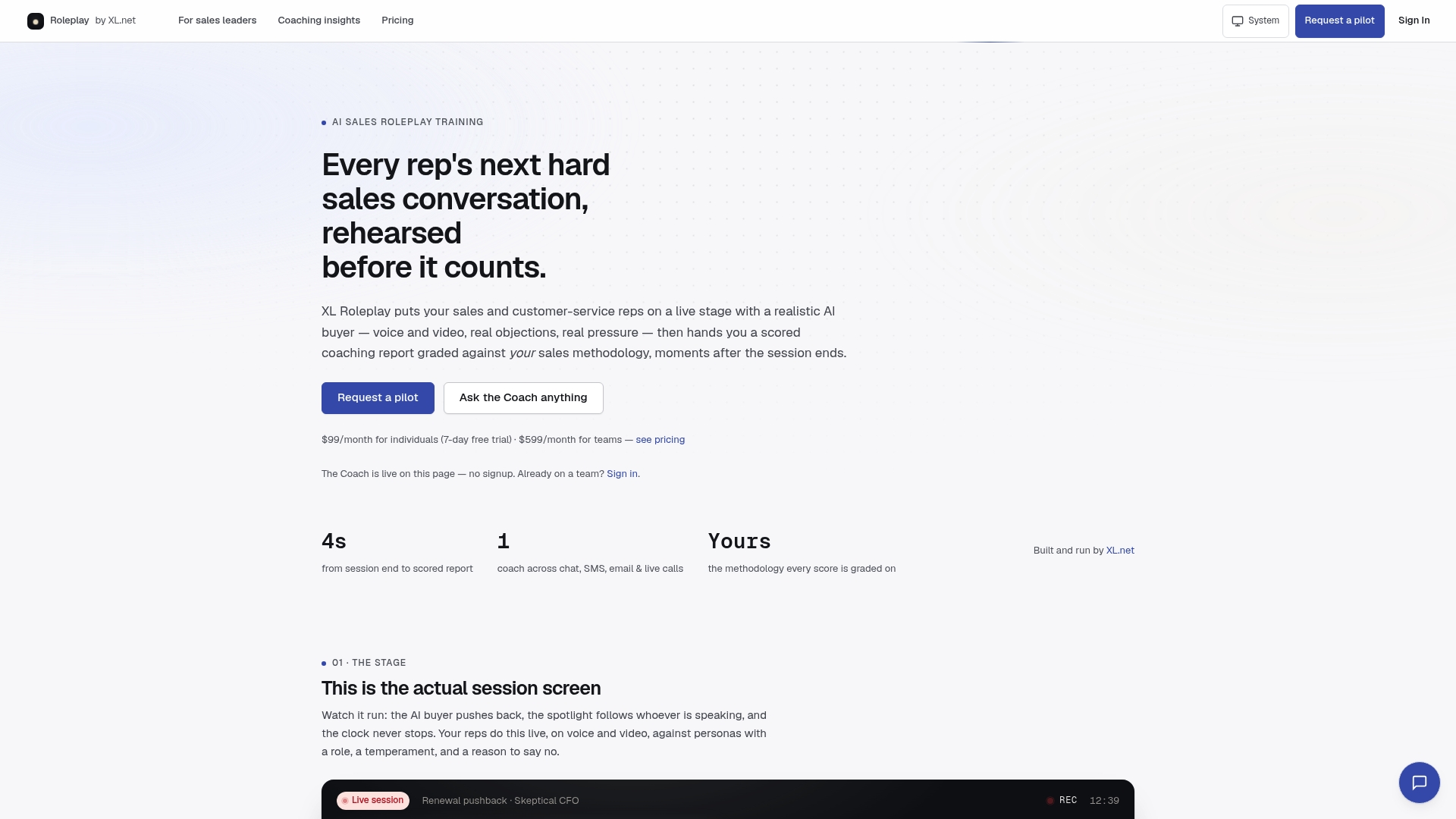
That means the 30-minute lab format above doesn’t have to be the only practice reps get. A rep can run three extra objection scenarios solo on a Tuesday night, and the scored coaching report flags the exact behavior to target in Thursday’s live triad. Managers get a way to verify transfer without sitting in on every session. If you want to see how this fits your team’s current cadence, the XL Roleplay pilot is built for exactly that, or check current plans and pricing to see what fits a team your size.
Facilitator and Reference Resources
- Build sales roleplay scenarios from real calls: step-by-step scenario card creation.
- How to run sales roleplay training reps don’t dread: facilitation checklist and cadence.
- Sales roleplay debrief guide: one-behavior coaching templates.
- Customer feedback and revenue growth: framing for tying training to measurable outcomes.
Sources
- Objection Handling Role-Play: 12 Practice Scenarios — Gangly Blog
- Handling Objections Sales Activity - Practice Responding with Confidence
- Handling clients’ objections — Thiagi
- Sales Hacker — Sales ratio: talk vs listening
FAQ
What Are the Five Steps for Objection Handling?
A common version runs: listen fully, acknowledge the concern, ask a clarifying question, respond with specific evidence, then confirm the objection is resolved before moving forward. Skipping the clarifying question is the most common failure point, since reps tend to jump straight to rebuttal.
What Are the Three Golden Rules for Objection Handling?
Listen before responding, respond to the real concern rather than the surface complaint, and always confirm you actually resolved it. Frameworks like LAER and LACE structure these steps, and a listening-focused analysis of sales conversations argues that reps who talk less and verify more close objections faster.
What Are Good Practices for Objection Handling Training?
The strongest practice combines timed role-plays, a behavioral scorecard, and an immediate debrief that replays the weakest moment. Sourcing objections from real transcripts instead of generic scripts, as recommended by scenario design guidance, keeps practice realistic enough to transfer to live calls.
What Are the Four Steps to Overcoming Objections?
Most short versions collapse to: acknowledge, clarify, respond with evidence, confirm. Some teams add a fifth verification step on the next live call to check whether the practiced behavior actually showed up.
How Much Does XL Roleplay Cost?
XL Roleplay offers an Individual plan at $99 per month and a Business plan at $599 per month, with extra seats and extra video hours priced separately on the same page. Pricing for the pilot program isn’t published; details are available by request through the pilot page.