How to Practice Your Sales Pitch and Actually Improve
How to Practice Your Sales Pitch and Actually Improve

The fastest way to improve your sales pitch is to run short, scored role-play reps every day, record them, and review the feedback before your next session. That’s it. Not reading more scripts. Not shadowing calls passively. Reps who practice with structured feedback close more deals and ramp faster than those who wing it and hope for the best.
Here’s a three-step routine you can start today:
- 5-minute warm-up: Read your hook aloud, then deliver your value prop cold, without notes.
- 8–12 minute scored rep: Run a full pitch or a single segment (cold open, objection, close) against a peer, an AI buyer, or a recording. Score it immediately using a rubric.
- 5–10 minute feedback and replay: Review the recording, mark timestamps where delivery broke down, and write one corrective action to fix in the next rep.
This beats winging it because deliberate, feedback-driven practice builds confidence faster and trains your brain to handle objections without freezing.
Key Takeaways
Deliberate, scored practice with a structured feedback loop is the single most reliable way to improve your sales pitch and close more deals.
| Point | Details |
|---|---|
| Daily micro-reps build muscle memory | Run 10–15 minutes of focused, recorded practice every day, not just before big calls. |
| Score every rep with a rubric | Measure hook, objection handling, and CTA clarity on a 1–5 scale to track real progress. |
| Objection drills are non-negotiable | Include at least one objection in every session; use 3-round rapid-fire and skeptic pressure tests. |
| AI role-play scales reps fast | AI buyers give immediate, objective feedback and let reps run more sessions without scheduling constraints. |
| Xl Roleplay delivers scored coaching | Xl Roleplay provides scored reports, transcripts, and manager dashboards calibrated to your sales methodology. |
Table of Contents
- Why deliberate pitch practice changes outcomes
- Concrete practice methods and when to use each
- A repeatable practice routine: session plan, cadence, and roles
- High-impact pitch frameworks and ready-to-use templates
- How to practice objections and tricky questions effectively
- How to measure progress: metrics, rubrics, and readiness scoring
- Common mistakes sellers make when practicing and what not to say
- How AI roleplay platforms help: Xl Roleplay as a practical example
- The case for committing to the routine, not just the tools
- Xl Roleplay puts this guide into practice for your team
- Sources
Why deliberate pitch practice changes outcomes
Structured practice with feedback reliably improves delivery, objection handling, and close rates. The mechanism is simple: repetition alone doesn’t fix bad habits, but repetition plus specific correction does. A rep who runs ten unreviewed pitches will ingrain the same filler words and weak closes every time. A rep who runs five pitches with timestamped coaching notes will correct the pattern by rep three.
Highspot’s research on sales pitch best practices confirms that regular role-play practice specifically improves objection handling, one of the highest-leverage skills in any sales conversation. The six core components they identify (hook, problem, value proposition, solution, social proof, and CTA) all require muscle memory, not just knowledge.
The evidence from AI-assisted practice is sharper still. According to vendor-reported data from EchoPitch, reps who practice with objective feedback close more deals than those who don’t. That’s a vendor figure, so treat it as directional, not definitive. But the direction is consistent with what coaches and sales leaders report across the board: faster ramp, fewer stalled objections, stronger CTAs.
Concrete improvements that structured practice produces:
- Faster ramp time: New reps reach quota-level confidence in weeks rather than months when they practice with scored feedback from day one.
- Fewer objection freezes: Rehearsing specific objection scenarios means reps have a prepared pivot, not a panicked pause.
- Stronger closing language: Reps who practice their CTA out loud stop trailing off and start asking directly.
- Shorter sales cycles: Confident delivery reduces the number of “let me think about it” deferrals.
Xl Roleplay provides scored coaching reports tied to your organization’s specific sales methodology, which means feedback is calibrated to what your team actually needs to improve, not generic delivery tips.
Concrete practice methods and when to use each
The right method depends on what you’re training and who’s available. Here’s a direct answer: for cold opens and early-stage SDR work, AI role-play and self-recording give the fastest reps-per-hour. For AE demo rehearsal and negotiation, peer roleplay with a structured debrief adds the realism and contextual pressure that solo practice can’t replicate.
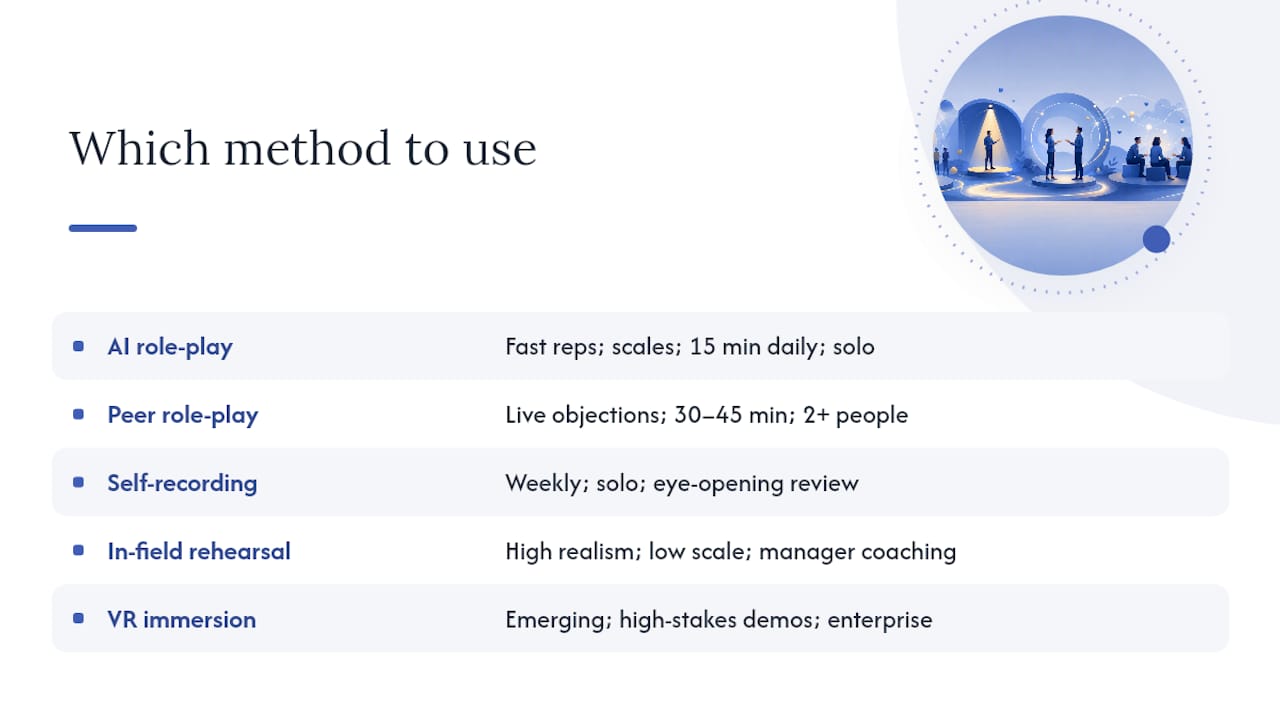
Peer roleplay trains tone, timing, and live objection handling. One rep plays the buyer using a persona card; the other pitches. The best sessions use a structured scene (a specific deal stage, a specific objection type) rather than a free-form conversation. Ideal cadence: two sessions per week, 30–45 minutes each. Works best for teams of two or more.
AI role-play scales reps without scheduling constraints. An AI buyer presents objections, applies pressure, and scores delivery on pace, filler words, and structure. Pitchr recommends daily rehearsal drills lasting around a quarter of an hour for rapid improvement, and AI role-play is the most practical format for that cadence. Best for individuals and distributed teams.
Self-record-and-review is underused and brutally effective. Most reps are shocked by what they see. Do this at least once a week.
In-field rehearsal and ride-alongs put practice in context. A manager sits in on a live call or a pre-call rehearsal and gives real-time coaching. High realism, but low scale. Reserve this for high-stakes deals or new reps in their first 30 days.
VR immersion is emerging for high-stakes demo environments where body language and spatial presence matter. Still limited in adoption but worth watching for enterprise teams running complex, multi-stakeholder demos.
Pro Tip: Combine AI role-play and peer debrief in the same session. Run two AI reps solo, then replay the recording with a peer who coaches on the moments the AI flagged. You get objective scoring from the AI and contextual interpretation from a human. That combination accelerates improvement faster than either method alone.
A repeatable practice routine: session plan, cadence, and roles
The most effective weekly cadence combines daily micro-reps with two longer coached sessions and a team review. Daily micro-reps build muscle memory. Coached sessions correct patterns. Team review surfaces shared blind spots.
Weekly cadence:
- Monday–Friday: 10–15 minute micro-rep (one pitch segment, one objection, or one cold open). Record it.
- Tuesday and Thursday: 30–45 minute coached session with a peer or manager. Use a rubric. Capture timestamped notes.
- Friday: 15-minute team review. Share one recording per rep. Identify one shared improvement area for next week.
Session plan template (30–45 minutes):
| Block | Duration | Activity |
|---|---|---|
| Warm-up | 5 min | Deliver hook and value prop aloud, no notes |
| Rep 1 | 8–10 min | Full pitch or targeted segment; record |
| Feedback round 1 | 5 min | Coach reviews rubric scores; rep notes corrections |
| Rep | 8–10 min | Same scenario with corrections applied |
| Feedback round | 5 min | Timestamped coaching notes; agree on one action item |
| Wrap-up | 1 min | Rep states the one thing they’ll fix before next session |
Structured roleplay with debriefs reduces on-the-job training risk and gives managers evidence-based coaching points via transcripts and rubrics, rather than impressionistic feedback that reps can’t act on.
Roles and artifacts to capture every session:
- Recorder: One person owns the recording setup and labels files by date and rep name.
- Rubric holder: Coach or peer scores each rep on a standard rubric (hook, objection handling, CTA, pace).
- Timestamped notes: Mark specific moments in the recording where delivery broke down or excelled.
- Transcript: Written record of what was said, useful for spotting filler words and missed value props.
- Action item log: One corrective action per rep, carried into the next session.
Scaling across a team means rotating roles so every rep spends time as both pitcher and coach. Managers checkpoint progress weekly using rubric score trends, not gut feel.
High-impact pitch frameworks and ready-to-use templates
The frameworks worth practicing are AIDA, PAS, BAB, and the 60-second elevator structure. Each fits a different context. Knowing which to reach for, and having the words ready, is what separates a polished rep from one who improvises their way through every call.
AIDA (Attention, Interest, Desire, Action): Best for cold outreach and email sequences. Grabs attention with a sharp hook, builds interest with a relevant problem, creates desire with a specific outcome, and closes with a single ask. Keep the whole thing under 90 seconds spoken or 150 words written.
PAS (Problem, Agitate, Solution): Works well for discovery-heavy conversations where the buyer hasn’t fully articulated their pain. Name the problem, make it feel real and costly, then position your solution as the relief. Salesforce recommends using discovery questions so prospects voice their own pains, which makes the agitate step land harder because the buyer said it first.
BAB (Before, After, Bridge): Strong for demos and follow-up messages. Describe the buyer’s current state (before), paint the future state with your solution (after), then show how you get them there (bridge). Concrete and visual.
60-second elevator structure: Pitchr’s breakdown is precise: 10 seconds for the hook, 15 seconds for the problem, 20 seconds for the solution, 15 seconds for the ask. Practice this until you can hit those splits without a timer.
Ready-to-use templates:
30-second elevator: “We help [buyer type] who struggle with [specific problem] to [measurable outcome], without [common trade-off]. Can I show you how we did that for [similar company]?”
Cold-call opener: “Hi [name], this is [your name] from [company]. I’ll be quick. We work with [buyer type] to [outcome]. Does that sound like something worth 15 minutes this week?”
Demo intro: “Before I show you anything, I want to make sure this is relevant. You mentioned [pain point]. Today I’ll show you exactly how [feature] solves that, and I’ll keep it to 20 minutes. Sound good?”
Follow-up message: “[Name], following up on our call. The one thing I want you to remember: [single value prop]. Here’s a two-minute overview: [link]. Worth a quick call Thursday?”
Language tips for converting features into outcomes:
- Replace “we have X feature” with “you’ll be able to Y because of X.”
- Replace “our platform integrates with Z” with “your team won’t have to switch tabs, which saves about [time] per rep per week.”
- Use storytelling techniques to anchor outcomes in a real customer scenario. A brief narrative sticks longer than a feature list.
Zendesk’s pitch structure guidance recommends keeping sales emails to roughly 300 words and presentations concise to avoid information overload. Practice your pitch to those limits, not beyond them.
How to practice objections and tricky questions effectively
The answer here is pressure drills, not passive preparation. Reading a list of objections doesn’t train you to respond calmly. Running timed, adversarial drills does. The goal is to make the hard objection feel familiar before it shows up in a live call.
Three core drill formats:
- 3-round rapid-fire: Coach fires three objections back-to-back with no pause. Rep must pivot to evidence, ask a question, and close each time. No more than 90 seconds per round. Builds speed and composure.
- Skeptic pressure test: Coach plays a deeply skeptical buyer who challenges every claim. Rep must respond with specific evidence (a customer name, a metric, a case study) rather than reassurance. Trains reps to stop saying “I understand your concern” and start saying “Here’s what happened when [company] had the same worry.”
- Money/priority/trust ladder: Three escalating objections in sequence: “It’s too expensive,” then “This isn’t a priority right now,” then “I’m not sure I trust the results.” Rep must handle each without discounting or backing down.
Sample objection prompts to seed your scenarios:
- Need: “We’re already handling this internally.”
- Urgency: “We’re not looking to make a change until Q4.”
- Price: “Your competitor is 30% cheaper.”
- Trust: “We’ve tried tools like this before and they didn’t stick.”
Scoring cues for coach feedback:
- Did the rep acknowledge the objection before responding? (Empathy)
- Did they use a specific piece of evidence, not a generic reassurance? (Evidence)
- Did they end with a next-step ask, not a trailing statement? (Close)
For negotiation roleplay scenarios that protect margin, the same pressure-test logic applies: practice the specific language you’ll use when a buyer pushes on price, not a vague “handle it professionally” plan.
Pro Tip: Intentionally lose a drill once a week. Tell the coach to play the toughest possible buyer and let the rep fail without rescuing them. The friction points that surface, the moment the rep goes quiet, the moment they concede too fast, are exactly what needs to be practiced. You can’t fix what you haven’t seen.

How to measure progress: metrics, rubrics, and readiness scoring
Measure both delivery behaviors and outcome signals. Delivery behaviors tell you what’s happening in the room. Outcome signals tell you whether it’s working in the field. You need both.
Vendor-reported data from EchoPitch points to pace, filler words, and conviction as the three delivery dimensions most correlated with deal outcomes. Those are measurable in every recorded session.
Readiness rubric (score each dimension 1–5):
| Dimension | What to measure | How to measure |
|---|---|---|
| Hook strength | Does the opener create immediate relevance? | Rubric score; peer rating |
| Problem relevance | Does the rep connect the problem to the buyer’s context? | Timestamp note at minute 1 |
| Evidence quality | Are claims backed by specific data or customer examples? | Count of specific vs. vague claims |
| Objection handling | Does the rep pivot with empathy, evidence, and a next ask? | Rubric score per objection |
| CTA clarity | Is the ask specific, timed, and unambiguous? | Yes/No per rep |
| Delivery pace | Filler words per minute; speaking rate | Recording analysis |
A rep scoring 4 or above across all six dimensions in three consecutive sessions is ready for live calls on that scenario. Below 3 on any single dimension means that dimension needs a targeted drill before the next live call.
Outcome metrics to track alongside rubric scores:
- Next-step conversion rate (did the call end with a booked meeting or a clear next step?)
- Demo-book rate from cold opens
- Objection-to-close ratio (how many objections does the rep face before closing?)
Structured roleplay with timestamped coaching notes and scored reports are the most reliable predictors of consistent improvement. A rubric score trend over four weeks tells a manager more than any single call review.
Common mistakes sellers make when practicing and what not to say
Over-scripting the delivery. A memorized script sounds memorized. Buyers feel it. Practice the structure and the key phrases, not word-for-word sentences. If you stumble on a word, you lose the whole thread. Instead, practice the three or four sentences that must land precisely (hook, CTA, key evidence) and improvise the connective tissue.
Skipping personalization. Generic pitches get generic responses. “We help companies like yours” tells the buyer nothing. Practice inserting the buyer’s specific situation into every rep. If you can’t name their problem in their language, you’re not ready to pitch them.
Ignoring objections in practice. Many reps practice the pitch but skip the objection handling. Then a buyer pushes back and the rep freezes. Every practice session should include at least one objection, even if the session is focused on delivery.
Leading with features, not outcomes. “Our platform has 47 integrations” means nothing to a buyer who hasn’t agreed they have an integration problem. Practice flipping every feature statement into an outcome statement before it leaves your mouth.
Ending without a clear ask. “Let me know if you have any questions” is not a close. Practice ending every rep with a specific, timed ask: “Can we get 20 minutes on Thursday to walk through your current process?” Reps who trail off in practice trail off in live calls.
Using jargon the buyer doesn’t share. “We leverage synergistic workflows to optimize your GTM motion” is not a pitch. It’s a red flag. Practice your pitch in front of someone outside your industry. If they can’t repeat the value back to you, simplify it.
Phrasing to avoid vs. better alternatives:
- ✗ “We’re a best-in-class solution” → ✓ “We cut [specific metric] by [specific amount] for [company name].”
- ✗ “Does that make sense?” → ✓ “What questions do you have about that?”
- ✗ “I just wanted to follow up” → ✓ “I’m following up because [specific reason tied to their situation].”
How AI roleplay platforms help: Xl Roleplay as a practical example
AI roleplay scales realistic reps in a way peer practice can’t. A rep can run ten cold-open scenarios before 9 AM without scheduling a single colleague. The AI buyer pushes back, applies pressure, and scores the delivery immediately. That feedback loop, immediate and objective, is what accelerates improvement.
Xl Roleplay provides the full stack for this kind of practice:
- Live voice and video role-play with AI buyers that present realistic objections and pressure scenarios
- Scored coaching reports calibrated to your organization’s specific sales methodology, not generic delivery tips
- Session transcripts with timestamped coaching notes for manager review
- Readiness scoring that tracks whether a rep is ready for live calls on a given scenario
- Customizable scenario libraries covering cold opens, discovery, demo, negotiation, and closing conversations
- Manager dashboards that give sales leaders visibility into team-wide readiness trends, not just individual session results
For SDR teams, Xl Roleplay accelerates cold-open ramp by letting new reps run dozens of AI-scored cold calls before their first live dial. For AEs, demo rehearsal scenarios let reps practice the specific objections that show up in their deal stage. For negotiation, margin-protection scenarios train reps to hold price under pressure without losing the deal.
Combining AI role-play with human coach debriefs produces both scale and contextualized coaching: AI supplies objective scoring; humans interpret nuance and career development. The two together outperform either method alone.
One practical note on recording: always confirm your organization’s recording consent policy before using recorded roleplay sessions for coaching. In most US states, one-party consent applies to internal training recordings, but check your specific jurisdiction and inform participants that sessions are recorded for coaching purposes.
The case for committing to the routine, not just the tools
The most common failure mode in sales practice isn’t using the wrong method. It’s inconsistency. Reps run two sessions, feel slightly better, and stop. Then a tough call shakes their confidence and they’re back to square one.

The reps who improve fastest treat practice the way athletes treat training: scheduled, scored, and non-negotiable. The daily micro-rep habit, 10–15 minutes of focused, recorded practice, builds the kind of muscle memory that holds up under pressure. A single weekly coached session won’t do that. Five daily micro-reps plus two coached sessions will.
The other underrated factor is specificity of feedback. “Good job, but work on your close” is not coaching. “At 4:12, you said ‘does that make sense?’ instead of asking for the meeting. Here’s what to say instead” is coaching. That level of specificity is what scored coaching reports and timestamped notes make possible, and it’s what separates reps who plateau from reps who keep improving.
One more thing worth saying plainly: the tools matter less than the habit. A rep who records themselves on a phone and reviews it honestly will outperform a rep who has access to every AI platform but skips the daily rep. Start with the simplest version of the routine, then add tools as the habit sticks.
Xl Roleplay puts this guide into practice for your team
Knowing the routine is one thing. Running it at scale, with consistent scoring and manager visibility, is where most teams fall short. Xl Roleplay gives sales teams the infrastructure to run the drills in this guide without the scheduling overhead or the inconsistent feedback that peer-only practice produces.
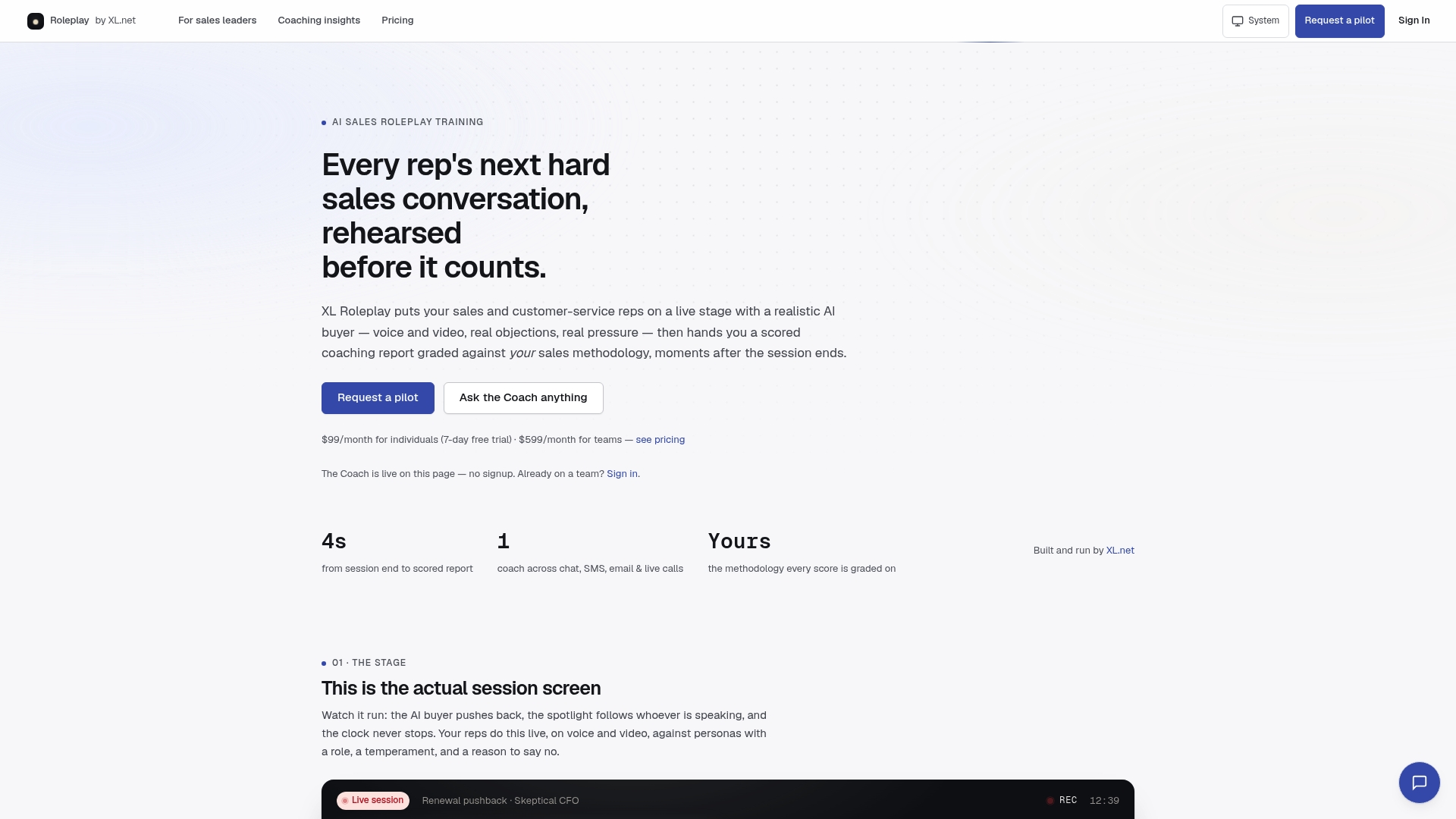
Teams using Xl Roleplay get scored coaching reports after every session, calibrated to their methodology, so managers see exactly where each rep needs work. Individuals get immediate feedback on delivery, objection handling, and CTA strength without waiting for a manager to review a recording.
- For teams: Manager dashboards track readiness across the whole roster, so no rep goes into a live call underprepared.
- For individuals: Run unlimited AI role-play reps on your own schedule, get scored instantly, and carry one corrective action into the next session.
Start with a free trial at Xl Roleplay and run your first scored session today. If you manage a sales team, the sales leaders page shows how the platform fits into your existing coaching workflow.
Sources
- The Perfect Sales Pitch: Examples & Best Practices
- Sales pitch examples
- 10 effective sales pitch presentation examples, templates, and tips
- How to Nail Your Elevator Pitch in 60 Seconds, Every Time | Pitchr
- Practice Sales Pitches with AI Feedback — Free Tool | EchoPitch