Price Objection Handling: Value-First Scripts for Sales Leaders
Price Objection Handling: Value-First Scripts for Sales Leaders

When a buyer says “it’s too expensive,” the worst move is defending the price. The best first move is a pause — three to five seconds — followed by one question: “Compared to what?” That single question shifts the conversation from negotiation to diagnosis, and diagnosis is where deals are saved.
Here’s a quick script you can use right now:
- “Compared to what?” (surfaces the reference point)
- “Out of curiosity, what number did you have in mind?” (reveals the gap)
- “If price weren’t the issue, would this be the right solution for you?” (isolates whether price is the real blocker)
- “Is this about the number itself, or confidence that you’ll get the outcome?” (separates budget from certainty)
For the authority stall (“I need to check with my boss”), try: “Totally understand. If you were presenting this internally, what would the strongest objection be?” That question surfaces the real concern and turns your champion into a co-seller.
Pro Tip: The pause is not awkward silence — it’s a power move. Reps who respond instantly to “too expensive” signal that they expected it and have a canned answer. Three seconds of silence followed by a calm diagnostic question signals confidence and control.
Key Takeaways
Effective price objection handling is a diagnostic skill: reps who pause, isolate the root cause, and reframe around ROI close more deals at full price than reps who defend the number or discount immediately.
| Point | Details |
|---|---|
| Pause before responding | A 3–5 second pause followed by “Compared to what?” surfaces the real objection. |
| Diagnose the root cause | Most price pushback is a value or certainty gap, not a budget problem — ask before you reframe. |
| Reframe with the buyer’s numbers | Cost-per-day, cost-of-inaction, and ROI line-item math built from discovery close faster than generic benchmarks. |
| Concessions require a trade | Only offer scope reduction or payment terms after diagnosis, and always ask for something in return. |
| Xl for team readiness | Xl’s scored role-play drills and transcripts turn the framework into a measurable, coachable team skill. |
Table of Contents
- Why price objections usually mask a value or risk concern
- How to handle price objections with a live diagnostic framework
- Proven reframes and dialogue examples that defend value
- When and how to offer concessions without training bad behavior
- How to train reps to internalize these responses
- Your one-page cheat sheet for price objections
- How to reinforce value after a price objection
- How to adapt your scripts by industry and product type
- Upselling and cross-selling after overcoming a price objection
- Practice the playbook with Xl Roleplay
- Sources
Why price objections usually mask a value or risk concern
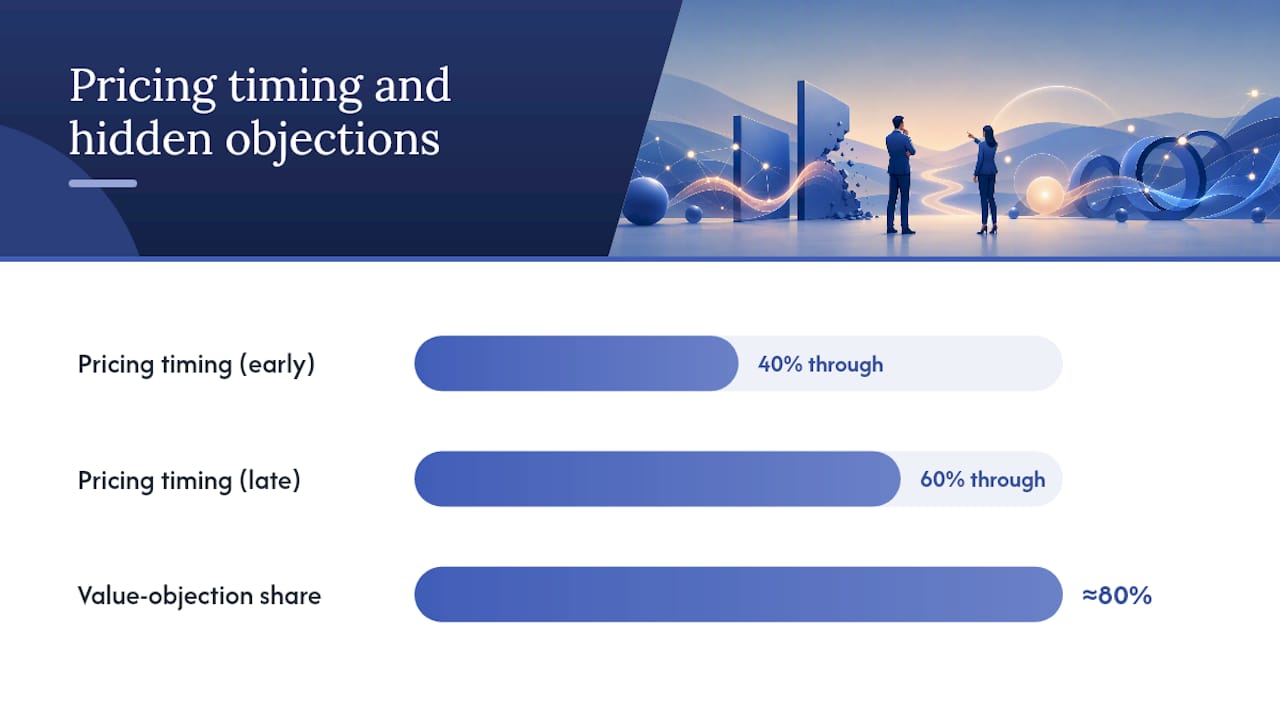
Summaries of Gong-style research show that top performers discuss pricing roughly midway into the conversation, after the problem is quantified. Reps who surface price early, before the buyer has felt the weight of the problem, almost always face harder pushback. Gong-style research shows that top performers discuss pricing roughly 40–60% of the way through the conversation, after the problem is quantified.
Practitioners estimate that roughly 80% of price statements are actually value objections in disguise. The buyer isn’t saying the number is wrong. They’re saying they haven’t yet seen enough evidence that the outcome is worth it.
Two behavioral dynamics drive this:
- Loss aversion: Buyers feel the pain of spending more acutely than they feel the gain of solving the problem. Until the cost of not solving it is concrete, the price feels like pure loss.
- Status-quo anchoring: Whatever the buyer currently pays (or pays nothing) becomes the reference point. Your price is measured against that anchor, not against the value of the outcome.
The cost-of-inaction reframe addresses both. If a rep can show that the current situation costs the company tens of thousands of dollars per quarter in lost productivity, a $30,000 annual contract stops looking expensive. Price objections most often mask risk or uncertainty, and the right response is ROI proof or a phased commitment, not a discount.
The implication: stop defending the price. Diagnose first. A rep who immediately justifies the number is playing defense on the wrong field.
How to handle price objections with a live diagnostic framework
This five-step sequence works under pressure. Run it in order.
-
Pause and acknowledge. Three to five seconds of silence, then: “I hear you — let’s make sure this makes sense for you.” Frameworks recommend this pause specifically because it prevents the reactive defense that kills deals.
-
Isolate the objection. Ask: “Is price the only thing standing between us and moving forward, or are there other concerns?” If there are other concerns, price is a symptom, not the disease.
-
Diagnose the root cause. Four common roots, each with its own question:
- Budget constraint: “What budget range were you working with?”
- Certainty gap: “Is this about the number, or confidence that you’ll get the result?” (Label it as a certainty gap and you can respond with proof, not price cuts.)
- Competitor anchor: “What are you comparing us to?”
- Authority stall: “Who else needs to be part of this decision?”
-
Validate and reframe. Confirm what you heard, then connect the price to the quantified problem: “So if I understand correctly, the concern is whether the ROI justifies the investment. Let me show you the math.”
-
Offer structured options or close. Present two paths: full scope at full price, or a reduced-scope pilot. Never present a discount as the default. A price objection can be a polite ‘no’ or an authority stall — if diagnosis reveals the buyer has no budget and no authority, the right move is to walk away and protect pipeline health.
What not to say: “I understand, let me see what I can do on price.” That sentence trains the buyer to ask for discounts every time, including at renewal.
Proven reframes and dialogue examples that defend value
Three calculation templates give reps something concrete to run on the call.
Cost-per-day: Divide the annual contract value by 365. A $36,500 contract becomes $100 per day. Ask: “What does one day of this problem cost you?” If the answer is $500, the math closes itself. Get the daily-cost input from discovery: ask about lost revenue, hours wasted, or error rates.
Cost-of-inaction: Quantify what staying in the current state costs over 12 months. If the buyer mentions manual work hours and rep count at an hourly cost, this can translate into significant annual costs, making your contract look like a strong return on investment
ROI line-item math: Build a one-pager with three to five specific line items: time saved, error reduction, revenue uplift, churn prevented. This is the document your champion takes to the CFO. Reps who skip discovery can’t build this — which is exactly why reps who ask more targeted discovery questions reduce late-stage price pushback.
Dialogue example 1 — the authority stall:
Buyer: “I love it, but I need to run this by my CFO.” Rep: “Of course. When you present it, what’s the number one question she’ll ask?” Buyer: “Probably what the ROI is.” Rep: “Let’s build that together right now so you walk in ready.”
Dialogue example 2 — the competitor anchor:
Buyer: “Your competitor is 30% cheaper.” Rep: “Good to know. What’s included in their price?” Buyer: “Honestly, I’m not sure.” Rep: “Let’s compare apples to apples. Here’s what’s in ours and what it’s worth per line item.”
Dialogue example 3 — the budget constraint:
Buyer: “We just don’t have the budget.” Rep: “What budget do you have? I want to see if there’s a version of this that fits.”
Pro Tip: For the CFO-ready one-pager, build it during the call with the buyer’s own numbers. When they help construct the ROI math, they own it — and they’ll defend it internally.
The ROI reframe backfires when discovery was weak. If you can’t fill in the buyer’s actual numbers, the math looks generic and the CFO will dismiss it. Run the full diagnostic before you attempt any calculation.
| Reframe | Best used when | Risk if misused |
|---|---|---|
| Cost-per-day | Buyer anchors on total price | Feels trivializing if the daily cost is still high |
| Cost-of-inaction | Buyer hasn’t quantified the problem | Backfires if discovery was shallow |
| ROI line-item math | Champion needs to sell internally | CFO rejects generic benchmarks |
When and how to offer concessions without training bad behavior
Immediate discounting is the single most damaging habit in sales. It signals that the price was inflated, it trains buyers to open every renewal with a discount request, and it erodes margin without solving the actual objection.
Do not:
- Apologize for the price or call it “a significant investment” (you’ve just validated their concern)
- Offer a discount before you’ve completed the diagnostic
- Defend features instead of ROI (feature lists don’t justify price; outcomes do)
- Give a concession without asking for something in return
Permitted concessions and their trade-offs:
- Scope reduction: Offer a smaller pilot or a phased rollout. Trade-off: slower expansion revenue, but lower buyer risk.
- Payment terms: Quarterly instead of annual, or net-60 instead of net-30. Trade-off: cash flow impact; ask for a longer contract term in return.
- Added references: Offer to connect them with a customer in their industry. Trade-off: low cost to you, high value to them.
- Phased pilots: Start with one team or one use case. Trade-off: longer sales cycle, but higher close rate on skeptical buyers.
Conditional discount template: “I can work with you on the investment, but I’d need [a two-year commitment / a case study right / payment within 30 days] to make that work. Does that fit?” Exchanging concessions for something verifiable preserves margin and prevents the discount from becoming a precedent.
Timing rule: Only offer a concession after the diagnostic is complete and after the buyer has confirmed that the reduced scope still delivers the core value they need. A concession offered before that confirmation is a discount, not a trade.
How to train reps to internalize these responses
Knowing the framework and using it under pressure are different skills. The gap closes through repetition, not memorization.
Sample role-play scenario:
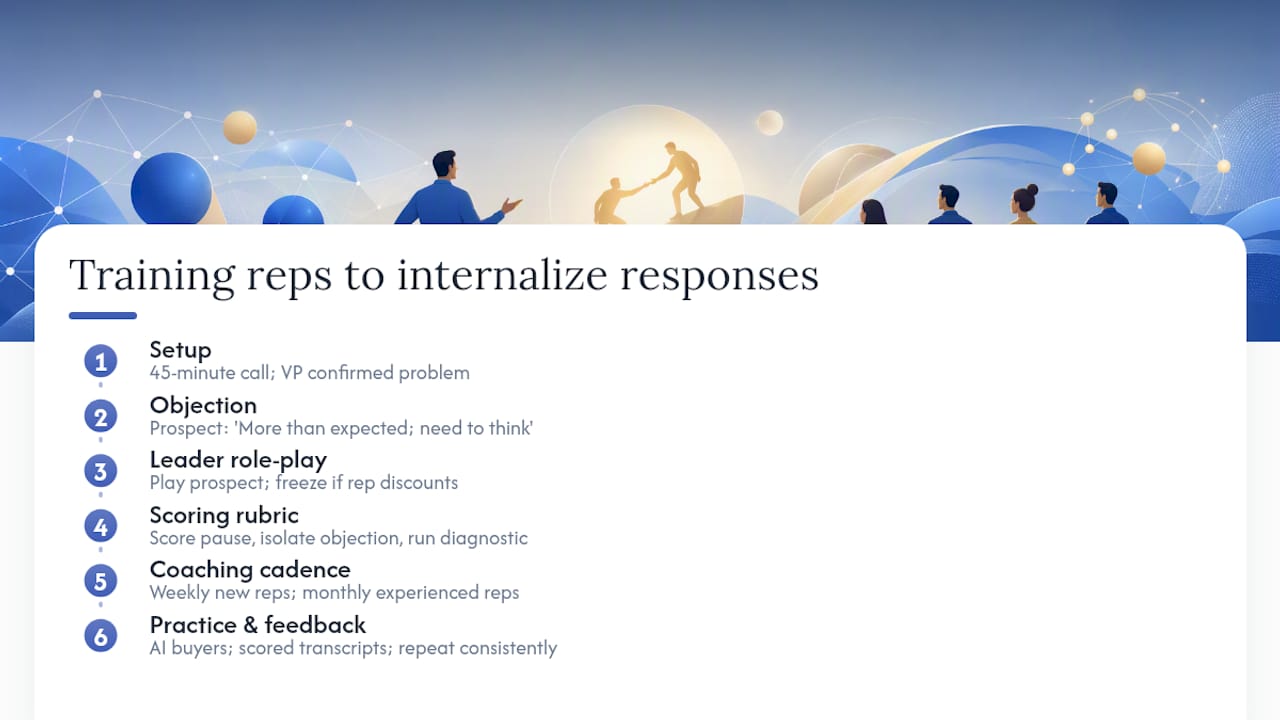
Setup: Rep is 45 minutes into a discovery call with a VP of Sales at a mid-sized SaaS company. The prospect has confirmed the problem is real. The rep presents pricing. The prospect says: “That’s more than we expected. We’re going to need to think about it.”
Leader script: Play the prospect. If the rep immediately offers a discount, freeze the scene and ask: “What diagnostic question should come first?” Restart. Score on whether the rep paused, isolated the objection, and ran the diagnostic before offering any concession.
Scoring rubric for managers:
Coaching cadence: Run price objection drills weekly for new reps and monthly for experienced ones. Review recordings and focus on the first 30 seconds after the objection lands — that’s where the deal is won or lost. Structured role-play with transcripts and scored coaching reports accelerates learning and gives managers observable behaviors to coach against, rather than impressions.
Xl’s platform lets reps practice against AI buyers who deliver realistic price pushback, then generates scored transcripts so managers can see exactly where the rep defended price instead of diagnosing. That feedback loop, run consistently, is what turns a framework into a reflex. The objection-handling training program section of Xl’s insights library has drill templates you can adapt directly.
Your one-page cheat sheet for price objections
Keep this at your desk or as a CRM snippet.
What to say first:
- Pause 3–5 seconds
- “Compared to what?”
- “What number did you have in mind?”
- “If price weren’t the issue, would this be the right solution?”
Diagnostic questions:
- “Is this about the number, or confidence in the outcome?”
- “What budget range were you working with?”
- “Who else needs to be part of this decision?”
- “What are you comparing us to?”
Reframes:
- Cost-per-day: divide annual price by 365
- Cost-of-inaction: quantify the current-state cost over 12 months
- ROI math: three to five line items built with the buyer’s own numbers
Follow-up asks:
- “Can we schedule 30 minutes to walk through the ROI together?”
- “Would it help if I connected you with a customer in your industry?”
60-second script:
[Pause 3 seconds] “I hear you. Before we talk about the investment, help me understand — compared to what? [Listen.] Got it. And if the price were right, is this the solution you’d move forward with? [Listen.] Okay, so the question is really whether the return justifies the cost. Here’s how our customers in your situation think about it: [cost-per-day or cost-of-inaction number]. Does that math change the picture?”
Pre-call checklist:
- Have you quantified the cost of the buyer’s problem in their own terms?
- Do you know the buyer’s budget range?
- Do you know who has final authority?
- Do you have one customer story in their industry ready to share?
- Can you build the ROI one-pager with their numbers in under five minutes?
How to reinforce value after a price objection
The conversation doesn’t end when the buyer accepts your reframe. Buyers who pushed back on price need continued reinforcement that the decision was right — or they’ll second-guess it before the contract is signed.
Customer stories are the most effective post-objection tool. A one-paragraph case study showing a similar company’s outcome, delivered by email within two hours of the call, keeps the ROI math alive while the buyer is still in the decision mindset. Common objection-response patterns are most effective when paired with specific social proof rather than generic feature claims.
Three ways to deploy social proof after a price objection:
- Peer reference call: Offer to connect the buyer with a customer in the same industry and company size. This is more persuasive than any case study PDF because the buyer can ask unscripted questions.
- ROI follow-up email: Send the cost-of-inaction math from the call in writing, with one customer outcome attached. Subject line: “The numbers we discussed + one example.”
- Champion enablement: Give your internal champion a one-page business case they can share with the CFO or procurement team. Include the buyer’s own numbers, not generic benchmarks.
The timing matters. Send the follow-up within two hours. Buyers who pushed back on price are often still in evaluation mode for 24–48 hours after the call. A well-timed case study can tip the internal conversation before a competitor gets a second look.
How to adapt your scripts by industry and product type
A cost-per-day reframe lands differently in enterprise software than it does in professional services. The diagnostic questions stay the same; the numbers and the proof points change.
Enterprise software: Buyers expect ROI models. Lead with line-item math and offer a pilot. The CFO will want a payback period, not just an annual return. Frame it as: “Most customers in your segment see payback in [X] months.”
Professional services: Hourly or project-based pricing makes cost-per-day less intuitive. Instead, anchor on the cost of the alternative: hiring internally, using a cheaper provider who misses scope, or doing nothing. The cost-of-inaction reframe is strongest here.
High-ticket B2B SaaS: The authority stall is the most common variant. Your champion loves it; the CFO hasn’t seen it. Build the internal business case during the call, not after. Pattern-interrupt and diagnostic questioning shifts the exchange from negotiation to explanation — that’s especially valuable when the real decision-maker isn’t in the room.
Transactional or SMB sales: Buyers often have a hard budget ceiling. Scope reduction is the most practical concession. Offer a smaller starting package with a clear upgrade path, and make the upgrade trigger explicit: “Once you hit [milestone], we move to the full plan.”
The underlying principle across all of these: the script adapts, the diagnostic doesn’t. Always isolate the root cause before you reframe.
Upselling and cross-selling after overcoming a price objection
A buyer who just pushed back on price and then committed is a buyer who has done the ROI math. That’s actually the best moment to introduce an add-on, because the value framework is already open.
Wait until the core deal is confirmed in writing or verbally agreed. Then:
- Anchor the upsell to the same ROI logic. If the buyer accepted the cost-of-inaction argument for the core product, extend it: “The reason this works is [X]. The add-on addresses [Y], which is the next biggest cost in that same category.”
- Use the pilot-to-full expansion path. If you closed on a reduced-scope pilot, build the expansion trigger into the agreement: “At 90 days, if you’ve hit [metric], we expand to the full team.” This turns the concession into a structured upsell.
- Cross-sell to a related problem surfaced in discovery. If the buyer mentioned a second pain point during diagnosis, return to it: “You mentioned [problem B] earlier. Now that we’ve solved [problem A], here’s how we’d approach that.”
The mistake most reps make is waiting too long. The window for an upsell conversation is widest in the 48 hours after the close, when the buyer’s confidence is highest. After that, inertia sets in and the conversation becomes harder to reopen.
The discount discipline that actually builds revenue
Most sales teams treat discounting as a closing tool. The data says the opposite: reps who discount frequently close at lower rates and generate weaker expansion revenue, because they attract buyers who chose them on price rather than value.
The discipline worth building is this: treat every price objection as a diagnostic signal, not a negotiating position. When a rep runs the full diagnostic and the buyer still won’t move, that’s information. Either the value wasn’t demonstrated well enough, or this isn’t the right buyer. Walking away from the second type is not a loss. It’s pipeline hygiene.
The coaching moment that changes rep behavior is usually not a script correction. It’s the first time a manager shows a rep the data: deals closed with a discount have a shorter lifetime value and a higher churn rate than deals closed at full price. Once a rep sees that pattern in their own numbers, the motivation to hold the line becomes internal.
Practice the playbook with Xl Roleplay
Reading a framework and running it under pressure are two different things. Xl gives sales teams a place to close that gap before it costs a deal.
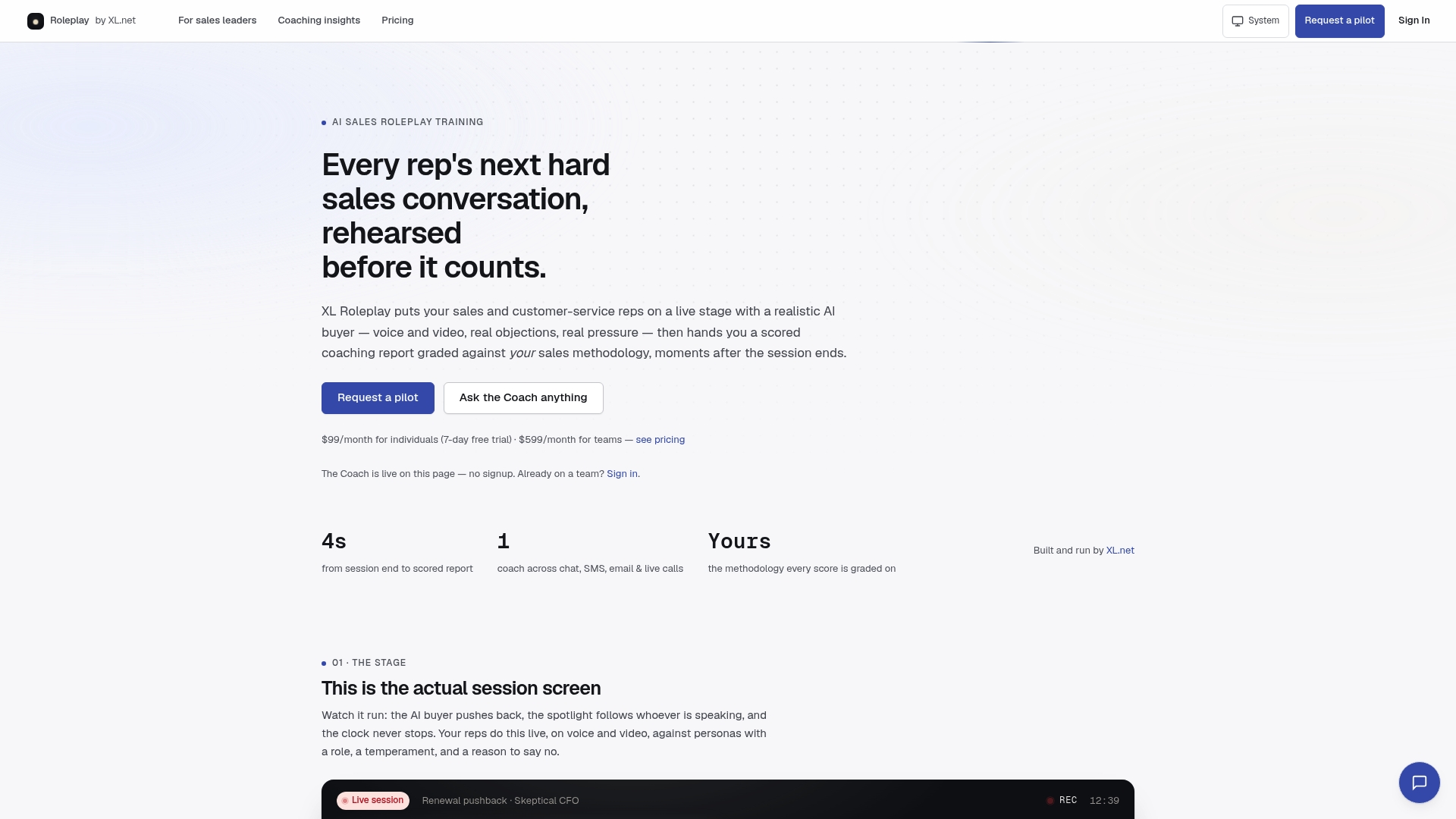
With Xl, reps practice against AI buyers who deliver realistic price pushback — the authority stall, the competitor anchor, the hard budget ceiling — and receive scored coaching reports tied to your organization’s specific methodology. Managers get full session transcripts and a rubric-based review so they can coach to observable behaviors, not impressions. The result is a team that has already handled the objection dozens of times before it appears on a live call.
For sales leaders who need to scale coaching across a distributed team, Xl replaces the one-off role-play session with a repeatable, measurable system. Start a free trial at Xl Roleplay and run your first price objection drill today.
Sources
- HubSpot: Price objection responses
- The Sales Blog: How to handle pricing objections without discounting
- Gangly: How to handle the price objection in B2B sales
- Vonsel: How to handle price objections
- B2B Sales Training: Overcoming price objections
- The Revenue Coaches: Handle “Can you lower the price?” without losing the deal
- ActiveCampaign: Common sales objections