A QA Scorecard for Call Centers: What Actually Works
A QA Scorecard for Call Centers: What Actually Works

A QA scorecard is a scoring rubric that quality analysts use to rate customer interactions against defined criteria: resolution, compliance, communication, and process adherence. The single best move you can make with yours: keep it short, weight it toward what actually predicts customer satisfaction, and make compliance a pass/fail gate rather than a partial-credit category.
Most scorecards fail because they try to measure everything and end up predicting nothing. A tight rubric with five or six categories, calibrated regularly against real CSAT results, beats a 40-item checklist every time. Start this week, not next quarter.
- Pick one call type (support, sales, or retention)
- Build or borrow a 5 to 6 category rubric weighted toward resolution and communication
- Set compliance items as auto-fail, not partial-credit
- Score 10 to 15 calls this week and compare results to CSAT on those same calls
Key Takeaways
A QA scorecard only improves performance when it’s short, weighted toward what predicts CSAT, and calibrated regularly against real scores from more than one reviewer.
| Point | Details |
|---|---|
| Keep the rubric short | Five to six categories produce more consistent, actionable scores than long checklists. |
| Weight toward resolution | Resolution and accuracy should carry the heaviest weight since they drive CSAT most directly. |
| Make compliance pass/fail | A single compliance miss should trigger an automatic review regardless of the weighted total. |
| Calibrate monthly | Two scorers rating the same calls independently exposes weak anchors before they distort coaching. |
| Sample beyond four calls | Traditional sampling covers under 1% of monthly calls; expand coverage or use AI-assisted scoring. |
Table of Contents
- What Is a QA Scorecard for a Call Center, and Why Does It Matter?
- What Should Go on a Call Quality Scorecard?
- Which Scoring Model Should You Use: Binary, Weighted, or Hybrid?
- How Do You Calibrate a QA Scorecard for Reliable Scoring?
- What Does a Sample Call Center QA Scorecard Look Like?
- How Do You Turn QA Scores Into Coaching That Actually Moves the Needle?
- Where Does AI Fit Into Call Center Quality Assurance?
- What Are the Most Common QA Scorecard Mistakes?
- Primary Sources and Templates for Building Your Scorecard
- Why Most QA Programs Are Optimizing for the Wrong Thing
- Sources
What Is a QA Scorecard for a Call Center, and Why Does It Matter?
A call center QA scorecard is not the same thing as a performance dashboard. A dashboard aggregates metrics like average handle time, occupancy, and adherence. A scorecard is a structured evaluation tool a reviewer applies to a single interaction, call by call, to judge how well an agent handled it against defined standards.
Good scorecards do three jobs at once: they predict customer satisfaction, they enforce compliance, and they give coaches a consistent language for feedback. Miss any one of those and the whole system loses credibility fast. An agent docked points for a vague “professionalism” category with no observable definition will tune out the feedback, and rightly so.
Most QA programs that fail do it for the same three reasons:
- Sampling is too thin. Reviewing four calls a month per agent, the common industry norm, means judging performance off a very small fraction of a typical agent’s monthly call volume.
- Checklists reward the wrong things. Long forms with 20 or 30 line items tend to reward scripted phrases over real problem solving.
- Scores don’t connect to outcomes. SQM Group’s research found that roughly 81% of traditional QA scores did not correlate with actual customer satisfaction, which means most programs are measuring compliance with a checklist, not quality as the customer experienced it.
That last point deserves attention on its own. If your scorecard doesn’t track CSAT, it isn’t measuring quality. It’s measuring obedience to a form.
What Should Go on a Call Quality Scorecard?
Every category on your call quality scorecard should be observable, meaning two different reviewers watching the same call should reach the same conclusion. Vague categories like “was the agent friendly?” invite disagreement. Specific behaviors don’t.
Resolution and accuracy deserve the heaviest weight on almost any rubric, because they connect directly to whether the customer’s problem actually got solved. Look for correct information given, the right department or process used, and confirmation that the issue is closed before the call ends. This is the category most tied to CSAT and first-call resolution, so shortchanging it on weight is the most common design mistake.
Compliance should be scored as pass/fail, not partial credit. Required disclosures, identity verification, and regulatory scripting either happened or they didn’t. A single miss here should trigger an automatic review, even if every other category scored well, because a compliance failure carries legal or financial risk that no amount of empathy points offsets.
Communication and empathy need anchor language tied to specific behaviors: did the agent acknowledge the customer’s frustration in their own words, or recite a scripted apology? Did they use the customer’s name, or plow through the call script?

Process and efficiency cover CRM notes, correct call coding, and workflow adherence. Handle time belongs here only as context, never as a standalone penalty, since agents who rush calls to hit a time target usually hurt resolution rates in the process.
Customer effort and sentiment shift round out a strong rubric. Did the customer have to repeat themselves? Did sentiment improve or worsen by the end of the call? Did the agent take ownership of the outcome instead of transferring blame?
Pro Tip: Write every anchor as something you could see or hear on a recording. “Agent was helpful” is not scorable. “Agent restated the customer’s issue in their own words within the first 60 seconds” is.
Which Scoring Model Should You Use: Binary, Weighted, or Hybrid?
Three models dominate call center QA, and each fits a different situation.
- Binary scoring (pass/fail per item) works well for compliance and process steps where there’s no middle ground. It’s fast to apply and impossible to argue with.
- Weighted scoring assigns point values to categories based on business impact, so resolution might count for 40% of the total score while tone counts for 10%. This model is best when you want one number that reflects overall call quality.
- Hybrid scoring combines both: compliance items scored as auto-fail gates, everything else scored on a weighted scale. This is the model most call center quality scorecard programs should be using, because it protects against catastrophic compliance misses while still rewarding nuanced performance elsewhere.
A reasonable starting weight distribution, based on what tends to correlate with satisfaction: resolution and accuracy at roughly 40%, communication and empathy at 25%, process and efficiency at 20%, and customer effort at 15%, with compliance held separately as a pass/fail gate rather than folded into the point total.
Don’t treat that split as gospel. Run an overlay: pull 50 to 100 scored calls, line up each call’s QA score against its post-call CSAT rating, and look for mismatches. If calls scoring 90+ on your rubric are routinely getting 2-star CSAT, a category is overweighted or an anchor is measuring the wrong thing. Roughly 81% of traditional scores show no correlation to CSAT at all when this overlay step gets skipped, which is the single strongest argument for building it into your process from day one rather than treating it as an optional audit.
How Do You Calibrate a QA Scorecard for Reliable Scoring?
Sampling four calls per agent per month, the norm at most centers, leaves you judging an entire month of performance off a sliver of actual interactions. That’s not a QA program. That’s a guess with a spreadsheet attached.
Fixing this takes two separate efforts: better sampling and real QA calibration.
- Increase your sample where you can. Random-sample at least 8 to 10 calls per agent monthly if you’re scoring manually, and stratify the sample across call types, shifts, and tenure so you’re not accidentally grading only easy calls.
- Run a calibration session before you coach anyone. Have two managers independently score the same three calls without discussing them first, then compare results category by category.
- Find where scores diverge. If both scorers land on similar totals but disagree on individual categories, the problem isn’t the scorers. It’s the anchors.
- Rewrite the anchor. When two reviewers score the same call differently on “communication,” the fix is rewriting that category to name an observable behavior instead of an impression, not retraining the reviewers.
Do this monthly, not once a year. Inter-rater reliability drifts as new reviewers join or as agents discover which phrases score well, and a rubric that isn’t recalibrated quietly turns into theater.
Pro Tip: If your calibration sessions keep surfacing the same disputed category every month, that’s not a training gap. Delete the category or rewrite it from scratch.
What Does a Sample Call Center QA Scorecard Look Like?
Here’s a compact rubric you can copy into a spreadsheet today and start scoring against this week. It’s built around the hybrid model: one compliance gate, four weighted categories.
| Category | Weight | What to Score |
|---|---|---|
| Compliance | Pass/Fail | Required disclosures, identity verification, regulatory scripting |
| Resolution & Accuracy | 40% | Correct information, issue closed, right process used |
| Communication & Empathy | 25% | Active listening, acknowledgment, tone match |
| Process & Efficiency | 20% | CRM notes, correct coding, workflow steps followed |
| Customer Effort | 15% | Repeat contacts avoided, sentiment shift, ownership shown |
To implement it in Google Sheets or Excel, score each weighted category on a 1 to 5 scale, multiply by its weight, and sum the results into a score out of 100. Templates using this structure typically set a pass threshold around 70 to 75 for general teams, with higher thresholds for regulated industries like financial services or healthcare, where a stricter bar reflects the added compliance risk. Any compliance fail should zero out or flag the call for review regardless of the weighted total.
- Duplicate the table above into a spreadsheet with formula columns for weighted totals.
- Build a compliance checklist as a separate tab with a simple yes/no dropdown that auto-fails the call.
- Adjust weights for call type: outbound sales calls should weight discovery and objection handling higher, while demo calls should weight next-step confirmation and technical accuracy higher than general communication.
Scenario-specific rubrics consistently outperform one-size-fits-all forms, because “process adherence” means something entirely different on a collections call than it does on a product demo. If you’re adapting this for discovery-heavy sales conversations specifically, it helps to look at what to score and what to ignore on discovery calls before finalizing your weights.
How Do You Turn QA Scores Into Coaching That Actually Moves the Needle?
A scorecard that never leaves the spreadsheet is a wasted exercise. The real value shows up in what you do with the pattern of scores, not the individual number.
- Low resolution scores across multiple agents point to a knowledge gap or a broken process, not an individual coaching issue. Fix it at the program level with a job aid or a workflow change.
- One agent consistently scoring low on empathy while others score fine is an individual coaching case. Pull two or three of their calls and role-play the exact moments where tone slipped.
- A compliance auto-fail should trigger an immediate manager review and a documented follow-up conversation, not wait for the monthly report.
- Sentiment-shift data (calls that start negative and end positive versus the reverse) is one of the most useful things you can share with agents directly, since it shows them the tangible effect of specific choices they made mid-call.
Report scorecard trends to leadership on a monthly cadence at minimum, broken out by category rather than one blended average, since a flat overall score hides whether the problem is resolution, compliance, or tone. Pair QA trends with CSAT and first-call resolution in the same report so leadership sees the connection your overlay analysis is designed to surface.
Where Does AI Fit Into Call Center Quality Assurance?
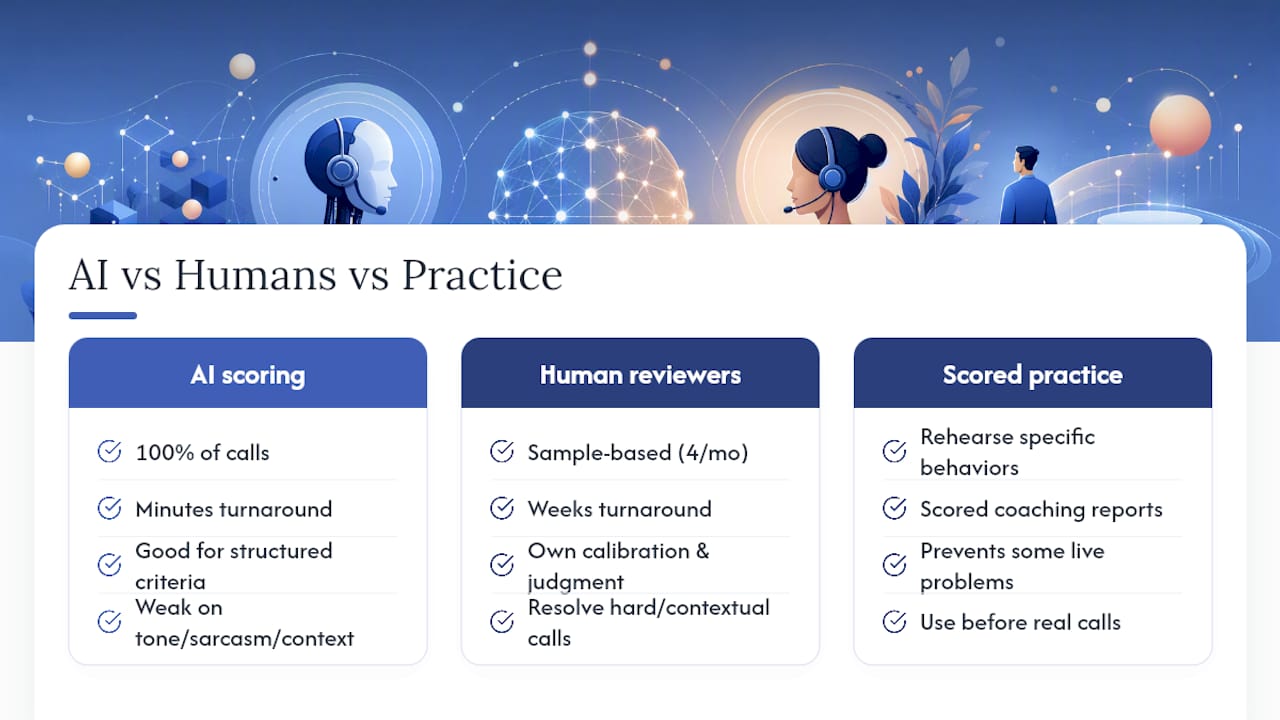
Automated scoring has changed what’s realistic for quality assurance call monitoring. Instead of a supervisor manually reviewing four calls a month per agent, AI-assisted systems can score 100% of calls and turn feedback around in minutes instead of weeks. That’s a real shift in coverage, not just speed.
The catch is judgment. AI scoring handles structured, observable criteria well: did the agent state a required disclosure, confirm the next step, mention the return policy. It’s less reliable on tone shifts, sarcasm, or a complex escalation where the “right” move depends on context a checklist can’t capture. Human reviewers still need to own calibration and the hard calls.
Automation doesn’t replace the calibration conversation between two managers arguing over what “ownership” looks like on a call. It just means you can finally afford to have that conversation about a representative sample instead of four calls a month.
That coverage gap is exactly why practice environments matter alongside live-call QA. XL Roleplay gives reps a place to rehearse the specific behaviors your scorecard is measuring, like discovery questions or objection handling, and returns a scored coaching report built on your organization’s own rubric before that behavior ever shows up on a real customer call. Coaching after the fact catches problems. Scored practice beforehand prevents some of them.
Gartner has projected that agentic AI will autonomously resolve a large share of routine customer service issues by 2029, which means the calls humans do handle going forward will skew toward the complex, high-stakes conversations your scorecard should already be weighting most heavily.
What Are the Most Common QA Scorecard Mistakes?
- Too many criteria. A 30-item checklist dilutes attention and produces noisy, inconsistent scores. Shorter forms with five or six categories produce clearer, more actionable results.
- Vague anchors. “Good communication” isn’t scorable. Rewrite every category as an observable action a reviewer can point to on the recording.
- Treating scores as punishment. A rubric used only to justify write-ups gets gamed or resented. Frame every score around what to try differently next time.
- One rubric for every call type. A collections call and a product demo don’t share a definition of “process adherence.” Build scenario-specific forms instead of forcing one form to fit everything.
Each of these is fixable in an afternoon. None require new software, just a willingness to cut a category or rewrite a sentence.
Primary Sources and Templates for Building Your Scorecard
For weighted scorecard structures and calibration procedures, see Callforce’s QA scorecard guide and CCDocs’ weighted scoring sheet. For ready-to-use spreadsheet formulas, check JustCall’s monitoring template and CYF’s free scorecard templates. For scenario-specific rubric design, see Verint’s QA scorecard guide. HR teams building similar objective evaluation frameworks may also find Evy’s interview scorecard practices useful for calibration techniques.
Why Most QA Programs Are Optimizing for the Wrong Thing
The uncomfortable truth buried in the research is that most call centers have spent years perfecting a measurement system that doesn’t measure what they think it measures. A scorecard with 30 line items feels rigorous. It feels defensible in an audit. But rigor and accuracy aren’t the same thing, and a program that can’t show its scores moving in step with CSAT has built an elaborate way to grade compliance with a script, not quality.
The conventional advice, more categories, more detail, more granularity, has it backward. Every additional criterion is another chance for two reviewers to disagree, and disagreement is what erodes trust in the whole system faster than anything else.
If you take one thing from this and act on it this week, make it the overlay: pull your last 50 scored calls, line them up against CSAT, and see where they diverge. That fifteen-minute exercise will tell you more about what’s broken in your rubric than another quarter of debating category weights in a conference room.
— Adam
Sources
- Call Center Quality Assurance: Build a QA Scorecard (2026)
- Call Quality Scorecard: Weighted QA Scoring Sheet | CCDocs
- Call Monitoring Scorecard & QA Form Template (Free Excel & Google Sheets)
- 12 Free Quality Monitoring Scorecard Templates for Excel
- How to Build Call Center QA Scorecards for Better CX | Verint