Sales Readiness Assessment for Managers: Six Dimensions and Rubrics
Sales Readiness Assessment for Managers: Six Dimensions and Rubrics

A sales readiness assessment is a scored, multi-dimension check that tells you whether reps can actually apply skills in live conversations, not just recite them in a quiz. The right move today is to run a short baseline across five dimensions and tier every rep by score. Success looks like a ranked list of gaps, tied to a specific remediation plan, not a folder of completed training modules nobody acted on.
TL;DR:
- Sales readiness assessments must measure actual application of skills through evidence like call recordings and role-plays, not just survey or quiz completion.
- Call reviews and scored simulations tied to specific behaviors are essential for accurately identifying skill gaps and informing targeted remediation plans.
- A comprehensive assessment should include input from CRM data, coaching observations, content usage, and cross-functional validation for reliable results.
- Progress should be tracked through both leading indicators, such as certification pass rates and coaching frequency, and lagging metrics like quota attainment and win rates.
- Certification programs must involve scenario-based role-plays, clear pass thresholds, and manager accountability to ensure skills translate into improved performance.
Table of Contents
- The Sales Readiness Checklist Every Manager Should Use
- What a Readiness Assessment Actually Needs to Measure
- How to Run a Sales Readiness Assessment Step by Step
- Which Metrics Actually Predict Sales Readiness?
- Building Certification That Actually Sticks
- Common Mistakes That Undermine a Readiness Assessment
- Turning Role-Play Data Into Objective Readiness Scores
- What the First 90 Days Should Look Like for a New Rep
- Do You Have the Right Tools to Run This Assessment?
- Getting Leadership and Other Departments Involved
- Sample Assessment Questions by Sales Role
- Connecting Assessment Results to Development Plans
- Fix the Foundation Before You Fix the Skills
- Turn Your Readiness Scores Into Certified, Coached Reps
- Sources
- FAQ
The Sales Readiness Checklist Every Manager Should Use
Most sales readiness checklists fail because they measure completion, not competence. Use these five to seven dimensions instead, and score each one from 1 (not ready) to 5 (ready to scale):
- ICP clarity: Can the rep name your ideal customer profile’s top three pain points unprompted? Low score: generic pitch regardless of prospect. High score: tailored discovery questions from the first call.
- Process maturity: Does the rep follow defined stages, or improvise? Low score: skips discovery, jumps to demo. High score: consistent stage discipline logged in the CRM.
- Product and market knowledge: Ask the rep to explain a competitor’s weakness in 30 seconds. Low score: vague or defensive. High score: specific, confident positioning.
- Discovery and objection handling skills: Run a mock objection (“your price is too high”). Low score: discounts immediately. High score: reframes value before touching price.
- Tools and data hygiene: Pull three closed deals from the CRM. Low score: missing notes, stale fields. High score: complete activity trails.
- Manager enablement: Ask the manager to describe their last coaching session. Low score: “I don’t really do those.” High score: specific example reflecting recent coaching activities.
Budget about a week or more per cohort: self-surveys take around an hour, manager interviews about half an hour each, and call review or role-play verification takes the longest but catches what surveys miss.
What a Readiness Assessment Actually Needs to Measure
A readiness assessment sales leaders can trust gathers evidence, not opinions. Score these four categories consistently across every rep so comparisons mean something:
- Skills: discovery questioning, demo delivery, objection handling, negotiation under pressure.
- Knowledge: product specifics, the outcomes buyers actually care about, and how the rep positions against named competitors.
- Behavior and process signals: CRM field completeness, how recent the last logged activity is, and whether deals move through stages in order or skip around.
- Tooling evidence: call recordings that show real objection handling, demo analytics showing where prospects disengage, and content usage data showing whether reps use approved materials or freelance their own.
The mistake most teams make is treating knowledge tests as a proxy for skill. A rep can ace a product quiz and still freeze when a buyer pushes back on price. That gap only shows up in observed behavior, which is why call review and role-play carry more weight than any multiple-choice test in a serious sales readiness evaluation.
How to Run a Sales Readiness Assessment Step by Step
Start by deciding scope. Are you validating a new hire’s ramp, checking a launch cohort before it goes live, or running a quarterly health check on a mature team? Each answer changes who you assess and how deep you go.
- Define scope and stakeholders. Pick the trigger (hire, launch, quarterly cycle) and name who reviews scores: the sales manager, an enablement lead, and ideally one revenue operations person.
- Mix your methods. Combine a self-assessment (roughly 15 minutes), a manager interview (30 minutes), a recorded call review (two calls per rep), and a live or AI-based role-play (20 to 30 minutes per rep).
- Score and average. Weight each dimension equally unless your business has a clear reason not to (a new product launch might weight product knowledge higher). Average dimension scores into a single tier: Not Ready, Developing, or Ready to Scale.
- Handle mixed cohorts carefully. A team blending tenured reps and new hires will skew averages. Score and report by tenure band, not as one blended number.
- Prioritize fixes. Map every low-scoring dimension to an action. Quick wins (CRM hygiene, a missing battlecard) get fixed in a week. Structural gaps (discovery skill, negotiation under pressure) need a coaching cadence, not a single training session.
Pro Tip: Before rolling this out to the full org, pilot it on one team of six to eight reps and have two different managers score the same three role-plays independently. If their scores disagree by more than one tier, your rubric is too vague to trust at scale.
Which Metrics Actually Predict Sales Readiness?
Leading indicators tell you if remediation is working before revenue moves. Track certification pass rates, demo quality scores, coaching session frequency per rep, and call quality index averages weekly during any active push.
Lagging indicators confirm the fix worked: time to first deal, quota attainment, and win rate by cohort. These lag by definition, so don’t wait on them to judge whether your assessment process is working.
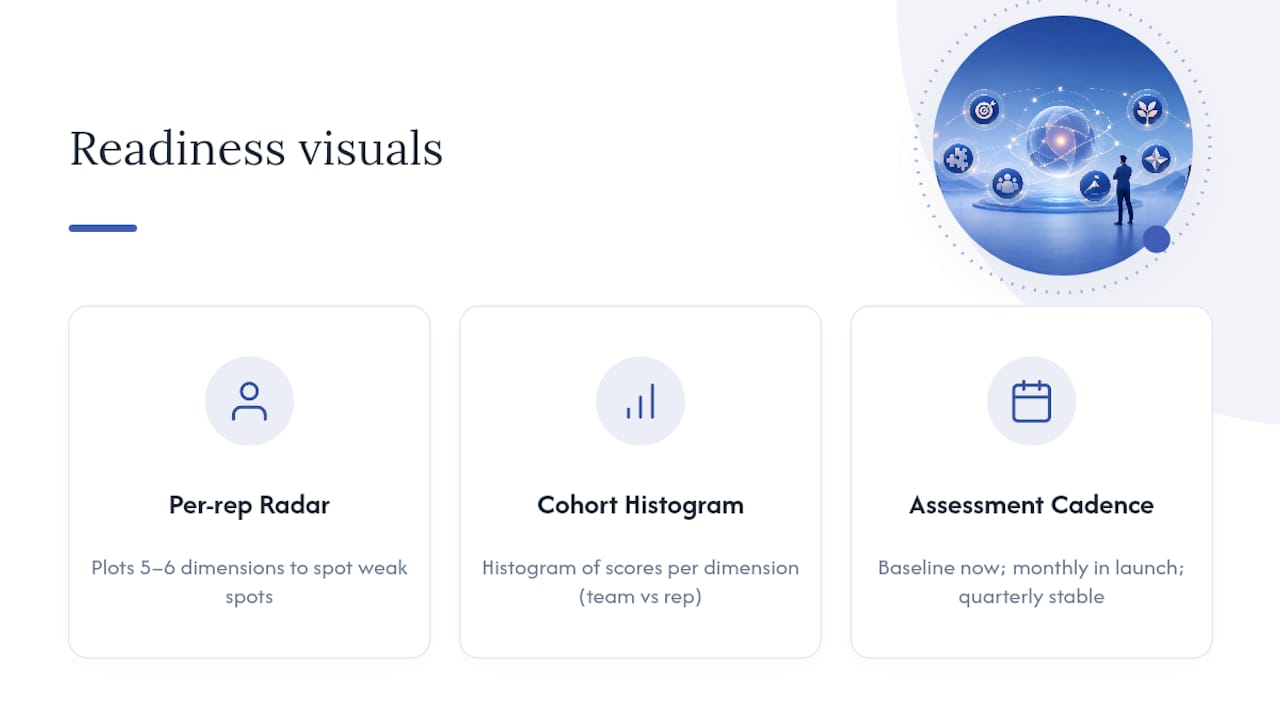
On cadence, run your baseline immediately, then reassess monthly during a launch window and quarterly once the team stabilizes. Hyperspect’s readiness tooling recommends this same rhythm, tying reassessment frequency to how volatile the team’s activity is, tighter monitoring right after a launch, looser once behavior settles.
A radar chart per rep, plotting all five or six dimensions at once, makes weak spots visible in seconds. Cohort distribution charts (histogram of scores per dimension) show whether a gap is one rep’s problem or a team-wide pattern worth a group coaching session.
Building Certification That Actually Sticks
Certification tied to real behavior works. Certification tied to a quiz score does not. Build role-based certification around these elements:
- Scenario-based role-play plus a rubric, not just an e-learning module with a completion checkbox.
- A clear pass threshold (say, 4 out of 5 average across dimensions) with a defined remediation path for anyone below it.
- Manager accountability built into the process. If a rep fails, the manager owns the coaching plan, not HR.
- Recertification triggers: a product update, a new objection pattern showing up in calls, or a cohort score dropping below its baseline.
Certification outcomes should feed directly into territory assignments and ramp decisions. A rep who certifies early on objection handling is ready for harder accounts sooner than one who barely clears the bar.
Common Mistakes That Undermine a Readiness Assessment
Most failed assessments share the same handful of root causes:
- Treating readiness as a one-time event. Skills decay without practice. HBR’s research on learning and development found that programs focused on content delivery, rather than applied reinforcement, routinely fail to change behavior.
- Trusting self-reported completion. A rep marking a module “done” tells you nothing about whether they can use it under pressure.
- Skipping call review and role-play. Surveys catch confidence, not competence. Verification methods catch the gap between the two.
- Leaving managers out of the coaching loop. An assessment that produces a score but no coaching plan just creates a report nobody acts on.
Avoid these by building verification into your method mix from day one and giving managers explicit ownership of the follow-up, not just a copy of the results.
Turning Role-Play Data Into Objective Readiness Scores
Subjective grading is the single biggest reason readiness scores lose credibility across a sales organization. Two managers watching the same call can walk away with different opinions unless they’re scoring against the same rubric and the same recorded evidence.
This is where scored role-play changes the equation. When a rep runs a live simulation against an AI buyer trained on your organization’s actual objections and methodology, the session produces a transcript and a rubric-based score tied to specific behaviors, not a manager’s gut feel after the fact.
A scored coaching report that ties every point to a moment in the transcript turns “I think they’re ready” into “here’s exactly where they lose the deal, and here’s the fix.”
Mapping this to remediation is direct: a low discovery score routes a rep into targeted discovery drills; a low objection-handling score triggers a specific role-play scenario built around that exact objection pattern. Xl’s readiness scoring approach works this way, replacing one-off judgment calls with a repeatable, evidence-backed process, though the quality of any scoring system still depends on how well the rubric matches your actual sales methodology.
What the First 90 Days Should Look Like for a New Rep
Time-to-productivity is one of the clearest readiness signals you have, because it’s measurable from day one. Set explicit milestones instead of a vague “get up to speed” expectation.
By day 30, a new rep should complete product and process certification, shadow at least five live or recorded calls, and run their first role-play scored against your rubric. This is a knowledge and orientation checkpoint, not a performance one.
By day 60, expect the rep to run discovery calls independently, with a manager reviewing at least two recordings per week. Their role-play scores on discovery and objection handling should be climbing toward your certification threshold, even if they haven’t hit it yet.
By day 90, the rep should be carrying a partial pipeline and closing on the process, if not yet on the numbers. This is where you compare their 90-day readiness score against the cohort baseline. A rep still scoring “Not Ready” on core dimensions at day 90 needs a structured performance conversation, not another quarter of hoping it clicks.
Building these milestones into your onboarding gives you an early warning system. Waiting until quota attainment lags at month six to notice a rep never developed discovery skills is an expensive way to find out your onboarding process has a hole in it.
Do You Have the Right Tools to Run This Assessment?
A readiness assessment is only as good as the data behind it, and most of that data lives in tools you already own. Three systems matter most.
Your CRM is the backbone. If activity fields are empty, stages are skipped, and notes are inconsistent, you can’t trust process-maturity scores no matter how good your rubric is. Fixing CRM hygiene often has to happen before the rest of the assessment means anything.
Call recording turns subjective coaching into evidence. Without it, “how did that call go?” is a matter of memory and opinion. With it, a manager and a rep can review the exact moment an objection got mishandled.
Enablement content tracking shows whether reps actually use the battlecards, case studies, and competitive positioning you’ve built, or whether they’re improvising. Low content usage combined with low knowledge scores usually means the content exists but nobody trained on it properly.
None of these tools substitute for observed skill, but without them you’re running an assessment on incomplete evidence. If your CRM data is unreliable, fix that first. A readiness score built on bad data points leaders in the wrong direction, which is worse than no score at all.
Getting Leadership and Other Departments Involved
A sales readiness assessment run in isolation by one sales manager produces a narrower, less trusted result than one built with cross-functional input. Bring in revenue operations to validate the CRM and pipeline data behind your process-maturity scores, since they’ll catch inconsistencies a sales manager might miss.
Product marketing should weigh in on the knowledge dimension, particularly around competitive positioning and messaging accuracy. They know where the market has shifted faster than most reps have caught up.
Sales leadership needs to see aggregate results, not individual rep scores, at least initially. A cohort-level view (what percentage of the team sits in each readiness tier) helps leadership decide where to invest: more coaching headcount, a revised onboarding program, or a messaging refresh.
HR or people operations should be looped in once assessment results start feeding into formal performance conversations, so the process aligns with how your organization already handles development plans and, where relevant, disciplinary steps. Skipping this step is how a well-intentioned assessment turns into a legal or morale problem later.
The goal isn’t a committee approving every score. It’s making sure the data feeding your assessment is trusted by the people who’ll act on it.
Sample Assessment Questions by Sales Role
Different roles need different rubrics. A sales development rep and an enterprise account executive should never be scored against identical criteria.
For SDRs, focus questions on qualification and objection handling in early conversations: “Walk me through how you’d handle a prospect who says they’re ‘just looking.’” Score based on whether they probe for real intent or accept the brush-off.
For account executives, weight discovery and negotiation heavier: “A buyer says your competitor is 20% cheaper. What’s your next three sentences?” Look for value reframing before any price concession.
For customer success or account management reps handling expansion conversations, focus on outcome articulation: “How would you position an upsell to a customer who says the current product ‘does enough’?” High scores connect the upsell to a business outcome the customer already cares about, not a feature list.
For sales managers themselves, the assessment should include a coaching scenario: “Role-play giving feedback to a rep who bombed a discovery call.” This tests whether the manager can coach specifically, not just say “good job, keep it up.”
Building role-specific criteria takes more setup than a single generic checklist, but it’s the difference between a score that predicts performance and one that just measures effort.
Connecting Assessment Results to Development Plans
A readiness score that doesn’t change what happens next in a rep’s career is just a number on a spreadsheet. Every low-tier result should trigger a specific, written development plan, not a verbal “let’s work on that.”
Tie individual development goals directly to the dimension that scored lowest. A rep weak on objection handling gets two role-play sessions a week for a month, with a follow-up assessment scheduled, not a generic “improve sales skills” bullet on a review form.
For reps who score in the “Not Ready” tier repeatedly across cycles, the readiness data should feed into a formal performance improvement plan with clear timelines and specific behaviors to demonstrate, backed by the same rubric used in the original assessment. This keeps the conversation objective: you’re pointing to a transcript and a score, not a manager’s general impression.
For reps scoring “Ready to Scale,” use the same data in the opposite direction: fast-track them toward harder territories, larger accounts, or a mentor role coaching newer reps through the same weak dimensions they’ve since mastered. Connecting assessment data to targeted coaching activities this way keeps the entire process focused on growth, not just grading.
Fix the Foundation Before You Fix the Skills
Fix structural blockers, CRM hygiene, missing call recordings, before layering on skills coaching. A rep with clean data and consistent role-play practice improves faster than one drowning in broken tools. Manager enablement is the highest-leverage fix in the whole system. Schedule your baseline assessment this quarter.
— Adam
Turn Your Readiness Scores Into Certified, Coached Reps
This approach addresses the common gap of readiness scores not turning into real coaching. Instead of guessing whether a rep can handle a live objection, you can run scored role-plays against AI buyers trained on specific methodologies, then get rubric-based reports tied to the actual transcripts.
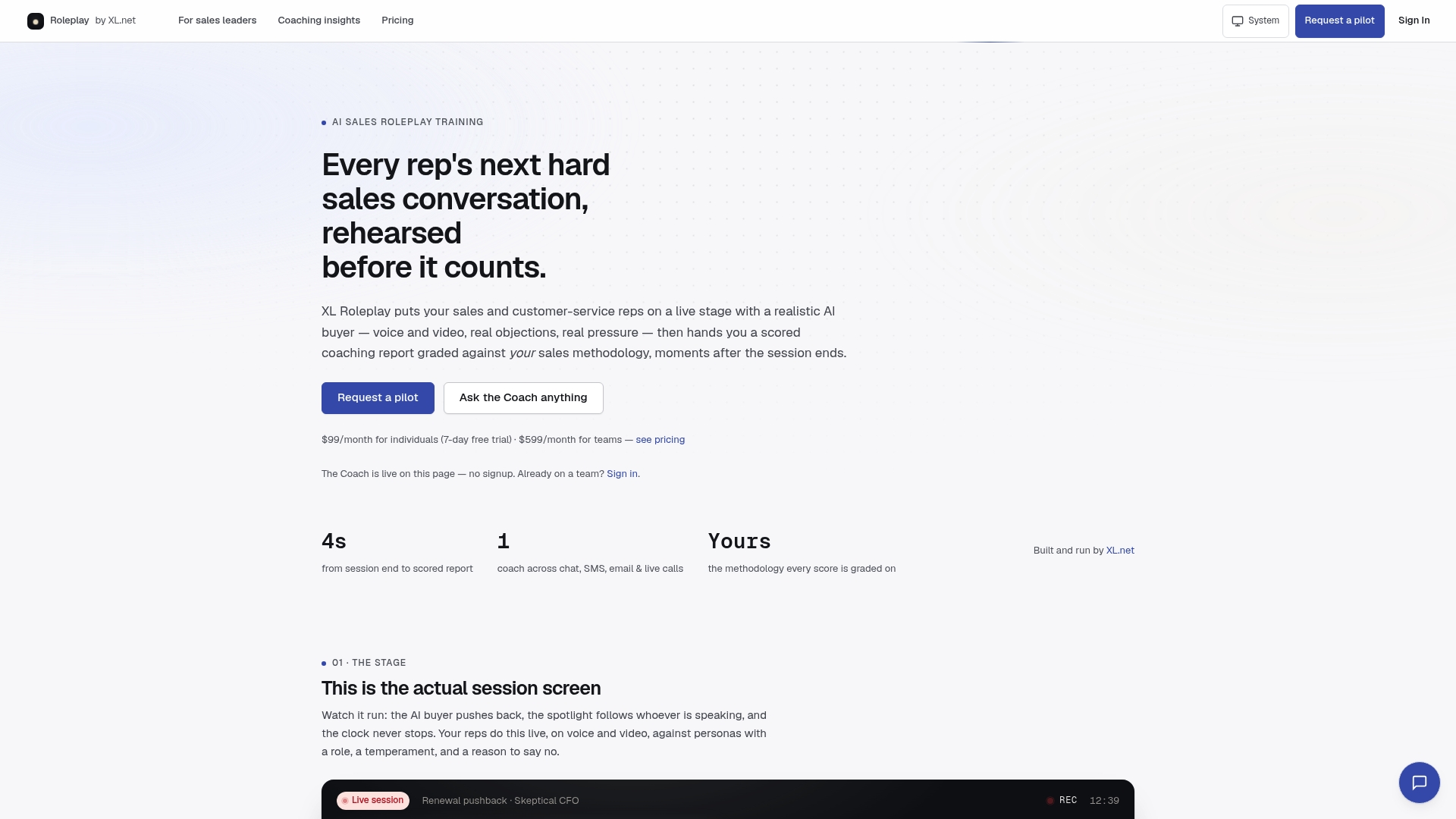
That maps directly onto the process outlined above: role-play sessions generate scored evidence, scores route reps into targeted remediation, and repeated high scores support certification and ramp decisions, all without pulling a manager into every single practice rep needs. Teams using this approach get evidence of readiness instead of a manager’s best guess, and reps get more reps in before a real call ever happens.
If your last readiness assessment produced a spreadsheet nobody acted on, that’s usually a signal the verification step was missing. Visit Xl’s platform for sales leaders to see how scored role-play and certification fit into your existing process, or start a trial directly at Roleplay.
Sources
- HBR: Where companies go wrong with learning and development
- Hyperspect: Outbound readiness assessment (tool example)
- SellSuccessfully: Sales Readiness Score
FAQ
What is a sales readiness assessment?
It’s a scored, multi-dimension evaluation of whether a rep can apply sales skills, like discovery and objection handling, in live conversations, not just recall training content.
What is the 30-60-90 rule in sales?
It’s an onboarding framework setting milestones at 30, 60, and 90 days: certification and shadowing early on, independent call ownership by day 60, and partial pipeline ownership with a measurable readiness score by day 90.
How do you pass a sales readiness assessment test?
Focus on demonstrating behavior, not memorized answers: practice objection handling out loud, review your own recorded calls for gaps, and treat role-play sessions as the real test since they’re weighted more heavily than knowledge quizzes.
What is the 2-2-2 rule in sales?
Definitions of this rule vary by organization and aren’t standardized industry-wide, so check how your specific sales team or methodology defines it rather than assuming a universal meaning.
How often should you reassess sales readiness?
Run a baseline immediately, reassess monthly during a launch or major onboarding push, and shift to quarterly once the team’s performance stabilizes.