Remote Sales Training: A Manager's 5-Step System
Remote Sales Training: A Manager’s 5-Step System

The fastest path to better remote selling performance is a behavior-first system: short async lessons, repeated role-play, and continuous coaching tied to measurable KPIs. Not a recorded workshop. Not a quarterly webinar. A repeating cycle that builds skill the same way athletes build muscle — through deliberate, frequent practice with immediate feedback.
Quick plan:
- Define your team’s top 3 skill gaps and the KPIs that prove improvement.
- Install an async microlearning plus role-play practice system (AI-driven or peer-based).
- Run a 30/60/90 onboarding cadence for new reps and a weekly coaching rhythm for the full team.
Do these in the next 72 hours:
- Pull your last 90 days of call data and identify the two stages where deals most often stall.
- Write one role-play scenario targeting the most common objection your reps face.
- Schedule a 30-minute manager calibration session to align on what “good” looks like for discovery calls.
- Choose one async learning platform and one role-play tool (or a combined solution) and set up a free trial.
Table of Contents
- Why remote sales training produces measurable ROI — and where most teams fall short
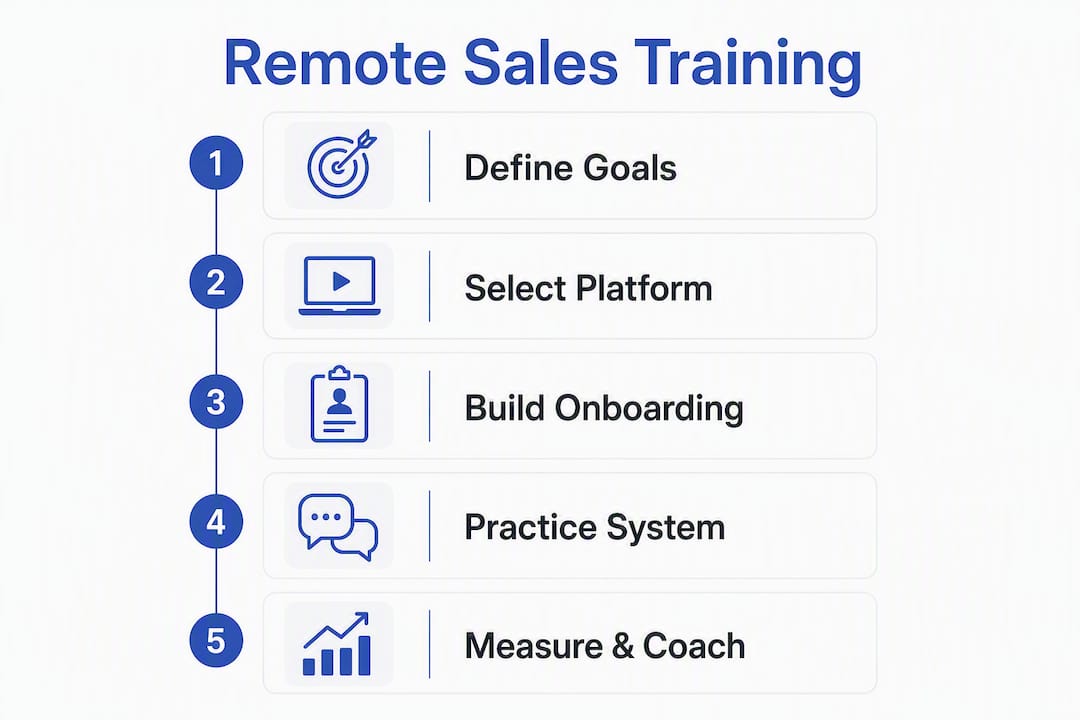
- How to build remote sales training that actually works: a 5-step framework
- Remote training methods and activities that actually change behavior
- Which remote-selling skills should you prioritize first?
- A practical 30/60/90-day onboarding plan for new remote reps
- How to measure whether your remote sales training is working
- How AI-driven role-play accelerates skill transfer
- Common pitfalls and how to avoid them
- Key Takeaways
- The thing most managers get wrong about remote training
- Xl Roleplay puts this system into practice for your team
- Useful sources and further reading
Why remote sales training produces measurable ROI — and where most teams fall short
Mural’s research puts the average training ROI for organizations that invest in structured sales training at 353%. That number is striking, but the operative word is structured. Most remote teams are not running structured programs. They are running recordings.
The most common failure pattern looks like this: a manager records a 90-minute product training, drops it in a shared drive, marks it “completed” in the LMS, and moves on. Reps watch it once, retain little by the following week, and never practice the behaviors the training was supposed to build. Win rates stay flat. Ramp time stays long. The manager concludes that training “doesn’t work.”
What actually doesn’t work is passive consumption without practice. The gap between watching a skill demonstrated and executing it under pressure is enormous — and that gap is exactly what most remote training programs ignore.
The specific failure modes to watch for:
- Relying on recorded workshops as the primary training format.
- Running coaching sessions without a consistent cadence or rubric.
- Measuring training completion rates instead of behavior change.
- Treating onboarding as a one-time event rather than a 90-day ramp.
- Skipping deliberate practice entirely and hoping reps “learn by doing” on live deals.
The cost of inaction shows up in ramp time, pipeline conversion, and rep turnover. A rep who takes 9 months to ramp instead of 5 costs the business several months of lost quota attainment. Multiply that across a team of 10 new hires per year and the impact becomes very real, very fast.
How to build remote sales training that actually works: a 5-step framework
Organizations that invest in structured programs see measurably better alignment, engagement, and retention. The structure matters as much as the content. Here is the framework.
Step 1: Define goals and skill gaps
Start with the data you already have. Pull conversion rates by funnel stage, average ramp time, and manager feedback from the last quarter. Identify the two or three behaviors most correlated with your top performers. Those become your training objectives. Vague goals (“improve communication”) produce vague results. Specific ones (“increase discovery question frequency from 3 to 7 per call”) give you something to measure.
Step 2: Select your platform and format mix
High-performing remote teams use async learning for foundational skills and reserve synchronous sessions for strategy and deal-level coaching. That means your platform stack needs at least two components: an async delivery tool (LMS or microlearning platform) and a practice tool (AI role-play or peer role-play with a rubric). Trying to do everything in one live Zoom session is the single most common structural mistake.
Step 3: Build and launch onboarding
Map your 30/60/90 plan before the first rep starts. Day 1 should not be a product dump. It should be a structured introduction to your sales methodology, your ICP, and your first role-play scenario. The goal of the first 30 days is not product knowledge — it is behavioral readiness.
Step 4: Install a continuous practice system
Spacing, deliberate practice, and AI role-play produce superior long-term skill transfer compared with one-off sessions. Design repeating cycles: assign a short lesson, require 3–5 role-play attempts, score each attempt with a rubric, surface transcripts for manager debriefs, and reinforce in CRM workflows. This is the engine of the system.

Step 5: Measure, coach, and iterate
Track KPIs weekly, not quarterly. Use call-level analytics and role-play transcripts to identify coaching priorities. Run a consistent 1:1 coaching cadence. Adjust content when the data shows a skill gap is closing — or when it isn’t.

Sample 30/60/90 milestone map:
| Phase | Learning focus | Practice activity | Expected output |
|---|---|---|---|
| Days 1–30 | Methodology, ICP, product basics | 3 role-play scenarios (discovery, objection, demo) | Readiness score ≥ 70% on core scenarios |
| Days 31–60 | Full sales cycle, competitive positioning | Live deal clinic + async objection drills | First solo calls; manager-certified on 2 scenarios |
| Days 61–90 | Negotiation, closing, multi-threading | Negotiation role-play + peer coaching | Pipeline contribution; ramp certification |
Launch readiness checklist:
- Training objectives mapped to measurable KPIs
- Async content library built (minimum 5 modules for onboarding)
- At least 3 role-play scenarios written with scoring rubrics
- Manager coaching cadence scheduled (weekly 1:1s confirmed)
- CRM fields or tags set up to track training-linked pipeline activity
Pro Tip: Write your role-play scenarios before you build your content modules. The scenarios will reveal exactly which skills your content needs to cover — and they prevent the common trap of building training around what’s easy to teach rather than what’s hard to execute.
Remote training methods and activities that actually change behavior
The format of training determines whether reps retain and apply what they learn. Here is how the main remote-native formats compare — and how to use each one.
Microlearning (5–10 minute async modules): Best for foundational concepts, methodology reinforcement, and pre-call preparation. Reps complete modules on their own schedule, which removes the scheduling friction that kills live-session attendance. Pair every module with a practice prompt so consumption leads directly to application.
AI role-play: The closest thing to live practice without the coordination overhead. A rep can run 5 objection-handling drills before a high-stakes call, get scored immediately, and review the transcript before their manager even knows the session happened. AI coaching platforms track behaviors across calls and produce ongoing insights for managers, which means the feedback loop is continuous rather than episodic.
Peer coaching and recorded role-play: Useful for calibration and team culture. Pair reps to practice a scenario, record it, and submit for manager review. The act of reviewing your own recording is itself a powerful learning tool — most reps have never watched themselves sell.
Live deal clinics (60–90 minutes, monthly): Reserve synchronous time for high-leverage work: reviewing a live deal, running a group strategy session, or calibrating on what “great” looks like for a specific scenario. Async handles the basics; live sessions are for applied practice and debriefing.
Simulation-based assessments: Use structured scenarios with a rubric to certify readiness before a rep goes live on a specific deal type (enterprise, renewal, competitive). This replaces the “gut feel” readiness check with an objective score.
Sample weekly activity schedule for a remote team:
- Monday: 10-minute async microlesson (new skill or reinforcement)
- Wednesday: 15-minute solo AI role-play drill (scenario tied to Monday’s lesson)
- Friday: Manager reviews top 3 transcripts from the week; flags coaching priorities for next 1:1
Pro Tip: The recorded-workshop trap is real. A 90-minute recording feels like training but functions like a podcast — passive, forgettable, and impossible to practice from. If you have existing workshop recordings, strip them into 5-minute concept clips and attach a role-play prompt to each one. You’ll get more behavior change from the same content.
Which remote-selling skills should you prioritize first?
Not all selling skills translate equally to a remote context. Some degrade significantly over video. Others become more important. Here is the priority order for most B2B remote teams, with one targeted exercise per skill.
Virtual rapport and presence: Reps who look distracted, have poor audio, or fail to create a sense of connection over video lose deals before the discovery even starts. Exercise: 10-minute “presence audit” — rep records a 2-minute intro on video, reviews it against a checklist (eye contact, framing, audio, energy), and repeats until the checklist is clean.
Discovery and questioning: The single highest-leverage skill in remote selling. Reps who ask fewer than 5 diagnostic questions per call close at significantly lower rates. Exercise: “Question ladder” drill — rep must ask 7 open-ended questions in sequence without pitching, scored on question quality and listening behavior.
Demo over video: Screen sharing introduces friction, pacing problems, and attention loss. Exercise: 20-minute demo role-play where the “buyer” (AI or peer) is allowed to interrupt, multitask, or ask off-topic questions — forces the rep to re-engage and stay adaptive.
Objection handling: The most commonly trained skill, and still the most commonly failed one. Exercise: Objection sprint — rep faces 5 different objections in 10 minutes, scored on acknowledgment, reframe, and next-step quality.
Negotiation: Protecting margin over video is harder than in person. Buyers know reps feel pressure to close. Tailored negotiation role-play scenarios that simulate trade-off conversations are the most direct way to build this skill before it costs you a deal.
Closing remotely: Asking for the business over video requires a different cadence than in-person. Exercise: Closing conversation practice — rep must navigate a “not yet” response and re-close within the same call.
Follow-up cadence: Remote deals die in the follow-up. Exercise: Rep writes 3 follow-up sequences (email + voicemail) for different deal stages and gets them scored against a rubric for specificity, urgency, and next-step clarity.
Sequencing during onboarding vs. ongoing development: In the first 30 days, focus on virtual presence, discovery, and objection handling. These three skills determine whether a rep can run a credible first call. Add demo, negotiation, and closing in days 31–60. Reserve advanced multi-threading and executive conversation skills for the ongoing development phase after ramp.
A practical 30/60/90-day onboarding plan for new remote reps
Ramp time is the most direct measure of onboarding quality. A rep who reaches full productivity in 5 months instead of 9 is worth roughly 4 months of quota attainment to the business. The plan below is built around that goal.
-
Days 1–30: Foundation. Cover sales methodology, ICP, and product basics through async modules. Require 3 role-play completions (discovery, core objection, intro demo). Manager checkpoint at day 15: review first role-play transcript and score against rubric. Artifact: readiness score on discovery scenario.
-
Days 31–60: Application. Rep runs first solo calls with manager shadowing. Weekly deal clinic (30 minutes). Async modules shift to competitive positioning and objection depth. Manager checkpoint at day 45: certify rep on 2 core scenarios. Artifact: recorded role-play library (minimum 3 sessions).
-
Days 61–90: Ramp certification. Rep carries a partial quota. Negotiation and closing role-play added. Peer coaching pairs introduced. Manager checkpoint at day 90: full ramp certification using readiness score and pipeline contribution data. Artifact: readiness score above threshold, pipeline at target.
Manager checklist for each milestone:
- Day 15: Has the rep completed all async modules? Review first transcript. Identify one coaching priority.
- Day 30: Readiness score ≥ 70% on discovery scenario? If not, assign additional practice before solo calls.
- Day 45: Is the rep running calls independently? Review 2 call recordings. Certify on core scenarios.
- Day 60: Is pipeline contribution on track? Adjust coaching focus based on conversion data.
- Day 90: Full certification. Document gaps for ongoing development plan.
Artifacts to collect during onboarding:
- Completed async module log (with scores where available)
- Role-play transcript library (minimum 3 sessions per rep)
- Readiness scores at each milestone
- Manager coaching notes from each 1:1
- First 30 days of pipeline activity (calls made, meetings set, opportunities created)
Multi-module, self-paced formats work well for the async component of onboarding, giving distributed teams flexibility without sacrificing structure.
How to measure whether your remote sales training is working
Training without measurement is just content consumption. The KPIs below connect training activity to business outcomes.
Priority KPIs to track:
- Time-to-ramp (days from hire to first quota attainment)
- Conversion rate by funnel stage (especially lead-to-meeting and demo-to-close)
- Discovery question frequency per call (from call analytics)
- Readiness score at each onboarding milestone
- Coaching session frequency (1:1s completed vs. scheduled)
- Role-play completion rate and average rubric score
- Win rate on deals where reps completed relevant training vs. those who didn’t
Recommended coaching cadence:
- Weekly 1:1 (30 minutes): review one transcript or role-play recording, identify one coaching priority, set one practice goal for the week.
- Monthly deal clinic (60 minutes): group session on a live deal or a shared skill gap surfaced by analytics.
- Quarterly calibration (90 minutes): align the full team on what “great” looks like for each core scenario; update rubrics if needed.
Integrating training metrics with your CRM:
AI coaching platforms track behavioral signals across calls — discovery quality, rapport indicators, value delivery — and surface them as manager dashboards. Push role-play completion data and readiness scores into your CRM as custom fields. Tag opportunities with the rep’s training status at the time of the deal. Over 90 days, you will see whether reps who completed specific training modules convert at higher rates. That correlation is the business case for your next training investment.
Pro Tip: Don’t measure training by completion rates. A rep who watches 10 modules and scores 45% on every role-play is not ready. A rep who completes 6 modules and scores 85% on role-plays is. Readiness scores and behavioral KPIs tell you what completion rates never can.
How AI-driven role-play accelerates skill transfer
The core problem with traditional role-play is logistics. Scheduling a manager or a peer for a practice session takes coordination, and most reps avoid it because it feels evaluative and awkward. AI role-play removes both barriers. A rep can practice at 7 AM before a big call, run 5 attempts, review the transcript, and walk into the meeting having already handled the hardest objection three times.
How the mechanics work:
- The system presents a simulated buyer persona with a defined profile, objections, and pressure points.
- The rep conducts the conversation in real time (voice or video).
- The system scores the session against a rubric tied to the organization’s sales methodology.
- A transcript is generated immediately, with behavioral annotations.
- The manager receives a coaching report flagging specific moments to debrief.
Example manager workflow:
- Manager assigns a “competitive displacement” scenario to the full team on Monday.
- Each rep completes 3 attempts asynchronously before Wednesday.
- The system surfaces the top 3 transcripts and the lowest 3 scores to the manager.
- Manager uses transcripts and scorecards to run targeted 15-minute debriefs on Thursday.
- Reps who scored below threshold complete 2 additional attempts before the next deal clinic.
What teams typically see after implementing this cycle:
- Ramp time shortens because reps arrive at their first live call having already practiced the core scenarios multiple times.
- Objection-handling scores improve measurably within 4–6 weeks of consistent practice.
- Managers spend less time on manual call review and more time on targeted coaching.
- Transcripts and rubrics create objective progress signals that replace gut-feel readiness assessments.
The evidence for behavior-based training systems is consistent: when remote training is designed as a repeating cycle of short lessons, AI practice, and in-flow reinforcement, distributed teams can outperform co-located ones. The digital format naturally supports spacing, practice frequency, and measurement in ways that in-person training often cannot.
Common pitfalls and how to avoid them
Most remote training programs fail for predictable reasons. Here is what not to do, and what to do instead.
What to avoid:
- Relying on recorded workshops as your primary format. Passive viewing does not build skill.
- Skipping deliberate practice. Reading about objection handling and practicing it are not the same activity.
- Measuring only completion rates. A rep who watched every video but never practiced is not ready.
- Running role-play without a rubric. Without a scoring standard, feedback is subjective and inconsistent.
- Coaching without a cadence. Ad hoc coaching is better than nothing, but a scheduled weekly 1:1 compounds over time in ways that occasional check-ins never do.
- Launching training without manager buy-in. If managers don’t reinforce training in their 1:1s, reps deprioritize it within two weeks.
Evidence-based best practices:
- Space learning across days and weeks rather than front-loading it. Spaced repetition produces retention rates that massed learning cannot match.
- Require practice, not just consumption. Every lesson should have a role-play or application prompt attached.
- Measure behavior, not activity. Track discovery question frequency, objection-handling scores, and conversion rates — not hours spent in the LMS.
- Coach targeted skills. Use transcript data to identify the specific behavior to improve, then assign a scenario that targets exactly that behavior.
- Build a role-play library reps actually use by writing scenarios around real objections from real deals. Generic scenarios get ignored; scenarios that mirror last week’s lost deal get practiced.
Quick fixes for common problems:
- Low engagement: Shorten modules to under 10 minutes and attach a role-play prompt to each one. Engagement drops when content feels abstract or too long.
- Poor adoption of role-play: Start with low-stakes, private AI practice before introducing peer or manager-observed sessions. Reps who feel safe practicing alone adopt the habit faster.
- Unclear KPIs: Pick two metrics and track them for 90 days before adding more. Complexity kills measurement consistency.
Key Takeaways
A behavior-first remote sales training system — built on spaced microlearning, repeated AI role-play, and a consistent coaching cadence — is the fastest way to shorten ramp time and improve win rates for distributed teams.
| Point | Details |
|---|---|
| System beats content | Repeating cycles of lesson, practice, and coaching outperform one-off workshops or recordings. |
| 30/60/90 onboarding | Map milestones, manager checkpoints, and readiness scores before the first rep starts. |
| Measure behavior, not completion | Track discovery frequency, objection-handling scores, and conversion rates — not module views. |
| AI role-play closes the practice gap | Async AI practice lets reps run multiple attempts before live calls, with immediate scored feedback. |
| Xl for consistent coaching at scale | Xl’s scored reports, transcripts, and readiness scoring replace gut-feel assessments with objective data. |
The thing most managers get wrong about remote training
The conventional wisdom says remote training is harder than in-person training. I’d push back on that — not because remote is easier, but because the framing is wrong. The question isn’t “how do we replicate the in-person experience remotely?” It’s “what does the remote format make possible that in-person never could?”
In-person training is constrained by scheduling, geography, and the social dynamics of a room. Remote training, when designed as a system, removes all three. A rep in Austin can practice the same scenario as a rep in Boston at 6 AM on a Tuesday, get scored against the same rubric, and have their transcript reviewed by the same manager before the end of the day. That kind of consistency at scale is genuinely hard to achieve in a room.
The managers who struggle with remote training are usually the ones trying to replicate the in-person model: a big live session, a lot of content, and the assumption that presence equals learning. The managers who succeed treat remote as a native format with its own strengths — async practice, objective scoring, transcript-level coaching — and build their system around those strengths rather than fighting them.
One nuance worth watching: the biggest risk in a well-designed remote training system is not low engagement. It’s false confidence. A rep who scores 85% on a controlled AI scenario may still freeze on a live call with a CFO who goes off-script. The system needs live deal clinics and real-call review to calibrate against actual performance. AI practice builds the muscle; live coaching tests it.
Xl Roleplay puts this system into practice for your team
Most of what this guide recommends — async practice, scored role-play, transcript-level coaching, readiness scoring — requires a platform that can actually deliver it at scale. Xl does exactly that, without the coordination overhead of peer-based role-play or the inconsistency of ad hoc coaching.
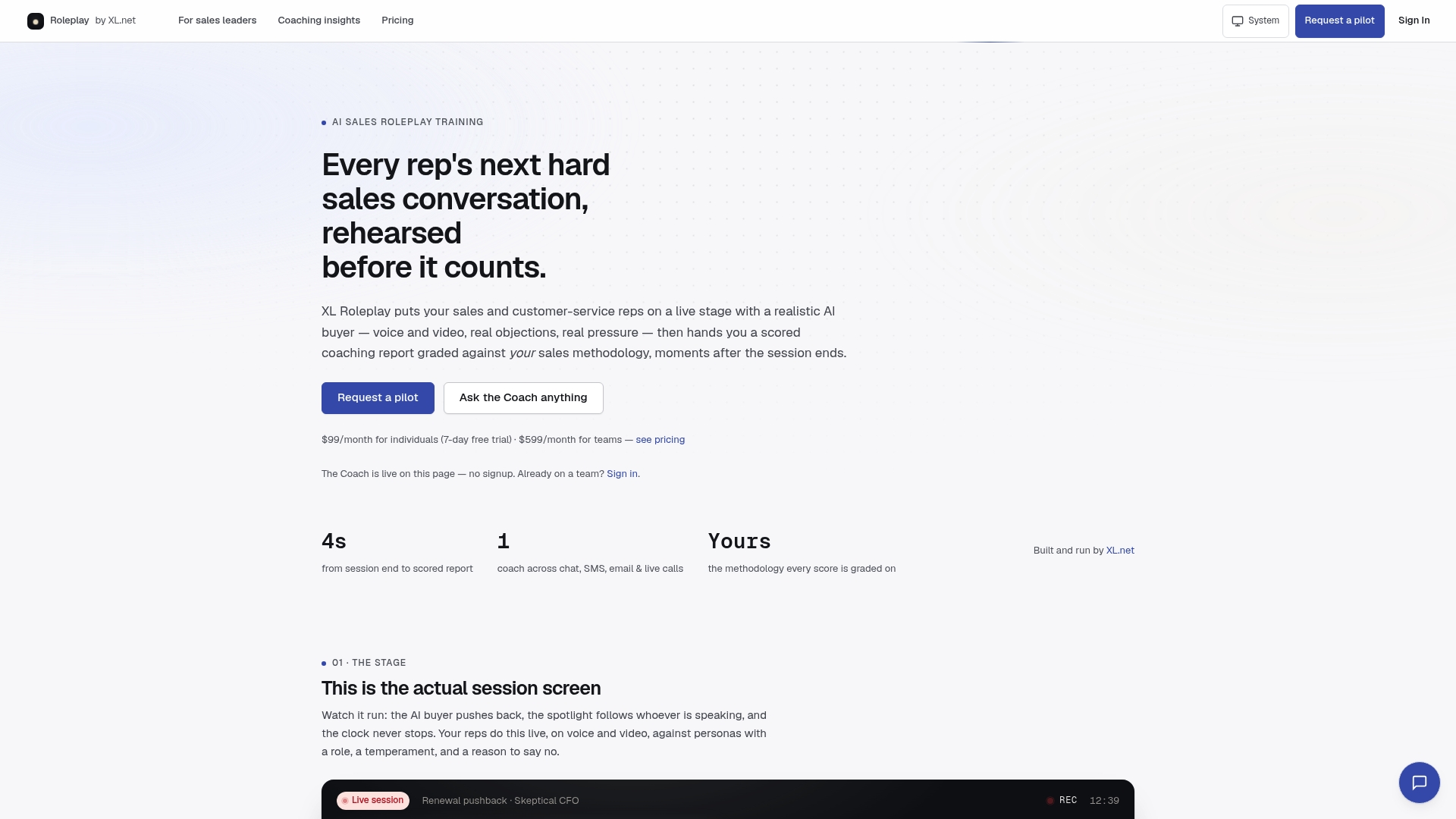
Reps practice live voice and video conversations with realistic AI buyers that present the objections and pressures your team actually faces. Every session produces a scored coaching report tied to your organization’s sales methodology, a full transcript with behavioral annotations, and a readiness score managers can track over time. The result: managers spend their 1:1 time on targeted coaching instead of manual call review, and reps arrive at live deals having already practiced the hardest moments multiple times.
If you’re building or rebuilding a remote training program, start a free trial of Xl Roleplay and run your first scenario this week. For team deployments and enterprise workflows, the sales leaders page covers team features and onboarding options.
Useful sources and further reading
- Remote Sales Training: Best Practices and Guide — Mural’s 5-step implementation guide and ROI evidence; most useful for the framework and context sections of this article.
- How to Run Sales Roleplay Training Reps Don’t Dread — Step-by-step tactics for running role-play sessions that increase adoption; directly supports the methods and onboarding sections.
- Sales Readiness Scoring: From Gut Feel to Evidence — Explains readiness scoring methodology; most useful for the measurement and onboarding sections.
- How to Evaluate AI Sales Roleplay Tools: A Buyer’s Checklist — Practical evaluation criteria for managers selecting an AI role-play platform.