Sales Leaders: Five Criteria Role Play Rubric With AI Transcripts
Sales Leaders: Five Criteria Role Play Rubric With AI Transcripts

A role play rubric is a behavior-based scoring template, usually five criteria on a 1 to 4 scale, that turns a simulated sales or service conversation into measurable coaching data instead of a vague “good job” or “needs work.” Adopt one now, pair it with a structured debrief where the rep speaks first, and you have a system. A tool like XL Roleplay can automate the transcript and scoring layer so managers spend their time coaching, not typing notes.
TL;DR:
- A behavior-based scoring rubric with clear criteria and timestamped evidence significantly improves coaching and reduces ramp time for new sales reps.
- Regular calibration and using real call clips ensure rubric consistency and prevent subjective scoring.
- Short, focused role-play sessions followed by immediate, specific debriefs are more effective for behavior change than lengthy, broad critiques.
- Tracking rubric scores alongside KPIs like objection-to-next-step rate and win rate provides measurable insights into coaching effectiveness.
- Automating scoring and transcript collection with tools like XL Roleplay streamlines implementation and enhances remote coaching consistency.
Table of Contents
- Why a Role Play Rubric Matters More Than the Role-Play Itself
- A Copy-Ready Role Play Scoring Rubric You Can Use This Week
- How to Build, Pilot, and Launch Your Rubric
- Running Sessions and Debriefs That Change Behavior
- Turning Rubric Scores Into Business Metrics
- What Most Sales Leaders Get Wrong About Scoring Role-Plays
- Try XL Roleplay to Automate Your Rubric and Debrief Workflow
- Sources
Why a Role Play Rubric Matters More Than the Role-Play Itself
Most sales teams already run role-plays. Few of them get better at anything because of it. The role-play itself is just data collection. The scoring and the debrief that follows are the actual training, and skipping either one is why so many practice sessions evaporate by Thursday.
Academic research on role-play assessment backs this up directly: a detailed evaluation form that critiques both content and delivery style is what enables reflective learning, not the act of performing the scenario. Without a form, reps repeat the same habits because nobody named the habit out loud.
The failure pattern shows up the same way across most organizations:
- Feedback stays vague (“be more confident”) instead of pointing to a specific moment in the call.
- Debriefs get skipped when the schedule runs long, so the rep never hears what to change.
- Scenarios feel scripted and unrealistic, so reps treat the exercise as theater rather than practice.
These gaps cost you ramp time. A new rep who never gets specific, evidence-based feedback takes longer to hit quota, and managers end up re-teaching the same objection handling six months in. Structured scoring plus a real debrief is what closes that gap, and it’s the difference between a role-play program that fades out and one that shows up in your win rate.
A Copy-Ready Role Play Scoring Rubric You Can Use This Week
Building a role play rubric from scratch is easier than most trainers expect once you settle on the right handful of criteria. Five to six is the sweet spot. Fewer, and you miss real skill gaps; more, and raters lose consistency because they’re juggling too many judgment calls per minute of conversation.
Here’s a standard set that covers the skills that actually predict deal outcomes:
- Listening and discovery — Does the rep ask open questions and follow up on what the buyer actually says, or just run a script?
- Questioning technique — Are questions layered to uncover pain, budget, and timeline, rather than surface-level checkbox questions?
- Value defense — When the buyer pushes on price or a competitor, does the rep hold ground with a specific value argument instead of caving or repeating a slogan?
- Composure under pressure — How does the rep handle interruptions, silence, or a hostile tone without losing the thread of the conversation?
- Next-step clarity — Does the call end with a concrete, mutually agreed next step, or does it just trail off?
Score each criterion on a 1 to 4 scale: 1 is “absent or actively hurts the deal,” 2 is “attempted but inconsistent,” 3 is “solid and repeatable,” 4 is “sets the standard other reps should hear.” A composite score is just the sum divided by the number of criteria, giving you a number between 1 and 4 you can track over time per rep, per cohort, or per scenario type.
The scoring only holds up if it’s defensible. That means every score needs at least one timestamped transcript excerpt tied to it. If you rate value defense a 2, note the exact moment (“1:42, buyer says price is too high, rep drops price without asking why”) rather than relying on memory an hour later.
Pro Tip: Never score a criterion without writing down the timestamp that justifies it. A number with no evidence is an opinion, and reps will argue with opinions. They rarely argue with a transcript.
How to Build, Pilot, and Launch Your Rubric
Skipping straight to a rubric template without diagnosing your actual gaps is the fastest way to build one that measures the wrong things. Follow this sequence instead.
- Pull five to ten real call clips where deals stalled or objections got fumbled, and identify the specific moment things went sideways.
- Write behavior-based anchors for each rubric criterion tied directly to what you saw in those clips, not generic sales theory.
- Pilot in triads (rep, buyer, observer) so you get a scored example and immediate peer feedback in the same session.
- Train your observers together on two or three shared recordings before they score live sessions, so a “3” means the same thing across raters.
- Run the pilot for about three weeks, which is long enough to collect scored examples across your team without stalling the rollout.
- Revise anchors based on transcript evidence and any early KPI movement before you roll the rubric out organization-wide.
The step people skip most often is observer calibration, and it’s the one that quietly destroys a rubric’s credibility. If your VP scores a call a 4 and your regional manager scores the identical transcript a 2, reps stop trusting the process within a month.
Pro Tip: Have two observers independently score the same recorded session before the pilot starts. If their scores land more than one point apart on any criterion, your anchors are too vague, not your raters too harsh.
Build scenarios that mirror real friction points instead of textbook objections. Sourcing scenarios from actual recorded calls makes the practice feel less like theater and more like the Tuesday afternoon call reps actually dread.
Running Sessions and Debriefs That Change Behavior
The session format matters as much as the rubric itself. Peer buyer triads work best for weekly practice and onboarding since they’re low-pressure and easy to schedule. Manager-as-buyer sessions belong in high-stakes prep, like before a competitive renewal, where the manager needs to apply real pressure. Recorded re-runs are underused: have the rep run the same scenario twice, minutes apart, applying one correction between takes.
Keep individual passes short. A 3 to 5 minute pass focused on a single micro-skill beats a 20-minute marathon that tries to cover discovery, objections, and closing all at once. For rapid-fire drills on a specific behavior, 90 seconds is often enough.
The debrief itself has a structure worth protecting:
- The rep speaks first. What did they think worked, and what felt shaky?
- Discuss one specific moment from the transcript, not the whole call in the abstract.
- Name one behavior to keep exactly as it was.
- Name one behavior to change, and immediately re-run that portion of the scenario.
Pro Tip: Resist the urge to list three things to fix. Reps retain one correction per session. Pile on more and you’ll get zero.
This “rep-first, one behavior, immediate re-run” pattern is the core mechanic behind effective debriefs, and it works because the correction gets practiced immediately, while it’s still fresh, instead of filed away for “next time.”

Turning Rubric Scores Into Business Metrics
A rubric score only matters if it moves numbers your CFO cares about. Track these four:
- Objection-to-next-step conversion rate — how often a handled objection still ends in a scheduled next step.
- Average discount given — a proxy for how well reps defend value under pressure.
- Ramp time — how many weeks until a new rep hits full quota attainment.
- Win rate on contested deals — deals with a named competitor in the mix.
Score rubrics weekly; review the business KPIs monthly, since deal cycles move slower than practice cadence. The Sales Role Play Effectiveness Score framework suggests treating consistent scores above 80% as a marker of a healthy training program, giving you a rough benchmark for where composite rubric scores should land once the system matures.
For managers, a one-page weekly scorecard works better than a dashboard: rep name, composite rubric score, one KPI trend line, and one transcript quote that explains the number.
What Most Sales Leaders Get Wrong About Scoring Role-Plays
Most training programs treat the rubric as paperwork. A checkbox to prove the role-play happened, filed away, never looked at again. That’s backward. The rubric is the actual product of the session. The role-play itself is disposable. If you lose the transcript and keep the scored rubric with its timestamped notes, you’ve kept everything that matters.

The other mistake I see constantly is treating calibration as optional. Teams write a beautiful rubric, skip training their raters, and then wonder why reps push back on scores. A 3 out of 4 means nothing if the person handing it out has never compared notes with anyone else on the team. Fix calibration before you fix the rubric wording.
Where this connects to what XL Roleplay builds: pairing every score with a timestamped transcript excerpt is exactly how consistent, defensible coaching happens at scale, and it’s the piece most manual rubric systems quietly drop because it’s tedious to do by hand. One example worth noting: a rep scored low on value defense in an early session, coached specifically on holding price against a stated objection, then showed a full point improvement on that same criterion in a re-run days later, with the transcript to prove exactly what changed.
— Adam
Try XL Roleplay to Automate Your Rubric and Debrief Workflow
Building and calibrating a rubric by hand works, but it takes hours of transcription and cross-checking that most training teams don’t have to spare. XL Roleplay is built to remove that overhead: it runs live voice and video simulations against AI buyers trained on realistic objections, then generates a scored coaching report and full transcript automatically, mapped to your own sales methodology instead of a generic template.
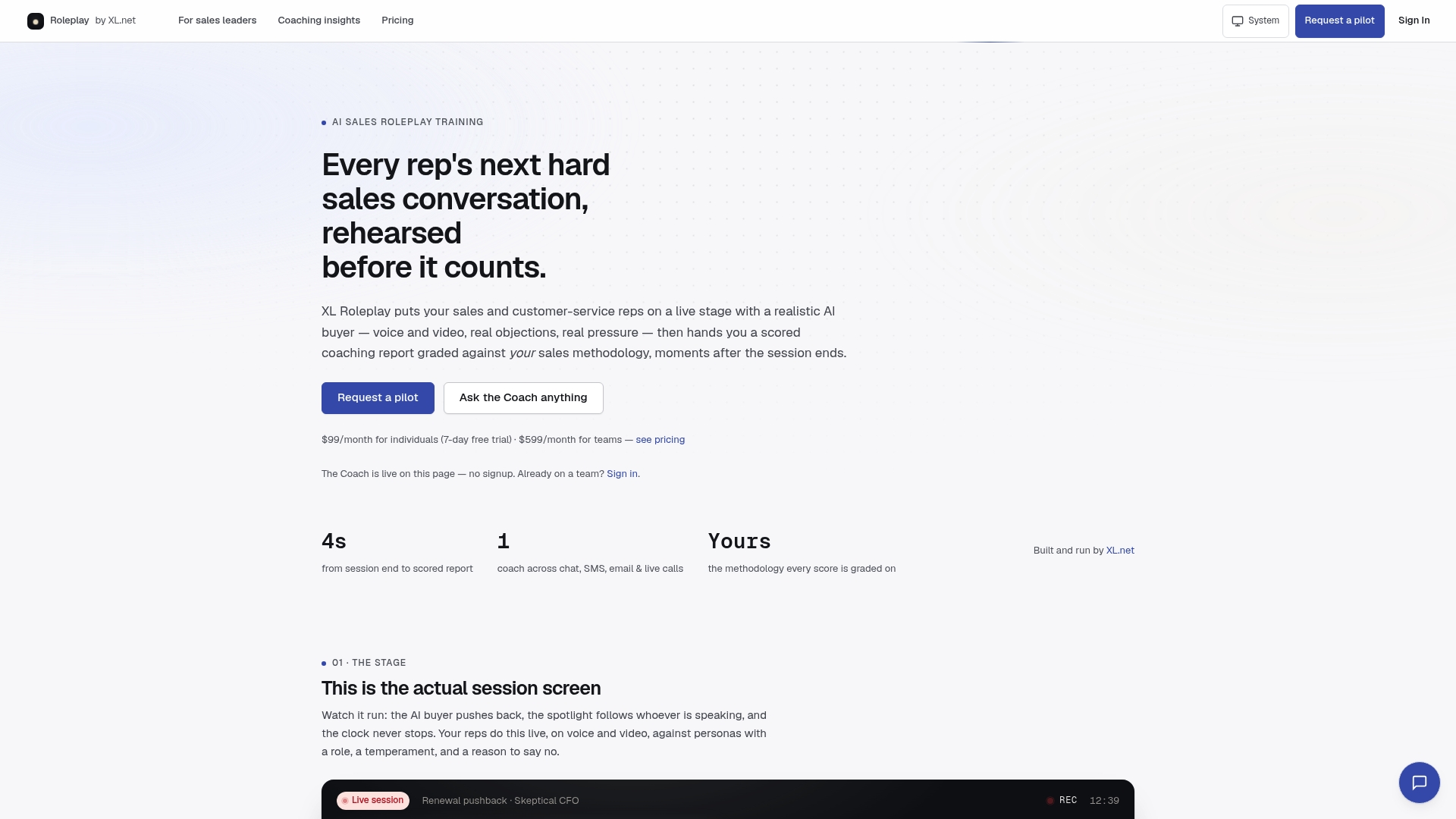
Every session comes with timestamped evidence baked in, so the “why” behind a score is never a guess and managers can review performance without sitting through the recording themselves. Teams running distributed reps benefit from consistent scoring through a centralized system without flying anyone in for calibration sessions. If you’re a sales leader trying to get objective, scalable coaching in place before next quarter’s ramp cycle, start a free trial at XL Roleplay and run your first scored session this week.
Sources
- Enhancing Reflective Learning through Role-Plays (Marketing Education Review, 2006)
- How do you use role-play to coach sales skills effectively? | PulseRevOps
- Sales Role Play Effectiveness Score - KPI Definition | KPI Depot