Rubric vs Scorecard: What Each Does in Sales Role-Play
Rubric vs Scorecard: What Each Does in Sales Role-Play

A rubric defines what good looks like. A scorecard records how a rep did against it. The rubric is the standard, the scorecard is the result, and a team that has only one of them either argues about what the numbers mean or has no numbers to coach from. In XL Roleplay, both live in the same place: sessions with AI buyers produce scored coaching reports built on your organization’s own methodology, with transcripts and rubrics that managers can review.
This guide shows how the two differ, what each should contain for sales and customer service conversations, how to keep scoring consistent across reviewers, and where a readiness score fits next to certification.
TL;DR
- Rubric = input. It spells out expected behaviors and what each score level means.
- Scorecard = output. It is the document that holds the scores for one conversation or one rep.
- Build the rubric first. A scorecard without written definitions produces numbers nobody can defend.
- Calibrate. Have reviewers score the same conversation independently, then compare by category.
- Readiness is not certification. A readiness score tells you where a rep stands today; certification is a pass/fail decision on evidence.
Table of Contents
- The difference in one table
- What a rubric contains
- What a scorecard contains
- How teams weight and scale their scorecards
- Keeping scoring consistent
- From score to coaching
- Readiness score vs certification
- Which one do you need?
- Where XL Roleplay fits
- FAQ
- Sources
The difference in one table
People use the words interchangeably, which is where most confusion starts. Qualtrics’ quality management documentation draws the line cleanly: the rubric defines the expectations and turns representative behaviors into a score that can be compared across reps, teams and call reasons, while the scorecard shows the results.
| Rubric | Scorecard | |
|---|---|---|
| Question it answers | What does good look like? | How did this rep do? |
| Role | The standard (input) | The result (output) |
| Contains | Criteria, weights, level descriptions | Scores per criterion, total, notes |
| Changes | Rarely, after deliberate review | Every conversation |
| Used by | Managers, enablement, reps before practice | Reps and managers after practice |
A simple test: if you could hand it to a new rep before their first call and they would know how to prepare, it is a rubric. If it is filled in after the call, it is a scorecard.
What a rubric contains
A useful rubric has four parts.
1. Criteria. The skills you actually want to see: opening, discovery, handling an objection, next step for sales; greeting, listening, resolution, empathy, compliance for service. Six to eight is a workable range. More than that and reviewers stop distinguishing between them.
2. Weights. Not every skill matters equally. Qualtrics notes that each rubric item carries a numeric weight, and that target scores set the points a document needs to pass. A common way to decide weights is to ask what a failure on that line costs the business. A wrong answer to a customer creates a second contact, a refund or a lost account, so resolution deserves more weight than a polished greeting.
3. Level descriptions. This is the part most teams skip, and it is what makes a rubric a rubric. “Discovery: 4 out of 5” means nothing until someone has written what a 4 sounds like. Write one sentence per level, in behavior you can hear on a recording: “asks at least three follow-up questions on the main pain point and confirms the buyer’s own words” beats “good discovery.”
4. Gates. Some items should not be traded off against others. A missed compliance disclosure, for example, is better treated as an automatic fail than as five lost points out of a hundred.

A worked example for a discovery criterion
Here is how the level descriptions might read for a sales rep (an illustration, not a standard):
| Score | What the rep did |
|---|---|
| 5 | Reached the root cause of the buyer’s problem, quantified its cost, confirmed it back |
| 3 | Asked relevant questions but stayed at surface-level answers |
| 1 | Moved to the pitch after one or two closed questions |
The rep, the manager and a second reviewer can all read that and land on the same number. That is the entire point.
What a scorecard contains
The scorecard takes the rubric’s criteria and adds the evidence from one conversation:
- the score for each criterion
- the weighted total
- a pass or fail against the target
- the moment in the conversation that justifies each score
- one or two coaching actions
The evidence line matters most. A score with no timestamp or transcript excerpt behind it cannot be coached, only argued with. When a rep asks why they got a 3 on objection handling, the answer should be a quote from their own call.
How teams weight and scale their scorecards
There is no single correct template. Weighting depends on what your conversations are for. Still, the structure is consistent: a handful of weighted criteria, a numeric scale with written anchors, and a pass line.
A sales scorecard typically puts most weight on discovery, value and the next step. A customer service scorecard typically puts most weight on resolution, with listening, empathy and compliance behind it. Pass thresholds also vary with risk: teams in regulated settings tend to set a higher bar because a compliance failure costs more.
When you set up your own:
- Pick a scale and keep it. 1 to 5 is common and easy to explain. Mixing pass/fail items with scaled items is fine if the rubric says which is which.
- Weight by consequence. Give the most weight to what decides the outcome of the conversation.
- Treat legal and policy items as gates. They fail the conversation outright rather than costing a few points.
- Fit the stage. A new rep’s practice rubric can emphasize fundamentals; a senior rep’s can emphasize negotiation or multi-threading.
- Use your own methodology. If your team sells with a defined qualification framework, the rubric should use its language. A generic rubric coaches generic behavior.
That last point is the reason generic templates disappoint. They measure a standard that is not yours. In XL Roleplay, scoring and coaching are grounded in your organization’s own sales methodology, so the report a rep receives uses the same words as the playbook they were trained on.
Keeping scoring consistent
A rubric that two reviewers read differently is just a more elaborate opinion. Consistency comes from calibration, and the process is simple:
- Pick one conversation with both strong and weak moments.
- Have every reviewer score it independently, without discussing.
- Compare by category, not by total. Two reviewers can reach the same total for opposite reasons.
- Discuss why scores differed, and rewrite the level descriptions where the gap came from vague wording.
- Repeat on a schedule, and again whenever the rubric changes.
ICMI’s guidance on role-play evaluation makes the same point from the training side: each role play should have a scoring rubric summarizing the skills being evaluated, so evaluation is consistent and fair. It also suggests using your existing quality evaluation form to score new-hire role plays, which keeps practice aligned with the standard reps will be held to on live calls. And it recommends introducing the format early, with low-stakes self- and peer-evaluation before any formal pass/fail round.
The human bottleneck here is time. A manager who reviews a handful of recorded practice calls a week cannot calibrate across a whole team. That is where an AI buyer plus a scored report helps: every session is scored against the same rubric, every score links to the transcript, and managers spend their time on the disagreements and the coaching instead of on the first pass.
From score to coaching
The scorecard is not the end of the process. A useful coaching note after a scored conversation has five parts:
- one strength, with the moment it happened
- one opportunity, with the moment it happened
- one specific thing to practice (for example, asking three follow-up questions when a buyer says the timing is wrong)
- a date to check again
- a rescored practice session
The last item closes the loop. A rep who practices the same objection again the next day, against a buyer who raises it the same way, can see whether the score moved. With live voice and video sessions, XL Roleplay lets a rep repeat a scenario until the behavior holds, and the transcript shows exactly where the improvement came from.
Readiness score vs certification
This is the other half of the question many sales leaders have. A scorecard tells you how one conversation went. A readiness score rolls up how prepared a rep is overall. Certification is a formal decision that a rep meets the bar. They sound alike and do different jobs.
| Readiness score | Certification | |
|---|---|---|
| Question | How prepared is this rep right now? | Has this rep met the standard? |
| Output | A number that moves over time | Pass or fail |
| When | Throughout practice and onboarding | At a defined checkpoint |
| Use | Decide what to practice next | Decide whether to release a rep to live calls |
The distinction is well established outside sales too. MSCi explains that a readiness score out of 100 measures how much of a standard you can currently answer for, and that it cannot predict a certification result, which is decided on evidence produced on the day by an assessor with their own scope. USGSR makes a parallel point: a readiness assessment is separate from certification and gives no advantage in the certification decision.
For a sales team, the practical reading is this. Use readiness to steer practice: low discovery scores mean more discovery scenarios. Use certification as a gate, with defined evidence: a scored mock call against a realistic buyer, a knowledge check, and a manager sign-off. If you certify, track the pass rate as reps certified divided by reps tested, and retest on a schedule so skills do not fade, as one sales methodology metrics guide suggests.
The readiness score should also be honest. MSCi describes hiding the marks while a person answers, and giving partial credit for uncertainty, so responses stay truthful. The same principle applies to reps: if a score is mostly a way to rank people, they will perform for the score instead of practicing.
Which one do you need?
- You have no consistent standard yet. Start with the rubric. Write criteria and level descriptions from your own best calls.
- You have a standard but reviewers disagree. Tighten the rubric wording and run calibration.
- You have scores but no improvement. Add the coaching note and the rescored practice session.
- You need to decide who can take live calls. Add a readiness score for steering and a certification event for the gate.
Most teams need all of these, in that order.
Where XL Roleplay fits

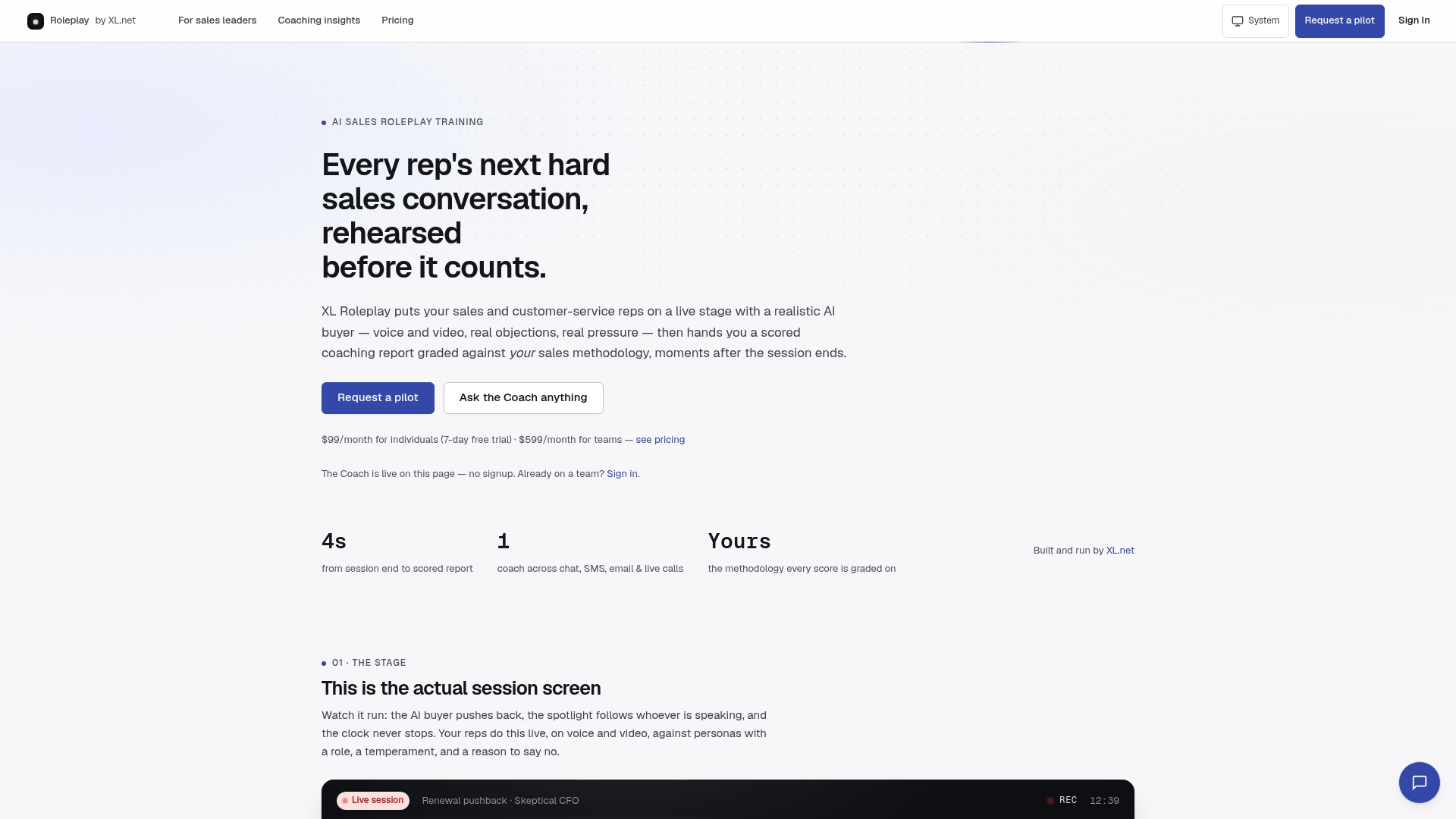
XL Roleplay is built around exactly this chain. Reps practice live voice and video conversations with AI buyers that raise realistic objections and pressure. Each session ends with a scored coaching report grounded in your methodology, and managers can open the transcript and rubric behind every score. Readiness scoring and performance tracking show how individuals and teams are moving.
Pricing is published on the pricing page: the Individual plan is $99 per month, the Business plan is $599 per month, extra seats are $54.95 per month per seat, and extra video is $16.99 per hour. For a team that wants to test the approach on its own playbook first, there is the XL Roleplay pilot.
If you are building your own QA forms, our collection of QA scorecard template articles is a good place to start, and the sales role-play scenarios give you conversations worth scoring.
Our view
Most teams treat scoring as an audit: a manager listens, assigns a number, files it. We think that wastes the most valuable moment. A score is only worth something if the rep can see why they got it and practice the fix right away.
That is why we built XL Roleplay so the rubric comes from your playbook, not ours, and every score in the report links back to the transcript. A rep reading it sees the sentence they said, the criterion it was judged against and what a stronger answer looks like. A manager sees the same thing, so the coaching conversation starts from shared evidence instead of two opinions.
Write the rubric first, make it specific enough that two people agree, and then let practice produce the scorecards.
Adam
FAQ
Is a scorecard the same as a rubric?
No. A rubric defines the criteria, weights and what each score level means. A scorecard is the filled-in record of one conversation or one rep. You can have a scorecard without a rubric, but its numbers will be hard to trust or coach from.
How many criteria should a rubric have?
Six to eight is a practical range for a single conversation type. Fewer leaves out skills you care about; more makes reviewers blur the categories together. Weight them by what a failure costs, and make compliance items automatic fails.
What is the difference between a readiness score and certification?
A readiness score shows how prepared a rep is at a given moment and guides what to practice next. Certification is a pass/fail decision against a defined standard, based on evidence produced at the checkpoint. A high readiness score does not guarantee a pass.
Can the same rubric be used for sales and customer service?
The structure can be the same: weighted criteria, written level descriptions and a pass line. The criteria and weights should differ. Sales leans on discovery, value and next steps; service leans on resolution, listening, empathy and compliance.
Sources
- Creating a Quality Management Rubric, Qualtrics
- Role-Play to Check Training Effectiveness, ICMI
- What a readiness score out of 100 tells you before an audit, MSCi
- Certification Readiness Assessment, USGSR
- 27 Sales Methodology Metrics: Track Adoption & Impact