Managers: Three Question Sales Call Debrief That Ties Calls to KPIs
Managers: Three Question Sales Call Debrief That Ties Calls to KPIs

After every sales call, run a 3-question debrief shortly after and capture one owner plus one due date. That single habit gives you a clear next step, a record of evidence for coaching, and a pipeline that reflects what actually happened instead of what you hope happened. Skip it, and even a strong call fades into a vague memory within a day.
TL;DR:
- Short, specific debrief questions help capture clear commitments, evidence, next steps, and coaching points, ensuring actionable follow-up after sales calls.
- Filling out a 7-field template within 24 hours and flagging deals based on commitment strength keeps debriefs effective and timely.
- Using recordings or transcripts to support debriefs reduces ambiguity, especially in complex negotiations or multi-stakeholder deals.
- Manager coaching should focus on one behavior during quick review meetings and include follow-up within 48 to 72 hours to reinforce change.
- Consistent practice of re-running flagged behaviors, linked to transcript evidence and scoring, significantly improves sales skill development and deal progression.
Table of Contents
- The 3-4 core debrief questions every rep should ask
- A compact post-call debrief template (fields, timing, and owners)
- Using recordings and transcripts to make debriefs evidence-based
- Manager coaching and follow-up: turning debriefs into measurable improvement
- Common debrief mistakes and quick fixes
- Practitioner perspective: how roleplay, scoring, and transcript-linked coaching change outcomes
- What matters most in a debrief, and what is overrated
- How XL Roleplay can operationalize roleplay and debrief at scale
- FAQ
- Sources
- Internal resources and pilot and pricing links
The 3-4 core debrief questions every rep should ask
A debrief only works if it is short enough that reps actually do it. Sales coaches widely recommend a small set of three to four questions because short templates lower cognitive load and raise adoption, and Lifeatspotify notes that the habit itself, not the format, is usually what breaks down when debriefs go undocumented or optional.
- What did the buyer actually commit to? This clarifies real progress instead of a vague “went well.” Example: “Agreed to share the proposal with finance by Friday.”
- What evidence backs that up? A direct quote or timestamp removes guesswork later. Example: “At 14:20, buyer said, ‘I need this signed off by our CFO.’”
- What is the one next step, and who owns it? Without this, deals stall in a gray zone. Example: “I send pricing comparison, due Wednesday.”
- What should I do differently next time? This turns the call into a coaching input. Example: “Ask about budget earlier, not after the demo.”
Each answer maps directly to a CRM field: commitment to the deal stage, evidence to call notes, next step to a task with a due date, and the coaching line to a manager review queue. That mapping is what makes the debrief useful past the day you wrote it.
A compact post-call debrief template (fields, timing, and owners)
A debrief template works only if it fits in the time between calls. Use these fields, in this order, and fill them in within 24 hours of hanging up:
- Call summary (18 to 25 words): what happened, in plain language.
- Commitment: what the buyer agreed to, and from whom.
- Evidence: a quote or timestamp that backs the commitment.
- Next step: the specific action that moves the deal forward.
- Owner: the person responsible for that action.
- Due date: a real date, not “soon” or “this week.”
- Coaching note: one behavior to repeat or change next time.
Enter this directly into your CRM or a shared debrief doc, not a personal notebook. Same-day entry matters more than format. If the call involved a new objection, a stalled timeline, or a multi-stakeholder deal, flag it for manager review promptly rather than letting it sit in a backlog.
A simple triage rule keeps this from becoming busywork. Mark each debrief green (clear commitment, clear next step, no manager action needed), yellow (next step exists but is weak or the buyer was noncommittal, flag for manager check-in), or red (no commitment, contradictory signals, or missing timeline, escalate immediately). Green debriefs move straight to the CRM. Yellow and red ones trigger a short manager review before the next touch point.
Pro Tip: Write the call summary before you fill in anything else. If you cannot summarize the call in 25 words, you probably do not understand what actually happened on it.
Using recordings and transcripts to make debriefs evidence-based
Memory is fine for a short, low-stakes call, as shown in this case study video demonstrating learner feedback and reflection after simulated conversations. It is not reliable for a complex demo, a negotiation with multiple stakeholders, or any call where the next step affects a large deal. For those, pull the recording or transcript before you finalize the debrief. Developer notes that using transcripts and timestamped evidence in coaching reduces ambiguity and shortens manager prep time, because the manager is reading what was actually said rather than a rep’s summary of it.
To turn a transcript into something a manager can score quickly, pull it against a short rubric:
- Discovery depth: did the rep uncover budget, timeline, and decision process, or skip straight to pitching?
- Objection handling: was the objection addressed directly, or deflected?
- Commitment capture: did the call end with a specific, dated next step?
Score each item as observed, partial, or miss, and require one re-run action for any miss. Many platforms now offer automated timestamps and keyword flags that surface likely objections or buying signals inside a long call, which cuts the time spent scrubbing through recordings manually. Treat those flags as a starting point, not a verdict: pair them with a human-scored rubric before you call a pattern a trend.
Manager coaching and follow-up: turning debriefs into measurable improvement
A debrief is only as useful as what a manager does with it. Keep the coaching touch short and tied directly to the artifact the rep already wrote.
- Review the evidence (5 minutes): read the commitment, evidence, and next step together, not in isolation.
- Pick one behavior to re-run (5 minutes): not a list of five fixes, one specific thing to try differently on the next similar call.
- Set a 48 to 72 hour check-in (5 minutes): confirm the next step happened and the behavior change showed up.
Track three numbers weekly: commitment conversion rate (how many promised next steps actually happen), time-to-next-step (how long between the call and the action being completed), and remediation completion rate (how many flagged coaching items get re-run and closed). Authors points to short, frequent manager touch points, roughly 15 minutes, focused on one re-run behavior, as a pattern that scales across a team without consuming a manager’s whole week.
When several reps show the same miss, such as weak discovery or early pricing talk, group them into a single roleplay session rather than coaching each one individually.
Pro Tip: If three reps get flagged for the same objection-handling gap in one week, that is a training session, not three separate coaching conversations.
Common debrief mistakes and quick fixes
Most debrief failures come from a handful of repeated habits, not a flawed process.
- Vague notes (“went well,” “good energy”): fix by requiring one quote or timestamp per debrief.
- Delayed entry: fix by setting a 24-hour hard deadline tied to the CRM task.
- No named owner: fix by refusing to close a debrief without an owner field filled in.
- Criticism without a re-run action: fix by pairing every coaching note with one specific behavior to try next time.
Escalate immediately when a debrief shows contradictory stakeholder signals or no visible decision timeline. Those are red flags, not yellow ones, and waiting a week to address them usually costs the deal.
Practitioner perspective: how roleplay, scoring, and transcript-linked coaching change outcomes
Re-running a single missed behavior in a roleplay session, right after a debrief flags it, sticks better than a general note to “handle objections better.” Transcript-linked coaching reports cut the time a manager spends reconstructing what happened, and they make feedback specific instead of generic. [brand_signal] [author_bio]
— Adam
What matters most in a debrief, and what is overrated
The template matters less than people think. Three fields, filled in consistently, beat a 12-field form that gets abandoned after a week. What is underrated is the re-run: a coaching note that says “ask about budget earlier” is worthless until the rep actually practices asking about budget earlier before the next live call.
Most teams treat debriefs as a reporting exercise for the CRM. That misses the point. A debrief is a diagnostic, and the value shows up only when the flagged behavior gets practiced, not just logged. Prioritize building a tight loop between debrief and practice before you spend more time refining the debrief form itself. A perfect template with no follow-up produces a perfect record of problems nobody fixed.

How XL Roleplay can operationalize roleplay and debrief at scale
We built our platform around one persistent AI coach with shared memory across channels, scoring and coaching grounded in each organization’s own sales methodology, and transcript-linked feedback for both reps and managers to act on directly. Debrief templates and scored rubrics only close the loop once a rep actually practices the flagged behavior, which is the gap a structured coaching routine is built to close.
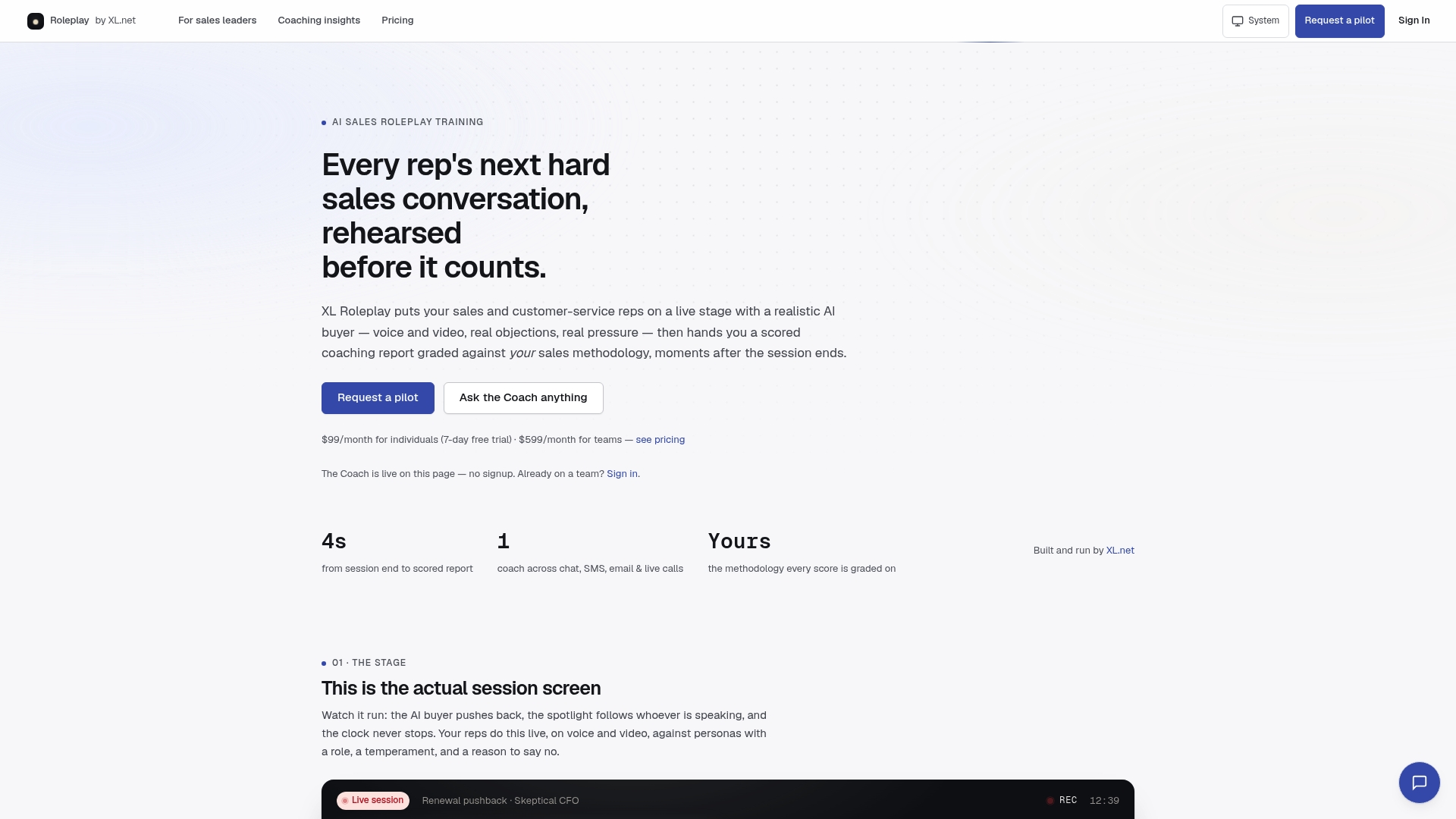
Sales leaders and managers running debrief-based coaching across a team get the most out of this: scored reports tied to playbooks replace hours of manual transcript review. If you want to try the workflow before rolling it out, start with the XL Roleplay pilot.
FAQ
What is the 3-3-3 rule in sales?
Definitions vary across sales teams, and there is no single standardized version of a “3-3-3 rule.” In the context of debriefs, a practical version used by some teams is three core questions, asked within three minutes, within three hours of the call ending.
What are the 7 steps of a sales call?
Most frameworks describe a sequence like: research, opening, discovery, presentation, objection handling, closing, and follow-up. The exact steps and labels vary by methodology, so the debrief should map to whichever framework your team already uses.
What four questions should be asked during a debrief?
A reliable core set asks what the buyer committed to, what evidence supports it, what the next step is and who owns it, and what the rep would do differently next time. These four map directly to CRM fields and coaching notes.
What is the 80/20 rule in cold calling?
This typically refers to the idea that a small share of calls or reps account for most results, though the exact framing varies by source. It is not a fixed statistic, so treat it as a general pattern rather than a precise ratio.
Sources
Internal resources and pilot and pricing links
- Sales Roleplay Debrief: One Behavior, Re-Run: a closer look at identifying one behavior to re-run from a debrief.
- Sales Roleplay Scenarios From Real Calls: turning real debrief misses into practice scenarios.
- One on One Sales Coaching Template: a ready-made template for the 15-minute coaching touch.
- XL Roleplay pricing: plan details for individuals and teams.
- XL Roleplay pilot: try the roleplay and debrief workflow with your team.