Sales Call Openers That Actually Get Prospects to Stay on the Line
Sales Call Openers That Actually Get Prospects to Stay on the Line

The openers that work fall into three buckets: permission-based, trigger-event, and pattern-interrupt. Skip the “how are you today” script. Try these instead.
- Permission ask: “Hey [Name], this is [Your Name] from [Company]. I know I’m calling out of the blue. Do you have 27 seconds for me to tell you why, and you can tell me to get lost?” Use this on a cold first touch without prior context.
- Value/why-I-called line: “[Name], the reason I’m calling is [specific reason tied to their role or a trigger event] — is that something on your radar right now?” Use this when you have a real recent event or change to reference, such as funding, a new hire, or a job posting.
- Pattern-interrupt: “[Name], I’ll be honest, I have no idea if this is relevant to you yet. Got 30 seconds so I can find out?” Use this when the prospect has heard a hundred generic pitches already and you need to break their autopilot.
Each works because it does one thing well: it respects the prospect’s time, names a real reason for the call, or breaks the script the prospect expects. That’s the whole game.
Key Takeaways
Permission-based, trigger-event, and pattern-interrupt openers outperform scripted pitches because they respect the prospect’s time and break autopilot listening.
| Point | Details |
|---|---|
| Lead with permission or context | Ask for a specific amount of time or reference a real trigger instead of pitching immediately. |
| Keep it to 20 to 30 seconds | HubSpot’s guidance and Klenty’s continuation data both point to this as the window that keeps prospects listening. |
| Build openers from four parts | Identify yourself, state the reason, ask permission or frame the time, then add quick value. |
| Practice with real objections | Timed scripts and objection-injection roleplay improve delivery faster than reading a script alone. |
| Use scored roleplay to close the gap | XL Roleplay lets reps test openers against an AI buyer and get a coaching report before the next live call. |
Table of Contents
- Sales Call Openers Explained by Category and Why They Work
- 25 Ready-to-Use Sales Call Opening Lines
- How Long Should a Sales Call Opener Be?
- The Anatomy of a Sales Call Opener That Sets the Agenda
- Practice Drills to Sharpen Your Sales Call Openers
- Common Sales Call Opener Mistakes and How to Fix Them
- What I’ve Learned About Testing Sales Call Openers
- Practice Your Openers Before You Burn Them on Real Prospects
- Frequently Asked Questions
- Sources
Sales Call Openers Explained by Category and Why They Work
Every effective opener leans on one psychological lever: consent, relevance, surprise, honesty, or shared context. Understanding which lever you’re pulling tells you when to use it.
-
Permission-based openers ask for a small yes before asking for anything bigger. “Can I take 30 seconds to explain why I called?” works because it turns the prospect from a passive target into someone who just agreed to something. Gong’s analysis of 300 million calls found these openers outperform pitch-first approaches on continuation rate by a wide margin. Newer reps should lean on this category first. It’s low-risk and easy to deliver naturally.
-
Trigger-event openers reference something specific and recent: a funding round, a new VP, an expansion into a new market. “Saw [Company] just opened a Denver office. Congrats. Is headcount growth part of that push?” This only works when the signal is accurate and current. A stale or generic trigger reads as lazy research, which is worse than no trigger at all.
-
Pattern-interrupt openers break the script the prospect has running in their head. “I know you weren’t expecting this call and probably don’t want it. Fair?” This category is high-risk and high-reward. It requires confident, unhurried delivery. Reps who rush the delivery sound gimmicky instead of disarming.
-
Transparency/honesty openers admit the obvious: this is a cold call, and you’re aware it might be unwelcome. “This is a cold call, so feel free to hang up. But if you’ve got a second, here’s why I called.” This works on skeptical or senior buyers who’ve been burned by scripted pitches before.
-
Rapport/post-email openers reference a prior touchpoint. “I sent an email last week about [topic] — did that land at a bad time, or is this just not a priority right now?” These carry built-in context, so they should feel less cold and more like a continuation.
Pro Tip: Match the category to your data access. If you have zero account intel, lean permission-based. If your CRM or intent tool surfaced a real trigger, use it. Never fake a trigger you don’t have.
25 Ready-to-Use Sales Call Opening Lines
Pick two or three per week, practice them out loud, and track which ones keep prospects talking past the first 30 seconds.
Permission-based:
- “[Name], got 27 seconds? I’ll explain why I called and you can decide if it’s worth more time.” Works because a specific number feels less rehearsed than “a minute.”
- “I know this is out of the blue. Mind if I take 20 seconds to tell you why I called?” Good for a true cold first attempt.
- “Can I ask you one question before I launch into anything?” Buys you a small commitment before the ask.
Trigger-event:
- “Saw [Company] just posted for three [role] positions. Growing that fast usually means [specific pain] shows up. Is that happening?”
- “Noticed [Name] joined as [Title] last month. Congrats. New leaders in that seat usually inherit [specific problem] within the first 90 days.”
- “Read that [Company] closed a Series B. Typically that means [specific initiative] gets prioritized. True for you?”
Pattern-interrupt:
- “Full disclosure, I have no idea if this is relevant. Got 30 seconds so I can find out and stop wasting your time?”
- “You’ve probably had five calls like this today. I’ll try not to make it six.”
- “I’m going to guess you’re not sitting there hoping for a sales call. Fair guess?”
Transparency:
- “This is a cold call. You can hang up, or give me 20 seconds. Your call.”
- “I don’t know you and you don’t know me, so let me earn 30 seconds before you decide if this is worth continuing.”
- “Most people brace for a pitch on calls like this. I’m not going to pitch you yet, I just want to ask one question.”
Rapport/post-email:
- “I emailed you last Tuesday about [topic]. Did that ever cross your desk?”
- “Following up on that note I sent, mostly because I know inboxes are a graveyard. Is [problem] still something you’re dealing with?”
- “We haven’t talked before, but you downloaded [resource] last week. Curious what prompted that?”
Value-first:
- “The reason I’m calling is [specific outcome], and I wanted to see if that’s a priority for [Company] right now.”
- “Companies like yours usually call us when [specific trigger]. Is that where you’re at, or am I off base?”
- “I work with [similar role] at companies your size, and the recurring issue is [pain point]. Sound familiar?”
Multi-touch/voicemail follow-up:
- “This is my second attempt, so I’ll keep it short. [One-sentence reason]. Call me back or I’ll try again Thursday.”
- “Left you a voicemail last week about [topic]. Wanted to try you live in case that’s easier.”
Referral/warm intro:
- “[Referrer] suggested I reach out. Is this a bad time, or can I take 30 seconds?”
- “[Mutual contact] mentioned you’re dealing with [specific issue]. Wanted to see if that’s accurate before I say anything else.”
Executive/senior buyer:
- “I know your time is limited, so I’ll ask directly: is [specific business outcome] on your list of priorities this quarter?”
- “I’ll be brief because I know you didn’t schedule this call. One question: does [problem] cost your team time right now?”
Test these in pairs. Swap one variable at a time (the ask, the reason, the tone) so you know exactly what moved the needle.
How Long Should a Sales Call Opener Be?
Twenty to thirty seconds. That’s the window HubSpot recommends, and it lines up with how attention actually works on a cold call: prospects decide whether to keep listening almost immediately, and a longer wind-up just gives them more time to hang up.
Klenty’s analysis of answered calls found permission openers kept prospects listening past that critical window at notably higher rates than pitch-first openers, with value-first lines close behind. The lesson isn’t just “be brief.” It’s that the first sentence has to earn the second one.
- Day and time patterns worth testing: Dataset trends around optimal call windows shift by industry and role, so treat any general “best day” advice as a starting hypothesis, not a rule. Track your own results by day and hour for at least two weeks before drawing conclusions.
- Sequencing with email: A cold call after a cold email isn’t a fresh cold call. Reference the email directly (“I sent a note last week about X”) rather than pretending it didn’t happen.
- Post-email openers run shorter: you’ve already established a reason for contact, so skip the permission ask and go straight to the follow-up question.
The Anatomy of a Sales Call Opener That Sets the Agenda
A working opener has four parts, and you can fit all four into 15 to 30 seconds if you cut the filler.
- Identify yourself and your company in one breath. No pause, no “how are you today.”
- State the reason for the call in a single sentence. Specific beats generic every time.
- Ask for permission or set a time boundary, which Northwood Group frames as one of four core opening moves, alongside confirming the desired outcome and framing how the call could end.
- Deliver a quick value or context statement that gives the prospect a reason to keep listening past the ask.
Three templates to adapt:
- “[Name], this is [You] from [Company]. Calling because [specific reason]. Got two minutes, and if it’s not a fit, just tell me and I’ll get off your line.”
- “[Name], quick context: I work with [role] at companies dealing with [pain]. Is that relevant to you, or should I not waste your time?”
- “[Name], before I say anything else, can I ask if [specific situation] is something you’re dealing with right now?”
Pro Tip: Framing how the call might end, “if this isn’t relevant, just say so”, removes pressure from the prospect and makes them more likely to engage honestly instead of stalling.
Practice Drills to Sharpen Your Sales Call Openers
Openers fail more often from delivery than from wording. The fix is repetition, not more scripts.
- Mirror and repeat: Say your opener out loud 10 times in a row, varying only your tone, until it stops sounding memorized.
- Timed scripts: Record yourself delivering three openers with a stopwatch. If you’re over 30 seconds, cut words until you’re not.
- Objection-injection roleplay: Have a colleague interrupt you mid-opener with “I’m busy” or “who is this” and practice recovering without losing your structure.
Track three numbers: how often you get past the first 30 seconds, how many calls turn into booked meetings, and a simple 1 to 5 confidence score after each session. Short, daily reps beat occasional long ones for building this kind of muscle memory.
Reps who rehearse with realistic pushback, not just a script read into a mirror, adapt faster once a live prospect throws them off course. That’s the entire case for structured roleplay over solo practice: the objection has to feel unpredictable to train the response.
XL Roleplay’s cold call drills build this exact structure into short, repeatable sessions, and general coaching insights cover how to layer feedback on top of the reps.
Common Sales Call Opener Mistakes and How to Fix Them
Most bad openers fail for one of four reasons, and each has a one-sentence fix.
- Apologizing for calling: Cut it. Replace “sorry to bother you” with a direct reason for the call.
- Pitching before earning attention: Ask a question or get a “yes” first, then pitch.
- Rambling past 30 seconds: Write your opener down and cut it by a third before you ever say it out loud.
- Generic personalization: If your “research” could apply to any company, it isn’t research. Find one specific detail or skip the trigger-event angle entirely.
Watch for red flags in the response, too: a flat “what’s this about” usually means your reason wasn’t clear, so restate it in one sentence. A quick “I’m busy” often just means “convince me it’s worth 20 seconds,” not an automatic no.
What I’ve Learned About Testing Sales Call Openers
The reps who improve fastest aren’t the ones with the cleverest script. They’re the ones who track results and change one variable at a time. Swap the permission ask, keep everything else the same, and run it for a week before touching it again.

Most people give up on an opener after two rejections, which tells you almost nothing about whether it works. Run it 20 times before you judge it. Sales teams using structured roleplay tools like XL Roleplay tend to compress that testing cycle, because a scored practice session surfaces delivery problems that live calls hide behind small sample sizes.
Practice Your Openers Before You Burn Them on Real Prospects
Every opener above sounds good on paper. The gap is delivery, and delivery only improves with reps against real pushback, not another reading of a script. That’s the specific problem XL Roleplay solves for opener practice.
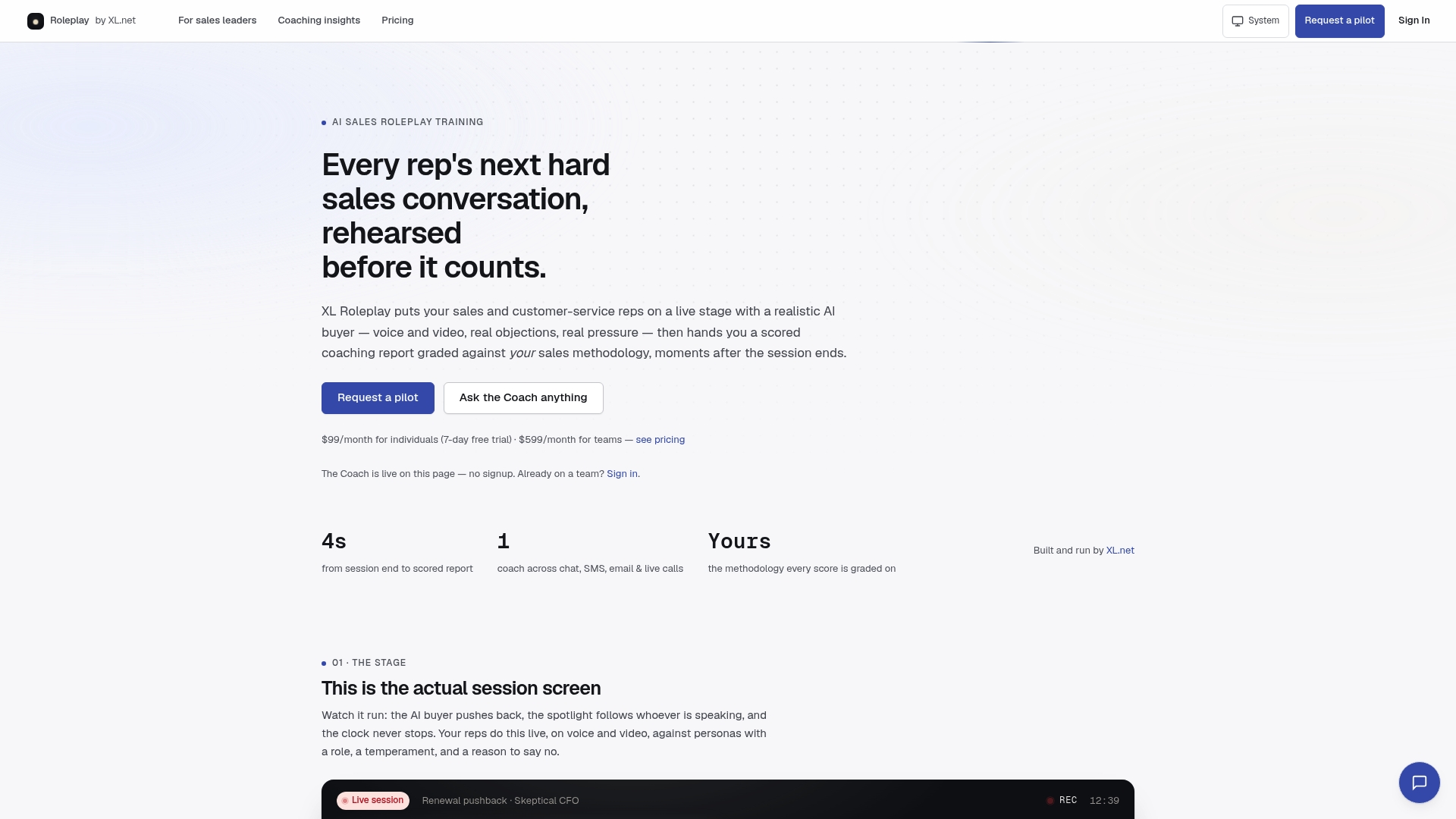
XL Roleplay puts you on a live voice or video call with an AI buyer that throws real objections back at you the moment your opener lands wrong, then hands you a scored coaching report against your own team’s methodology instead of a generic rubric. You get a transcript of exactly where the prospect tuned out, whether that’s the permission ask, the reason line, or the pivot into value. Sales leaders get the same detail across the whole team, so coaching stops being a guess. Managers running team practice can see how the for sales leaders tools turn individual reps’ opener drills into a measurable rollout. Start a session and run your next opener against an AI buyer before you run it against a real prospect.
Frequently Asked Questions
What is the best sales call opener for a true cold call with no prior research? A permission-based opener works best here. Ask for a specific, small amount of time, like 20 or 30 seconds, before saying anything else. It respects the prospect’s control over the call and tends to keep more people on the line than a pitch-first approach.
How do I adapt sales call openers for different buyer personas? Senior or executive buyers respond well to directness: state the business outcome in one sentence and ask if it’s a priority. Mid-level managers often respond better to trigger-event openers that show you’ve done specific homework on their team or department.
How should I handle an immediate objection during the opener? Don’t abandon your structure. If a prospect says “I’m busy,” acknowledge it in one sentence and restate your ask for a specific short amount of time. Most objections at this stage are reflexive, not final.
Should cold call opening lines change for a follow-up after an email? Yes. Reference the email directly instead of opening as if it’s a fresh cold call. Skip the permission ask and move straight into a question about the topic you already raised.
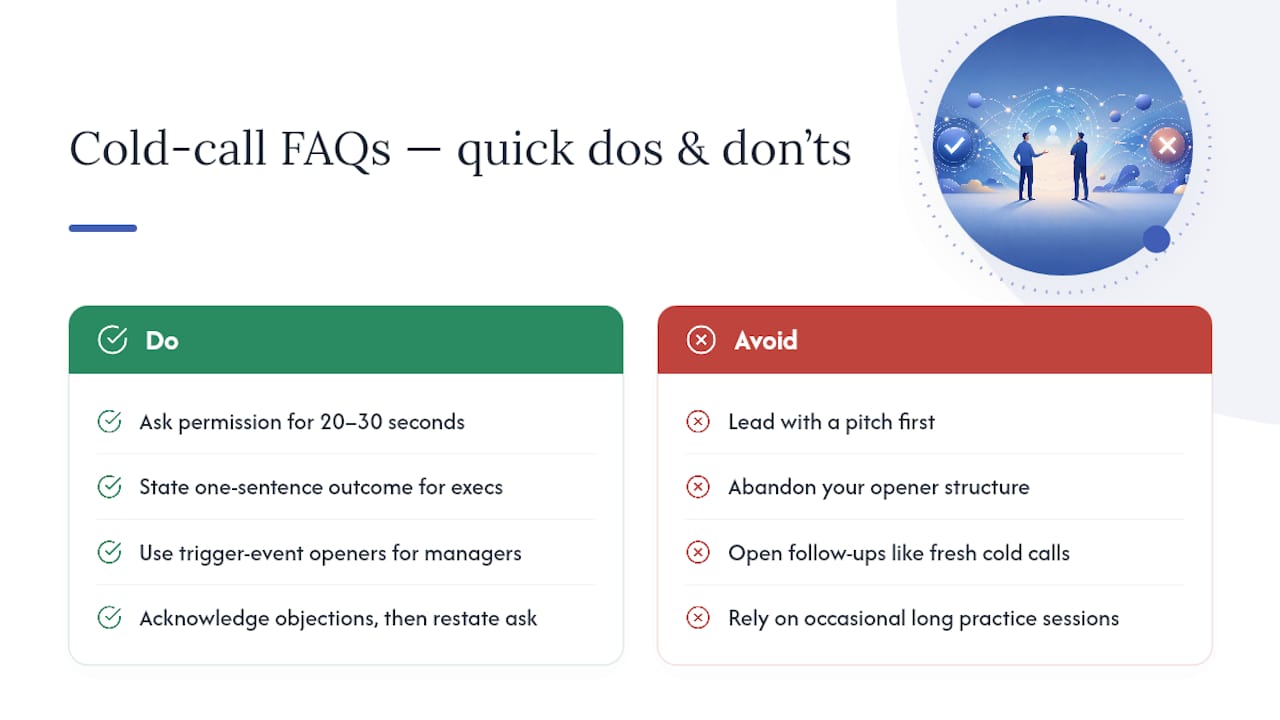
What’s the fastest way to improve at delivering sales call openers? Short, frequent practice beats occasional long sessions. Daily drills, especially ones involving realistic pushback like roleplay with an AI buyer or a colleague, build the muscle memory needed to stay composed on live calls.
Sources
- The best and worst cold call openers (backed by data from 300M calls) | Gong Labs
- What is the best cold call opener to keep prospects on the line? | Klenty
- How to start a sales call | HubSpot (sales blog)