Sales Coaching Scorecards: Practical AI Templates for Managers
Sales Coaching Scorecards: Practical AI Templates for Managers

A sales coaching scorecard is a rubric that grades observable rep behaviors on a call against a fixed set of criteria, so coaching is based on evidence instead of gut feel. If you’re starting today: pick 3 to 6 behaviors tied to deal outcomes, assign one owner and a weekly scoring cadence, and run your first scored call review before Friday.
- Pick metrics: choose behaviors that predict revenue, not everything you can measure.
- Set cadence and owner: weekly scoring, one accountable manager, monthly calibration.
- Run your first review: score one recorded call this week, manual or AI-assisted, and coach one behavior from it.
Whether you score manually or use AI to scan transcripts, the first action is identical: define the rubric before you touch a single recording.
Key Takeaways
A sales coaching scorecard turns subjective call feedback into a shared, weighted rubric that predicts outcomes before they show up in a pipeline report.
| Point | Details |
|---|---|
| Start small | Limit the scorecard to 5 to 7 behaviors directly tied to deal outcomes. |
| Calibrate monthly | Have two managers score the same recorded call to keep scoring consistent. |
| Mix question types | Use yes/no checks for objective items and 1 to 5 scales for subjective quality. |
| Coach leading indicators | Focus 1:1s on behaviors, like discovery depth, not just lagging quota numbers. |
| Pilot for a quarter | Commit to one rubric version for a full quarter before revising it. |
| Practice with AI roleplay | XL Roleplay scores live role-play sessions against your own rubric so reps can rehearse the exact behavior a scorecard flags. |
Table of Contents
- What Is a Sales Coaching Scorecard?
- Why Do Sales Coaching Scorecards Improve Performance?
- How Do You Build an Effective Sales Coaching Scorecard?
- Which Metrics Belong on a Sales Coaching Scorecard?
- What Do AI Scorecards Add, and Where Do They Fall Short?
- What Does a Sales Call Scorecard Template Look Like?
- How Should Scorecards Fit Into Your Weekly Coaching Rhythm?
- How Do You Measure Whether the Scorecard Is Working?
- What Mistakes Undermine a Sales Coaching Scorecard?
- Scoring Role-Play Calls in Practice
- Prioritizing Scorecards in a Coaching Program
- Put Scorecards Into Practice with AI Roleplay
- Frequently Asked Questions
- Sources
What Is a Sales Coaching Scorecard?
A sales coaching scorecard grades specific, observable behaviors and skills on a call against a shared rubric. Instead of asking “how did that call go?” a scorecard asks “did the rep confirm budget authority: yes or no” and “how well did they handle the pricing objection, on a scale of 1 to 5.” It’s a coaching tool built for the individual conversation.
A sales dashboard is different. Dashboards aggregate outcomes: pipeline generated, close rate, average deal size, quota attainment by rep or team. They tell you what happened across many deals, not why it happened on any single call.
- Use a call scorecard when you’re diagnosing a specific skill gap, like discovery depth or next-step language.
- Use a dashboard when you’re tracking team-level trends, forecasting, or comparing reps over a quarter.
You need both. A dashboard might show a rep’s win rate dropping. A scorecard, applied to that rep’s recent calls, tells you the actual behavior driving it, whether that’s a weak discovery question or a rushed close.
Why Do Sales Coaching Scorecards Improve Performance?
Scorecards catch problems before they show up in a pipeline report, and they replace vague feedback (“be more confident”) with specific, repeatable direction. Five benefits stand out for managers running a coaching program:
- Earlier issue detection. A pattern of skipped discovery questions shows up in week two, not in a missed quarterly number.
- Tailored coaching. No two reps have the same gaps, so a scorecard should surface each rep’s individual weak point rather than force everyone through the same generic checklist. There’s no universal coaching model that works for every rep, according to Sandler Training, which frames the scorecard as a tool for finding each rep’s own “success code.”
- Objective feedback. Grading against a written rubric removes the “that felt like a good call” ambiguity that erodes trust between reps and managers.
- Scalable calibration. Once managers score the same sample call and compare notes, the whole team grades consistently.
- Predictive leading indicators. Behavior scores move before outcome metrics do, giving you a head start on coaching.
Pro Tip: If you can only track one leading indicator, track next-step commitment language. It’s one of the tightest correlations between a single behavior and forward pipeline movement.
Vendor research on seller productivity consistently links coaching investment to faster ramp and better output, which is exactly the kind of signal scorecards are built to surface early, according to Salesforce’s State of Sales research.
How Do You Build an Effective Sales Coaching Scorecard?
Building a scorecard is a one-afternoon workshop, not a multi-month project. Follow these steps in order:
- Define the coaching goal. Are you fixing a stalled discovery-to-demo conversion, or shoring up new-hire ramp? Pick one problem to solve first.
- Audit lost deals to find 3 to 5 behaviors. Pull ten recent losses and look for the recurring skill gap: skipped budget questions, weak objection handling, no clear next step.
- Choose question types. Use yes/no for objective checks (“did the rep confirm a next meeting?”) and a 1 to 5 scale for subjective quality (“how well did the rep handle price pushback?”).
- Set weights and targets. Not every behavior matters equally. If next-step commitment drives 40% of your forecast accuracy, weight it accordingly.
- Map your data sources. Decide whether scores come from call recordings, CRM activity fields, or both, and confirm your recording tool captures usable audio.
- Write plain scoring language. A 3 on a 5-point scale should mean the same thing to every manager reading the rubric.
A compact rubric might look like this: discovery question count (weight 20%, target 4+ per call), objection handling quality (weight 25%, scale 1 to 5), next-step commitment (weight 30%, yes/no), talk-to-listen ratio (weight 15%, scale), competitive positioning (weight 10%, scale). Keep the total at 5 to 7 rows. A practical scorecard sticks to items directly tied to deal outcomes, mixing objective yes/no checks with ranged scales for subjective quality, according to Bigmind’s coaching documentation.
Before rolling it out to the full team, pilot it: pick one scorer, sample 10 to 15 calls per rep, run a calibration session where two managers score the same call and compare results, and commit to running the pilot for one full quarter. Tell reps what’s being measured and why before the first scored call, not after.
Which Metrics Belong on a Sales Coaching Scorecard?
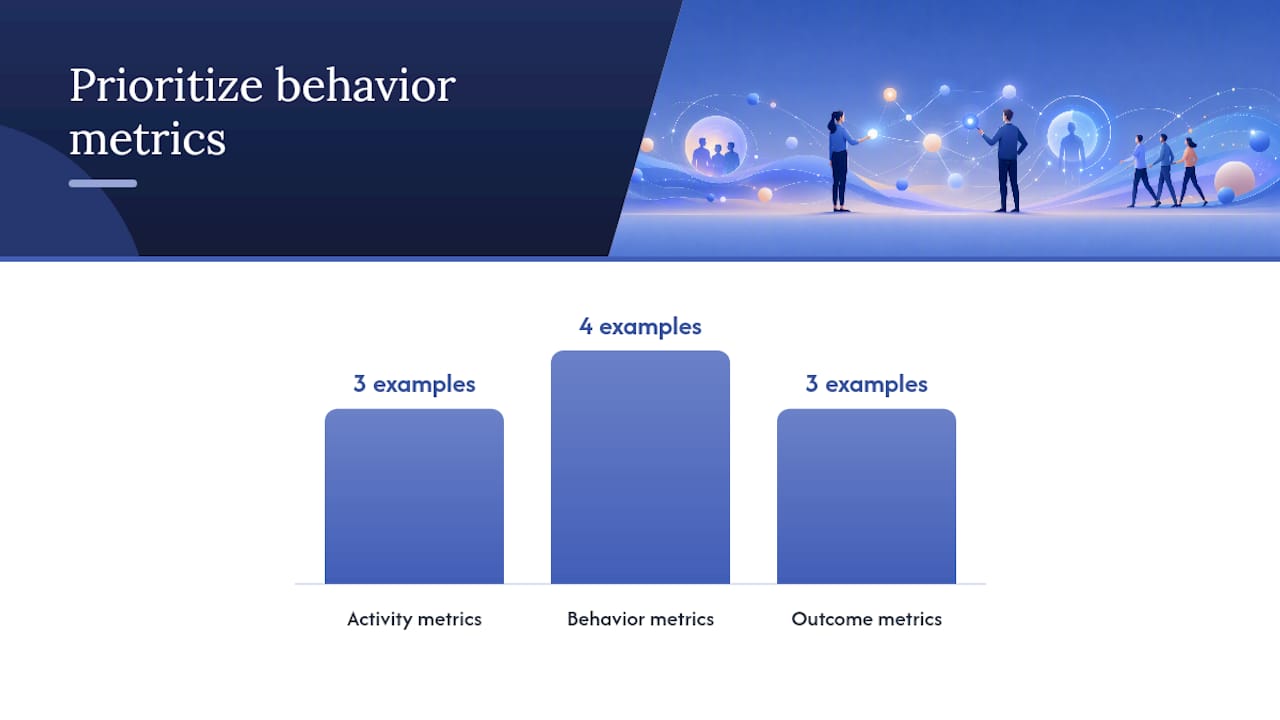
Group your metrics into three buckets, and don’t let any one bucket dominate the sheet.
- Activity metrics: calls made, meetings booked, emails sent. Easy to track, weak on their own as coaching signals.
- Behavior metrics: discovery question depth, next-step commitment language, objection-handling quality, talk-to-listen ratio. This is where most of your coaching weight should sit.
- Outcome metrics: conversion rate, win rate, average deal size. These validate whether the behaviors you’re coaching actually move revenue.
Role changes the mix. A BDR scorecard should weight connect rate and discovery question count heavily, since their job is opening doors. An account executive scorecard should lean on demo value articulation and objection handling, since they’re closing. An account manager’s scorecard should track renewal conversation signals and expansion language, since churn risk shows up in word choice long before it shows up in a renewal date.
Use binary yes/no scoring for anything a manager can check objectively, like “did the rep ask about budget.” Save 1 to 5 scales for judgment calls, like the quality of a value proposition. Every row should trace back to an outcome metric; if you can’t explain how a behavior connects to win rate or deal size, cut the row.
What Do AI Scorecards Add, and Where Do They Fall Short?
AI scoring is genuinely strong at scale work: transcribing calls, calculating talk-to-listen ratios, flagging whether next-step language appeared, and searching thousands of transcripts for a specific objection pattern in seconds. It struggles with nuance, like judging whether a value proposition actually landed with a skeptical buyer or reading sarcasm in a prospect’s tone.
- AI does well: pattern detection, objective yes/no checks, transcript search, consistent scoring at volume.
- AI struggles with: context-specific judgment, subtle value articulation, reading relationship dynamics.
Before turning on AI scoring, run through an AI-readiness checklist: audio quality, recording consent, transcript accuracy, CRM integration, and rubric clarity. AI scoring needs an explicit rubric to work reliably, and objective yes/no items score far more consistently than subjective ones, according to Bigmind.
Pro Tip: Run your rubric through AI and a human manager on the same 10 calls before trusting it solo. Where the scores diverge by more than one point on a 5-point scale, that’s your calibration gap, not the AI’s failure.
Keep manager override in place for any AI-flagged score, and require the AI to show its reasoning, not just a number. Calibration sessions matter just as much here as they do for human scorers.
What Does a Sales Call Scorecard Template Look Like?
A usable spreadsheet template needs these columns: call ID, rep name, date, deal stage, question 1 (yes/no), question 2 (1 to 5 scale), weight, normalized score, manager notes, and rep self-score.
Here’s one worked row: Rep Maria, call on a discovery-stage deal, “confirmed budget authority” scored yes (weight 30%), “objection handling quality” scored 3 out of 5 (weight 25%), next-step commitment scored yes (weight 30%), competitive positioning scored 4 out of 5 (weight 15%). That single number tells the manager exactly what to coach in the next 1:1, rather than a vague “good call, keep it up.”
- Build the template in a shared spreadsheet so reps can see their own self-score next to the manager’s score.
- Adapt the columns to your own sales methodology rather than forcing a generic framework onto your process.
Templates like this typically track calls and progress toward quarterly targets week over week, which keeps scoring lightweight enough that managers actually stick with it, according to the Sales Enablement Collective.
How Should Scorecards Fit Into Your Weekly Coaching Rhythm?
Run scorecards on a three-tier cadence: weekly call score reviews for individual reps, monthly manager calibration to keep scoring consistent across the team, and a quarterly rubric review to check whether the behaviors you’re grading still matter.
A simple coaching meeting script keeps 1:1s focused:
- Rep shares their own self-score on the call first.
- Manager reviews the scorecard and highlights one specific gap.
- Both agree on a single behavior to practice before the next call.
- Manager assigns a practice method and a follow-up date.
- Owner (usually the manager) confirms the behavior gets re-scored the next week.
- Who scores: the direct manager, on recorded calls, not live ones.
- Who validates: a peer manager during monthly calibration.
- When to escalate: if reps consistently dispute scores or the rubric stops predicting outcomes, send it to RevOps for a rubric revision.
Scoring recorded rather than live calls, and calibrating monthly on the same sample, keeps scores consistent across managers, according to Pulse RevOps. Downloadable coaching session agendas can slot directly into step two of that script.
How Do You Measure Whether the Scorecard Is Working?
Track six numbers over a full quarter: ramp time for new hires, quota attainment, win rate, next-step rate, coaching coverage (percentage of reps scored weekly), and self-score alignment (how closely rep self-scores match manager scores).
- Run a staggered rollout. Score half the team weekly for six weeks while the other half continues with informal coaching, then compare ramp and win-rate trends.
- Set a minimum window. Give any pilot a full quarter before drawing conclusions. Behavior changes take a few weeks to show up in outcome metrics.
- Build two reports. One dashboard tracks per-behavior trends across the team; a second flags where manager scores diverge, which is your calibration gap.
Leading indicators from the scorecard and lagging outcomes from the dashboard need to be read together to build a credible case for coaching’s impact, a point Gartner’s peer community research makes directly. A readiness scoring approach can tighten that self-score alignment metric further by giving reps an objective number before the manager ever weighs in.
What Mistakes Undermine a Sales Coaching Scorecard?
The most common failure is scoring too many items. Cap the sheet at 5 to 7 behaviors; anything more turns coaching into paperwork. Inconsistent manager scoring is the second killer. Fix it with monthly calibration on the same recorded call.
- Coaching only to outcomes (win rate, quota) misses the behaviors that actually drive them. Coach the leading indicators instead.
- Changing the rubric every few weeks destroys any ability to compare scores over time. Commit to one version for a full quarter.
- Deploying a scorecard for a territory or system problem wastes everyone’s time. If reps are losing because of pricing or product gaps, no amount of discovery coaching fixes that.
Get recording consent sorted as part of your AI-readiness checklist before scoring a single call, not as an afterthought.
Scoring Role-Play Calls in Practice
Here’s what a scored role-play cycle looks like end to end, using an AI-driven platform built for this exact workflow:
- A rep runs a live role-play scenario against an AI buyer that raises a realistic objection, like a budget freeze or a competitor comparison.
- The system scores the session against the team’s own rubric, not a generic template.
- The manager reviews the transcript and scorecard side by side, spotting exactly where the rep’s discovery stalled or the objection response fell flat.
- The 1:1 focuses on one behavior from that score, not a laundry list.
- The rep practices the same scenario again and gets re-scored to confirm the gap closed.
Roleplay scoring works best for skill-building and onboarding, where you control the scenario and can force repetition on a weak spot. Live-call scoring stays essential for validating that the skill actually transfers to real buyer conversations. The strongest programs run both and compare the scores.
Turning vague feedback into a shared rubric, scoring calls weekly, and re-scoring the same behavior the following week is how a manager actually verifies whether coaching worked.
That loop, borrowed from Pulse RevOps’ coaching guidance, applies just as well to a role-play session as it does to a live call.
Prioritizing Scorecards in a Coaching Program
I’d rather see a manager run one scorecard well on 5 behaviors than juggle three half-built ones. Scorecards earn their spot as the first investment in any coaching program, ahead of new content libraries or extra 1:1 time, because they force you to name what “good” actually looks like before you spend a minute coaching toward it.

Success looks like this: managers scoring consistently within a point of each other, and reps who can predict their own score before the manager gives it. Get calibration right first. Everything else, including which behaviors to weight heaviest, follows from that.
Put Scorecards Into Practice with AI Roleplay
A written scorecard tells you what to coach. It doesn’t give reps a safe place to practice the fix. XL Roleplay closes that gap by running live voice and video role-play sessions against AI buyers that raise the exact objections your rubric is designed to catch, then scoring each session against your own methodology automatically.
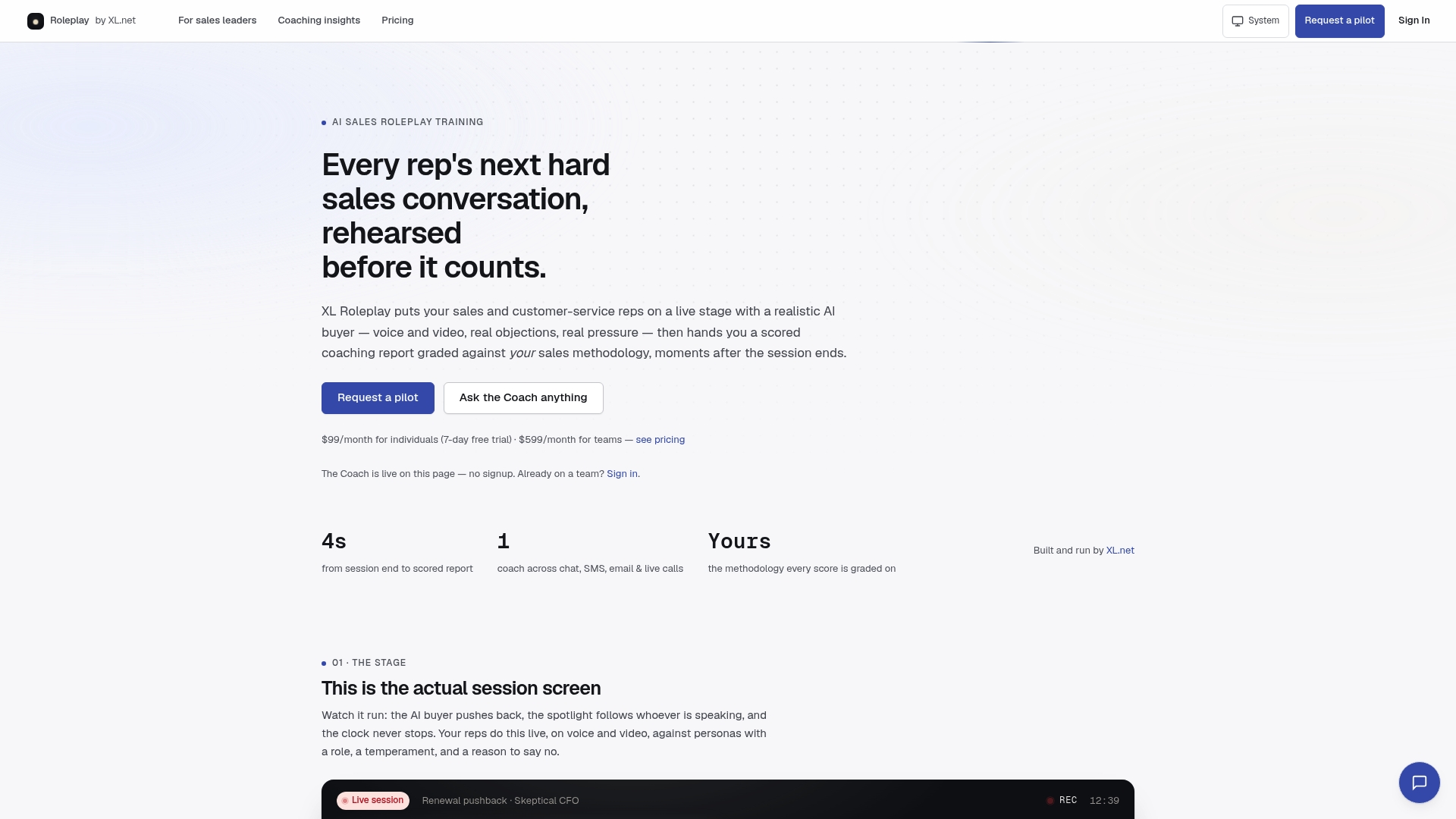
Every session generates a transcript and a scored coaching report, so a manager can review the same behavior twice, once from a real call and once from a role-play, without waiting weeks for the rep’s next live opportunity to test the fix. For a starting pilot, run 2 to 4 reps through weekly role-play sessions over six weeks, score each one against your rubric, and hold a monthly manager calibration to keep the scoring consistent. Visit the sales leaders program page to see how a pilot maps onto your existing coaching cadence, or start a trial directly on the XL Roleplay platform.
Frequently Asked Questions
What is a sales coaching scorecard? It’s a rubric that grades specific, observable rep behaviors on a call, like discovery depth or objection handling, against weighted criteria tied to revenue outcomes.
How is a sales call scorecard different from a sales dashboard? A scorecard evaluates behaviors on individual calls; a dashboard aggregates outcomes like win rate and pipeline across many deals and reps.
How many metrics should a sales coaching rubric include? Keep it to 5 to 7 behaviors. More than that turns scoring into paperwork nobody sustains past the first month.
Can AI reliably score sales calls? AI scores objective, pattern-based items like talk-to-listen ratio and next-step language reliably. Subjective judgment calls, like value articulation quality, still need manager validation.
How often should managers score calls? Weekly for individual rep reviews, monthly for manager calibration, and quarterly for a full rubric review.
How do I know if my scorecard is actually working? Track ramp time, quota attainment, win rate, and self-score alignment over a full quarter, and compare a scored group against an unscored one if you can stagger the rollout.
Sources
- How do you use a scorecard to coach a sales team? | Pulse RevOps
- Scorecards | Bigmind
- Sales rep scorecard template (with example) | Sales Enablement Collective