Make Methodology Stick for Sales Leaders: Manager Cert, CRM Gates
Make Methodology Stick for Sales Leaders: Manager Cert, CRM Gates

Adoption succeeds when the methodology becomes the team’s operating system, not when it stays a training event. Sales reps forget a large majority of what they learn in training within a few months, which is why the highest-leverage move is embedding the method into CRM fields, manager coaching, and deal-desk approval gates so following it becomes easier than avoiding it.
TL;DR:
- Embedding sales methodology into CRM fields, coaching, and approval gates is essential for long-term adoption, not just a training event.
- Consistent reinforcement, visible leadership support, and tool alignment are critical to prevent common rollouts from stalling or failing.
- Full behavioral adoption typically takes several months, with focused pilot programs, manager certification, and ongoing metric tracking.
- Mapping methodology stages to CRM and integrating conversation tools reinforce compliance and facilitate objective coaching.
- Reps are more likely to embrace new frameworks when they see clear, measurable improvements and are involved in feedback and change processes.
Table of Contents
- What drives real sales methodology adoption?
- Why sales methodology rollouts fail (and how to fix each one)
- How do you calculate sales methodology adoption rate?
- What does a realistic rollout timeline look like?
- How do you build a sales methodology into your CRM?
- How should managers get certified before their reps?
- How do you sustain adoption after the initial rollout?
- How does role-play practice accelerate methodology adoption?
- How do you get sales reps to actually buy into a new methodology?
- How should you manage the change process for a methodology rollout?
- How does the methodology fit with your existing sales stack?
- How do you capture feedback from reps to improve the methodology?
- Should compensation change to support the new methodology?
- Should training differ by rep experience and role?
- What rules actually hold a rollout together?
- Give your team a place to practice before it counts
- Sources
What drives real sales methodology adoption?
Most rollouts collapse because leadership confuses a kickoff event with a change program. The methodology has to live inside the tools reps already use and the reviews managers already run.
Start by diagnosing where deals actually stall: is it discovery, multi threading, or forecast accuracy? That gap should determine which framework you pick, not the other way around. Too many teams select a methodology because a competitor uses it, then spend a year fighting a mismatch between the framework and their actual sales motion. Define the operating model, meaning who owns what and how compliance gets checked, before anyone sits through a single training slide.
- Diagnose the gap. Pull win/loss data and pipeline stage conversion to find where deals die, then match a methodology to that specific failure point.
- Pilot with a speed team. Choose five to ten of your most coachable reps and one manager, not your top performers who will succeed regardless of the method.
- Run capability sprints. Four to six-week cycles that certify one behavior at a time beat a single long workshop by a wide margin.
- Certify managers before scaling. A manager who cannot run a discovery call review cannot coach one.
- Enforce with CRM gates. Require methodology fields to be complete before a deal can advance stage, and route exceptions through deal-desk review.
- Layer in temporary incentives. A short-term bonus or SPIF tied to certified, compliant deals accelerates the habit before the gate alone can carry it.
Pro Tip: Give your pilot team a name and a visible dashboard. Teams that can see their own leading indicators improve week over week self-reinforce the behavior faster than any mandate from above.
Why sales methodology rollouts fail (and how to fix each one)
Rollouts rarely die from a bad framework. They die from how the framework gets introduced and reinforced. The Forbes Business Development Council has documented the pattern repeatedly: leadership announces a methodology, runs a workshop, and never touches it again.
Five failure modes show up on nearly every stalled rollout:
- Training as a one-time event. No reinforcement, no re-certification, no coaching cadence tied to it.
- No visible sponsor. If the CRO or VP Sales never references the methodology in a pipeline review, reps assume it is optional.
- Translation tax. Reps juggling MEDDPICC, SPIN, and a homegrown discovery guide simultaneously default to whatever is fastest, which is usually nothing formal.
- Tool misalignment. The CRM still rewards moving a deal to “Proposal” with zero required fields, so the path of least resistance ignores the method entirely.
- Incentive mismatch. Comp plans pay on booked revenue only, so a rep who skips discovery and closes anyway looks like a star.
The fixes map directly to each cause: publish pilot results early to build internal proof, name a single accountable owner per region or segment, collapse overlapping frameworks into one shared vocabulary, audit manager scorecards monthly, and require method compliance as a condition of deal-desk approval.
How do you calculate sales methodology adoption rate?
Adoption rate measures the share of in-scope open opportunities where required methodology fields are complete and current, not just filled in once and forgotten. The standard formula is:
Adoption rate = (opportunities with complete, current required fields ÷ total in-scope open opportunities) × 100
Scope filters matter more than the formula itself. Without them, legacy pipeline distorts the number in both directions.
| Scope filter | Why it matters |
|---|---|
| Deal age (e.g., opened after pilot launch date) | Excludes pre-existing pipeline that predates the rollout |
| Minimum deal size (e.g., ARR above a set threshold) | Prevents small, low-effort deals from inflating the rate |
| Stage threshold (e.g., Stage 2 and beyond) | Early-stage deals may not yet need full field completion |
| Field freshness (updated regularly) | Catches fields filled in once, then left stale |
Reporting straight adoption rate to your executive team too early is a mistake. In the first 60 to 90 days, track leading indicators instead: discovery completeness (percentage of required discovery fields populated per opportunity), stakeholder engagement (number of confirmed contacts per deal), and conversation-score usage (percentage of calls scored against the methodology rubric). Teams with disciplined process adherence convert at a significantly higher rate than undisciplined peers, and that gap is the argument to make once lagging KPIs like win rate and cycle time finally show movement, typically two full quarters into the program.
What does a realistic rollout timeline look like?
A full behavioral adoption arc typically takes several months for most teams larger than 50 reps, and treating it as anything shorter sets up your sponsor for disappointment. The enforcement cadence managers run, not the quality of the initial training, is the single biggest variable in whether that timeline holds.
Pre-launch (weeks 1 to 8). Finalize the methodology-to-CRM field mapping, build the scorecard and inspection script, and draft scenario libraries for role-play practice drawn from real recorded calls. This phase produces the deliverables everything else depends on, so rushing it costs you weeks later.
Pilot (days 1 to 30). Launch with five to ten reps under one manager. Certify that manager first using live scenarios, then certify the pilot reps against specific behaviors, not the whole methodology at once.
Applied certification (days 30 to 90). Reps apply certified behaviors on live deals. Managers audit weekly using the scorecard, and you debrief one behavior at a time and re-run it until it sticks rather than trying to fix everything in a single session.
Scale (months 3 to 6). Roll out to the next cohort using pilot proof points as the internal case. Activate the deal-desk gate so stage progression requires complete methodology fields. Begin call-scoring at volume across the wider team.
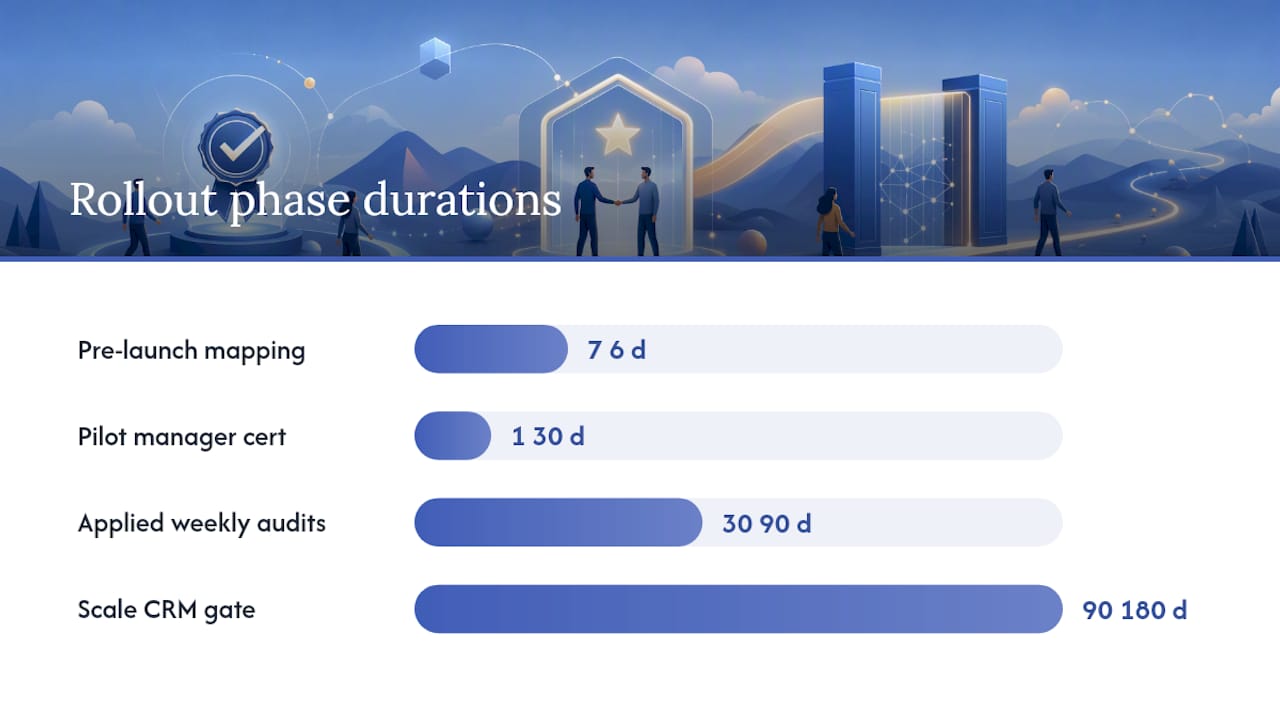
Sustain (months 6 to 9 and beyond). Run quarterly reviews comparing leading and lagging metrics. Retire temporary incentives once the CRM gate alone sustains compliance.
Ownership has to be explicit from day one:
- CRO: public sponsor, references the methodology in every leadership forum, models it personally.
- VP Sales: owns manager certification and the enforcement gate.
- RevOps: owns adoption-rate measurement, CRM field mapping, and dashboard accuracy.
- Enablement: owns scenario content, training sprints, and scorecard design.
How do you build a sales methodology into your CRM?
Your CRM is either your strongest enforcement tool or your rollout’s biggest leak. Mapping methodology stages directly onto CRM pipeline stages, with required fields tied to each stage, turns the system itself into the accountability mechanism.
Map every piece of methodology evidence, whether that is a confirmed economic buyer, a documented pain point, or a validated timeline, to a specific CRM field, and require a buyer-confirmed entry (not a rep’s guess) before the deal can progress. A deal that sits in “Proposal” without a completed decision-criteria field should be visually flagged or blocked outright.
- Require methodology fields as mandatory before stage advancement, not optional.
- Automate reminders when a field goes stale for more than two weeks.
- Trigger manager alerts automatically when a deal skips a required field.
- Pull conversation-intelligence data (call recordings, talk-time ratios, objection mentions) directly into the opportunity record for objective coaching.
- Surface external buyer-engagement signals, like email opens or proposal views, alongside CRM data so managers coach on evidence, not gut feel.
Pro Tip: Do not gate every field on day one. Start with two or three non-negotiable fields tied to your biggest deal-killing gap, then add more once reps trust the system isn’t just extra admin work.
Automations and digital adoption tooling exist specifically to cut the administrative burden that makes reps resent the CRM. If updating a field takes thirty seconds and skipping it takes an email from your manager, the math favors compliance.
How should managers get certified before their reps?
Certify managers first. A manager who has never run a discovery call review under the new framework cannot credibly coach a rep through one, and reps notice the gap immediately.
Plan for a significant time investment per manager for certification, including live scenario practice, scorecard calibration, and shadowed pipeline reviews. That is a real time investment, and shortening it is the most common way programs quietly fail in month two.
- Scenario certification. Managers run live or simulated calls against realistic objections and get scored against the same rubric reps will eventually use.
- Scorecard calibration. A group of managers scores the same recorded call independently, then compares results until scoring converges within an acceptable range.
- Shadowed pipeline review. A senior enablement lead or RevOps partner sits in on a manager’s first two weekly pipeline reviews to confirm the inspection script is actually being used, not just referenced.
- Independent certification. The manager runs a full weekly review solo, and that session gets audited against the scorecard.
Give managers an inspection script, not a vague instruction to “check the pipeline.” A script that asks the same five questions every week (what’s the confirmed pain, who’s the economic buyer, what’s the next mutual action) turns a subjective conversation into a repeatable audit. Transcripts and scorecards from practice sessions give managers concrete evidence to point to in coaching conversations instead of relying on memory or gut feel. Publishing a completion leaderboard, showing which managers have certified and which reps are compliant, keeps attention on the program past its first exciting month.
How do you sustain adoption after the initial rollout?
Short-term incentives are for launch, not for life. A SPIF tied to certified, compliant deals gets initial behavior moving, but the deal-desk approval gate is what keeps it in place once the incentive budget runs out. Treat the incentive as training wheels, not the permanent mechanism.
- Retire temporary bonuses once the CRM gate shows sustained compliance above your target threshold for two consecutive quarters.
- Run quarterly reviews that compare leading indicators (field completeness, engagement scores) against lagging KPIs (win rate, cycle time, average deal size).
- Use that quarterly data to decide the next capability sprint rather than guessing which skill needs reinforcement.
- Fold methodology certification into new-hire onboarding from day one, so it is never treated as an optional add-on for tenured reps only.
- Require annual re-certification for every rep and manager, not a one-time badge that never expires.
Programs that skip re-certification tend to drift back toward pre-rollout habits within a year, quietly, without anyone flagging it until win rates slip.
How does role-play practice accelerate methodology adoption?
Reading a playbook and applying it under pressure are different skills, and the gap between them is where most methodology adoption quietly dies. Repeated simulated practice with immediate scored feedback closes that gap faster than a workshop ever will, because reps build muscle memory against realistic objections before those objections show up on a call that actually matters.
Xl gives managers exactly the kind of evidence certification requires: scored transcripts, rubric-based feedback tied to the organization’s own methodology, and a record of which behaviors a rep has actually demonstrated under pressure, not just discussed in a meeting.
The real test of methodology adoption isn’t whether a rep can explain the framework in a training session. It’s whether they can execute it live, against a buyer who’s actively pushing back, without freezing or reverting to old habits.
Detailed platform usage benchmarks and customer case studies will follow as more organizations complete full rollout cycles on the platform. What is already clear from practitioner rollout guidance is that structured, repeated scenario practice shortens the distance between “trained” and “certified.”
How do you get sales reps to actually buy into a new methodology?
Reps buy in when they see the method solve a problem they already feel, not when they are told to comply. Open the rollout by naming the specific pain the methodology addresses, like deals stalling in the same stage for months, rather than framing it as a compliance requirement from above.
Share pilot results early and specifically. A vague “the pilot went well” convinces no one. A stat like “the pilot cohort’s average discovery call length dropped by four minutes while stakeholder count per deal went up” gives skeptical reps something concrete to weigh. Publicizing those numbers inside the pilot group before wider rollout turns early adopters into internal advocates who talk to peers more credibly than any manager memo.
Two-way communication matters as much as the announcement itself. Hold small group sessions where reps can push back on specific framework elements before full rollout, not after. A rep who feels heard on one detail, even a minor one, is far more likely to accept the parts of the framework they cannot negotiate.
Language matters too. Avoid framing the methodology as “extra work.” Frame it as replacing ad hoc habits that were never formally taught with a structure that gives reps a repeatable answer when a deal gets complicated. Reps resent added process; they welcome a framework that makes hard calls easier to navigate.
Finally, keep the message consistent from every level of leadership. If a VP references the methodology in the all-hands but a frontline manager never mentions it in one-on-ones, reps correctly read that gap as “this isn’t really required.”
How should you manage the change process for a methodology rollout?
Treat a methodology rollout as a change management initiative with its own project plan, not an enablement side project squeezed into an already full calendar. That distinction shapes almost every decision that follows.
Communicate the change in stages rather than one big announcement. A kickoff email followed by silence signals that the initiative was a moment, not a mandate. Instead, build a visible communication cadence: a launch announcement, pilot result updates, certification milestones, and a public timeline for when the rest of the team rolls in.
Address resistance directly instead of hoping it fades. Some reps will resist because the old way worked well enough for them personally. Others resist because they’ve survived a failed rollout before and assume this one will fade too. Naming that history openly, and pointing to concrete pilot evidence that this rollout is different, defuses more resistance than any mandate memo.
Sequence the change so wins compound. The pilot cohort’s success becomes the proof point for cohort two, and cohort two’s results become the case for company-wide scale. Skipping straight to a broad launch throws away that compounding credibility.
Assign a single accountable owner for the change itself, distinct from who owns the methodology content. RevOps or a program manager tracking milestones, blockers, and adoption metrics on a visible dashboard keeps the initiative from drifting once the initial launch energy fades. Without that owner, momentum tends to die quietly around month three, right when the novelty wears off and the real behavioral work begins.
How does the methodology fit with your existing sales stack?
CRM gating is the anchor, but methodology has to show up everywhere a rep actually works, not just inside opportunity records. A framework that lives only in the CRM while sales enablement content, call scripts, and proposal templates all use different terminology creates exactly the translation tax that kills adoption.
Audit every tool in your stack for methodology alignment: your sales engagement platform’s email and call sequences, your proposal or quoting software’s stage triggers, your onboarding LMS content, and your battle cards for competitive deals. Each should reference the same vocabulary and the same required evidence the CRM demands.
Discovery call guides deserve particular attention, since discovery is where most methodologies live or die. A ready-made bank of discovery workshop questions adapted to your specific framework gives reps a starting point rather than a blank page, which matters most for newer hires still building comfort with open-ended questioning.
Conversation-intelligence tools deserve a direct integration, not a parallel system reps have to check separately. If your call-recording platform can push objection-handling and discovery-completeness signals straight into the CRM record, managers get one dashboard instead of three browser tabs to reconcile before a coaching conversation.
The test for any tool in your stack: does it reinforce the same method the CRM enforces, or does it quietly let reps default to an older habit? If the answer is the latter, that tool needs remapping before it undermines the gate you’ve built everywhere else.
How do you capture feedback from reps to improve the methodology?
Methodology rollouts that never change based on rep feedback tend to calcify into rules reps follow without believing in. Building a real feedback loop, not a suggestion box nobody checks, keeps the framework credible and current.
Structure feedback collection around specific friction points rather than open-ended “any thoughts?” surveys, which produce vague answers nobody can act on. Ask reps which required CRM field feels redundant, which scorecard criterion doesn’t match how buyers actually respond, and where the scenario library doesn’t reflect the objections they’re hearing this quarter.
Manager one-on-ones are the fastest feedback channel available, faster than any survey cycle. A manager who hears the same complaint about a clunky field from three reps in one week should be able to escalate that pattern to RevOps within days, not wait for a quarterly review cycle to surface it.
Treat pilot cohorts as standing feedback sources even after they scale past pilot status. The reps who lived through the roughest version of the rollout usually have the sharpest opinions about what needs fixing, and they’ve earned enough credibility with peers that their endorsement of a change carries weight.
Close the loop visibly. When feedback leads to an actual change, like simplifying a field or updating a scenario, announce it and credit the source. Reps who see their input shape the program stay engaged with it; reps who feel ignored quietly stop bothering to flag problems at all, which is a worse outcome than the original friction.

Should compensation change to support the new methodology?
Comp plans send a louder message than any training deck ever will. If reps get paid the same whether they follow the methodology or skip it entirely, most will optimize for whatever closes fastest, formal process included or not.
That does not mean rebuilding your entire compensation plan around methodology compliance. It means adding a short-term lever during rollout and a longer-term structural nudge afterward. A temporary SPIF tied to certified, compliant deals, paid out for deals that pass deal-desk review with complete methodology fields, gets initial adoption moving faster than a mandate alone.
Longer term, some organizations tie a portion of variable compensation as a plan modifier to methodology compliance metrics like adoption rate or certification status, though the exact structure depends heavily on your existing plan design and should involve finance and sales ops before rollout, not after.
Recognition matters alongside cash. Publicly crediting the first cohort to hit full certification, or the manager whose team shows the sharpest adoption-rate improvement, costs nothing and reinforces the same behavior comp dollars are meant to drive.
Avoid the trap of punishing non-compliance before the framework has had time to prove itself. A rep penalized for skipping a field in week two of a pilot, before training even finished, will resent the program permanently. Sequence consequences after the certification window closes, not during it.
Should training differ by rep experience and role?
A tenured rep with eight years of pattern recognition and a new hire in their first ninety days need fundamentally different onboarding paths into the same methodology, even though the end certification standard should stay identical for both.
New hires benefit from a longer runway inside the framework itself: teach the methodology as their default operating model from day one, rather than layering it on top of habits they haven’t formed yet. This is actually the easiest population to certify, since there’s no old habit to unlearn.
Tenured reps need the opposite approach. Acknowledge what already works in their current process, then show specifically where the new framework closes a gap their instincts miss, like a consistent way to document multi-threading progress that their gut-feel approach never captured. Framing the change as an upgrade to their existing skill, not a replacement for it, reduces the defensiveness that experienced reps often bring to new process.
Role also matters beyond tenure. An SDR focused on qualification needs deep scenario practice on early discovery and objection handling, while an account executive closing complex deals needs more time on negotiation and stakeholder mapping. Building role-specific scenario libraries rather than one generic training track respects that reps at different stages of the funnel face genuinely different pressure points, and generic content tends to feel irrelevant to at least half the room.
Sales engineers and customer success handoffs, where relevant, need a lighter-touch version focused on the specific fields and terminology they’ll encounter, not the full certification depth reps carry.
What rules actually hold a rollout together?
Every rollout I have studied that stuck shares a few non-negotiables, and they are less about the framework chosen than about who owns the follow-through.
Public executive sponsorship needs to last at least six months, not one kickoff email. Managers get certified before a single rep does, and a small pilot beats a company-wide launch every time. Most of all, let data pick your next sprint. If the numbers say discovery completeness lags while stakeholder engagement is strong, that is your next four weeks. Evidence beats opinion, every time.
— Adam
Give your team a place to practice before it counts
Every playbook above depends on one thing: reps applying certified behaviors under real pressure before a live deal is on the line. Xl gives sales leaders and enablement teams exactly that environment, live voice and video sessions with AI buyers built to raise the objections and pressure tactics your reps actually face, scored against your own methodology’s rubric.
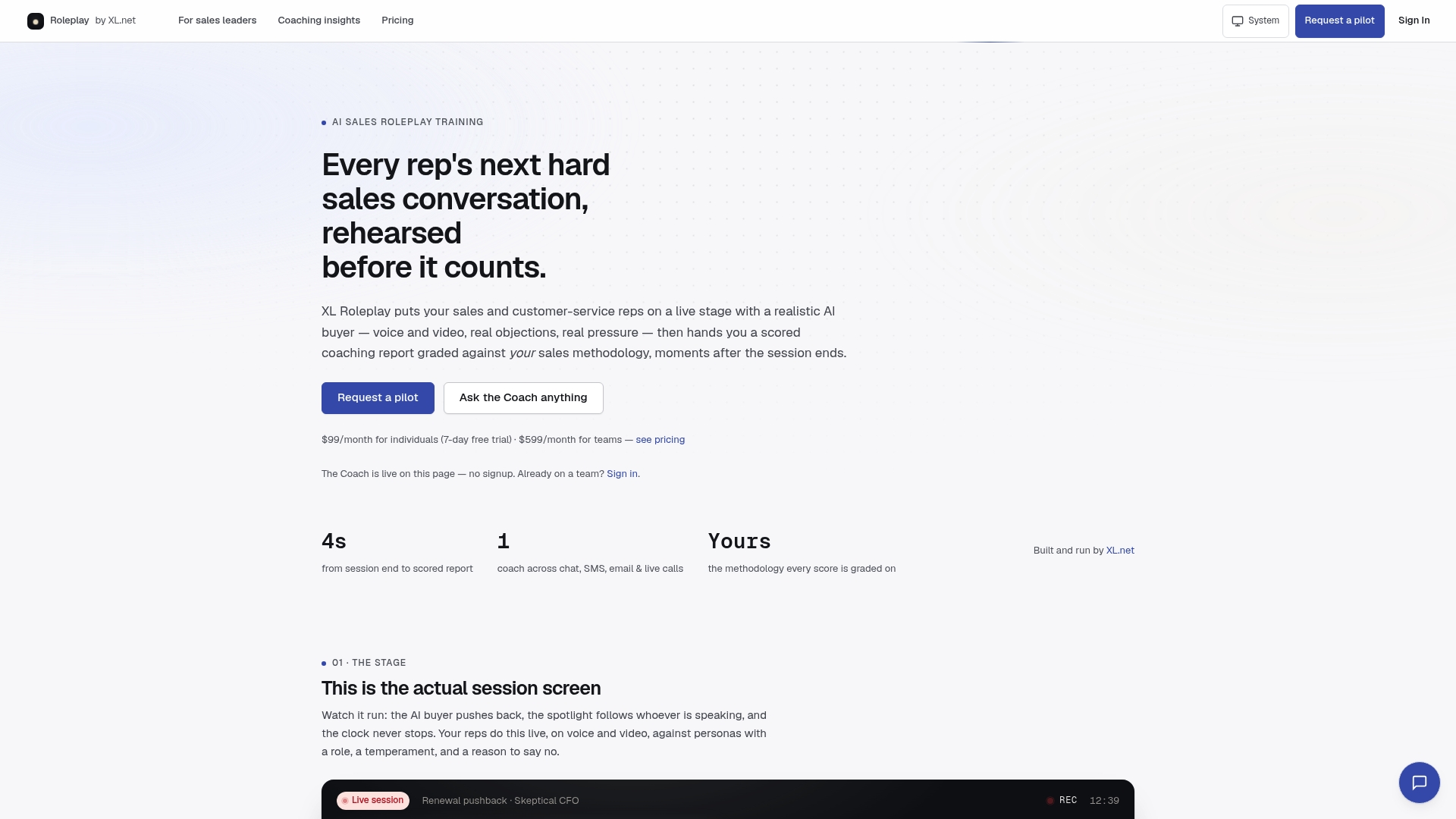
Instead of waiting for a quarterly business review to reveal a coaching gap, managers get scored transcripts after every session, the same evidence a certification audit requires, without waiting on a live call to go wrong first. Capability sprints get a practice ground that matches the certification gates you’re already building into the CRM, so reps arrive at their first live deal having already run the objection, not guessing how to handle it in real time.
If you’re planning a rollout or trying to fix a stalled one, see how XL Roleplay supports sales leaders running capability sprints and manager certification, or start a session on the platform to see how scored role-play fits into your next sprint.
Sources
- Why Most Sales Methodology Rollouts Fail (And What The Best CROs Do Differently) - Forbes
- Sales Methodology Adoption Rate - ORM Technologies
- How to roll out a new sales methodology across 100+ reps in 2027 - PulseRevOps