Sales Onboarding Checklist: Your 30–60–90 Day Ramp Plan
Sales Onboarding Checklist: Your 30–60–90 Day Ramp Plan

A sales onboarding checklist is a prioritized, milestone-driven list of tasks and certifications that moves a new rep from signed offer to productive selling as fast as possible. The single most important action you can take right now: complete every pre-boarding item before Day 1, then gate progress through a 30–60–90 day ramp plan with clear pass/fail checkpoints.
Before your new hire walks in (or logs on), these items must already be done:
- Hardware shipped and confirmed delivered
- CRM access provisioned and SSO credentials tested
- Sequencing tool and call recording logins verified
- Peer buddy assigned and briefed
- Week-one roadmap shared via email
Miss any of these and you’ve already lost a day. Pre-boarding tasks completed between offer and Day 1 are the single highest-leverage items on the entire checklist. The rest of this guide gives you the full 30–60–90 plan, the metrics to track, and a template you can copy today.
Key Takeaways
A structured sales onboarding checklist built around 30–60–90 competency gates, deliberate practice, and clear ownership is the most reliable way to shorten ramp time and improve first-year quota attainment.
| Point | Details |
|---|---|
| Pre-board before Day 1 | Provision CRM, hardware, and buddy assignment before the hire arrives to eliminate Day 1 friction. |
| Gate progress at 30/60/90 | Use pass/fail certification checkpoints so advancement is earned, not assumed by time elapsed. |
| Track lead indicators first | Monitor call volume and certification pass rates in Weeks 1–6 before pipeline data is meaningful. |
| Assign every task an owner | Map HR, IT, manager, and buddy responsibilities using a RACI to prevent items from falling through. |
| Practice beats passive training | Scored roleplay sessions produce evidence-based readiness data that replaces subjective manager recall. |
| Xl accelerates competency gates | Xl’s AI roleplay sessions, transcripts, and readiness scoring map directly to checklist certification items. |
Table of Contents
- Why does structured sales onboarding cut ramp time?
- What goes on every sales onboarding checklist?
- The 30–60–90 day checklist with certification gates
- Which tools belong on the checklist from Day 1?
- How do you measure whether onboarding is working?
- Adapting the checklist for remote and hybrid hires
- How to build a scalable onboarding program
- Xl Roleplay turns practice reps into pipeline-ready reps
- Sources
Why does structured sales onboarding cut ramp time?
The business case is straightforward. Reps who go through a structured onboarding process reach full productivity faster, hit quota more often in their first year, and are less likely to quit before the 12-month mark. The cost of a failed sales hire, when you factor in recruiting, salary, and lost pipeline, runs well into six figures for most organizations.
- Faster time-to-productivity: A phased 90-day plan with competency gates at 30, 60, and 90 days and five core modules (product, ICP, methodology, tools, manager 1:1s) is the operational backbone of effective onboarding.
- Higher quota attainment: Structured enablement correlates with higher quota attainment when combined with role-specific practice.
- Lower attrition: Reps who feel prepared and supported in the first 90 days are significantly less likely to leave before they’ve had a chance to ramp.
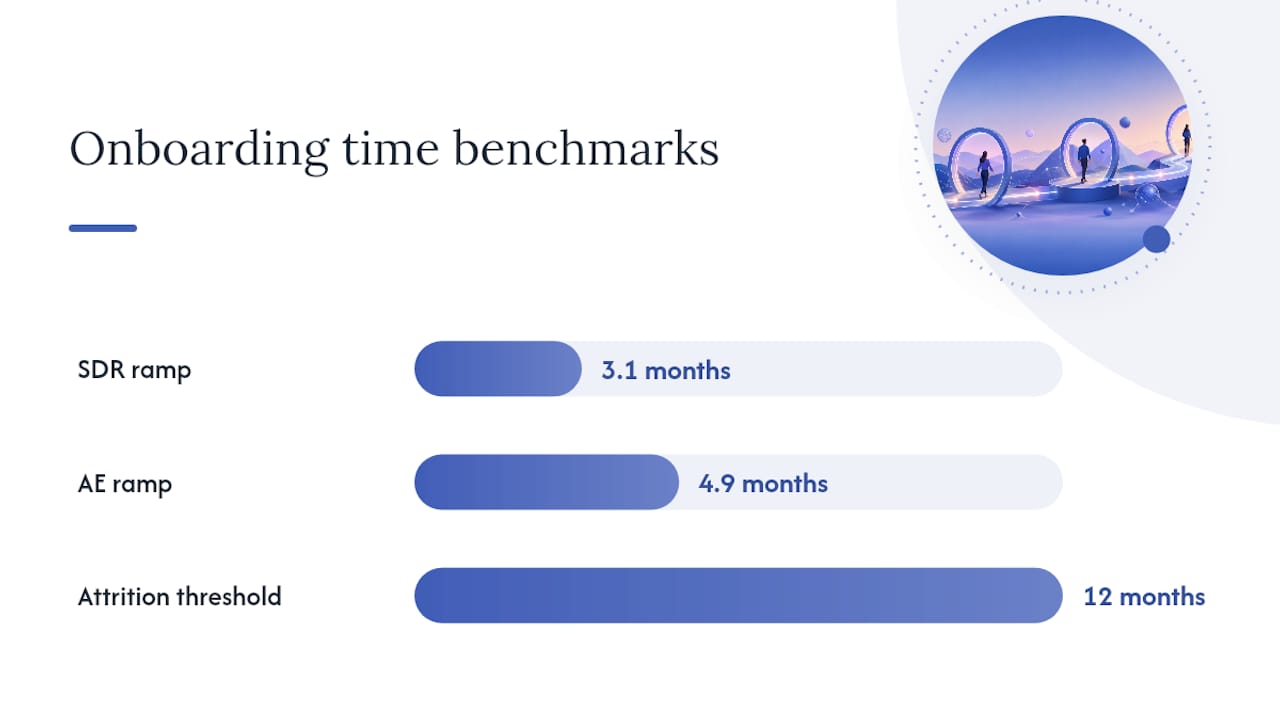
Role-based benchmarks give you a realistic target: SDRs typically ramp in about 3.1 months, AEs in about 4.9 months. Those numbers assume deliberate practice and clean prospecting data. Without structure, both timelines stretch.
Pro Tip: Track lead indicators first. Call volume, training completions, and certification pass rates tell you whether a rep is on track weeks before pipeline or revenue data can. Don’t wait for a missed quota to find out the onboarding failed.
What goes on every sales onboarding checklist?
Every effective sales induction checklist covers the same core modules, regardless of company size or sales motion. Here’s what to include:
Pre-boarding (before Day 1)
- Ship hardware; confirm delivery date
- Provision CRM, SSO, sequencer, and call recording logins
- Assign peer buddy and schedule their first 1:1 with the new hire
- Share a written week-one roadmap with times, owners, and links
Day 1 orientation
- HR paperwork and benefits enrollment completed
- IT check: all logins verified, VPN tested, email confirmed
- Company pitch and mission walkthrough (30 minutes max)
- Meet the immediate team and key cross-functional contacts
Product and ICP training
- Product demo walkthrough (rep watches, then delivers)
- ICP and persona profiles reviewed and discussed
- Written product knowledge assessment passed at a defined score threshold
Sales methodology and playbooks
- Discovery framework taught (MEDDPICC, SPIN, or your company equivalent)
- Qualification criteria documented and tested via roleplay
- Objection handling playbook reviewed and practiced
Tools and CRM hygiene
- CRM: sample deal logged, pipeline stages understood
- Sequencer: first sequence built and reviewed by manager
- Call recording: first recorded call reviewed with manager
Mentoring and deliberate practice
- Shadow schedule set: three calls in Week 1, five in Week 2
- First recorded roleplay submitted and scored
- Call review cadence established (weekly minimum)
Manager responsibilities
- 1:1 cadence set (weekly for first 90 days)
- Scorecard template shared with rep at Day 1
- Certification gates communicated with pass criteria in writing
Checklist phrasing matters. Write tasks as actions with an owner and an artifact: “Rep logs a sample deal in CRM by end of Day 3 — manager verifies.” Vague tasks like “learn the CRM” produce vague results.
The 30–60–90 day checklist with certification gates
The three-phase framework maps to three modes: absorb (Days 1–30), apply (Days 31–60), and accelerate (Days 61–90). Each phase ends with a certification gate. A rep who can’t pass the gate doesn’t advance, regardless of how much time has elapsed.
| Phase | Primary objectives | Sample tasks | Acceptance criteria |
|---|---|---|---|
| Days 1–30 | Product fluency, tool access, methodology foundation | Product cert, CRM hygiene check, first recorded roleplay, shadow 10+ calls | Pass product knowledge assessment, CRM deal logged, roleplay scored by manager |
| Days 31–60 | Apply methodology, run live discovery calls, build pipeline | MEDDPICC scorecard on 3 real opportunities, deliver a full demo, first qualified opportunity logged | Demo scored ≥70% on rubric, at least 1 qualified opportunity in CRM, discovery call reviewed |
| Days 61–90 | Full-cycle ownership, quota contribution, independent prospecting | Run a full sales cycle from discovery to close attempt, hit ramp quota (a moderate portion of full quota), objection handling cert | Ramp quota achieved, full-cycle simulation passed, manager sign-off on readiness |
Certification gates covering product knowledge, discovery, demo, objection handling, and full-cycle simulations with documented pass criteria are what make a checklist auditable rather than aspirational. Without them, “onboarding complete” means nothing.
The activity-to-output transition is deliberate: in Month 1, weight expectations toward training completions and certifications; by Month 3, shift to pipeline and ramp quota.
To use this as a template, copy the table into Notion, Google Docs, or your LMS. Add a column for “Owner” and one for “Completion Date.” For a paste-ready week-by-week version, the 30–60–90 ramp plan from Xl maps artifacts and competency gates by week.
Pro Tip: Onboard in cohorts when possible. A cohort of two to four reps lets you run group certification sessions, compare scores across the group, and identify whether a low score reflects the rep or a gap in your training content.
Which tools belong on the checklist from Day 1?
Keep it minimal. Three tools on Day 1, nothing more:
- CRM (Salesforce, HubSpot, or equivalent): the rep must log a deal and navigate the pipeline before end of Week 1
- Call recording / conversation intelligence (Gong, Chorus, or equivalent): first recorded call reviewed within the first week
- Sequencer or email tool (Outreach, Salesloft, or equivalent): first sequence built and approved by manager
Add an LMS or enablement platform once your onboarding volume justifies it. Stacking six logins on Day 1 guarantees cognitive overload and poor adoption across all of them. Deliberate tool selection — CRM, call recording, and verified prospecting data as the day-one essentials — materially shortens ramp.
Writing tool acceptance checks
Every tool on the checklist needs a pass/fail check, not just a login. Examples:
- “CRM login verified + sample deal logged with correct stage and close date by end of Day 3”
- “First sequence built in Outreach and reviewed by manager by end of Week 1”
- “First recorded call uploaded to Gong and reviewed in 1:1 by Day 10”
Xl Roleplay in the onboarding checklist
Roleplay belongs in the checklist from Week 2 onward. Xl’s AI-driven roleplay platform runs live voice and video sessions with realistic AI buyers, scores each session against your sales methodology, and produces a transcript the manager can review in the next 1:1. That means the rep gets immediate feedback, and the manager gets an evidence-based artifact instead of a gut feeling.
Checklist items that reference Xl:
- “Complete discovery roleplay session in Xl by Day 10 — readiness score reviewed in Week 2 1:1”
- “Submit demo roleplay in Xl by Day 45 — score ≥70% required to advance to live demos”
- “Objection handling session completed in Xl by Day 60 — transcript reviewed with manager”
For managers evaluating whether to add a roleplay platform, the buyer’s checklist from Xl covers the key criteria.
How do you measure whether onboarding is working?
Track by cohort, not by individual hire. Aggregated data hides whether a low performer reflects a training gap or a hiring mistake.
Leading metrics (Weeks 1–6)
- Training completion rate by module
- Certification pass rates (first attempt vs. retake)
- Call volume and activity levels
- CRM data quality score (fields completed, stages accurate)
Lagging metrics (Months 2–6)
- Time-to-first-deal
- Quota attainment at 30, 60, 90, and 180 days
- Win rate on first 10 opportunities
- Pipeline coverage ratio at Day 90
Tracking cohorts using both quota attainment at 30/60/90/180 days and training completion rates gives you the full picture: whether reps are completing the program AND whether it’s translating to revenue.
Sample manager scorecard fields for 30/60/90 reviews
| Review | Fields to score |
|---|---|
| Day 30 | Product cert pass/fail, CRM hygiene, roleplay score, call shadow count |
| Day 60 | Demo score, MEDDPICC adoption, qualified opportunities logged, discovery cert |
| Day 90 | Ramp quota attainment (%), full-cycle simulation pass/fail, manager readiness sign-off |
Role benchmarks give you a sanity check: SDRs at roughly 3.1 months and AEs at roughly 4.9 months are realistic targets when the program includes deliberate practice. If your cohort is running significantly longer, the checklist itself is the first place to audit.
Sales enablement and coaching technology has evolved to provide scaled, data-driven feedback loops that support frequent coaching and faster ramp. A sustainable coaching cadence is what keeps those feedback loops running after the formal onboarding period ends.
Adapting the checklist for remote and hybrid hires
Remote onboarding doesn’t require a different philosophy, just different logistics. The structure stays the same; the delivery changes.
Pre-boarding adjustments:
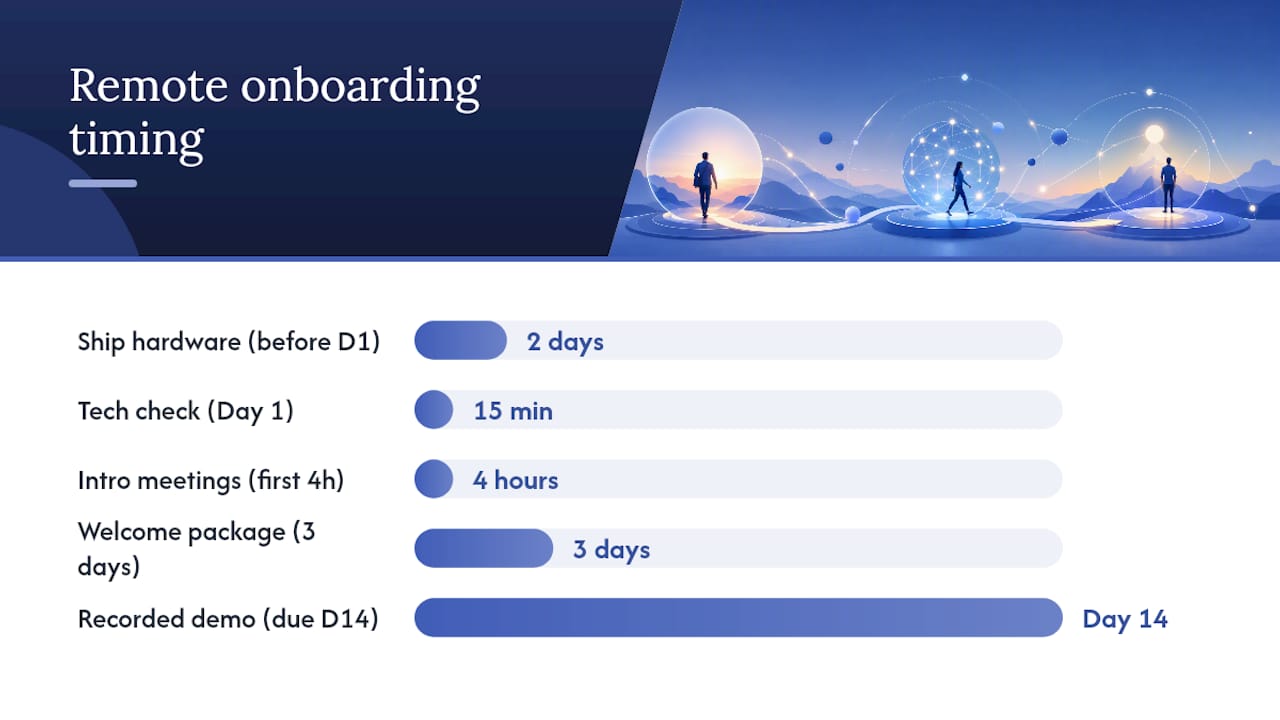
- Ship hardware with enough lead time to arrive two days before Day 1 (not the day of)
- Send a digital access verification checklist the new hire completes independently before their first call
- Schedule a 15-minute “tech check” call on the morning of Day 1 to confirm everything works
Day 1 for remote hires:
- Virtual orientation: a recorded company overview the rep watches async, followed by a live Q&A
- Intro meeting sequence: manager, buddy, and two teammates in the first four hours
- Digital tool tour: screen-share walkthrough of CRM, sequencer, and call recording
Remote-specific checklist items:
- Recorded demo submitted asynchronously by Day 14 (manager reviews and comments in Loom or equivalent)
- Live roleplay session scheduled in Xl for Week 2 (replaces in-person call shadowing when geography makes it impractical)
- Async call review: rep submits a recorded call with self-assessment notes before the 1:1
Remote onboarding works best when administrative tasks move entirely to pre-boarding, leaving Day 1 free for human connection and tool orientation.
Pro Tip: Time the welcome package to arrive on Day 1, not before. A box that sits unopened for three days loses its impact. Include a handwritten note from the manager and a printed copy of the week-one roadmap.
How to build a scalable onboarding program
A checklist that works for one hire needs an operational backbone to work for ten. Here’s the build sequence:
Step 1: Audit what you have
Ask three questions: What’s the current average ramp time by role? Where do new hires most often get stuck or fail in the first 90 days? Which checklist items have no clear owner? The answers tell you where to start.
Step 2: Build the playbooks
(AE demo scripts). Write every task as an action with an owner and an artifact. “Review the pitch deck” becomes “Rep delivers a 10-minute pitch to manager by Day 7 — recorded and scored.”
Step 3: Assign a RACI
Every checklist item needs one owner. A simple ownership model:
- HR: pre-boarding paperwork, benefits enrollment, system access requests
- IT: hardware delivery, SSO provisioning, login verification
- Manager: 1:1 cadence, scorecard reviews, certification sign-off
- Buddy: informal guidance, call shadows, first-week check-ins
Assigning owners for every checklist item and using a phased timeline prevents the two most common onboarding failures: delayed access and an overloaded first-day orientation.
Step 4: Run a continuous improvement loop
After each cohort completes the 90-day program, run a 30-minute retrospective. Change one thing per quarter based on the data, not instinct. If certification pass rates are low on the demo gate, the training content is the problem, not the rep. Update the artifact, retest with the next cohort.
Phased onboarding checklists with action-oriented, artifact-based phrasing reduce manager cognitive load and keep cross-functional owners aligned across every hire.
The case for deliberate practice over passive training
The programs that consistently produce shorter ramp times share one trait: they replace passive content consumption with deliberate practice. Watching a product demo video is not the same as delivering one under pressure. Reading an objection handling guide is not the same as fielding a hard “why would I switch?” from a skeptical buyer.
The shift that matters most is moving from subjective manager feedback (“that call felt a bit flat”) to evidence-based readiness assessments. When a rep submits a recorded roleplay and receives a scored report tied to your specific methodology, the manager’s 1:1 conversation changes. Instead of “here’s what I thought,” it becomes “here’s what the rubric shows, and here’s what we work on next.” That’s a fundamentally different coaching conversation, and it’s one that scales.
The managers who replicate this consistently do three things: they set a roleplay cadence in the checklist (not “when time allows”), they use the transcript in the 1:1 rather than recalling the session from memory, and they tie the readiness score to a certification gate so advancement is earned, not assumed.
Xl Roleplay turns practice reps into pipeline-ready reps
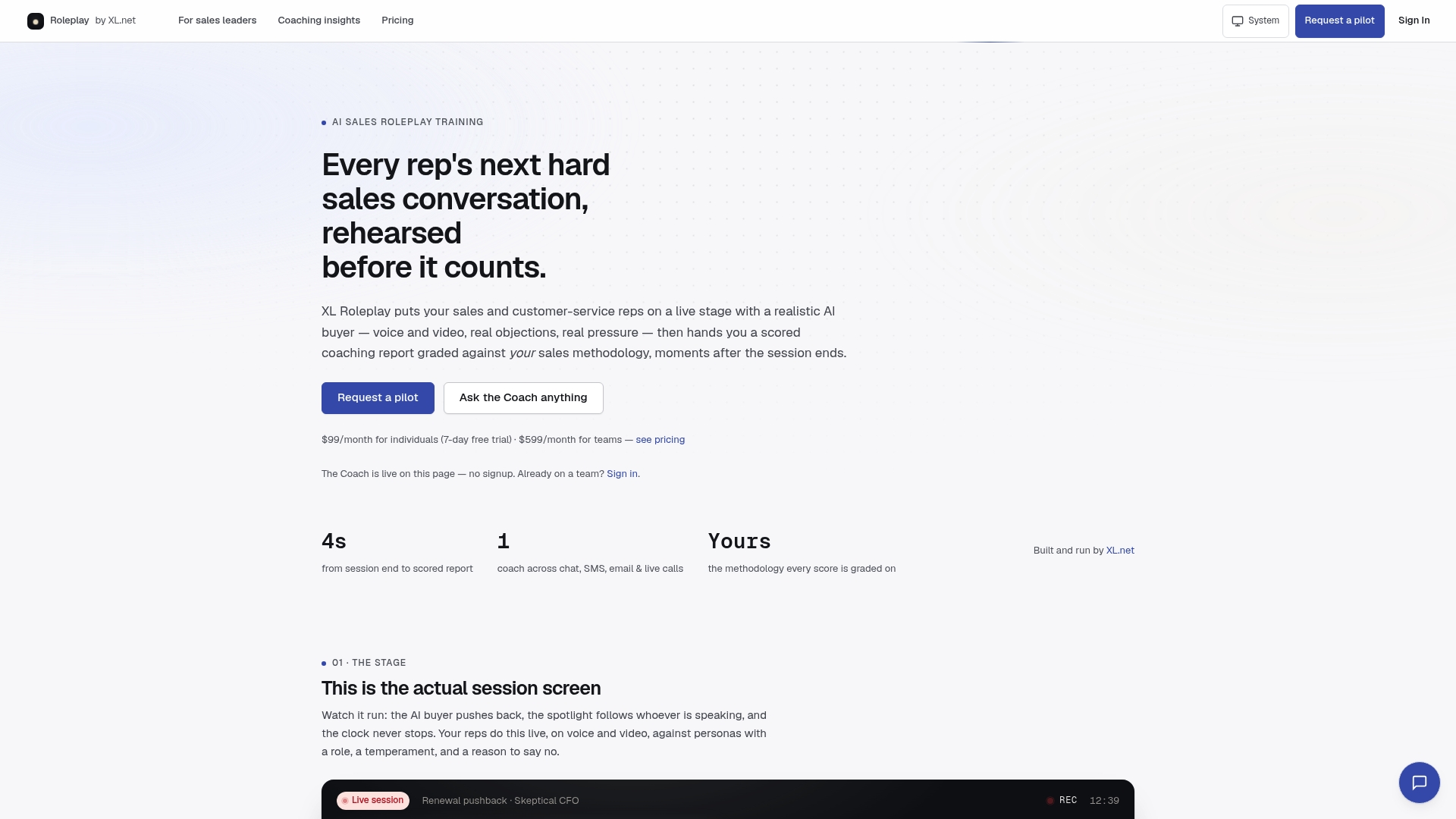
Faster competency gates come from one thing: more quality practice reps with immediate, scored feedback. Xl delivers exactly that. Each session pairs your new hire with a realistic AI buyer who pushes back, raises objections, and responds the way your actual prospects do. The rep gets a scored coaching report tied to your sales methodology the moment the session ends. You get a transcript and a rubric to review in the next 1:1.
Three places Xl fits directly into the onboarding checklist:
- Discovery practice (Week 2): Rep completes a live AI discovery session; readiness score reviewed in the next 1:1 before any live prospect calls.
- Demo certification (Day 45): Rep submits a full demo roleplay; score of ≥70% required to advance to live demos.
- Objection handling gate (Day 60): Rep runs a closing scenario in Xl; transcript reviewed with manager before full-cycle ownership begins.
Sales leaders can explore the full feature set and team dashboard at Xl for sales leaders, or start a free trial at XL Roleplay to run your first session today.
Sources
- The complete employee onboarding process: Steps, checklist, and workflow examples | Moxo
- Sales Onboarding Playbook — Complete 12-Week Framework (2026) | Nimitai
- New Hire Sales Training: The 90-Day Playbook for 2026
- Onboarding process | SHRM
- Sales Onboarding Checklist: The Complete 30-60-90 Day Guide (2026) | CheckFlow