The Best Sales Role Play Scenarios: A Trainer's Playbook
The Best Sales Role Play Scenarios: A Trainer’s Playbook

Run short, role-specific, repeatable practice sessions that map to active deals and end with targeted feedback. That single sentence is the whole philosophy. Everything else in this playbook is execution.
Before your first session, confirm you have five things in place:
- A clear objective (one skill, one scenario)
- A written buyer persona with goals, constraints, and at least two objections
- A defined win condition the rep can hit or miss
- An observer who scores in real time
- A debrief rubric ready before the run starts
A workable cadence for a 30-minute session: 5 minutes of setup, 7 minutes of live run, 10 minutes of structured debrief, 3 minutes of rep self-assessment, 5 minutes of re-run with one adjustment. Rotate roles so every participant plays buyer at least once per cycle. Psychological safety is not a soft concern. Reps who fear judgment play it safe, and safe practice does not prepare anyone for a difficult buyer.
Key Takeaways
Structured, repeatable sales role play scenarios tied to active pipeline stages and followed by rubric-scored debriefs are the most direct path from practice to measurable selling improvement.
| Point | Details |
|---|---|
| Session structure matters most | Every session needs an objective, persona card, win condition, observer, and debrief rubric before it starts. |
| Debrief is where learning locks in | Score five criteria per session; the lowest-scoring criterion drives the next scenario assignment. |
| Customize by role and tenure | SDRs need prospecting scenarios; AEs need negotiation and competitive drills; CSMs need renewal and upsell practice. |
| Track rubric scores over time | Rising scores across 30 days confirm skill transfer; flat scores signal a debrief or scenario design problem. |
| Xl scales what works | Xl’s AI buyers, scored coaching reports, and scenario libraries let managers run consistent practice across large or remote teams. |
Table of Contents
- Why realistic role play actually improves selling
- How to run a session: facilitator runbook and debrief rubric
- The scenario library: 12 copy-ready role-play cards
- How to adapt scenarios by rep role, tenure, and sales stage
- Debriefing, scoring, and measuring training impact
- When to add AI-driven role play to your program
- What I’d actually do in the first 30 days
- Xl makes it easier to scale this practice across your team
- Sources
Why realistic role play actually improves selling
The evidence for structured role play goes back decades. Academic and business research since the 1980s has consistently found role-playing effective for sales training when exercises include clear objectives and focused debriefs. The mechanism is straightforward: reps get to fail in a low-stakes environment, receive specific feedback, and immediately try again. That loop, repeated often enough, rewires default responses.
What makes the difference between practice that transfers to real calls and practice that wastes everyone’s time? Three things: the scenario has to feel real, the feedback has to be specific, and the rep has to practice the same skill more than once in the same session.
Measurable benefits trainers consistently see from well-structured sessions:
- Faster ramp time for new hires who practice discovery and objection handling before their first live call
- Higher objection-handling scores on recorded calls within 4–6 weeks of weekly practice
- Reduced discount frequency when reps practice diagnosing price objections rather than immediately conceding
- Improved next-step ownership, measured by CRM activity rates after practice on closing scenarios
The pitfall is generic role play. A scenario with no persona, no constraints, and no win condition produces theater, not skill development. Scenario guides that name common mistakes, show better approaches, and provide sample language shorten the coaching loop because the rep knows exactly what “good” looks like before the run starts.
Pro Tip: Run the same scenario twice in one session. The first run surfaces the gap; the second run, after focused feedback, is where the learning actually locks in.
How to run a session: facilitator runbook and debrief rubric
This is the section you paste into your training calendar. Follow it in order.
Step-by-step session plan
- Open with context (2 minutes). State the scenario name, the skill being practiced, and why it matters right now. Tie it to a real deal type in the current pipeline if possible.
- Distribute the persona card (2 minutes). The buyer gets a written card with their role, company, goals, and two to three specific objections. The rep gets the scenario objective and win condition only. Do not let the rep read the buyer card.
- Set the win condition aloud (1 minute). Say it out loud: “A win is X.” Examples: “A win is booking a discovery call before the buyer ends the conversation” or “A win is getting the buyer to name their real constraint without the rep offering a discount.”
- Run the scenario (5–8 minutes). The facilitator stays silent. The observer scores in real time using the rubric. No interruptions unless the scenario completely stalls.
- Rep self-assessment (2 minutes). Before the facilitator speaks, ask the rep: “What went well? What would you do differently?” This is not optional. It builds self-awareness faster than any amount of external feedback.
- Observer feedback (3 minutes). The observer shares two specific moments: one that worked and one that did not. Specific means timestamped or quoted, not general (“your tone was good”).
- Facilitator debrief (5 minutes). Use the rubric. Score each criterion, explain the score in one sentence, and give one concrete adjustment for the next run.
- Re-run with one change (5–7 minutes). The rep applies the single most important adjustment. The buyer can escalate one objection to increase difficulty.
- Wrap and log (2 minutes). Record the rubric scores, note the adjustment made, and assign the next scenario.
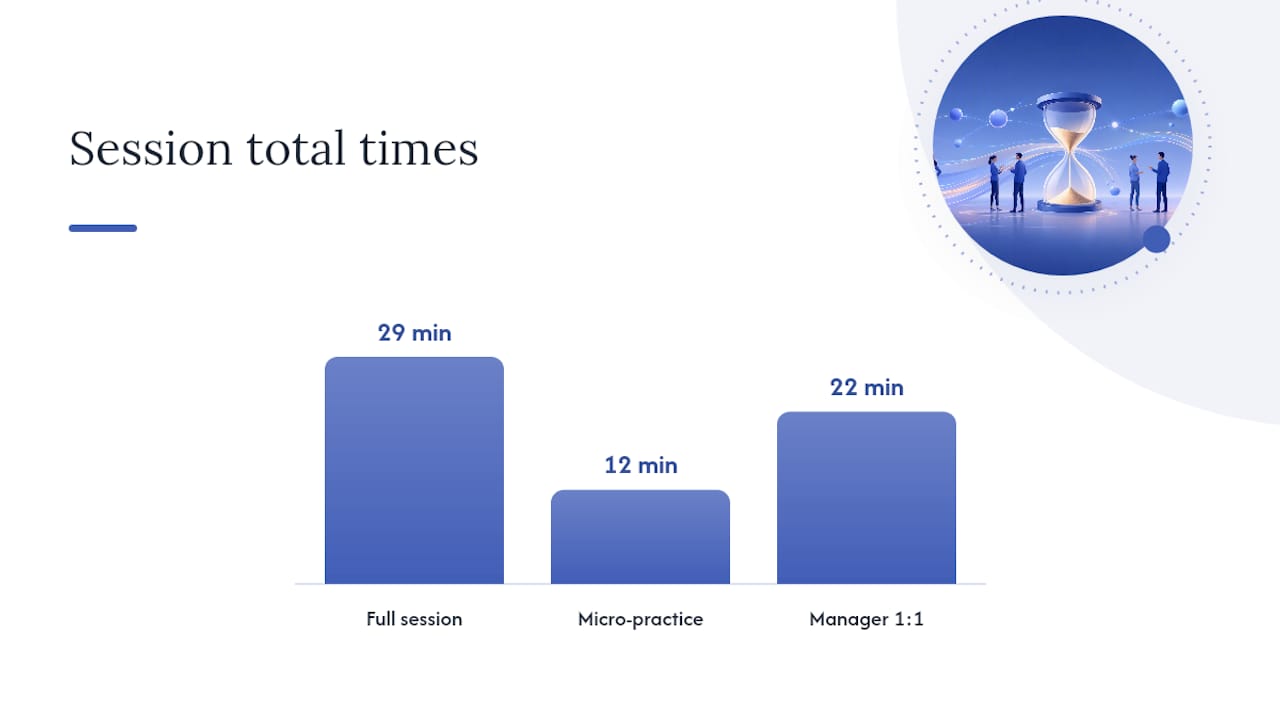
Timing options
| Session format | Setup | Live run | Debrief | Re-run | Total |
|---|---|---|---|---|---|
| Full session | 5 min | 7 min | 10 min | 7 min | 29 min |
| Micro-practice | 2 min | 5 min | 5 min | 0 min | 12 min |
| Manager 1:1 | 3 min | 6 min | 8 min | 5 min | 22 min |
Debrief rubric template
Score 4 = consistently strong, 3 = adequate with minor gaps, 2 = inconsistent, 1 = skill not demonstrated. Total out of 20. A score below 12 triggers a re-run in the same session.
Facilitator feedback phrases that actually work
Avoid: “Good job overall, but work on your tone.” Use instead:
- “When the buyer said [X], you moved straight to the price. What question could you have asked first?”
- “You named three features in 45 seconds. Which one mattered most to this buyer, and how do you know?”
- “You got the next step, but you let the buyer pick the date. How does that change your follow-up leverage?”
Structured role plays with clear objectives, realistic buyer personas, and defined win conditions convert practice into skill growth. The debrief is where that conversion happens.
Pro Tip: For remote sessions, keep video on for both rep and buyer, use a shared scoring doc the observer fills in live, and cut the live run to 5 minutes maximum. Shorter is better on video.
The scenario library: 12 copy-ready role-play cards
Each card below includes the objective, buyer persona, opening line, two core objections, win condition, and one debrief prompt. Swap your product name, company name, and deal size wherever you see brackets.
Published scenario templates covering cold calls, upsells, renewals, and negotiation give trainers reproducible starting points they can tighten to their own environment. These 12 are built on that foundation.
Scenario 1: Cold call opener Stage: Prospecting | Role: SDR Persona: VP of Operations at a 200-person manufacturer. Busy, skeptical of vendor calls, has been burned by software promises before. Objections: “I’m not interested” / “Send me an email.” Win condition: Rep earns 90 seconds of genuine conversation and books a discovery call. Buyer opening line: “I’ve got two minutes. What is this about?” Rep goal: Lead with a specific business problem, not a product pitch. Debrief prompt: Did the rep name a specific pain before mentioning [Company]?
Scenario 2: Discovery call Stage: Qualification | Role: SDR or AE Persona: Director of Sales at a SaaS company. Open to new tools but has a tight budget cycle ending in 60 days. Objections: “We’re already evaluating another solution” / “I’m not sure we have budget.” Win condition: Rep uncovers the buyer’s top priority and confirms a next step with a specific date. Buyer opening line: “We’re pretty early in our process. What do you want to cover today?” Rep goal: Ask three open discovery questions before mentioning any feature. Debrief prompt: How many questions did the rep ask before pitching? What did they learn about the buyer’s real constraint?
Scenario 3: Objection handling — price Stage: Evaluation | Role: AE Persona: CFO at a mid-market company. Financially conservative, focused on ROI, will not approve without a business case. Objections: “Your price is too high” / “We can get something similar for less.” Win condition: Rep diagnoses the real constraint (budget cap, ROI uncertainty, or competitor comparison) without offering a discount. Buyer opening line: “I’ve looked at your proposal. Honestly, it’s more than we expected.” Rep goal: Ask at least two diagnostic questions before responding to the price objection. Debrief prompt: Did the rep treat the price objection as a signal or a conclusion? See objection-handling training drills for scoring guidance.
Scenario 4: Demo — managing feature overload Stage: Demo | Role: AE Persona: Head of Marketing at a B2B tech company. Technically literate, has seen many demos, gets bored fast. Objections: “We don’t need that feature” / “How does this actually work in our environment?” Win condition: Rep delivers a demo focused on two buyer-specific use cases, not a full product tour. Buyer opening line: “I’ve got 30 minutes. Walk me through what’s relevant to us.” Rep goal: Confirm the buyer’s top two priorities before opening the product. Debrief prompt: Did the rep demo features or outcomes? How many times did they reference the buyer’s stated goals?
Scenario 5: Negotiation — protecting margin Stage: Negotiation | Role: AE Persona: Procurement lead at an enterprise company. Trained negotiator, expects concessions, has a competing offer in hand.
Win condition: Rep holds price and trades on non-price value (implementation support, SLA, training). Buyer opening line: “We want to move forward, but we need to talk about the numbers.” Rep goal: Offer a non-price concession before any discount discussion. See negotiation role-play templates for margin-protection tactics. Debrief prompt: What did the rep trade, and did it cost the company margin or time?
Scenario 6: Upsell conversation Stage: Expansion | Role: AE or CSM Persona: Current customer, 6 months in, happy with the core product but unaware of the advanced tier. Objections: “We’re not ready to expand yet” / “I’d need to get approval.” Win condition: Rep connects the upsell to a business outcome the customer already cares about and gets a meeting with the decision-maker. Buyer opening line: “Things are going well. What did you want to talk about?” Rep goal: Reference a specific usage metric or success moment before introducing the upsell. Debrief prompt: Did the rep lead with a feature or a customer outcome?
Scenario 7: Renewal at risk Stage: Renewal | Role: CSM Persona: VP of Customer Success at a company that has had two support escalations in the past quarter. Considering alternatives. Objections: “We’ve had some issues” / “I’m not sure we’re getting the value we expected.” Win condition: Rep acknowledges the issues specifically, presents a remediation plan, and secures a verbal commitment to renew. Buyer opening line: “I’ll be honest with you. We’ve been talking internally about our options.” Rep goal: Do not get defensive. Acknowledge, diagnose, and propose a specific fix. Debrief prompt: Did the rep acknowledge the specific issues or pivot too quickly to the product’s strengths?
Scenario 8: Reaching the economic buyer Stage: Late-stage | Role: AE Persona: C-suite executive who has been briefed by their team but has concerns about strategic fit. Objections: “My team handles vendor decisions” / “What makes you different from what we already use?” Win condition: Rep earns a 15-minute executive conversation and plants one strategic insight. Buyer opening line: “I have 10 minutes. My team tells me you’re worth talking to.” Rep goal: Lead with a business insight, not a product pitch. Reference the buyer’s industry or a known challenge. Debrief prompt: Did the rep sound like a vendor or an advisor?
Scenario 9: Competitive displacement Stage: Evaluation | Role: AE Persona: IT Director currently using a competitor’s product. Satisfied but open to a conversation because of a recent pricing increase. Objections: “We’ve been with [Competitor] for three years” / “Switching costs are real.” Win condition: Rep surfaces one specific gap in the current solution without disparaging the competitor. Buyer opening line: “We’re happy with what we have. Why should we even consider switching?” Rep goal: Ask about the buyer’s current workflow before mentioning any alternative. Debrief prompt: Did the rep attack the competitor or let the buyer’s own words surface the gap?
Scenario 10: Virtual selling — video call with a distracted buyer Stage: Any | Role: AE or SDR Persona: Sales Director joining from a noisy open office, clearly multitasking, camera off. Objections: “Can you just send me a deck?” / “I only have 10 minutes now.” Win condition: Rep re-engages the buyer, gets the camera on, and books a focused follow-up. Buyer opening line: “Sorry, I’m a bit distracted. Go ahead.” Rep goal: Ask one question that makes the buyer want to engage. Do not start presenting. Debrief prompt: How did the rep handle the power imbalance of a distracted buyer?
Scenario 11: Inbound lead — high intent, low information Stage: Qualification | Role: SDR or AE Persona: Marketing Manager who filled out a form but gave minimal detail. High intent, unclear fit. Objections: “I’m just looking” / “I don’t want to be sold to.” Win condition: Rep qualifies budget, authority, need, and timeline in under 10 minutes without sounding like a checklist. Buyer opening line: “I saw your site. I’m not sure if this is right for us yet.” Rep goal: Make the buyer feel heard before asking any qualifying question. Debrief prompt: Did the rep qualify or interrogate? What is the difference in this conversation?
Scenario 12: Stalled deal — re-engagement Stage: Late-stage | Role: AE Persona: VP who went dark after a strong demo. Internal priorities shifted. Objections: “We put this on hold” / “Now isn’t a great time.” Win condition: Rep uncovers the real reason for the stall and either re-engages or qualifies out cleanly. Buyer opening line: “Oh, right. We’ve just had a lot going on internally.” Rep goal: Do not push. Ask one question about what changed. Debrief prompt: Did the rep accept the stall or diagnose it? Closing conversation practice covers re-engagement tactics in detail.
Short scenario cards with explicit objections and constraints increase realism and make debrief prompts more specific and useful for trainers.

How to adapt scenarios by rep role, tenure, and sales stage
The same scenario can be too easy for a senior AE and too hard for a new SDR. The fix is not a different scenario. It is a different set of constraints.
Role-to-scenario mapping
| Rep role | Priority scenarios | Why |
|---|---|---|
| SDR (0–6 months) | Cold call opener, inbound lead, discovery call | Core prospecting skills; low deal complexity |
| SDR (6+ months) | Discovery call, reaching economic buyer | Advancing qualification skills |
| AE (new) | Discovery, demo, objection handling (price) | Foundational deal skills before live pipeline |
| AE (experienced) | Negotiation, competitive displacement, stalled deal | High-stakes, nuanced conversations |
| CSM | Upsell, renewal at risk, virtual selling | Retention and expansion focus |
Making a scenario harder or easier
To increase difficulty:
- Add a second objection mid-run that the buyer introduces without warning
- Cut the rep’s available time (“I have five minutes, not ten”)
- Give the buyer a competing offer with a specific number attached
- Require the rep to reach a win condition without using any product-specific language
To reduce difficulty:
- Give the rep the buyer’s top priority in advance
- Remove one objection from the card
- Allow the rep to pause and consult their notes once during the run
- Run the scenario with a peer buyer instead of the manager
Customization example
Before (generic): “The buyer says your price is too high.”
After (pipeline-specific): “The buyer is a CFO at a 300-person logistics company. They received your proposal yesterday. Their budget for this category is $80,000 annually and your proposal came in at $110,000. They have a board meeting in three weeks and need a decision before then. Their current solution costs $60,000 but has caused two compliance incidents in the past year.”
The second version gives the rep something real to work with. It also gives the observer something specific to score against. Integrating active pipeline context into practice so reps practice against current deals is one of the highest-leverage adjustments a trainer can make.
Debriefing, scoring, and measuring training impact
A session without a structured debrief is just theater. The debrief is where behavior change actually happens.
Debrief rubric in practice
Use the five-criterion rubric from the facilitator runbook above. After each session, record:
- The scenario name and date
- The rep’s total score out of 20
- The lowest-scoring criterion
- The one adjustment the rep committed to
That last item is the most important. A rep who leaves a session with a specific, named adjustment is far more likely to apply it on the next live call than one who leaves with general encouragement.
Metrics to track
| Metric | Definition | How to use it |
|---|---|---|
| Practice frequency | Sessions per rep per week | Baseline: at least one focused session per week |
| Rubric score trend | Average score across sessions over 30 days | Rising scores = skill transfer; flat scores = debrief gap |
| Objection-handling rate | % of calls where rep diagnoses before responding | Pull from call recordings; compare pre/post practice |
| Pipeline velocity | Days from stage entry to close | Track for reps with consistent practice vs. those without |
| Discount frequency | % of deals with a price concession | Should decrease as objection-handling scores rise |
Pro Tip: Log rubric scores in your CRM or a shared spreadsheet tied to the rep’s name and scenario. After 30 days, sort by lowest criterion score across the team. That column tells you exactly which scenario to run next.
Practical programs use repetition, scoring, and manager-led debriefs to convert practice into measurable skill improvements tied to pipeline metrics. The key word is repetition. One session per quarter does not move numbers. Weekly practice does.
Using transcripts and scorecards
If your sessions are recorded or run through an AI platform, transcripts give you a second layer of coaching data. Pull the transcript from a session where the rep scored low on discovery quality. Find the moment they pivoted to pitch. Show them the exact line. That specificity is what separates coaching from feedback.
When to add AI-driven role play to your program
AI role play is not a replacement for human facilitation. It is a volume multiplier. The right question is not “AI or human?” It is “which skill, at which stage, benefits most from private repetition versus coached observation?”
AI is the better tool when:
- A rep needs to practice the same objection 10 times in a row without burning a manager’s time
- You want dynamic buyer reactions that respond to the rep’s actual words rather than a fixed script
- You need consistent scoring across a large team without observer bias
- Reps are remote and scheduling live sessions is logistically difficult
Human facilitation remains essential when:
- The skill being practiced involves nuance that a rubric cannot fully capture (tone, body language, reading silence)
- The rep is early-tenure and needs a coach to model the behavior, not just score it
- The scenario involves a complex multi-stakeholder dynamic
Integration checklist before adding AI role play
- Persona fidelity: does the AI buyer respond to your specific product context, not a generic scenario?
- Scoring transparency: can you see exactly why a session received a given score?
- Pipeline linking: can you assign scenarios tied to the rep’s active deal stages?
- Privacy: are session recordings and transcripts handled in compliance with your company’s data policies?
- Output usability: do transcripts and scored rubrics flow into your existing coaching workflow?
AI-driven role plays offer dynamic buyer reactions and unlimited private practice, which reduces the “play-acting” problem common in human-to-human sessions. When a rep knows their manager is watching, they perform. When they practice privately with an AI buyer that pushes back unpredictably, they actually problem-solve.
For a minimum viable pilot, start with one scenario type (objection handling is the most common entry point), one team of 5–8 reps, and a 30-day window. Measure rubric score change and compare call recording quality before and after. That data makes the case for broader rollout. See how to evaluate AI role-play tools for a buyer’s checklist covering scoring transparency, persona fidelity, and integration requirements.
What I’d actually do in the first 30 days
Here is the honest version of a launch plan, not the polished one.
Day 1: Pick one scenario from this library that maps to your team’s most common deal-stage challenge right now. Do not build a curriculum. Run one session with one rep, observe it yourself, and score it with the rubric. You will immediately see what needs adjusting in the scenario card before you run it with the full team.
Week 1: Run the same scenario with your strongest rep and your weakest rep back to back. The gap between their rubric scores tells you more about your training priorities than any survey. Share both scorecards with both reps. Transparency here is a feature, not a risk.
Weeks 2–4: Add one new scenario per week, always tied to a current pipeline challenge. By week four, you have four scenarios in rotation, a baseline rubric score for every rep, and enough data to know which criterion is the team-wide gap.
The biggest mistake trainers make in the first month is trying to build a complete program before running a single session. A pilot with one pod of four reps, one scenario, and one rubric will teach you more than six weeks of planning. Run it messy. Fix it after.
On psychological safety: the fastest way to kill authentic practice is to tie rubric scores to performance reviews in the first 30 days. Keep early scores private between the rep and the manager. Once the team trusts the process, scores can become a shared coaching tool.
Xl makes it easier to scale this practice across your team
Running weekly role-play sessions manually works for a team of five. At 20 reps across two time zones, the logistics start to break the program.
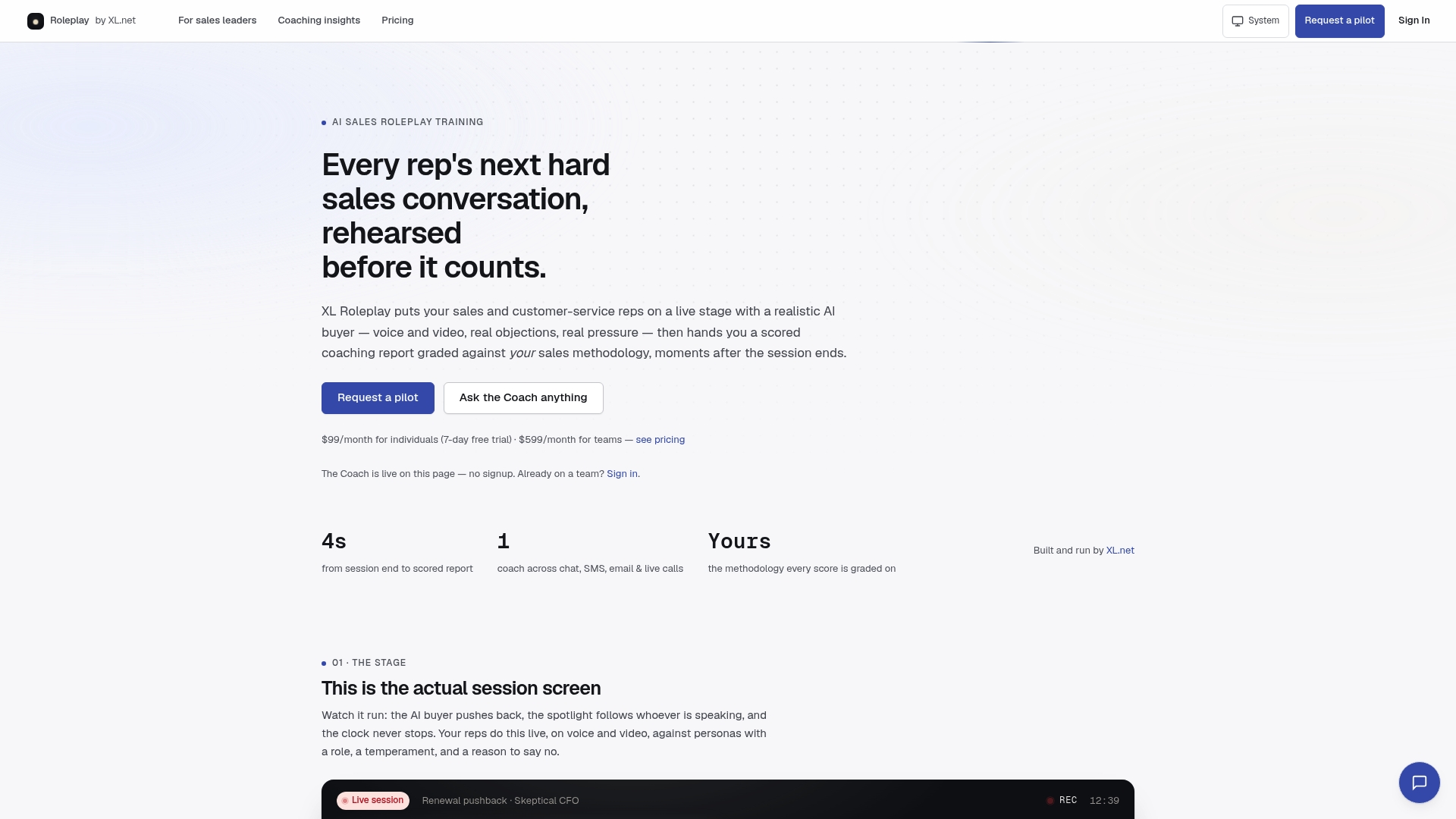
Xl is built specifically for this scaling problem. The platform lets you load the scenario cards from this article directly into a custom library, assign them to specific reps by role and tenure, and have reps practice with an AI buyer that responds dynamically to their actual words. Every session produces a scored coaching report tied to your organization’s own sales methodology, a full transcript, and a readiness score the manager can review asynchronously.
For a 30-day pilot, the setup looks like this: load three to five scenarios, assign them to one team, set a weekly practice target per rep, and review rubric trends at the end of week two and week four. No scheduling overhead. No observer fatigue.
Sales leaders exploring a pilot can see the platform’s team-level dashboards, scenario library tools, and scoring reports. Start a free trial at Roleplay and run your first session within the hour.
Sources
- Role-playing as a sales training tool | HBR
- 12 Sales Role Play Scenarios and Tips to Train Your Team
- Examples of Role Play Scenarios for Sales Training - Nimble Blog
- 6 sales role play exercises to try with your reps | Bigtincan
- 5 Sales Role-Play Scenarios To Boost Your Skills