Sales Role Play Scripts for Trainers: 10 Ready-Run Scenarios
Sales Role Play Scripts for Trainers: 10 Ready-Run Scenarios

This page gives you ten copy-ready sales role play scripts, a five-step facilitation method, and a scoring rubric your team can use in a session this week. Everything here is built for sales managers and trainers who need working material, not theory. Run one scenario Thursday, score it against the rubric below, and you’ll have a baseline for coaching before Friday’s pipeline review.
TL;DR:
- Role-play sessions should focus on one scenario type, tailored to the funnel stage where your team struggles most, with short, repeated practice for best results.
- Use calibrated resistance levels and clear objectives to ensure realistic, effective practice that builds automatic responses rather than reliance on recognition.
- Score each session with a simple five-metric rubric and debrief with specific improvements, rather than vague discussions, to track tangible progress over time.
- Incorporate industry-specific adjustments and psychological triggers into scripts to enhance relevance and behavioral change during practice.
- Leverage AI-driven platforms to increase practice frequency for remote or busy teams, complementing live coaching and supporting consistent skill development.
Table of Contents
- What To Run This Week: A Quick-Start Plan
- What Is a Sales Role-Play Scenario, Exactly?
- Why Sales Role-Play Actually Works
- How to Run a Sales Role-Play Session, Step by Step
- Matching Scenario Types to Role and Tenure
- 10 Ready-to-Run Sales Role Play Scripts
- How to Use These Scripts Without Sounding Scripted
- Matching Scenarios to Your Sales Cycle and KPIs
- Debrief Script and a 5-Metric Scoring Rubric
- Common Mistakes to Avoid During Sales Role-Play
- Adapting Scripts for Different Industries or Products
- Incorporating Customer Personas and Psychological Triggers Into Scripts
- Measuring the Impact of Role-Play Training on Sales Performance
- Using Technology and Tools for Remote or Virtual Role-Play
- What Most Training Programs Get Backward
- When an AI-Driven Platform Extends Your Practice Program
- Sources
What To Run This Week: A Quick-Start Plan
Don’t overthink week one. Pick the scenario tied to your weakest funnel stage, timebox the session, and assign roles before anyone walks in the room.
- Pick one scenario, not five. If cold outreach is stalling, run the cold-call opener. If deals die at the discount ask, run the negotiation haggler script. Trying to cover everything in one session teaches nothing well.
- Timebox it. Fifteen minutes works for a single scenario with a quick debrief; forty-five minutes fits three reps rotating through rep, buyer, and observer roles.
- Assign roles before the session starts. Someone plays the buyer, someone plays the rep, someone scores. Rotating these roles weekly builds pattern recognition faster than always watching from the sidelines.
Run this weekly if you can, biweekly at minimum. HBR’s research on redesigning sales training found that short, repeated practice paired with immediate coaching outperforms one-off training events. A once-a-quarter workshop doesn’t build muscle memory. Weekly fifteen-minute reps do.
Your quick-win metric: track either the conversion rate at the next funnel stage (did discovery calls convert to demos more often?) or the number of manager coaching flags per call. Either one will move within three to four weeks if the scenario is calibrated correctly.
What Is a Sales Role-Play Scenario, Exactly?
A sales role-play scenario is a structured practice exchange between a rep and a stand-in buyer, built around four specific ingredients. Skip any one of them and the exercise turns into vague improv that wastes everyone’s time.
Persona. The buyer needs a role, an industry, and one defining trait, not a blank slate. “A skeptical IT director at a mid-size manufacturer who’s been burned by a vendor before” gives your rep something real to read and respond to. “A prospect” gives them nothing.
Starting situation. Where in the funnel does this conversation happen? A cold call opens differently than a renewal conversation with a champion who’s gone quiet. Naming the stage tells the rep what tools they’re allowed to use.
Calibrated resistance. Every scenario needs a resistance level, typically on a 1 to 5 scale, that tells the buyer-actor how hard to push back. A level 1 buyer raises one soft objection and moves on. A level 5 buyer stonewalls, interrupts, and tests whether the rep can hold the frame under real pressure. Pitchbase’s scenario design framework treats persona, situation, and calibrated resistance as the backbone of any scenario worth running twice.
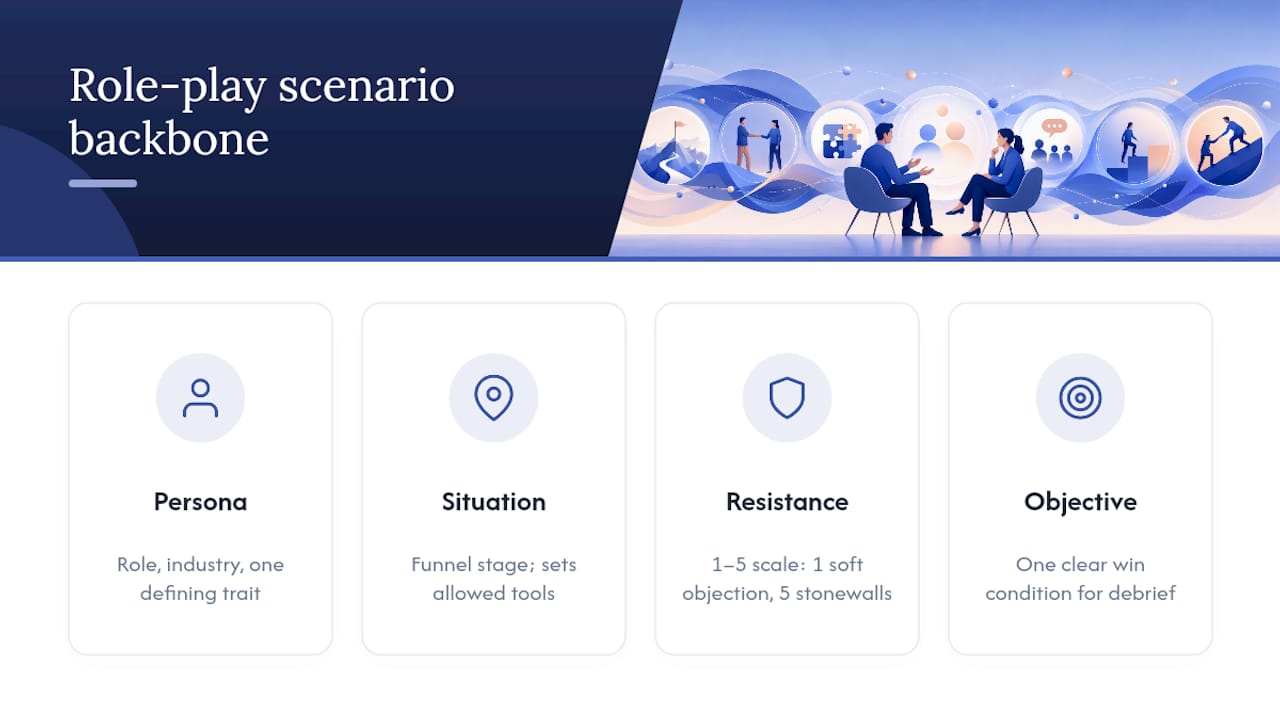
Single learning objective. What does a win look like? Booking the next meeting? Getting the buyer to name their budget? Isolating the real objection behind “I need to think about it”? One clear win condition keeps the debrief focused instead of a scattershot list of everything that went wrong.
Why Sales Role-Play Actually Works
Role-play works because it rehearses behavior under conditions that resemble the real thing, and that rehearsal is what makes a skill automatic instead of theoretical. This isn’t a new idea. Harvard Business Review documented role-playing as an effective sales-training tool back in 1987, and the underlying mechanism hasn’t changed: reps who’ve said an objection rebuttal out loud twenty times respond faster and more naturally than reps who’ve only read it on a slide.
The distinction that matters here is between recognition and recall. Reading a script and nodding along creates recognition. You’d know the right answer if someone showed you four multiple-choice options. But live buyer conversations don’t hand you options. They hand you a curveball and three seconds to respond. Recall, the ability to produce the right move under time pressure, only comes from doing it live, badly, several times, until it stops being effortful.
Spaced repetition compounds this. A rep who practices the same price objection once a week for a month, with a coach flagging what to adjust each time, ends up saying it differently than a rep who heard it explained once in onboarding. The behavior gets tuned in small increments rather than installed all at once and forgotten.
The practical payoff shows up in two places managers actually track: ramp time and objection conversion. New reps who rehearse discovery questions and common objections before their first live calls typically need fewer shadowed calls before they’re trusted solo. Reps who’ve practiced isolating a price objection from a genuine budget objection close more of those conversations, because they’re not improvising the distinction for the first time with revenue on the line.
How to Run a Sales Role-Play Session, Step by Step
A role-play session without structure turns into two people awkwardly reading lines at each other. Here’s the five-step method that avoids that.
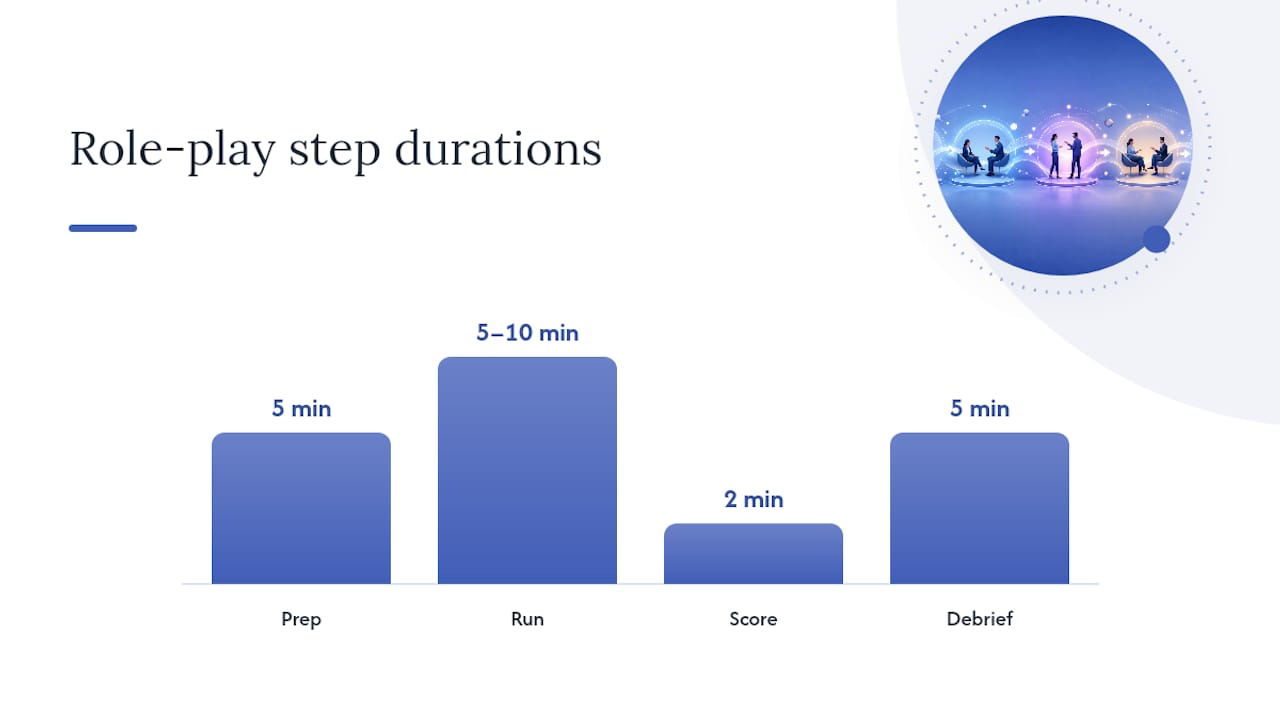
- Prep (5 minutes). Pick the scenario, print or screen-share the persona and resistance level, and assign three roles: rep, buyer, and observer/scorer. If you’re running this solo with one other person, combine buyer and scorer.
- Run (5 to 10 minutes). The rep and buyer play the scenario live, with the buyer staying in character and applying the assigned resistance level. No pausing to coach mid-scene. Let it play out, even when it’s uncomfortable.
- Score (2 minutes). The observer scores the exchange against the rubric before anyone talks about impressions. Scoring first, discussing second, keeps the debrief from turning into a vague “that felt fine” conversation.
- Debrief (5 minutes). One strength, one specific improvement, one action for next time. Keep it tight. A twenty-minute debrief after a five-minute role-play is a sign the exercise wasn’t structured enough to yield clear feedback.
- Repeat (48 to 72 hours later). Run a slightly harder version of the same scenario within a few days. Replaying scenarios on a short delay helps the corrected behavior actually stick instead of reverting under the next real call’s pressure.
Rotate roles across sessions. A rep who’s played the resistant buyer a few times gets noticeably better at anticipating objections when they’re back in the rep seat, because they’ve seen the manipulation from the other side.
Score these five things every time, and keep the rubric visible during the run so the observer isn’t scrambling to remember what to watch for:
- Talk-to-listen ratio. Reps should be listening more than half the call in discovery; less in a demo or close.
- Question quality. Open, specific questions that surface real information beat closed questions that just confirm what the rep already assumes.
- Objection handling. Did the rep validate the concern, isolate whether it’s the real objection, and reframe, rather than arguing or caving?
- Close attempt. Did the rep actually ask for the next step, or let the conversation trail off without one?
- Recovery. When the buyer threw a curveball outside the script, did the rep adapt or freeze?
Pro Tip: Record every session, even the rough ones. A rep watching their own hesitation on price is more convincing than any manager pointing it out live, and a library of recordings turns into onboarding material for the next new hire.
To scale beyond your own calendar, pair peer-led practice (two reps running scenarios on each other without a manager present) with periodic manager-scored sessions, and consider an AI-driven role-play platform for the reps who need more reps than your schedule allows.
Matching Scenario Types to Role and Tenure
Not every rep needs every scenario, and running the wrong one wastes a session. Match the practice to the job the rep actually does.
- Gatekeeper and cold-call scenarios fit BDRs and SDRs, since getting past a screener and opening a cold conversation is most of their week.
- Discovery and demo scenarios fit AEs early in a deal cycle, where the skill being built is asking sharp questions before pitching anything.
- Objection-handling and negotiation scenarios fit AEs mid-to-late cycle, when price pushback and stall tactics start showing up.
- Renewal and expansion scenarios fit CSMs and account managers, where the conversation is less about winning trust and more about defending it.
BigTinCan’s research on role-play best practices recommends objection handling, negotiation, discovery, demo pressure, and getting-to-power as the core exercise families worth rotating through regularly, regardless of team size.
Calibrate resistance to tenure, not just role. A brand-new rep facing a level 5 stonewalling buyer in their first week won’t learn technique, they’ll just get discouraged. Start new hires at level 1 or 2, where the buyer raises one clear objection and responds reasonably to a good answer. Move tenured reps to level 4 or 5, where the buyer interrupts, contradicts themselves, and tests whether the rep can hold the frame without getting rattled.
10 Ready-to-Run Sales Role Play Scripts
Each scenario below includes the persona, the resistance level, a sample exchange your rep and buyer-actor can run live, a coaching takeaway, and a practice prompt. Keep exchanges conversational when you run them; don’t recite the sample lines word for word.
1. Cold-call opener (Difficulty 2) Persona: Busy operations manager, mildly annoyed at the interruption but not hostile. Situation: Rep is calling a name from a purchased list, no prior contact. Sample exchange: Rep: “Hi, this is [name] from [company]. I know I’m catching you cold, do you have 20 seconds?” Buyer: “Kind of a bad time.” Rep: “Totally fair, I’ll be quick. We help ops teams cut manual reporting time. Worth 15 minutes next week to see if it’s relevant, or should I follow up another time?” Coaching takeaway: Reps who ask permission to continue, rather than barreling through a pitch, get more “sure, go ahead” responses. Practice prompt: Run this three times, changing only the opening line, to find which phrasing gets past “bad time” fastest.
2. Gatekeeper navigation (Difficulty 2) Persona: Front-desk assistant screening calls for a VP. Situation: Rep needs to get past the gatekeeper without sounding evasive. Sample exchange: Gatekeeper: “Can I ask what this is regarding?” Rep: “Sure, I work with [VP’s] team on vendor contract renewals, and wanted to confirm the right person to loop in for that.” Coaching takeaway: Confidence and specificity beat vague pitches; gatekeepers screen out anything that sounds like a mass cold call. Practice prompt: Practice three different reasons for calling that sound specific without lying.
3. Discovery qualification (Difficulty 3) Persona: Mid-level manager who’s curious but guarded about sharing budget details. Situation: Second call, rep is trying to qualify pain and timeline. Sample exchange: Rep: “What’s driving the timing on looking at this now?” Buyer: “Just exploring options, nothing urgent.” Rep: “Got it. What happens if this stays unsolved through next quarter?” Coaching takeaway: “What happens if nothing changes” surfaces urgency better than directly asking about budget. Practice prompt: List three follow-up questions to use when a buyer says “just exploring.”
4. Elevator pitch under interruption (Difficulty 2) Persona: Executive with 90 seconds between meetings. Situation: Hallway or post-webinar conversation. Sample exchange: Buyer: “I’ve got two minutes, what do you do?” Rep: “We help teams like yours cut onboarding time by weeks. Worth 15 minutes to see if that’s relevant to what you’re dealing with?” Coaching takeaway: A pitch that ends in a question, not a statement, keeps the buyer engaged instead of just nodding politely. Practice prompt: Cut your standard pitch down to two sentences and time it under 20 seconds.
5. Price objection (Difficulty 3) Persona: Budget-conscious manager comparing three vendors. Situation: Late in the sales cycle, buyer has seen a proposal. Sample exchange: Buyer: “This is more than we budgeted for.” Rep: “That makes sense, can I ask what you were expecting to invest?” Buyer: “Something closer to half this.” Rep: “Got it, so is it the total number that’s the issue, or is it that the ROI isn’t clear yet?” Coaching takeaway: This follows a validate, isolate, reframe pattern; most durable objection scripts use this same skeleton regardless of the objection type. Practice prompt: Practice isolating whether a price objection is really a value objection in disguise.
6. “Let’s revisit this later” stall (Difficulty 3) Persona: Interested but non-committal buyer avoiding a decision. Situation: End of a proposal call. Sample exchange: Buyer: “Let’s circle back next quarter.” Rep: “Happy to. Can I ask what would need to be true for this to be a priority sooner?” Coaching takeaway: “Later” often means the buyer doesn’t see urgency, not that they’re uninterested; the fix is surfacing cost of delay, not pushing harder. Practice prompt: Write three cost-of-inaction questions specific to your product category.
7. “Just send me some information” brush-off (Difficulty 2) Persona: Guarded prospect trying to end a cold call politely. Situation: Early cold call or inbound inquiry. Sample exchange: Buyer: “Just send me some info.” Rep: “Happy to. So I send the right thing, what’s the specific problem you’re hoping this solves?” Coaching takeaway: Reps who send generic info without a follow-up question rarely hear back; one clarifying question turns a brush-off into a real qualifying conversation. Practice prompt: Practice three versions of this pivot question for your top three use cases.
8. Demo pressure and rapid-fire questions (Difficulty 4) Persona: Technical buyer peppering the rep with edge-case questions. Situation: Live product demo with a skeptical technical evaluator in the room. Sample exchange: Buyer: “What happens if we need to integrate with our legacy system?” Rep: “Good question, let me note that and come back to it after I show you the core workflow, does that work?” Coaching takeaway: Reps who try to answer every tangent lose control of the demo; parking questions and returning to them keeps the narrative intact. Practice prompt: Practice parking a hard question three different ways without sounding dismissive.
9. Negotiation and discount haggler (Difficulty 5) Persona: Procurement lead trained to always ask for more. Situation: Final pricing conversation before contract signature. “If we can find a number that works, is this week realistic on your end too?” Coaching takeaway: Trading a concession for a commitment (timeline, term length, referral) beats giving a discount for nothing in return. Practice prompt: List three things you can trade for a discount besides just lowering price. This scenario pairs well with deeper negotiation drills if your team handles complex procurement cycles regularly.
10. Close stall with an internal champion (Difficulty 4) Persona: Enthusiastic champion who’s lost momentum internally. Situation: Deal has gone quiet after verbal buy-in. Sample exchange: Rep: “Last we talked, you were excited to move forward. What’s changed?” Champion: “Honestly, I haven’t had time to loop in my boss yet.” Rep: “No worries, want to set up a quick call so I can help make that case directly?” Coaching takeaway: A stalled champion usually needs help selling internally, not another round of your own pitch. Practice prompt: Practice offering to join an internal call without sounding pushy. Related closing conversation drills build on this exact scenario.
11. Renewal and churn-save (Difficulty 4) Persona: Existing customer whose usage has dropped and who’s gone quiet on emails. Situation: CSM reaching out ahead of a renewal date. Sample exchange: CSM: “I noticed usage dropped last quarter, wanted to check in before renewal comes up. What’s changed on your end?” Customer: “Honestly, we’re not sure we’re getting the value anymore.” CSM: “Appreciate you being direct. Can we walk through what success was supposed to look like when you signed, and where the gap is now?” Coaching takeaway: Naming the drop in usage before the customer has to bring it up builds trust and buys room for an honest conversation. Practice prompt: Practice opening a churn-risk conversation without sounding defensive about the product’s performance.
How to Use These Scripts Without Sounding Scripted
The fastest way to kill a good script is reciting it word for word on a live call. Buyers can hear the difference between a rep thinking and a rep reading.
- Chunk it. Break each script into two or three usable lines rather than a full paragraph to memorize. A rep who’s internalized “validate, then ask what number they expected” adapts that structure to whatever the buyer actually says.
- Add a personalization hook. Swap in something specific to the buyer, their industry, or something they said earlier in the call, before delivering the core line.
- Lead with a question, not a statement. Scripted statements sound canned. A scripted question, delivered with real curiosity, sounds like a conversation.
- Practice improv branches. Run the same scenario twice, once where the buyer follows the expected path and once where they throw a curveball, so reps build comfort adapting instead of freezing when reality doesn’t match the script.
Pro Tip: Turn one scripted line into three conversational versions before a session. “What’s driving the timing?” can become “What made now the right moment to look at this?” or “Curious what’s pushing this up the priority list.” Same intent, less robotic delivery.
Matching Scenarios to Your Sales Cycle and KPIs
Pick scenarios based on where your funnel actually leaks, not based on what feels easiest to run.
- Identify your weakest stage first. If demo-to-close conversion is low, prioritize negotiation and close-stall scenarios over cold-call drills, even if cold calling feels like the more obvious training need.
- Short sales cycles (days to a few weeks) benefit from weekly practice on cold-call and objection scenarios, since reps move through these stages fast and errors compound quickly.
- Long sales cycles (months, multiple stakeholders) benefit from biweekly practice on discovery, demo, and stakeholder-navigation scenarios, since the cost of a bad discovery call doesn’t show up for weeks.
- Set a KPI target tied to the scenario. If you’re running price-objection drills, track close rate on deals where a discount was requested, not just general win rate.
Treat each scenario cycle as a small experiment: run it for three to four weeks, check whether the targeted metric moved, then either double down or swap in a different scenario if it didn’t.
Debrief Script and a 5-Metric Scoring Rubric
End every session with the same debrief format so feedback becomes comparable across reps and over time. Say one strength, one specific improvement, and one concrete action for next time, in that order. Starting with the strength keeps reps receptive to the improvement point that follows.
| Metric | What “good” looks like | Flag if… |
|---|---|---|
| Talk-to-listen ratio | Rep talks under 50% in discovery | Rep talks over two-thirds of the call |
| Question quality | Mostly open questions that surface new information | Mostly closed, yes/no questions |
| Objection handling | Validates, isolates, reframes before responding | Argues or caves immediately |
| Close attempt | Explicitly asks for a next step | Call ends with no clear next action |
| Recovery | Adapts smoothly to an unscripted curveball | Freezes or reverts to the script verbatim |
Score each metric on a simple 1 to 5 scale during the live run, not from memory afterward. A static script without a coaching layer rarely improves anything on its own; the rubric is what turns practice into measurable progress. When a rep scores below 3 on the same metric two sessions in a row, schedule a follow-up drill targeting that specific gap within the week, rather than waiting for the next regular cycle.
Common Mistakes to Avoid During Sales Role-Play
The biggest mistake is running scenarios with no calibrated resistance level, so the “buyer” either folds instantly or stonewalls unrealistically. Both extremes teach reps the wrong lesson: that objections are trivial, or that nothing works.
A second common mistake is skipping the scoring step and jumping straight to a casual chat about how it felt. Feelings aren’t data. Score against the rubric first, then discuss, or the debrief drifts into vague reassurance instead of specific correction.
Letting the same person always play the buyer is a third mistake. Reps who never sit in the buyer’s seat lose the chance to feel what manipulation and resistance actually look like from the other side, which is often the fastest way to recognize it in a real call.
Overloading a single session with too many objectives is the fourth mistake. A session trying to fix talk-to-listen ratio, objection handling, and closing technique all at once usually fixes none of them. Pick one focus per session and let the rubric catch the rest incidentally.
Finally, watch for sessions that never get harder. If every scenario stays at difficulty 2, reps plateau. Resistance levels should climb as reps demonstrate consistency, the same way a coach adds weight once a lift gets easy.
Adapting Scripts for Different Industries or Products
A script written for a SaaS deal with a 30-day sales cycle won’t fit a capital equipment sale that takes six months and five stakeholders. Adjust three things when porting a script into a new vertical: the vocabulary the buyer would actually use, the objections specific to that category, and the number of stakeholders involved in a realistic conversation.
In real estate, for example, discovery questions need to surface financing timeline and emotional decision drivers rather than technical requirements, since the buying process is personal rather than committee-driven. Trainers building industry-specific discovery frameworks often find that swapping in vertical-specific pain points, rather than rewriting the entire scenario structure, is enough to make a script feel native to that market.
For regulated industries like healthcare or financial services, add a compliance-aware objection into the mix, something like “I need legal to review this before we can sign,” since that objection rarely appears in a general B2B script but shows up constantly in those verticals.
For complex enterprise sales with multiple stakeholders, don’t just adapt the single-buyer script, add a scenario where the rep has to navigate a committee with conflicting priorities, since that’s a fundamentally different skill than handling one resistant buyer.
The core four ingredients, persona, situation, resistance, and objective, stay the same across every industry. Only the specifics inside each ingredient need to change.
Incorporating Customer Personas and Psychological Triggers Into Scripts
A generic “skeptical buyer” persona is a start, but the scripts that actually change behavior build in specific psychological triggers the rep has to recognize and respond to, not just a personality label.
Loss aversion shows up when a buyer stalls on a renewal; the trigger isn’t “convince them of value,” it’s helping them feel the cost of losing what they already have. Social proof shows up when a buyer says “nobody else on our team thinks we need this,” and the effective response references how similar teams solved the same doubt rather than repeating your own pitch. Authority-seeking shows up in procurement conversations, where the buyer needs to feel like they extracted a concession to justify the deal internally, regardless of whether the discount itself is large.
Build personas around the trigger you want the rep to practice recognizing, not just a job title and an attitude. “A committee member who needs social proof before committing” gives your buyer-actor a specific behavior to perform: dropping in “what are other companies like us doing?” partway through the call. That’s a far more useful rehearsal than a vague instruction to “be skeptical.”
Measuring the Impact of Role-Play Training on Sales Performance
Track two categories of metrics: leading indicators from the sessions themselves, and lagging indicators from actual pipeline performance.
Leading indicators come straight from your scoring rubric: average scores per metric over time, percentage of reps clearing a 4 or better on objection handling, and how many reps have practiced each scenario family at least twice. These move fast, often within two to three weeks of consistent practice.
Lagging indicators are the ones your VP actually cares about: stage-to-stage conversion rates, average deal cycle length, win rate on deals where a discount was requested, and ramp time for new hires measured from start date to first closed deal. These take longer to shift, typically a full quarter, since pipeline metrics lag behind the behavior change that drives them.
The connection between the two is what justifies the training budget. If talk-to-listen scores improve in role-play sessions but discovery-to-demo conversion doesn’t move over the following quarter, either the scenarios aren’t calibrated to your real objections, or reps aren’t transferring the practiced behavior to live calls. Track both, and treat a gap between them as a signal to adjust the program, not a reason to abandon it.
Using Technology and Tools for Remote or Virtual Role-Play
Distributed teams can’t always gather three people in a room for a fifteen-minute drill, which is exactly the friction that kills consistent practice. Video conferencing with recording enabled solves the basic logistics: two reps on a call, one manager reviewing the recording later against the rubric.
The harder problem is frequency. A manager can realistically score a handful of live sessions per week, which caps how often any individual rep gets quality reps in. This is where AI-driven simulation platforms fill a real gap: they let a rep run a scenario against a simulated buyer at 9 p.m. the night before a big call, get scored feedback immediately, and repeat it three times without booking anyone else’s calendar.
The honest framing here matters. AI simulation doesn’t replace a manager’s live coaching judgment, it removes the scheduling bottleneck that limits how often that coaching happens. A rep who runs five AI-scored reps between manager sessions shows up to the next live role-play further along than one who only practiced once. Used well, technology increases the volume of practice a manager’s limited time can actually cover.
What Most Training Programs Get Backward
Most sales training treats role-play as the reward for finishing the real training, the fun part at the end of a slide deck. That’s backward. The scripted lecture should be the warmup, and the rehearsal should be where the actual skill gets built.
I’d also push back on the instinct to write elaborate, novel scenarios for every session. The research on scenario design points the other way: a smaller set of scenarios, run repeatedly at rising difficulty, builds more durable skill than a constant stream of fresh situations. Reps need to see the same objection enough times that their response stops being a decision and starts being a reflex. Novelty for its own sake works against that.
The other underrated piece is scoring discipline. Managers who skip the rubric and go straight to “that felt pretty good” are training on vibes, not data, and vibes don’t show up in a quarterly business review. The five-metric scorecard here isn’t bureaucracy, it’s what lets you say with a straight face that role-play moved your close rate, not just that everyone felt more confident.
Where I’d diverge from a lot of standard advice: don’t wait until a rep is “ready” to put them in a level 4 or 5 scenario. Controlled discomfort, in a room with no client on the line, is the entire point. The rep who freezes in a practice negotiation this week is the rep who won’t freeze in the real one next month, precisely because they already have.
— Adam
When an AI-Driven Platform Extends Your Practice Program
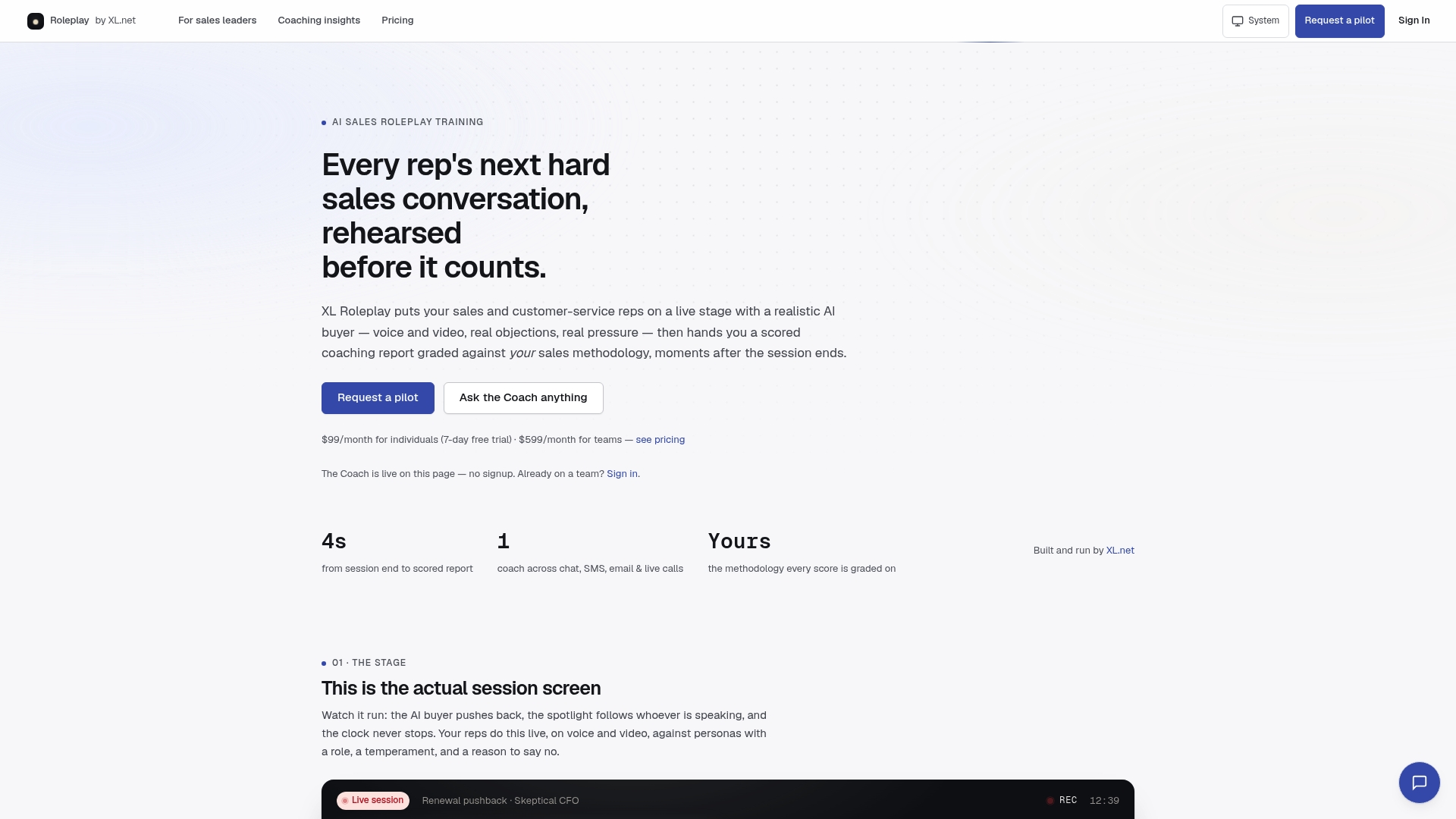
Live, manager-led role-play is still the foundation of a strong training program, but it has a ceiling: your calendar. XL Roleplay extends that ceiling by giving reps live voice and video sessions with realistic AI buyers that raise the exact objections and pressure tactics your organization’s methodology calls for, then hands back a scored coaching report and full transcript the moment the session ends.
Three moments where this closes a real gap in a typical training cadence: a new hire needs ten reps of the same discovery scenario before their first live call, and no manager has ten spare hours; a rep wants to rehearse a high-stakes negotiation the night before it happens, with no one else available to play the buyer; and a manager wants objective, comparable scores across an entire team instead of relying on inconsistent gut impressions from whoever happened to observe each call.
If your team already runs the scripts in this guide, XL Roleplay lets reps run them on their own schedule and gives you the transcripts and readiness scores to coach from. Sales leaders managing a distributed or fast-growing team can see how the platform fits enterprise onboarding on the for sales leaders page and start a trial from there.