Close More Deals: 6 Coachable Sales Soft Skills With Daily Drills
Close More Deals: 6 Coachable Sales Soft Skills With Daily Drills

Sales soft skills are the interpersonal habits, communication, active listening, empathy, rapport-building, and adaptability that determine whether a buyer trusts you enough to say yes. Prioritize six: clear communication, active listening, empathy, emotional intelligence, rapport-building, and adaptability. Reps who build these consistently close more deals because trust and clarity beat pressure almost every time.
TL;DR:
- Building soft skills like active listening and empathy requires deliberate practice through daily drills and weekly roleplays, not one-off workshops.
- Reps should focus on isolating specific behaviors, such as paraphrasing objections or naming buyer emotions, to make meaningful progress.
- Effective coaching relies on concrete KPIs like talk-to-listen ratio, follow-up timeliness, and objection recovery rate, tracked through structured rubrics.
- Repetition with real feedback, including AI-driven roleplay tools, significantly accelerates skill development more than relying on innate talent or infrequent training.
- Developing consistent, observable behaviors enhances reputation, trust, and ultimately, close rates, as soft skills directly influence buyer decisions and referrals.
Table of Contents
- What Are the Core Sales Soft Skills?
- How Do You Practice and Improve Sales Soft Skills?
- What Training Methods Actually Build These Skills?
- How Do Managers Measure and Coach Soft Skills?
- Your 30/60/90-Day Soft Skills Plan
- Do Sales Soft Skills Actually Affect Close Rates?
- What Mistakes Derail Sales Soft Skills Development?
- How Should You Adjust Soft Skills by Customer Type?
- How Do Soft Skills Shape Your Reputation as a Salesperson?
- Why Deliberate Practice Beats Natural Talent Every Time
- Turn Practice Into Progress With XL Roleplay
- Sources
What Are the Core Sales Soft Skills?
Every list of sales soft skills eventually collapses into the same six, and for good reason: each one solves a specific failure point in a deal. Miss one, and buyers stall, ghost, or pick a competitor who simply made them feel understood. Here’s what each skill looks like in an actual call, not a textbook.
Communication. This isn’t about talking well, it’s about being understood fast. Clarity beats eloquence every time a prospect is deciding whether to keep listening.
- Say the price and the reason for it in the same breath, instead of burying cost in a paragraph of features.
- Send a one-paragraph follow-up email within an hour that restates the next step, not a recap of everything discussed.
- Use short sentences on calls. If a sentence needs a comma to breathe, it’s probably two sentences.
Example line: “Here’s the plan: we start with a 30-day pilot at $2,400, and if it doesn’t cut your onboarding time in half, you walk.” That’s clarity and brevity doing the selling.
Active listening. Most reps think they listen. Few actually do, because they’re mentally drafting their next pitch line while the buyer talks.
- Paraphrase before responding: “So the real issue is your team ignores the dashboard, not that the dashboard is wrong.” That single sentence proves you were tracking, not waiting for your turn.
- Sit in silence for two full seconds after a buyer finishes a sentence. Reps who fill every gap miss the follow-up thought buyers often add when given room.
- Ask one clarifying question before answering an objection. “When you say it’s too expensive, compared to what you’re spending now, or what you budgeted?”
Empathy and emotional intelligence. These get lumped together, but they’re distinct. Empathy is reading the room; emotional intelligence is managing your own reaction to what you read.
- Name the emotion before addressing the content: “Sounds like the last vendor burned you on implementation. That’s fair; let’s talk about how this is different.” Naming it disarms defensiveness.
- Slow your own pace when a buyer speeds up or gets terse. Matching their urgency with urgency escalates tension instead of resolving it.
- Ask about the business impact, not just the feature gap: “What does that delay actually cost your team each month?” gets you real empathy in sales examples territory, not surface-level sympathy.
Rapport and relationship-building. Buyers rank respectfulness and caring among the top traits they want in a salesperson, ahead of most product-specific factors. Rapport isn’t small talk. It’s proof you did your homework.
- Reference something specific from the prospect’s world, a recent press release, a LinkedIn post, an earnings call detail, before pitching anything.
- Mirror pace and tone subtly. If a buyer speaks in short, direct sentences, don’t answer in long, meandering ones.
- Follow up on a personal detail they mentioned last call. Remembering a name or a deadline signals you were paying attention, not performing attention.
Adaptability. The same pitch delivered to a skeptical CFO and an eager operations manager will land differently, and reps who deliver it identically both times lose one of them.
- Read the buyer’s communication style in the first two minutes and adjust: data-driven buyers get numbers up front, relationship-driven buyers get context first.
- Have three versions of your value statement ready, one for cost-focused buyers, one for risk-averse buyers, one for growth-focused buyers, and pick on the fly.
- When a call goes sideways (technical issue, wrong stakeholder, unexpected objection), name it and reset instead of pushing through the original script.
How Do You Practice and Improve Sales Soft Skills?
Sales soft skills training works the same way muscle training does: short, frequent reps beat occasional marathon sessions. A once-a-quarter workshop teaches concepts. Daily five-minute drills change behavior.
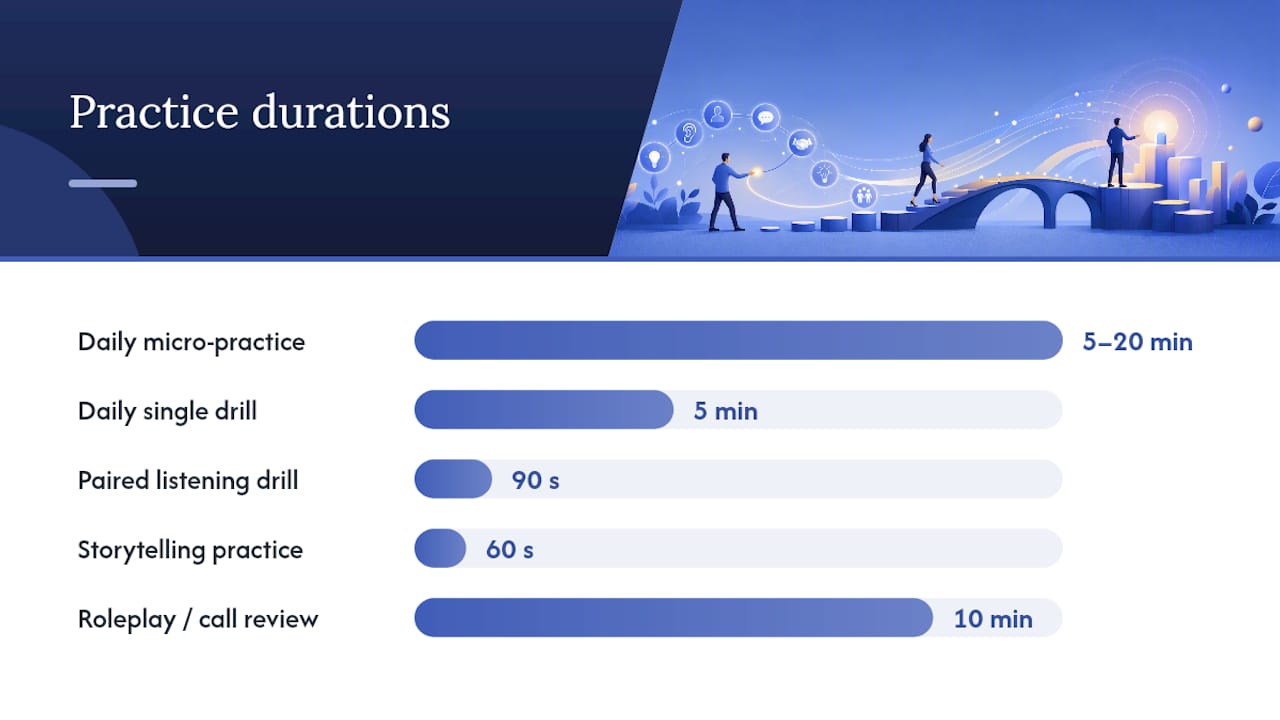
Daily micro-practice (5 to 20 minutes):
- Record yourself delivering your value statement out loud once a day for a week, then listen back and cut every filler word.
- Practice the two-second pause after a statement, out loud, alone, until it stops feeling awkward.
- Write one paraphrase sentence for a real objection you heard that week, then say it aloud three times.
Weekly drills for pairs or small teams:
- Paired listening drill. One person talks for ninety seconds about a work frustration. The partner can only respond with a paraphrase and one clarifying question, no advice, no pitch.
- Objection reframe drill. Partner throws five common objections rapid-fire. Rep has ten seconds to name the underlying concern before responding.
- Storytelling practice. Rep tells a sixty-second customer success story with a clear before, during, and after. Partner scores it on whether the outcome was specific or vague.
Structured roleplay template:
A good roleplay needs five parts, and skipping any one of them is why most roleplay sessions feel like theater instead of training.
- Scenario: A specific, realistic setup (mid-market buyer, budget cut, competing vendor already in play).
- Goal: One behavior to isolate, not “handle the whole call well” but “use silence after the price objection.”
- Script fragment: A two-line opener so both people start from the same place.
- Rubric: Three to five observable behaviors scored on a simple scale, covered in detail in the measurement section below.
- Debrief questions: What worked, what felt forced, what would you say differently next time?
Indeed’s career guidance on sales soft skills points to the same core loop: reflect, refine your delivery, then rehearse it with a peer or a recording until it’s automatic.
The 10-minute call review. Pick one real call recording a week. Score it on exactly three things: talk-to-listen ratio, number of clarifying questions asked, and whether you named the buyer’s emotion at least once. Don’t try to grade the whole call, three metrics is enough to spot a pattern over a month.
Pro Tip: Isolate one behavior per roleplay round. Trying to fix your listening, your pacing, and your close all in one ten-minute scenario means you improve none of them. Pick one, drill it for a week, then move to the next.
What Training Methods Actually Build These Skills?
Different formats solve different problems, and most sales teams use only one when they need at least three.
- Workshops are good for introducing a framework or a new objection-handling model, but they rarely change behavior on their own.
- Manager coaching works best for calibration, catching the gap between what a rep thinks they’re doing and what they’re actually doing on calls.
- Peer roleplay builds comfort with discomfort, saying the awkward line out loud enough times that it stops feeling awkward.
- AI-driven roleplay scales the repetition that peer practice can’t, since a colleague can only run so many practice sessions before patience runs out.
The most effective path follows a sequence: introduce the concept, drill it repetitively, have a manager calibrate the rep’s read on their own performance against reality, then check retention a few weeks later. Blended programs that combine live coaching, repetition, and AI-driven practice produce measurably better conversational outcomes than any single format alone.
This is where a platform like Xl’s roleplay tool fits into the repetition stage. It runs realistic voice and video sessions against AI buyers who throw the objections and pressure reps actually face, then scores the session against the organization’s own sales methodology, with transcripts a manager can review afterward. It doesn’t replace manager coaching or peer practice, it fills the gap between them: the volume of reps needed to make a behavior automatic before it ever reaches a live buyer.
How Do Managers Measure and Coach Soft Skills?
Soft skills feel unmeasurable until you break them into observable behaviors, and then they’re no harder to track than pipeline velocity.
KPIs worth tracking:
- Listening score (clarifying questions asked per call)
- Talk-to-listen ratio (a balanced target in discovery calls)
- Follow-up timeliness (hours between call end and recap sent)
- Objection recovery rate (percentage of raised objections that didn’t end the conversation)
Measuring soft skills through concrete KPIs tied into CRM workflows keeps coaching grounded in behavior rather than gut feel.
A simple three-point rubric:
| Level | Observable behavior |
|---|---|
| Needs work | Interrupts, jumps to pitch before understanding the problem, no paraphrase |
| Competent | Asks one clarifying question, paraphrases at least once, follows up within a day |
| Role model | Names the buyer’s underlying concern unprompted, uses silence deliberately, follow-up references specific call details |
Concrete rubrics like this let a manager give direct feedback without it reading as a personality critique. “You didn’t paraphrase in the first five minutes” lands very differently than “you’re not a good listener.”
A 10-minute debrief script:
- “What was the buyer’s actual concern, in one sentence?”
- “Where did you feel the conversation shift, for better or worse?”
- “What’s the one thing you’d say differently next time?”
- “What’s one behavior you want me to watch for on your next call?”
Your 30/60/90-Day Soft Skills Plan
Personal plan:
- Days 1 to 30: Daily five-minute drills, one weekly paired roleplay, baseline call review.
- Days 31 to 60: Add objection-reframe drills, track talk-to-listen ratio weekly, manager debrief every two weeks.
- Days 61 to 90: Full call reviews against the three-point rubric, manager calibration session, measure objection recovery rate against baseline.
Team rollout checklist:
- Set a weekly roleplay cadence (30 to 45 minutes, fixed day and time).
- Standardize the rubric across the team so scores mean the same thing rep to rep.
- Require one recorded call review per rep per week.
- Review KPI trends monthly, not just individual scores, watch for team-wide gaps.
Success at 90 days looks like a measurable shift in objection recovery rate and a rubric score that’s moved from “needs work” to “competent” for most of the team.
Do Sales Soft Skills Actually Affect Close Rates?
Yes, and the connection is more direct than most sales leaders assume. Harvard Business Review’s analysis of why salespeople fail to close points to weak listening and poor rapport as recurring, fixable causes, not product gaps or pricing objections. Deals stall in the interpersonal layer more often than in the value proposition.
Think about the last deal that died for no clear reason. The product fit was there, the budget existed, and the timeline made sense. What usually killed it was a rep who missed a signal, pushed past an unspoken concern, or never built enough trust for the buyer to admit what was really holding them back.
Soft skills compound across a deal cycle rather than showing up in one dramatic moment. A rep who listens well in discovery uncovers the real objection before it becomes a deal-killer in the final stage. A rep with strong rapport gets an honest answer about budget instead of a polite deflection. A rep with adaptability adjusts the pitch when a new stakeholder joins mid-cycle instead of repeating a pitch built for someone else.
Reps and managers who treat these as trainable, measurable skills rather than fixed personality traits see the clearest gains, because they can isolate exactly which behavior is costing them deals and drill it specifically. That’s a fundamentally different approach than hoping charisma shows up on its own.
What Mistakes Derail Sales Soft Skills Development?
The most common mistake is treating soft skills as innate rather than trainable. Reps who believe rapport is a personality trait (“some people just have it”) never practice it deliberately, and it never improves.
A close second: practicing the wrong unit of behavior. Reps run full mock calls trying to fix everything at once, listening, pacing, closing, and improve nothing measurably because feedback is too diffuse to act on. Isolating a single behavior per roleplay round, using silence after an objection, or asking three calibrated questions before responding, produces feedback specific enough to actually change behavior.
Managers make a parallel mistake: giving vague feedback like “be more empathetic” instead of naming an observable action. “Be more empathetic” gives a rep nothing to do differently on the next call. “Name the buyer’s frustration before responding to it” gives them something they can practice by Tuesday.
Inconsistent practice cadence kills momentum too. Teams run one big roleplay session, feel good about it, then don’t touch it again for two months. The skill decays faster than most managers expect, especially the harder ones like reading emotional cues under pressure.
Last mistake: ignoring context. A script that works for calming an anxious first-time buyer will read as condescending to a sophisticated enterprise procurement lead. Reps who memorize one version of “empathetic language” and deploy it identically across every buyer type sound scripted, and buyers notice scripted instantly. The fix isn’t more scripts, it’s more reps practicing the judgment call of which approach fits which person.
How Should You Adjust Soft Skills by Customer Type?
The six core skills stay the same. How you express them shifts hard depending on who’s across the table.
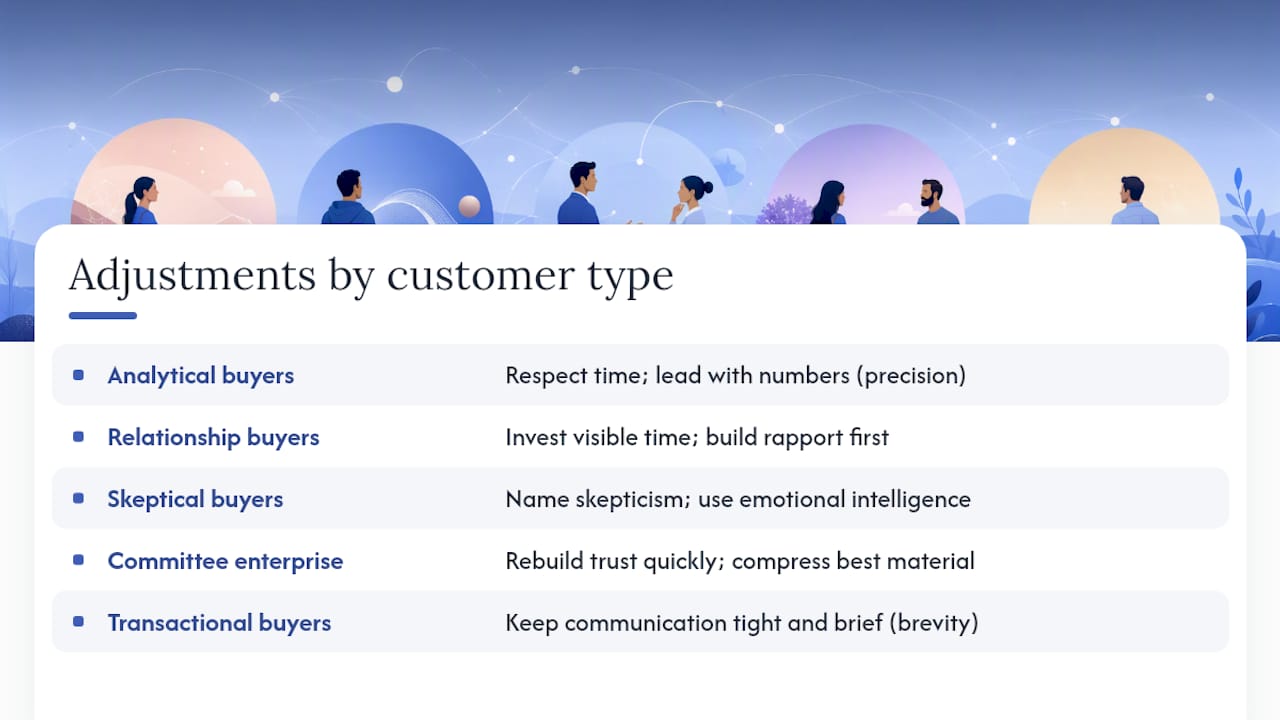
With analytical, data-driven buyers (finance leaders, engineers, procurement), empathy shows up as respecting their time and precision, not as warmth. Skip the small talk, lead with numbers, and let active listening mean catching the exact metric they care about instead of the general theme.
With relationship-driven buyers, especially in industries like healthcare, education, or family-owned businesses, rapport-building carries more weight than data density. These buyers want to know you’ll be reachable after the contract’s signed, so adaptability here means slowing your pace and investing visible time in the relationship before pushing toward close.
With skeptical or previously burned buyers, emotional intelligence matters most. They’re testing whether you’ll oversell. Naming their skepticism directly, “sounds like the last vendor promised more than they delivered”, does more for trust than any feature comparison.
With committee-based enterprise deals, adaptability means recognizing that your rapport with the champion doesn’t automatically transfer to the skeptical VP who joins in round three. You’re rebuilding trust with each new stakeholder, often in a single meeting, which means your communication needs to compress your best material into far less time.
With transactional, price-sensitive buyers in fast sales cycles, communication needs to be tighter and more direct. Long discovery conversations feel like friction to a buyer who already knows what they want; here, brevity itself is the empathetic move; respecting that they don’t want an extended process.
The skill set doesn’t change context to context. The weighting does. Reps who ask “which of these six needs to lead in this specific conversation” outperform reps applying the same formula everywhere.
How Do Soft Skills Shape Your Reputation as a Salesperson?
A rep’s reputation, inside their company and in their market, is built almost entirely from soft skills, not quota attainment alone. Two reps can hit the same number, but the one known for genuinely listening gets the referral, the LinkedIn recommendation, and the internal reputation as someone worth mentoring under.
Personal branding in sales isn’t a content strategy. It’s the accumulated evidence of how you make people feel across hundreds of interactions. A buyer who felt understood during a deal that didn’t even close will still recommend you to a colleague, because the emotional intelligence and rapport were real regardless of outcome. That’s a soft skill compounding into a reputation asset over years, not quarters.
The reps who move fastest into senior roles, enterprise accounts, sales leadership, are rarely the ones with the flashiest pitch. They’re the ones colleagues describe as good listeners, fair negotiators, and easy to trust under pressure. Those are the same six skills, just observed by peers and leadership instead of buyers.
If you’re building a reputation deliberately, the fastest lever is consistency: the same level of empathy and clarity whether you’re talking to a $500,000 prospect or a colleague asking for five minutes of help. Reputations get built on the small interactions nobody’s grading, not just the big calls everyone’s watching.
Why Deliberate Practice Beats Natural Talent Every Time
Here’s the uncomfortable truth about most sales soft skills training: it’s built for people who already have the instinct, and it does almost nothing for everyone else. Workshops that tell reps to “listen more” or “build rapport” assume the skill exists somewhere and just needs encouragement. It doesn’t work that way. Rapport is closer to a mechanical skill, built the same way a golf swing is built, through repetition with feedback, not through motivation.
The reps who improve fastest aren’t naturally gifted communicators. They’re the ones willing to isolate one awkward behavior, silence after an objection, a paraphrase before responding, and repeat it until it stops feeling forced. That’s less glamorous than “developing charisma,” but it’s the part that actually transfers to a live call under pressure.
My practical recommendation for teams: build a culture where practicing out loud isn’t embarrassing. Most sales floors treat roleplay as something you do reluctantly before a big call, not as a habit. The teams that treat weekly practice the way athletes treat drills, unremarkable, expected, non-negotiable, are the ones where soft skills actually compound instead of plateauing after the onboarding month ends.
— Adam
Turn Practice Into Progress With XL Roleplay
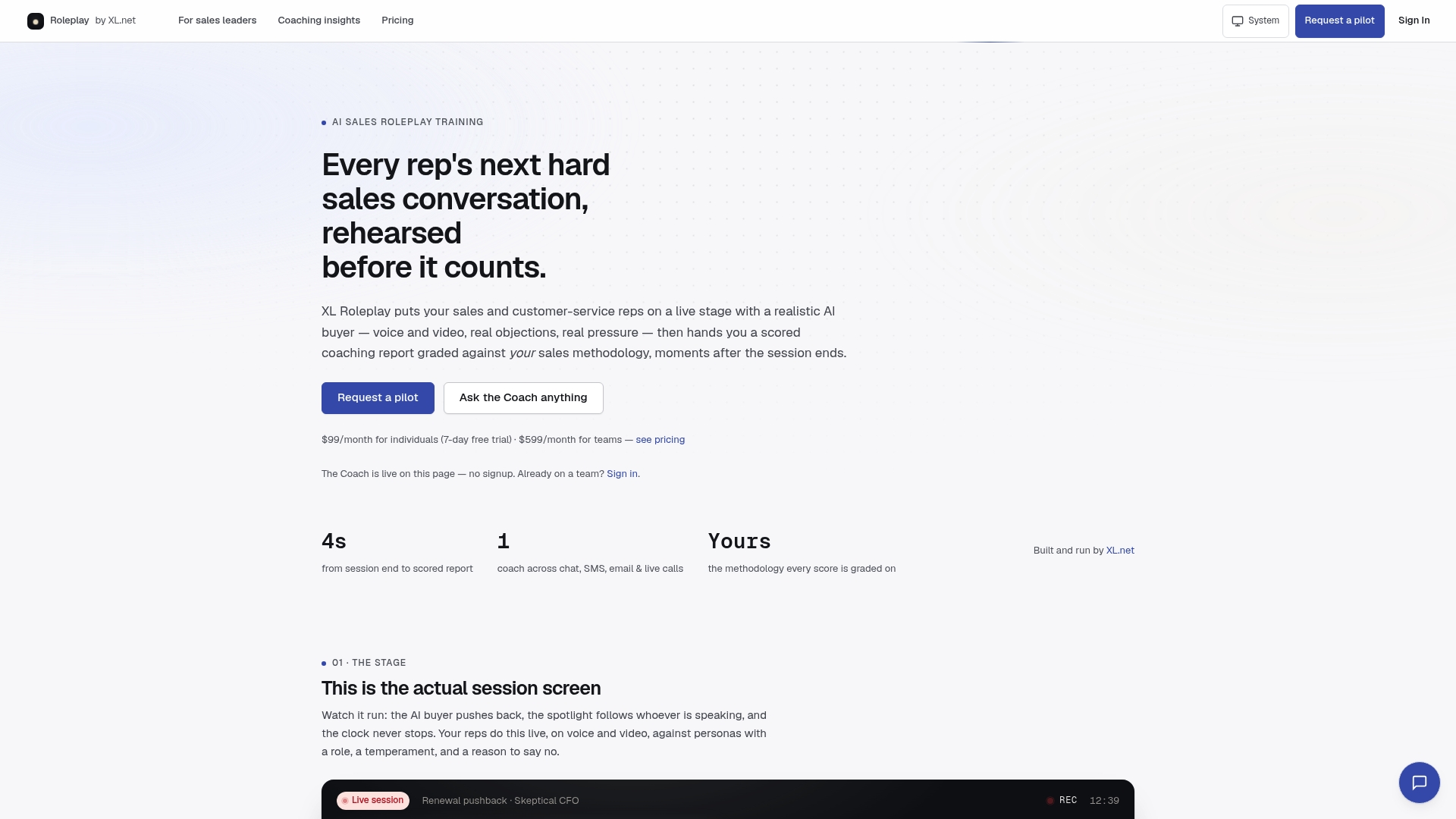
Everything in this guide comes down to repetition with real feedback, and that’s exactly where most teams stall out. Peer roleplay is valuable but limited by everyone’s patience and schedule; workshops teach the concept but rarely the muscle memory. XL Roleplay fills that gap by running live voice and video sessions against AI buyers who throw the objections and pressure your reps actually face, then scores each session against your own sales methodology instead of a generic rubric.
That scored feedback maps directly onto the practice templates and manager rubrics covered above: transcripts let a manager run the same debrief questions without having sat in on the call, and readiness scores turn subjective call quality into a tracked number over time. For sales leaders trying to scale this across a whole team without burning peer patience on endless practice rounds, the team plans built for managers are worth a look. Start a trial session and see how one scored roleplay compares to your last live debrief.
Sources
For deeper reading on the ideas covered here: SalesFuel on rapport and buyer trust, Highspot’s soft skills training framework, Indeed’s practical skill-building guide, HBR on why deals fail to close, and RingCentral’s call rapport checklist.
- Why Is Building Rapport in Sales A Powerful Strategy? - SalesFuel
- Sales soft skills training: 20 tips for GTM teams - Highspot
- Career in Sales: 6 Soft Skills Every Salesperson Should Have - Indeed
- 7 reasons salespeople don’t close the deal - Harvard Business Review